Kathmandu
Tuesday, July 21, 2026





KATHMANDU: The land-slide victory of the Rastriya Swatantra Party (RSP) in the recently held elections is a watershed moment in Nepal’s history. International Community whole-heartedly supported the general elections as it was an outcome of the Gen Z movement of September last year in which young people throng to the streets in their thousands protesting corruption, economic stagnation, social media ban and political paralysis that gripped Nepal.
The NC, CPN(UML) and the Maoists jockeyed power among themselves for decades but did not realize that a volcano of massive frustration was brewing among the Gen Z on the manner in which the country was being run. Worse was the fact that although the governments after 2008 were all short-lived, only three old men were passing the Prime Ministerial baton among themselves in a relay track that would only go in circles forever.
As a result, most of the youngsters of Nepal do not remember any other Prime Minister in their lives other than Oli, Deuba and Prachanda. Surrounded by sycophants and political dwarfs, they thought they were giants with all the know-how and information of the world. The worst thing that they had done was to ram all the institutions with their party cadres and near and dear ones thus rendering them ineffective.
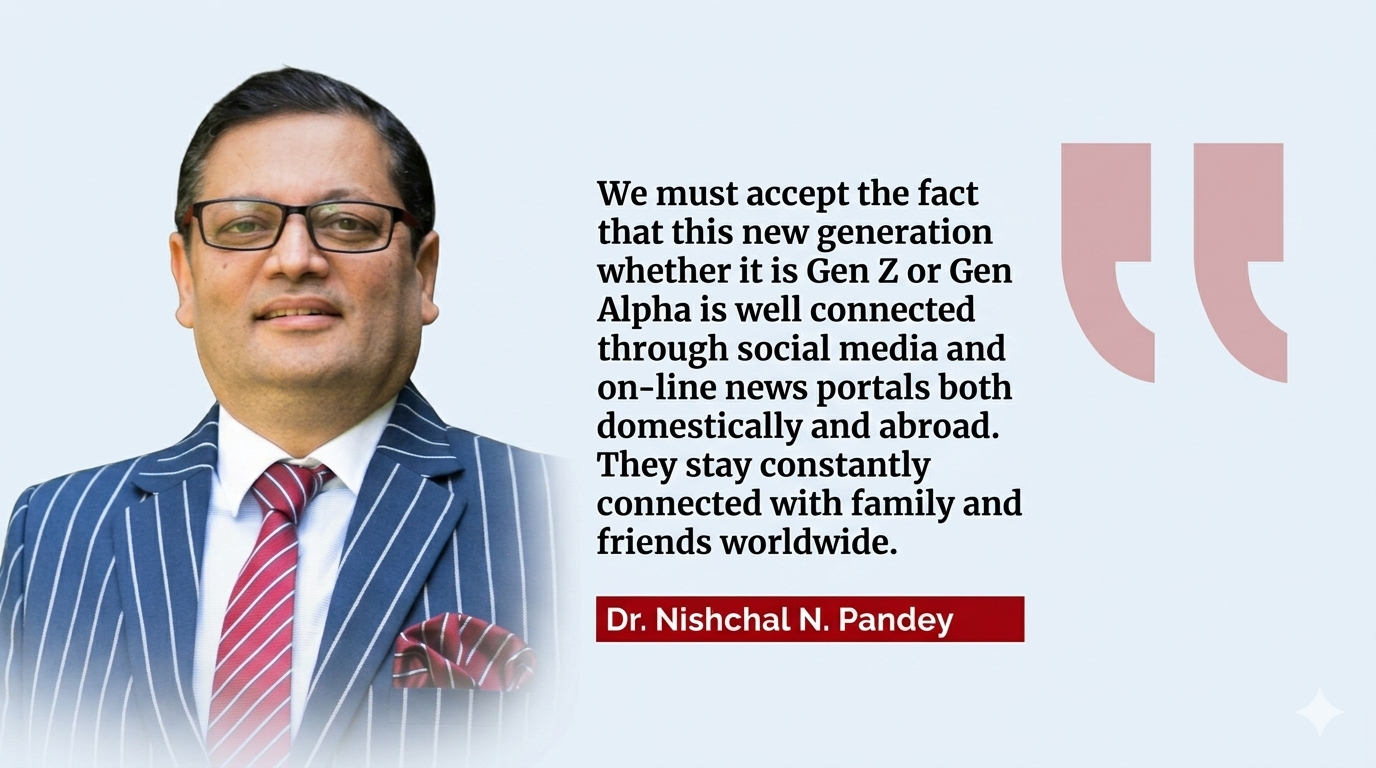
We must accept the fact that this new generation whether it is Gen Z or Gen Alpha is well connected through social media and on-line news portals both domestically and abroad. They stay constantly connected with family and friends worldwide. For most Gen Z and Gen Alpha, social media is not just communication, it is a part of daily life.
Unlike the Millennials or the Gen X before them, they do not rely on the print media for news and opinions. On the one hand there is misinformation and fake news everywhere, on the other there is inspiration, creativeness and motivation from what is happening in other countries.
Student uprisings in Sri Lanka and Bangladesh that led to regime change therefore should have been taken seriously by our three old political parties for urgent corrective measures. Unfortunately, arrogance of ‘Nepal being different’ led to indifference about the massive political upheaval taking place in the vicinity. The three old leaders did not even nominate youth leaders from their own respective factions as successors after them.
What we are witnessing today is a churning of sorts in all major political parties which would not have been possible without the Gen Z movement. This landslide victory of the RSP is not just a political win but it carries expectations and responsibility. There is much hope among the people which is why there is an urgency for performance. Not only on the domestic front, on the foreign policy domain too there is a demand for massive improvement while maintaining policy consistency.
Opposition is weak and fragmented but there should not be over-confidence and complacency. RSP should remember that this is not the first time that Nepal has a government with a two-thirds. Previous majority governments could not give political stability like the coalition ones.
Actually, there was a problem ever since 2008 on who is the final authority in Nepal’s international affairs? Whose voice is the voice of the Government of Nepal? The Balen Shah government has settled this problem. The Finance Ministry is nodal authority on economic matters and the Foreign Ministry on foreign policy issues. At least, this has been settled in the last one month.
Current Global Dis-Order
Nepal is active member of the United Nations, twice elected to the UN Security Council. But this was nearly four decades ago. We have abiding faith in the UN Charter and we feel that the organization should function as a mediator, facilitator of conflict resolution and a moral voice on a number of issues facing humanity.
But we are witnessing extreme chaos—wars are spiraling, systems are collapsing but the UN is only passing resolutions. Much of this is got to do with the members of the P5, some of whom are involved in these wars. For a country like Nepal, the conflict in the middle east is of primary concern at the moment.
The migrant labour problem is complex, and often overlooked in these wars. It affects not just the Middle East but South Asia which sends millions of foreign workers and they are now a vulnerable group. Nepalese labour is employed in construction, transport, domestic work, and services. Many have low wages, no safety nets.
Around 1.7 million Nepalese work in Gulf countries—many in high-risk zones. There are security threats, job losses. There is also a risk to Nepal’s remittance-based economy in case they are forced to return.
Surely it directly affects Nepal’s economy and even the private household. As soon as the Balen Shah government was formed, this issue has become a major cause of worry and close coordination and communication with other governments has become a necessity.
Foreign Minister Shishir Khanal has informed us about regular monitoring being done by his ministry on the situation arising due to the conflict in the Middle East and its multifaceted impact on Nepal’s economy including rising fuel prices which is why two-day holiday was announced by the current government.
Another issue in vogue these days is of the diplomatic code of conduct that is being enforced effectively wherein mid-level officials from foreign countries are not getting direct access with our head of the government. Actually, we are a nation where Queen Elizabeth visited twice, Vice-President of the US, current Emperor of Japan, Chancellor of Germany, President of France – all visited Nepal.
But there has been a long gap in highest level visits from these countries. Last US Secretary of State to visit Nepal was Colin Powel 24 years ago. Last Japanese Prime Minister to visit was Yoshiro Mori 26 years back. It has been a decade after the last visit of the President of India.
Therefore, I would like to suggest to the international community that in order to further strengthen our treasured friendship, they should advocate for high level visits to Nepal as there has been a generational change in our politics.
On the Buffer Zone Controversy
Nepal is the oldest sovereign country of South Asia. Our forefathers have used a lot of metaphors and similes to create vivid imagery about our geography, our society and our standing among the comity of nations so that different generations understood it clearly at different interludes of history. The often cited ‘yam between two boulders’ does not actually mean that we are a root vegetable nor does it mean that our two neighbours are lifeless rocks. It is only a metaphor.
While on a visit to Chengdu in June 1976, King Birendra compared Nepal with Sichuan Province of China and said that Nepal too is full of hills, mountains and rivers with the attendant problems of floods, landslides and difficult terrain. “If the innumerable terrace of this province won its name ‘the land of a million steps’, I feel that the description only completes the comparison”, he said.
The Gen Z Nepali watch youtube a lot. Youtube downloads a small portion of a video ahead of playtime and the ‘buffer’ holds data so that small drops in the internet speed don’t stop the video. So the Gen Z youngsters would view the ‘buffer zone’ notion entirely differently than the older generation of politicians. Times have changed. Generation has changed. Nepal has entered a new era. We should be confident. Let us elevate the standard of our public discourse rather than concocting criticism for the sake of criticizing.
The Road Ahead
There has been rapid transformation in Nepal in 2026 and there is a lot of international solidarity and support for us. We need to embrace and welcome this tremendous goodwill rather than be inward looking. We are not yet a finished success story. This new era should be defined by correcting past mistakes and laying the foundation for long term economic growth.
(Dr. Nishchal N. Pandey is a Nepali foreign policy expert and former Executive Director of the Institute of Foreign Affairs, where he served for eight years. He has held research and academic roles in Singapore, the United Kingdom, and Germany, and was an advisor to Nepal’s National Planning Commission. A PhD graduate of Tribhuvan University, he has authored and edited numerous books on foreign policy. He is currently an Adjunct Professor at the National Institute of Advanced Studies in Bengaluru.)