Kathmandu
Sunday, June 21, 2026





By failing to specify responsibility and resources, the education plan risks leaving the most vulnerable children in Madhesh and Karnali behind
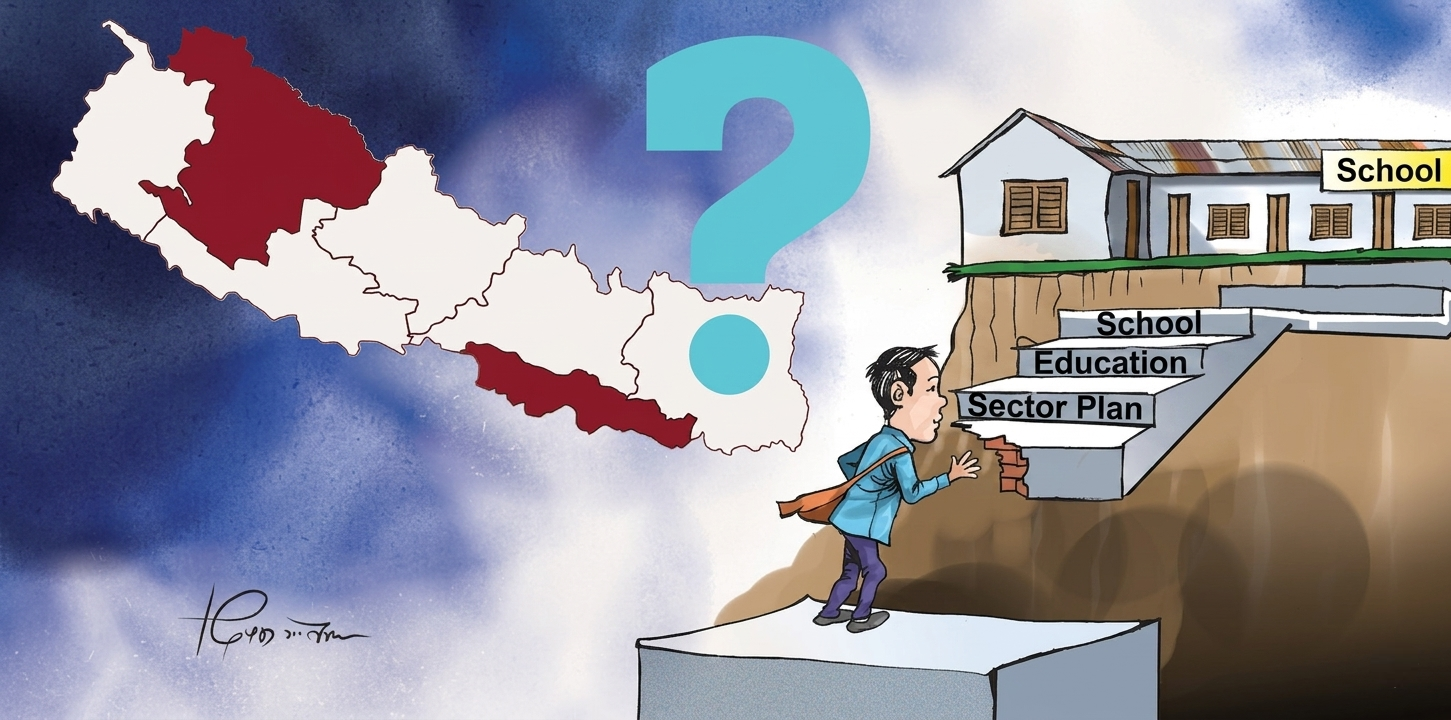
KATHMANDU: Nepali settlements are diverse in structure. Some are centered around state power, others around caste power, and some around linguistic power. Others are centered around religious power, geographical power, muscle power, or political party power. Recently, they have become centered around money power.
School establishment happened in the same way. Initially, people from all types of centers studied in the same school. Urbanization led to the creation of different types of schools in money-centered locations. Consequently, the children of the well-to-do began studying there. Currently, this culture has reached all local units of the country to some extent. In this situation, those we must do justice to are the Dalits of Karnali and Madhesh. There are the impoverished. There are the Muslims. How do we reach those invisible and marginalized groups? Will the government’s School Education Sector Plan 2022-32 do this work? This article is focused on this vicinity.
Foreign practices
Marginalized students like those in Madhesh and Karnali also exist in the African countries of Chad and Niger. To reach them, they ran short-term classes. They made them equivalent to formal education. Kenya adopted a policy of assisting with homework. It provided counseling to parents. It gave financial facilities to students. Malaysia made arrangements to implement inclusive policies. According to need, it made schools trauma awareness centers. From these and similar practices, international organizations established five foundations. First, go where the children are. Second, provide food, counseling, monitoring, mentoring, and social support along with enrollment. Third, train teachers in special methods for teaching those students. Fourth, keep data updated. The fifth foundation: provide legal aid.
China took a three-point policy to teach children of impoverished settlements by connecting three things simultaneously. The use of technology is the first point. Under this, it directly connected urban school classrooms to rural schools. This reduced the educational distance between the city and the village. Residential schools are another point. It arranged for children from impoverished settlements to study in urban residential schools for one week or one month. The government provided the transportation, food, and snack expenses needed for those children of impoverished settlements. Policy reform is the third point. It made a policy not to take entrance exams for village children to study in the city. It converted rural schools into residential-type schools opened by the people under state responsibility. According to the local economic capacity, the government invested 80:20 in some places. 60:40 in some. 20:80 in others. It added physical facilities in some places. In some, it took a policy of two waivers and one reimbursement. Two waivers mean not covering food, lodging, and transportation costs. One reimbursement means assisting parents of children with disabilities. It also provides loans according to need. It arranges free education for poor students in the best colleges in the city.
Cuba engaged millions of students studying in college in the work of teaching children from impoverished settlements. Like China, it arranged food and lodging for poor children. It gave counseling to parents. It ran short-term classes. It assisted those whose capacity was insufficient after studying there with bridging materials. It gave training to teachers. It instilled the confidence that “I can.” It provided access to technology even by connecting solar energy. It sent teachers to remote settlements.
Mindset of the planners
To take educational programs to the impoverished settlements of Madhesh and Karnali, Nepal’s educational planners took equity and inclusion as a basis. On that basis, they talked about Madhesh. They talked about Karnali. They wrote the same thing in the School Education Sector Plan made for up to 2032. There they said, “Implement a decentralized policy.” UNICEF will ensure the education of out-of-school children. It will operate informal education. It will connect them to school education. Projects like ‘Aarambha’ will be implemented. That too, only in Bara and Rautahat.
Then they said, “Reduce child marriage.” The non-governmental organization Open Learning Exchange (OLE) Nepal will provide digital education in government schools. Save the Children will bring awareness among Dalits and girls. The provincial government will provide free education to three children per family. What is the message of this plan? Decentralization? Responsibility of the local government? Or projects of UNICEF, Save the Children and OLE? Investment in specific children of the province? Where is the answer to this question to be found? There are eight districts in Madhesh Province. There are 10 districts in Karnali Province. The School Education Sector Plan did not write what to do in other districts either. It also did not say that UNICEF, Save the Children, and OLE would assist all local levels of Madhesh Province. Then is this only a project of UNICEF, Save the Children, and OLE? Will children from all districts of Madhesh receive basic-level education this way? Is it decentralization when not working under Schedule 8 of the Constitution of Nepal, 2015? The provincial government should probably collaborate with the local unit. Does Schedule 9 of the same Constitution suggest working directly? Can a way out be found without seeking answers to these and similar questions?
The School Education Sector Plan did not write what to do in other districts either. It also did not say that UNICEF, Save the Children, and OLE would assist all local levels of Madhesh Province.
The same situation exists in Karnali Province. The School Education Sector Plan says UNICEF and SAC Nepal will conduct teacher training there. Global Partnership for Education (GPE) and UNICEF will assist in physical infrastructure. HEAD Nepal will assist in residential schools for children with disabilities, school meals, and safety work in Humla. Overall, the government leads the education in Madhesh and Karnali provinces. Organizations like UNICEF, the European Union (EU), Finland, GPE, Asian Development Bank (ADB), Save the Children, OLE Nepal, People in Need, Social Awareness Center (SAC), and HEAD Nepal assist.
The question of responsibility
Whose responsibility is compulsory and free basic education? In whose charge is the literacy program? The School Education Sector Plan of the federal government is evaluated by these two questions. According to Schedule 8 of the Constitution, it is understood that the answer to both these questions is the local government. The Compulsory and Free Education Act, 2018, also emphasizes the same thing. The intent of the Education Regulations, 2021, is also the same. If that is so, what is the motive of the School Education Sector Plan? Action contrary to the statement of the Constitution? Action contrary to the Compulsory and Free Education Act, 2018, and Regulations, 2021?
And if organizations like UNICEF, the EU, Finland, GPE, ADB, Save the Children, OLE Nepal, People in Need, SAC Nepal, and HEAD Nepal do not assist, what is the alternative? If it is their project, what is the responsibility of the local unit? If it is the work of the local unit, what is the intent of the borrowed desire of the School Education Sector Plan? If the local unit is to do it, where is the information about what strength exists or does not exist in which local unit? If it is directly written that such and such an organization will do this work, did it become the project of the respective organization? In other words, what should local units write in their plans? Where is the information about which local units have sought the help of organizations like UNICEF, the EU, Finland, GPE, ADB, Save the Children, OLE Nepal, or People in Need? What is the relationship between the problems of the local unit and the work these organizations say they will do? Where is the matter of seeking/causing to seek in this way? Otherwise, why talk of decentralization? Why talk of constitutional rights? If UNICEF, EU, Finland, GPE, ADB, Save the Children, OLE Nepal, People in Need, SAC Nepal, and HEAD Nepal are the ones to work. Why a separate government plan? What if it is their project?
There is also no information as to why local units did not implement the Compulsory and Free Education Act, 2018.
If work is to be done through centralization, why not say this arrangement exists in all local levels of Madhesh and Karnali provinces? Why not write, as Bhutan does, to put money into a single basket for organizations like UNICEF, the EU, Finland, GPE, ADB, Save the Children, OLE Nepal, or People in Need? Why not write that the local level will combine that money and its own money to give compulsory and free basic education to all? If the federal government itself takes responsibility, why connect the local government? The answers to these and similar questions are not in the School Education Sector Plan. There is also no information as to why local units did not implement the Compulsory and Free Education Act, 2018. Why not talk about the mandatory situation of implementing Section 19 of the same Act, stating that if they do not do so, this will be the consequence? If you make an act and then give an alternative, why is the act needed at all? Why is the Constitution needed?
What do others do?
Countries with federal governance like America, Germany, and Britain make compulsory and free education acts. Britain gives a framework. America reinforces it. Japan evaluates whether there was uniformity. In our country too, there is a compulsory and free education act. There is also a 12-point basis for being called literate. There are prohibitive things such as those not having a qualification equivalent to Grade 8 by the end of mid-April 2028 will not get citizenship or a job. Level-wise and subject-wise competencies have also been publicized in the curriculum, stating that these specific capacities must exist. There is also a policy of complementary investment. Despite knowing this, why did the School Education Sector Plan not raise this matter? Why not think about it?
China asks the county how much money is needed to do this work. It also gives its central and prefectural standards. In our School Education Sector Plan, it is not like that. There is also no information that such-and-such a local level in Madhesh needs this amount for this work, such-and-such a local level in Karnali needs this much for the same work, of which the local level can spend this much, the province assists with this much, foreigners give this much, and NGOs give this much. Looking at it this way, the question remains: Whose is the School Education Sector Plan?
What is the relation of the local units of Madhesh and Karnali Province with the School Education Sector Plan? In other words, the right of the local government, but the federal government makes the decision? Outsiders make the plan. It has become as if UNICEF, the EU, Finland, GPE, ADB, Save the Children, OLE Nepal, People in Need, SAC Nepal, and HEAD Nepal are the ones getting it made? Let’s ask another question: will these organizations take responsibility for compulsory and free education? My information says they do not take responsibility; they can assist. That too, since they have no financial sources of their own, they are to assist if someone gives them funds. Even in that, they consider themselves technical advisors. They do not consider themselves a funding agency.
Level-wise and subject-wise competencies have also been publicized in the curriculum, stating that these specific capacities must exist.
ADB, however, calls itself an investment partner. Primarily in providing loans. In getting one used to it by giving a little grant. That grant is also for the work of technical assistance (TA = technical advisor). Because ADB is a bank. It gives a smaller grant. It gives more loans. Its loan-giving areas are physical construction, environment, digital transformation, energy, and poverty alleviation. In which local levels of Madhesh and Karnali Province is such help needed? There is no information about this in the School Education Sector Plan.
What should our path be?
If we are proponents of federalism, decentralization is natural. If we are proponents of decentralization, there must be a plan to assist the local government. There must be a list of what it wants to ensure compulsory and free education for all at the basic level. Under those items in the list, information is needed on what their own capacity is. In some places, internal sources within the local level must be mobilized. In some, interlocal-level assistance must be taken. A detailed account of that matter is needed. And if they need external help, in what will UNICEF assist which local unit? European Union in what? Finland in what? GPE in what? ADB in what? Save the Children in what? OLE Nepal in what? People in need of what? Information on this is needed.
In the current School Education Sector Plan, things have come in a lump sum. There is talk of the work these organizations are doing. But which local unit of Madhesh needs help from which organization? Which local unit of Karnali needs help from which organization? This very thing is missing.
Overall, the School Education Sector Plan does not make the local unit responsible. Nor does it excavate and use the local sources. Nor does it make arrangements to use the sources of neighboring local units. Nor does it know the spirit of decentralization. Nor does it know the meaning of federalism. It gives the impression of exactly what was done in a centralized governance system. It provides a setting to sell the projects of organizations that call themselves development partners.
In this situation, who will ensure the education of the marginalized of Madhesh? Who will be the responsible body to ensure the education of the marginalized of Karnali? Who will provide the decision for these and similar matters? I leave it to the government for a decisive statement. I leave it to the experts who interpret the clauses of the Constitution. I leave it to the proponents of decentralization. I leave it to the leadership of the local units. I leave it to the individuals who examine the sections and subsections of the Acts, Regulations, and Procedures.
(Professor Koirala, active in public education reform, is an educationist.)