Kathmandu
Tuesday, July 21, 2026





Hearing Committee breaks with past tradition, hurriedly approving the Chief Justice's recommendation on the very day the 16 complaints were opened without conducting any investigation

KATHMANDU: Without examining the 16 complaints filed against Chief Justice-designate Manoj Kumar Sharma, the Parliamentary Hearing Committee has approved his nomination in a hurried manner, effectively bypassing established scrutiny practices. In a departure from past parliamentary tradition, the committee completed the hearing on the same day the complaints were opened and endorsed the Constitutional Council’s decision.
With this, Sharma has been appointed the thirty-third Chief Justice of the Supreme Court of Nepal. He is also set to become the first chief justice in the court’s history to serve a full six-year term.
On May 7, the Constitutional Council, chaired by Prime Minister Balendra Shah (Balen), recommended Sharma for the post from among six judges proposed by the Judicial Council, selecting him from the fourth position in the seniority order. Following the recommendation, the Parliamentary Hearing Committee invited complaints and allowed a 10-day period for submissions before proceeding with the approval process.
The hearing committees prior to this used to call the complainants and forward the approval process only after a few days of discussion. However, this time, the committee, where the Rastriya Swatantra Party (RSP) holds dominance, has breached the tradition and limited the hearing to a formality.
Complaints had been filed in the Parliamentary Hearing Committee against Sharma, including charges of receiving the recommendation due to being a ‘nepo baby’ and making wrong verdicts in cases related to Ncell. Because of being a nephew of former Chief Justice Damodar Prasad Sharma, the allegation of ‘nepo baby’ was leveled against him. Regarding this matter, he stated during the course of the hearing that he was appointed chief justice on the strength of capacity and qualification alone. He has said, “Since there is no legal recognition that one must not receive an appointment to any post just because of having a family relation, it did not feel appropriate to keep speaking on this matter.”
The committee Q&A session
The chairperson and members of the parliamentary committee had asked questions connected to the judiciary to Sharma, who was recommended for chief justice. While some Members of Parliament (MPs) asked questions by praising Sharma at first, some questions were limited to the formality of the process only. During the course of the hearing, the RSP MP Bodha Narayan Shrestha, who is also the chairperson of the committee, had made a ‘ruling’ to conclude the process quickly. Sharma did not give answers to all the questions of the MPs. He has stated that it was not necessary to give answers to some questions.
MP Padma Aryal had posed a question to Sharma: ‘After being appointed Chief Justice, can you fearlessly put a check on the wrong decisions of the executive?’ Sharma evaded it without giving an answer.

Parliamentary Hearing Committee Meeting. Photo courtesy: Nepal Photo Library
Another MP, Nara Bahadur Bista, had asked questions regarding the allegations that he tried to capture the Supreme Court even before becoming Chief Justice and did not let the writ against himself be registered. In response, Sharma gave an answer that whether to register a writ or not is a matter of the administration’s authority. “The chief registrar and registrar have the authority to use discretion on the matter of whether to register a writ or not. Therefore, others formed an opinion on this matter and leveled allegations,” was his answer.
After the Constitutional Council recommended the Chief Justice by breaching seniority, senior advocate Dinesh Tripathi and others had gone to the Supreme Court for the registration of a writ petition against it. After the Supreme Court administration did not register the writ and also failed to provide the refusal order, the acting Chief Justice, Sapana Pradhan Malla, had ordered the administration to register it by 1:00 PM on the afternoon of May 18. However, the Supreme Court administration did not register the writ petition. Immediately after that, the hearing committee became active, completed all processes in a single day, and made the appointment of the chief justice.
To the question asked by MP Bista in the hearing, ‘How can you bring down the corruption occurring in the court to zero during your tenure?’ Sharma claimed that irregularities will be removed once all processes are made transparent and arrangements are made for the ‘live’ broadcast of hearings as well. During the course of the hearing, Bista had raised questions about Sharma’s PhD as well. To the question, ‘There is an allegation that you did your PhD after a professor of some law college wrote the thesis.’ ‘What do you say?’ Sharma urged not to doubt. Along with this, Bista had also placed a question to Sharma: ‘There is a complaint stating that during the time you were a judge of the Supreme Court, a ‘deal’ of Rs 7 million took place in a case with a nephew of the then Chief Justice Cholendra Shumsher Rana, and the amount was returned after losing the case, and it is said that evidence will be given if necessary.’ In that, Sharma stated that the allegation was wrong.
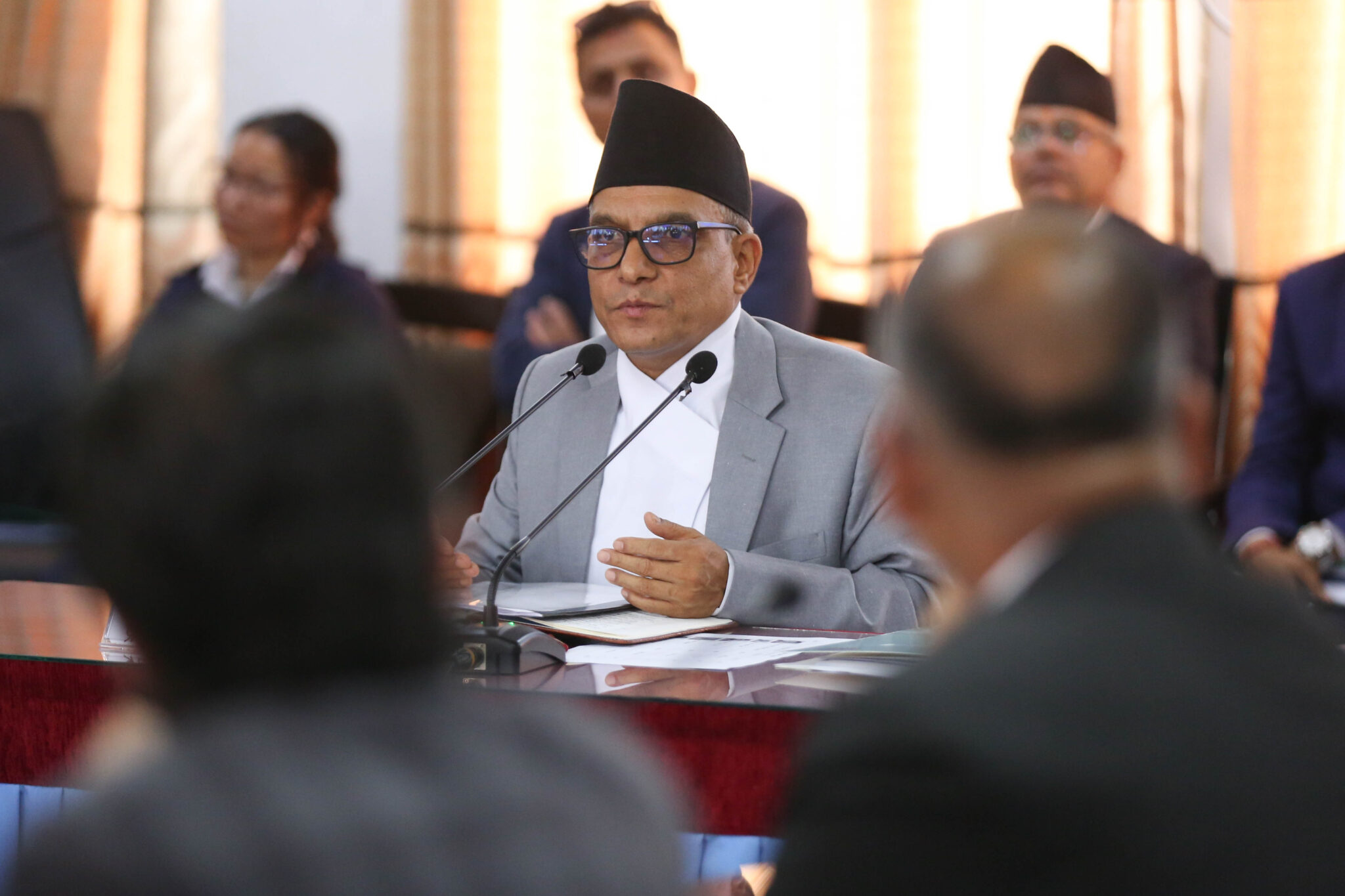
Chief Justice Manoj Kumar Sharma. Photo courtesy: Nepal Photo Library
When the MPs placed questions regarding the best verdict so far, he did not mention any verdict. During the course of the hearing, the MPs also asked questions regarding the relationship with the remaining judges and the factionalism started in the Supreme Court after becoming the chief justice from the fourth position on the basis of seniority. In reply, Sharma stated that the Constitution has explained the post of Chief Justice not as a ‘promotion’ but as an ‘appointment.’ He claimed that seniority cannot be the only strong basis. He has said, “I do not need to speak further on a matter that a high body like the Constitutional Council has already recommended after completing its process.” Sharma’s response was that there was no factionalism in the Supreme Court.
MP Rajiv Khatri had asked, ‘Will the current resources and means of the Supreme Court be sufficient to implement the action plan?’ In response, Sharma stated that 1 percent of the total budget must be allocated for the judiciary.
The Hearing Committee of the Parliament summoned a meeting at 8:00 AM in the morning on exactly the tenth day of calling for complaints, giving the formality of a hearing, and approved the recommendation of the council.
Immediately after the committee approved, President Ram Chandra Paudel administered the oath of office and secrecy to Chief Justice Sharma. He has already assumed office by reaching the Supreme Court on the evening of May 19.
Since April 1, Sapana Pradhan Malla had been handling the responsibility of acting chief justice in the Supreme Court on the basis of seniority. According to tradition, if the Constitutional Council had recommended on the basis of seniority, Malla would have had an opportunity to become the second female Chief Justice. However, she has been limited to being an acting chief justice only.