Kathmandu
Thursday, June 11, 2026





Crippled by unclear form layouts and a lack of proper official guidance, vulnerable and elderly retirees are running from one government office to another, describing the high-stakes asset-verification process as an outright source of harassment and panic
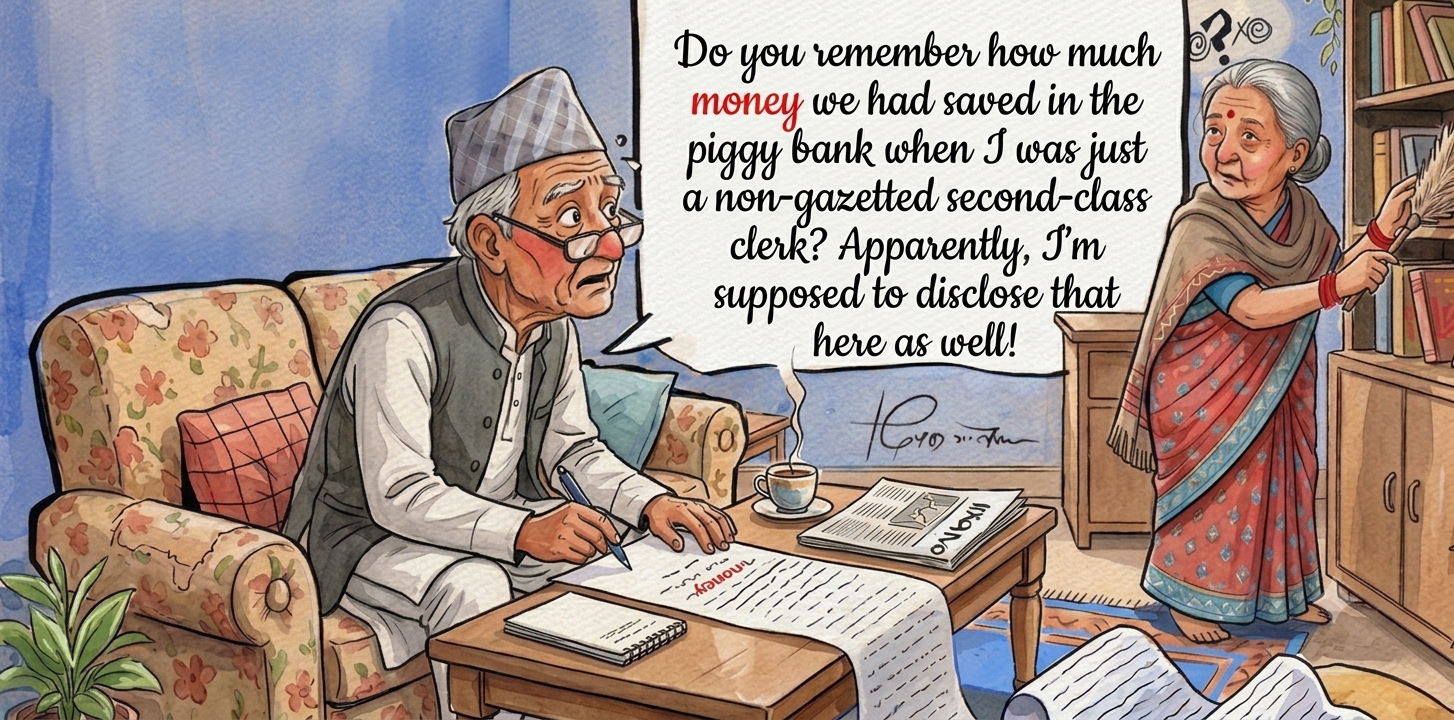
KATHMANDU: Former government employees enjoying their retirement have been thrown into a state of panic and frantic activity following an aggressive asset-declaration sweep across Nepal. Ever since the newly formed Property Inquiry Commission demanded comprehensive financial declarations, both retired and sitting public officials have been left scrambling to unearth, verify, and justify assets dating back decades. Forced to navigate a bureaucratic maze, elderly and often physically infirm retirees are desperately visiting various far-flung government administrative offices and past workplaces to track down historical financial records, a high-stakes ordeal that many describe as a source of severe physical exhaustion and mental trauma.
The Inquiry Commission has received a mandate from the government in the first phase to collect, verify, and investigate the property details of public officials from those sitting in the government to employees after the fiscal year 2005/06 for two decades, meaning up to the end of April 13 this year, and in the second phase, from the year 1991 to the fiscal year 2004/05. According to this, the commission is currently focused on the first phase of work.
On May 13, 2026, the commission issued a notice giving public officials ranging from former prime ministers to joint secretaries until June 14 to submit property details for themselves and their families covering the years 2006 to April 13, 2026. However, because very few submissions were made, the commission extended the deadline on June 10 to July 16. According to commission spokesperson Ganesh Karki, around 20,000 individuals are required to file in this first phase, but by June 7, just over 1,000 people had submitted their forms and complaints.
According to the commission’s criteria, there is an arrangement where those who sat in public office during the period of two decades must fill out a 12-page form. On April 15, the government formed a five-member Property Inquiry Commission under the chairmanship of former Supreme Court Judge Rajendra Kumar Bhandari. The commission, which has received a one-year period for property investigation, compels those under its investigation scope to submit details along with the verification of their property.
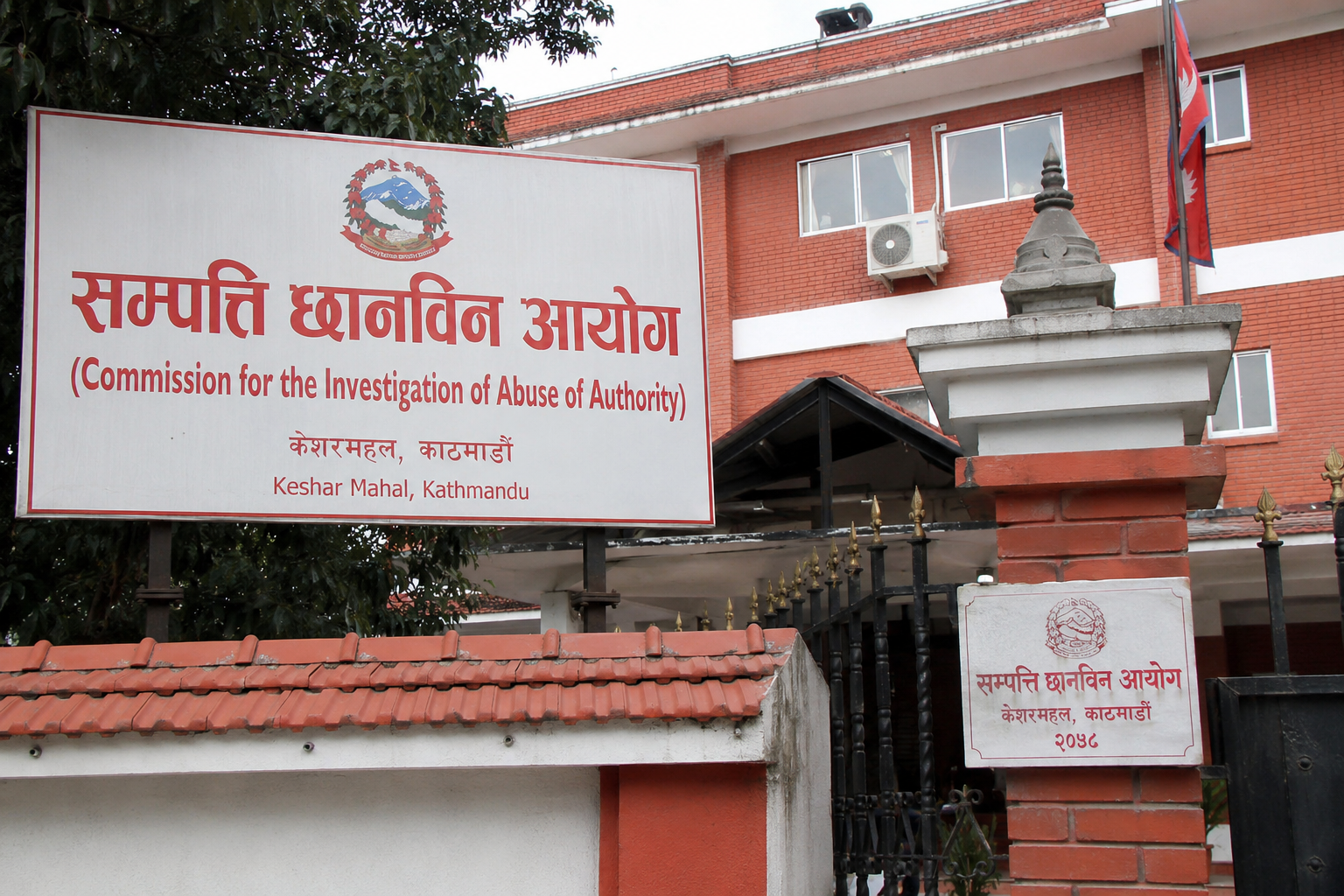
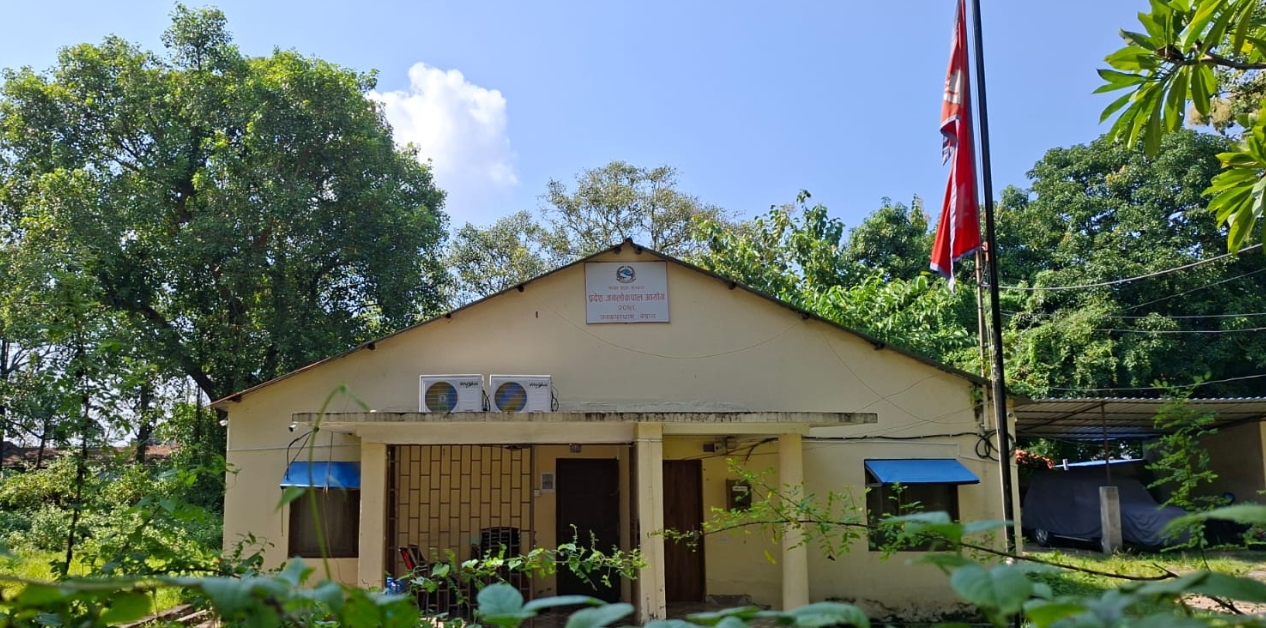
Property Inquiry Commission, Keshar Mahal, Kathmandu. File photo
For this very purpose, former employees are reaching the Employees Provident Fund, Department of National Personnel Records (Civil), Citizen Investment Trust, Pension Fund, various banks, and the offices where they worked. Former Secretary Bal Krishna Prasai, who retired from service 19 years ago, states that it is becoming extremely difficult at this time to verify every detail of the time when he was in his job. He says that many other friends are making similar complaints to him. “I am positive about the fact that the details demanded by the government must be submitted, but many have taken it as unnecessary pain and hassle,” he says. “How to certify the documents of an allowance received in some training or an amount received for working in a project of a donor agency? On top of that, it has become even more difficult as the layout of the commission’s form is not clear.”
It has become troublesome because there is a single layout of the form in a lump sum for all employees, including sitting joint secretaries, employees who retired 20 years ago, and officials who sat in public office. According to former Secretary Prasai, since it is an old matter, it is also becoming difficult to remember all financial details and accounts. “Sometimes we went to remote areas. How much remote allowance did we receive, how much had the grade of salary increased, it is difficult to remember all things. Everything is not written in the letter of transfer,” he says, “Many have become old up to 80 or 85 years, and physically infirm. They are not in a position to reach various offices to collect details.” His suggestion is that it would have been better if the government had started this work after doing some adequate homework.
The Chairman of the Council of Former Public Employees of Nepal, Ram Babu Nepal, states that a difficult situation has come at present for employees who left after submitting all details to the government when leaving their jobs.
In the form prepared by the commission to fill out the property details, it is mentioned that it must be filled out along with family details. ‘Family means husband, wife, son, unmarried daughter, daughter-in-law, father, mother, elder brother, younger brother, elder sister, younger sister, grandson, granddaughter, daughter-in-law [repeated in text], unmarried granddaughter, adopted son, unmarried adopted daughter, widow, mother-in-law, as well as father-in-law living together in a joint family,’ the form states, ‘When submitting property details, all documents verifying income and expenditure must be verified.’
According to this, because documents for the verification of all details of income and expenditure must be gathered a long time after leaving the job, it has caused harassment to the employees.
The Chairman of the Council of Former Public Employees of Nepal, Ram Babu Nepal, states that a difficult situation has come at present for employees who left after submitting all details to the government when leaving their jobs. He states that by virtue of being the chairman of the Council, many former employees are complaining to him. According to him, employees who left their jobs a long time ago have complained that it has become difficult to remember the source of income, records of allowances received in districts, work done in various donor agencies, and to gather proof of allowances given in projects when going to any country.
As an example, Nepal shares that complaints have come stating that it is being difficult to verify the allowance received while working in that project because the United States Agency for International Development (USAID) has closed down. “Since that office itself has closed down, from where to search, gather, and bring the details?” he says, “Many individuals have asked me whether the details given by writing oneself will verify it or not. Some have stated that it has become difficult to verify regarding land they have already sold.”
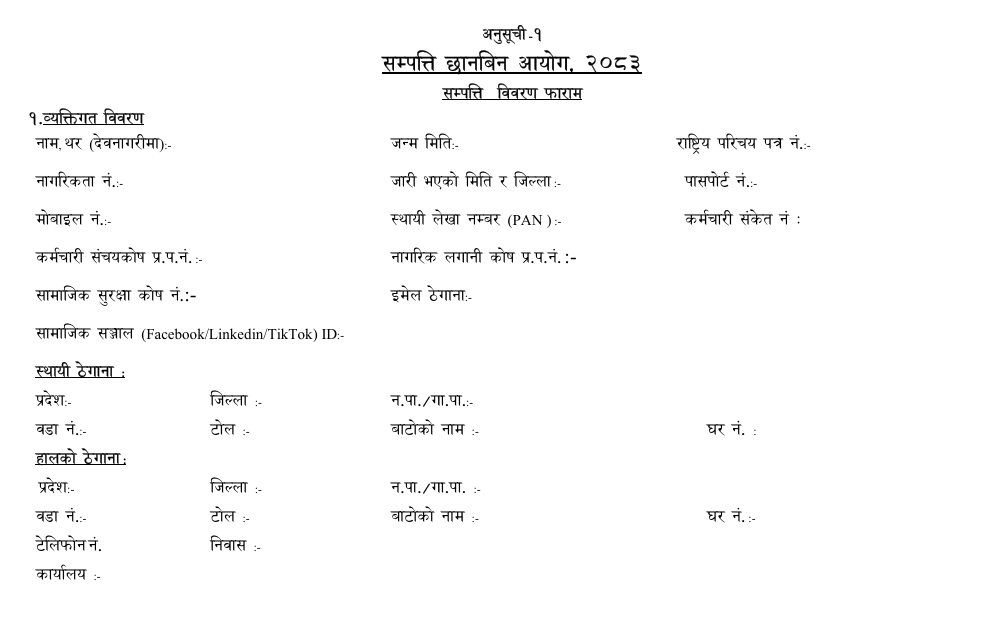
Property disclosure form of Property Inquiry Commission
According to Chairman Nepal, they stated it has become difficult because there was no inkling that the government would demand details later like this, and those retired did not keep ledgers of their income and expenditures. “Details must be given since the government demanded it, but there is a practical difficulty,” he says.
He comments that due to the corruption and actions against moral conduct committed by a few individuals, all people holding public office in the country have fallen under the state’s investigation radar. “When everyone is told to submit property details, a general perspective could be formed from this that all individuals who held public office are corrupt, and the image of the country did not look good internationally either,” he says.
Former Secretary Prasai, however, laments that it is felt that the government has undervalued senior citizens. “The age of the employees should also have been looked at; it feels as if the government has forgotten the work they did while remaining in positions in the past,” he says, “The government can search and take action against those who commit wrongdoing, but the hassle of collecting details is giving mental stress.” He states that harassment should not be given by putting everyone in the same basket in the name of a few individuals who commit wrongdoing.
While several public officials have voiced deep frustrations over the rigid layout of the Property Inquiry Commission’s asset forms, the commission’s spokesperson, Ganesh Karki, maintained that flexible submission channels have been established to ease the burden. According to Karki, individuals under scrutiny are not strictly required to show up in person; instead, they have been given multiple avenues to deliver their mandatory declarations, including submission via traditional postal mail or directly through email.
Former employees state that the main thing is that problems are occurring just to collect details. According to former Secretary Prasai, it has become difficult to gather details because documents of many former employees were lost when their houses collapsed during the earthquake, many did not keep documents safely, and the physical and mental condition of many has become weak, so they are unable to remember old things. And he states that many of advanced age are not in a condition to fill out details by operating computers at all. “Because the children of many are abroad, there is a problem when one has to run around oneself to gather details from government offices. On the other hand, even though the option to submit details from email exists, many who retired cannot fill it out themselves on the computer,” he says.
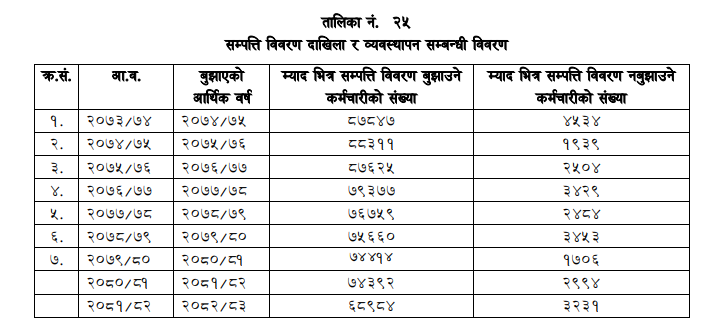
Details regarding property declaration filing and management
According to the Inquiry Commission, 15,000 to 20,000 individuals who were in public office in the second phase, 1991 to 2006, will have to submit property details. However, the government has not been able to prepare exact statistics until now as to precisely how many individuals will mandatorily submit property details in the first and second phases combined. The calculation of the commission is that around 20,000 individuals must submit details in the first phase.
To the question of how you will investigate that many individuals, the spokesperson of the commission, Karki, states that they will adopt established norms and investigatory procedures created previously for investigations on various matters. He says, “We will work in a manner to conduct detailed investigation if discrepancies are met after looking at everyone’s details.”
Employees submit property details annually
There is a legal arrangement that those who are in government service must submit their property details every year to the concerned office. The arrangement regarding property details has been made in Section 50 (1) of the Prevention of Corruption Act, 2002. In which it is mentioned that a public servant, within 60 days from the date of completion of every fiscal year, must submit updated details along with the source or receipt of the property held in their own and their family’s names to the body they are working in or the official there. There is an arrangement that the submitted property details will be kept confidential.
In Section 50 (2) of the Act, it is mentioned that if a person who fails to submit the details of property within the specified deadline requests a deadline extension by mentioning the reason for being unable to submit, the concerned body or official can extend time up to a maximum of 30 days. ‘A fine of 10,000 rupees will be imposed on those who do not submit property details within the deadline. An investigation can be conducted by assuming that illegal property exists in the name of their family,’ it is written in the Act.
According to this arrangement, employees have made complaints that while they had been submitting property details every year, the hassle of verification has been given again by forming a commission without conducting investigations into that.
Senior Advocate Shree Hari Aryal states that the formation of the Property Inquiry Commission is a political matter. Being a former president of Transparency International Nepal as well, he says, citing the instance of the formation of the Lamsal Commission in the past, “The Lamsal Commission had also demanded property details in this very manner. Ultimately, the commission faced the allegation that it tried to brand people by picking and choosing while remaining close to the King and harboring prejudice.”
On March 8, 2002, the government led by Sher Bahadur Deuba had formed the ‘Judicial Commission for Property Inquiry’ under the chairmanship of the then Justice of the Supreme Court, Bhairab Prasad Lamsal. The commission was formed for investigation after criticism took place stating that officials sitting in public office had amassed ‘unaccounted property’. The commission prepared a report taking 13 months and submitted it to the former King Gyanendra Bir Bikram Shah Dev on March 18, 2003. However, that report was not made public.
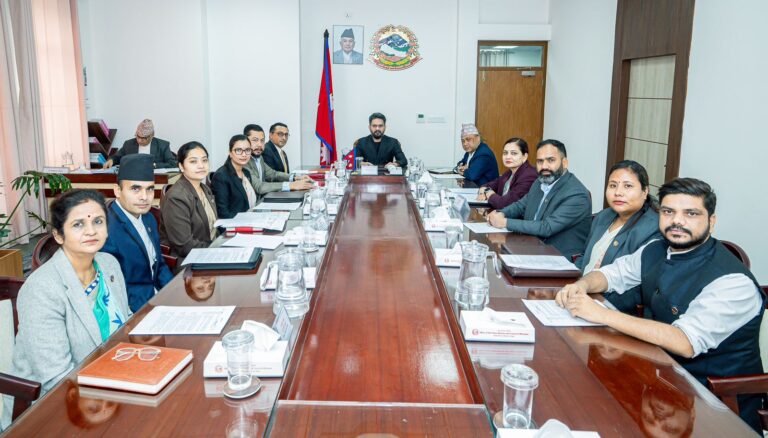
Cabinet meeting. Photo courtesy: PM’s Secretariat
Even if the current inquiry commission collects property details, senior advocate Aryal sees challenges just to conduct the investigation. “According to the mandate received by the commission, it collects the property details of those who sat in public office and prepares a report and submits it to the government, only this much,” he says, “It is difficult for the commission to recommend action after investigating the property.”
On the other hand, he comments that the matter of mentioning about the property of all relatives in the property details is also not practical. “Where land is held in the name of the in-laws or maternal house, how to know? Similarly, the property of the son and daughter-in-law might not be known to the parents; how practical would it be to have to fill out their property details too?” he says.
Claiming that the report of the commission cannot completely control corruption, he says, “One must be able to take action by implementing the law.”
Mandate to the commission
The Inquiry Commission has been given a mandate to inquire into the collection of property details held within the country and abroad in the names of officials who are in public office, those retired, and their families as well.
From the year 2006 to mid-April 2026, Prime Ministers to Assistant Ministers, Ambassadors, chiefs and employees of diplomatic missions, employees above Joint Secretary in civil service, employees of Nepal Police, Armed Police Force, and National Investigation Department who worked and are working in the post of office chief, employees of parliament service, Gazetted Second Class employees of health service, Governor of Nepal Rastra Bank, office bearers of the board of directors, Deputy Governors, Executive Directors, and others must verify and submit property details to the commission. Advisors, personal secretaries, or officials appointed by the government from the President to Assistant Ministers have also fallen under those required to submit property details.
When investigating property, the commission has a mandate to conduct investigations even regarding matters hidden or sent within the country or abroad in relation to oneself, members of one’s family, relatives, and kin. After the commission finishes investigating the property in one year, it will submit a report to the government. ‘After receiving the report, the government must advance the process of necessary action within 45 days,’ it is mentioned in the mandate given to the commission.
Initially, it was specified in the mandate to investigate the property from Prime Ministers to Assistant Ministers, members of parliament, members of the constituent assembly, those who already worked sitting in constitutional bodies, former judges, retired officers of the Army, chiefs of province assemblies, Chief Ministers to Assistant Ministers, province members, and chiefs to deputy chiefs of local levels.
However, on April 27, the government amended the mandate of the commission. In the context of sitting judges and the Army, an arrangement has been made to send it to the concerned body for investigation only if a complaint is filed against someone in the commission.
Sitting officials not to be investigated
The commission has been specified a mandate in a manner not to keep the current Council of Ministers to other sitting officials within the scope of investigation. Members of the Council of Ministers, office bearers of constitutional bodies, sitting judges, and those working in the Army do not have to submit details to the commission. The spokesperson of the commission, Ganesh Karki, states that an arrangement has been made where they do not have to submit details because those remaining in specified sitting posts can be investigated according to other laws.
His argument is that they do not have to submit because the constitution itself protects the Army and sitting judges. “For judges, there is the Judicial Council to conduct investigations. The Army has its own court-martial,” Karki says.
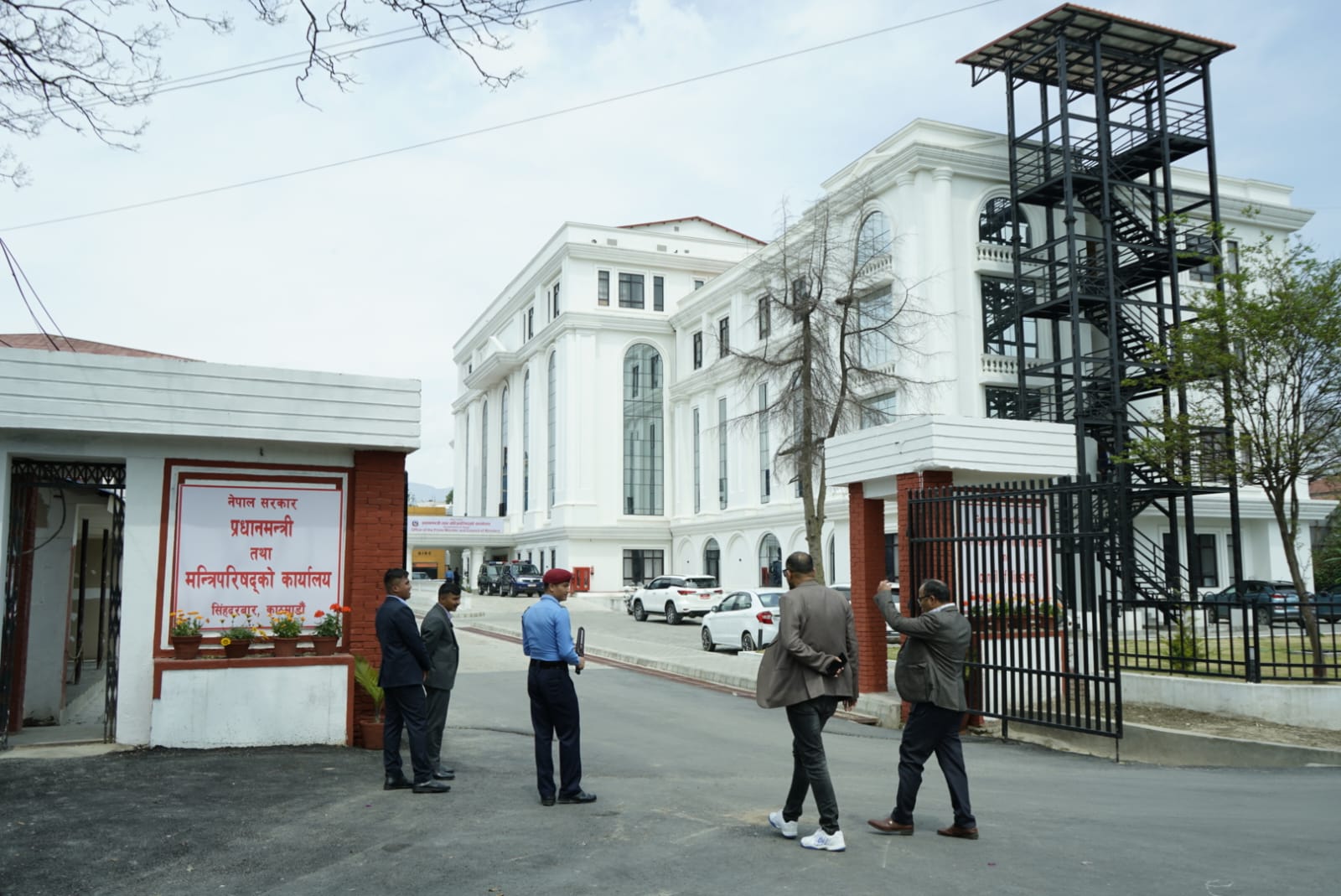
Office of the Prime Minister and Council of Ministers. Photo: Bikram Rai/Nepal News
State leaders who reached power, officials who sat in public office, and employees have been facing allegations of amassing unaccounted property, so he states that the commission being formed and conducting investigations is an opportunity to prove oneself innocent. “The government has given an opportunity to public officials to come into investigation, prove the valid source of property, and prove themselves innocent,” he says.
Meanwhile, a writ petition has already been filed in the Supreme Court against the Property Inquiry Commission. Advocate Prem Raj Silwal had registered the case on May 12, raising questions about the commission. He had registered the writ petition, making the Chairman of the commission, Rajendra Kumar Bhandari, the Office of the Prime Minister and Council of Ministers, and the commission opponents. On May 13, the Supreme Court demanded the written reason for the formation of the commission by the government and called both parties for discussion. After that, the case, which was listed for hearing five times until June 5, has been falling under ‘unable to be viewed.’
Challenge of not submitting details
Retired judges who fell into the property investigation have already declared that they will not submit their details to the Property Inquiry Commission. The gathering of former judges that took place on Jestha 17 (May 31) stated that property details do not have to be submitted in accordance with the constitution. In the statement issued on June 2 by the Chairman of the Former Judges Forum, Nepal, Top Bahadur Singh, it is mentioned that the commission issued the notice against the constitution in a manner adverse to the judges.
The Chairman of the Communist Party of Nepal (Unified Marxist-Leninist), abbreviated CPN (UML), and former Prime Minister, KP Sharma Oli, has also stated that he will not fill out the property details. At a party program organized on June 3, he publicly challenged the government to take away only the ashes, stating that because his property was set on fire in the Gen Z protest last year’s September, only ashes remain.
The commission, however, has not clarified what to do with those who do not submit details. The spokesperson of the commission, Karki, claims that former judges are submitting property details. He says, “Former judges are submitting details. We are confident that everyone who fell within the criteria of the commission will submit the details.”