Kathmandu
Sunday, June 14, 2026





Sherpas have become indispensable for climbing mountains across all seven continents
On the morning of May 13, 2026, Mingtemba Sherpa (35) stepped onto the summit of Mount Everest. He was a member of the very first team to reach the world’s highest peak this climbing season. However, he did not undertake this climb to set any personal records. He went as a member of the ‘rope fixing team’ that opens the route for other Mount Everest climbers. The main climbing season for Everest opens only after they fix the ropes. Government officials noted that by holding onto the ropes fixed by this team, more than 1,000 climbers reached the highest peak this year. This number stands as the highest ever for Mount Everest climbers in a single season.
To create and repair the climbing route on Mount Everest—which involves tasks like fixing ropes and placing ladders for climbers—a total of 13 people went from various companies, including Mingtemba from Seven Summit Treks. They were deployed for this task by the Expedition Operators Association of Nepal (EOA-Nepal), an organization of mountaineering expedition companies.
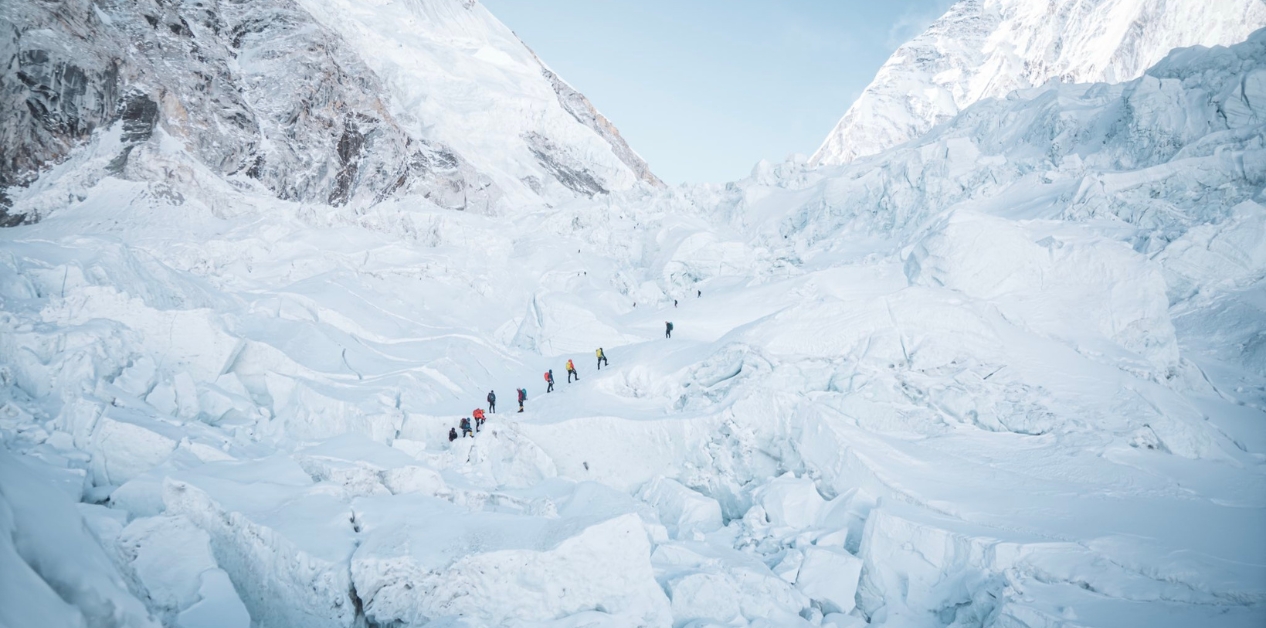
Every year, as the Mount Everest climbing season begins, they build and repair the route from the base camp all the way to the summit to assist climbers. As part of this work, they fix ropes and place ladders across crevasses and cracked ice sections. For this job, the team including Mingtemba reached base camp on April 10, 2026. They completed the work of breaking and setting the route in about one month.
In past years, work would begin on April 10 and the rope-fixing would wrap up around May 10; however, this time the schedule was pushed back by a few days due to an obstruction in the Khumbu Icefall. The Khumbu Icefall is considered the most difficult section of Mount Everest. While preparing the route, an ice collapse spanning a hundred-foot area in the Khumbu Icefall forced them to halt right there for two weeks. Ultimately, after a route was forged through that section on April 29, they reached the summit of Mount Everest on May 13.
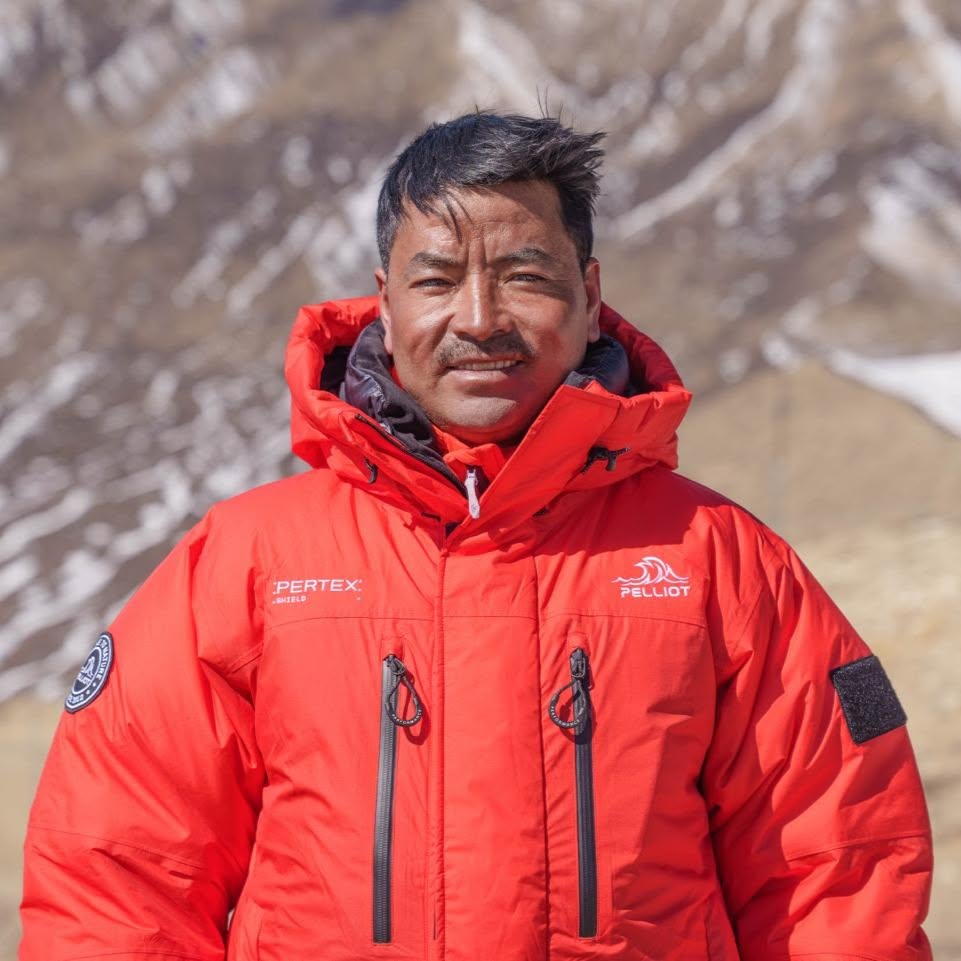
Mingtemba Sherpa. Photo: Sherpa’s Facebook
Climbers reached the peak of Mount Everest by using the path created by the team including Mingtemba. They unfurled the flags of their respective nations and took photos. Some even set personal records. The spring season (from March to May) is considered ideal for climbing Nepali mountains, including Mount Everest. While other climbers were celebrating their success as the end of the season was declared on May 29, the team of Sherpas working as high-mountain guides, including Mingtemba, had already reached Pakistan to assist with mountain climbing there. As soon as the climbing season ends in Nepal, it begins in Pakistan. Experienced Sherpa guides like Mingtemba are highly sought after to fix ropes and assist climbers on all five mountains taller than 8,000 meters located there. In addition to creating the climbing routes, they also transport essential supplies such as food and oxygen for the climbers.
Met in Kapan, Kathmandu on June 4, 2026, he had said, “Now I am heading to Pakistan. This season, I will fix ropes on all five mountains taller than 8,000 meters there.” At that time, it hadn’t even been a week since he returned from climbing Mount Everest twice in this single season.
There is a huge demand for Nepali Sherpas, including Mingtemba, to fix ropes and work as guides on the world’s mountains taller than 8,000 meters. Among the 14 mountains taller than 8,000 meters, eight are in Nepal (including Mount Everest), five are in Pakistan, and one is in Tibet, China. He travels not only to Pakistan but also to Tibet. Shishapangma, a mountain taller than 8,000 meters, is located in Tibet. The ascent of Cho Oyu also takes place only from the Tibet side.
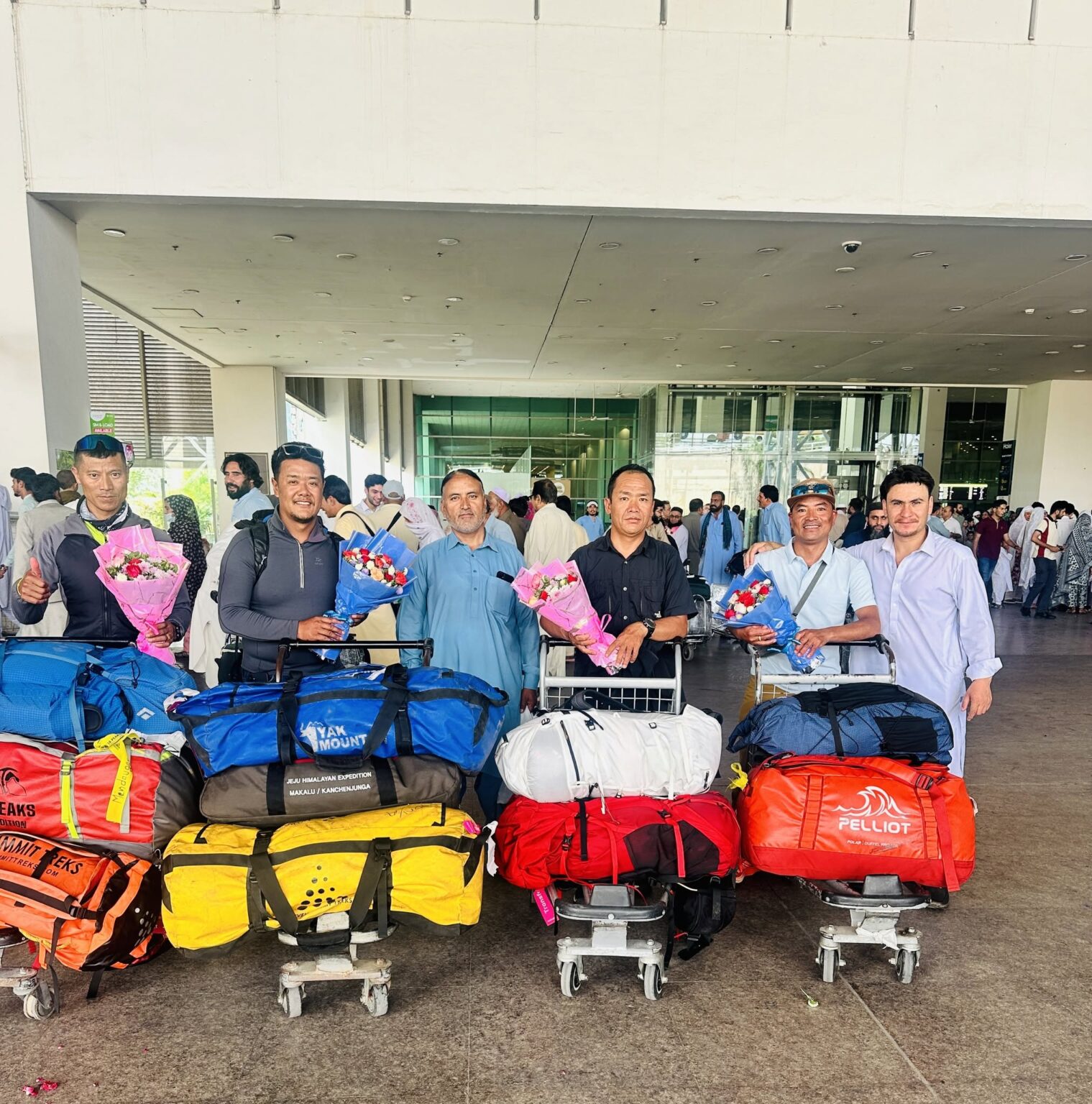
High-altitude mountain guides, including Mingtemba Sherpa, at Islamabad Airport to assist with climbing mountains in Pakistan. Photo: Sherpa’s Facebook
Mingtemba has climbed all 14 mountains taller than 8,000 meters multiple times. However, his primary job is not just climbing mountains for himself, but acting as a supportive companion to facilitate other climbers.
A separate team is deployed for the task of fixing ropes on Mount Everest and Lhotse. The Expedition Operators Association of Nepal deploys the rope-fixing team during the peak climbing season, selecting expert guides from various mountaineering companies. Khim Lal Gautam, the coordinator of the Department of Tourism’s temporary Everest Field Office, explains that experienced mountain guides are chosen to fix ropes. “Those who possess deep knowledge of the subject, are experienced, trained, and physically strong are selected to fix and arrange the ropes,” he says.
Mingtemba is not the only one who goes to Pakistan and Tibet to work as a guide in mountain climbing. There are dozens of high-altitude Sherpa guides like him in this profession. Among them are Mingtemba Sherpa, known as Mikel, and Lhakpa Sherpa (Makalu). They are also preparing to head to Pakistan in the second week of June. “This time, I am going to guide on G-I (Gasherbrum I) and G-II (Gasherbrum II),” Mikel says. He shares that there will be a team of 12 to 13 Sherpas for this expedition. Another high-altitude guide, Pemba Sherpa, is also heading to ‘K2’, the second-highest mountain in the world.
From Everest to Antarctica
Sherpas who head to Pakistan after Nepal’s climbing season ends join as assistants and guides starting from Nanga Parbat (8,126 meters), where the climbing season kicks off this year. Mingtemba, who has already reached Pakistan, is working on rope-fixing and guiding on this very mountain. He says, “Just like Annapurna is climbed first during the spring season in Nepal, climbing begins with Nanga Parbat in Pakistan. The end of June and the first week of July are considered ideal for the ascent.” Following that, he will climb G-I (8,080 meters), G-II (8,025 meters), K2 (8,611 meters), and Broad Peak (8,051 meters).
He notes that although there are a small number of Pakistani guides available for this work, climbers do not rely heavily on them. He states, “Climbers place their absolute trust in Nepali Sherpas.”
According to climbers, Pakistan does not offer the same infrastructure and convenience for mountain climbing as Nepal does. Due to ongoing traditional tensions between India and Pakistan, air services between the two countries remain suspended. Nepali Sherpa guides have also been facing the brunt of this. To travel to Pakistan, they fly from Nepal to Islamabad, using Dubai or Doha as transit hubs. To go to Mount K2, they take a one-hour domestic flight from there to Skardu. After about four hours of driving by motor vehicle, they trek for seven days through barren terrain to reach the K2 base camp. “You don’t find hotels along the stopping points like you do in Nepal. You have to pitch your own tents, cook, and feed yourself,” Mingtemba shares.
Chhang Dawa Sherpa, the Expedition Manager at Seven Summit Treks—the company through which Mingtemba has been guiding—states that 60 climbers will be heading to climb various mountains in Pakistan through his company this time. He explains, “In Nepal, a separate team is deployed for ‘rope fixing’ on Mount Everest and Lhotse, but that is not the case on other mountains. The Sherpas who go there as guides are the ones who fix the ropes and complete the climb.” He mentions that climbing in Pakistan begins at Nanga Parbat and concludes after the ascents of G-I, G-II, K2, and Broad Peak within the Karakoram mountain range.
Mingtemba mentions that after finishing his work on Nanga Parbat, he will trek directly to G-I from there. “The base camps of G-I, G-II, K2, and Broad Peak are close to Nanga Parbat; one can travel from one location to another in a single day. Other mountains, however, are a bit farther away,” he says.
Along with Seven Summit Treks, Imagine Nepal also operates mountaineering expeditions in Pakistan.
After Nepal’s high-altitude Sherpa guides return from climbing Pakistan’s mountains, they shift to climbing Mount Manaslu in Nepal and mountains in China (Tibet) during the autumn season. Because of this cycle, guides spend extended periods away from home. “I am away from home five months a year for climbing,” Mingtemba says. “I haven’t gone anywhere else besides Pakistan, China, and Nepal.” Although he spends his summers in the mountains, he returns home for the winter.
However, Mikel’s story is different. During the winter season in the Northern Hemisphere, he heads toward the Southern Hemisphere. He finds himself in high demand when it is time to climb the tall mountains of South America, Africa, and Australia. He has already climbed as a mountain guide on Aconcagua (2020), the highest mountain in South America located in Argentina, Mount Elbrus in Russia, which is the highest in Europe, and Australia’s Mount Kosciuszko, among others. “During the summer season, we are around Nepal, Pakistan, and Tibet, and in the winter, we regularly go to the mountains of South America, Africa, and Australia as mountain guides,” Mikel says.
Not only the 14 mountains taller than 8,000 meters, but the highest peaks across all seven continents attract climbers.
Seizing this opportunity, foreign companies as well as Nepali companies have introduced expedition packages for those mountains. Consequently, Nepali Sherpas are connecting with various mountain expeditions worldwide as guides.
Sherpas began emerging in the global market as high-altitude guides back in the 1970s. According to Everest, Inc., a book written about the commercialization of Mount Everest, Nawang Gombu Sherpa was brought in by the American company Rainier Mountaineering Inc. in 1970 to work as a guide on Mount Rainier. Nawang led expeditions on Mount Rainier on behalf of that company during the seventies and eighties.
Mikel has so far climbed 12 mountains taller than 8,000 meters, with the exceptions of Dhaulagiri and Shishapangma. He has scaled these mountains 30 times in total. “We don’t climb just to set a record for how many times we summit; we climb right alongside our clients to guide them to the top,” he says. Having climbed Manaslu for the first time in September 2009, he summited Cho Oyu in October of that same year. His journey of climbing mountains taller than 8,000 meters kicked off after he scaled Manaslu in 2008. “As for mountains 6,000 and 7,000 meters high, I’ve climbed so many I can’t even count them right now,” Mikel says.
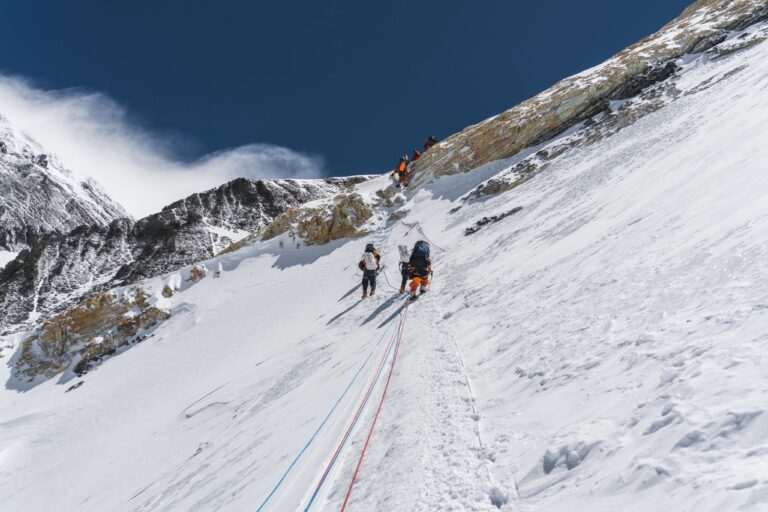
High-altitude guides fixing ropes on Mount Everest. Photo: Seven Summit Treks
Another internationally renowned mountain guide is Phunuru Sherpa. He has been working as an expedition guide worldwide for the American company International Mountain Guides (IMG). As noted in the book Everest, Inc.: “Phunuru is not only the most sought-after guide on Mount Everest, but he frequently receives personal offers from IMG clients to guide them up peaks across all seven continents, including Aconcagua (Argentina), Kilimanjaro (Tanzania), and Denali (USA).”
Mingtemba has been consistently involved in climbing in Pakistan every year since 2019. “I have been going for the K2 climb every year for the past six years, and I have summited that mountain four times during this period,” he says. “On two of those trips, I had to abandon the climb midway because the clients could not move forward.”
Starting his high-altitude climbing career with Manaslu in the autumn of 2016, Mingtemba has scaled all mountains taller than 8,000 meters. “When I first started climbing mountains, I used to feel very happy. Now, it doesn’t feel like anything special anymore. It has turned into a regular job, hasn’t it!” he says.
Sherpas working as high-altitude guides earn substantial money from mountaineering companies. Guides who navigate Mount Everest and K2 receive particularly massive payouts. A new guide receives USD 4,000 to 5,000 for a single expedition, while a guide with about 10 years of experience earns USD 7,000 to 8,000 USD.
Experts note that Sherpas are no longer limited to the mountains of Nepal; they travel to countries like Pakistan, China, the USA, Antarctica, Argentina, Tanzania, and France for commercial mountaineering.
The world first learned about Sherpas in 1953 when Tenzing Norgay Sherpa accompanied Edmund Hillary on the historic first ascent of Mount Everest. Originally working as porters, Sherpas later established themselves as expert guides. The continuous string of records set by Sherpas during mountain expeditions further solidified the strength of that brand name.
Thanks to their willingness to face danger, hard work, professionalism, and natural physical resilience, the Sherpa name has evolved into a highly prestigious global brand today. As a result, people across the globe specifically look for Sherpas when climbing high mountains. While they initially embraced the high-altitude guiding profession by putting their lives at risk for a livelihood, they have now become completely irreplaceable in mountaineering. Wherever there are mountains in the world, the presence of a Sherpa has become absolute.
A perilous profession
Fixing ropes on mountains is considered a highly hazardous task. Even though elite guides are selected, working at high altitudes remains one of the most dangerous occupations in the world. According to an article published in the American magazine Outside in 2013, the mortality rate for Sherpas working above Mount Everest Base Camp is 1.2%. This means that out of a thousand individuals working in high-altitude zones, 12 lose their lives.
The magazine compared the risks faced by Sherpas working in high-altitude zones to commercial fishing—widely considered America’s most dangerous profession—and the risks faced by US soldiers deployed in the Iraq War. The publication highlighted that a Sherpa’s job carries a risk 10 times higher than commercial fishing and four times higher than the mortality risk of an infantry soldier deployed in Iraq. According to the Himalayan Database, a website that archives mountaineering records, the number of people dead or missing on Mount Everest from the start of expeditions in 1921 up to 2025 stands at 344. Among the deceased, 137 are Nepalis, 111 of whom belong to the Sherpa community.
Those going on mountain expeditions must confront avalanches, rockfalls, crevasses, and high-altitude sickness. Data from the Himalayan Database shows that avalanches are the primary cause of death on mountains taller than 8,000 meters. Pakistan’s K2 is considered far more hazardous than other mountains. “K2 is the most dangerous one to climb. It is pure rock up to 7,000 meters, where stones constantly rain down. Above that, avalanches occur,” says Mingtemba, who has summited K2 four times. “Every year, climbers are injured and killed here by falling rocks and avalanches.” Due to the extreme risks and high loss of human life, K2 is also referred to as the ‘Killer Mountain’.
Sherpa guides spend a significantly longer time in high-altitude zones compared to other climbers. Even within a single season, they pass through dangerous areas dozens of times.
Take Mingtemba’s case: this year, he summited Mount Everest twice within a span of just two weeks. Having completed his first ascent of this season on May 13, he stood on the summit for the second time on May 28. During his second ascent, he was accompanied by the world-famous Norwegian climber Kristin Harila. Harila holds the record for climbing all 14 mountains taller than 8,000 meters in the shortest amount of time.
In between his two Everest climbs, Mingtemba also scaled Lhotse (8,516 meters), the world’s fourth-highest mountain, and Nuptse (7,861 meters) alongside Harila. “If I can get just one day of rest after returning from climbing an 8,000-meter peak, I am instantly ready to climb another mountain,” Mingtemba says.
Although risk levels vary depending on the mountain, any area above 8,000 meters is famously dubbed the ‘Death Zone’. Harsh geographical terrain, oxygen deprivation, and rapidly shifting weather conditions do not just make the climb difficult—accidents can instantly claim lives. Due to low oxygen, human organs begin to shut down. Yet, despite the extreme dangers, mountain peaks continue to draw climbers. In the past, it was a matter of boosting national pride for climbers; more recently, it has transformed into a venue for the wealthy to fulfill their hobbies. For the Sherpas, however, this dangerous and challenging environment remains their dedicated profession and duty.