Kathmandu
Sunday, June 14, 2026






KATHMANDU: For most countries, budget season is a ritual of spreadsheets, forecasts and political theatre. In Nepal, it has once again become a story of leaked tax decisions, privileged access and growing public distrust.
What began as a dispute over customs duties on electric vehicles has rapidly evolved into one of the most politically damaging controversies confronting Finance Minister Dr. Swarnim Wagle and the government of Prime Minister Balen Shah. Opposition parties are demanding a parliamentary investigation. Critics allege that tax rates were altered without proper authorization, confidential budget information was leaked before the official announcement, and selected importers were able to rush vehicles through customs before higher taxes came into force.
The accusations are serious. Yet the government’s response has arguably become even more controversial.
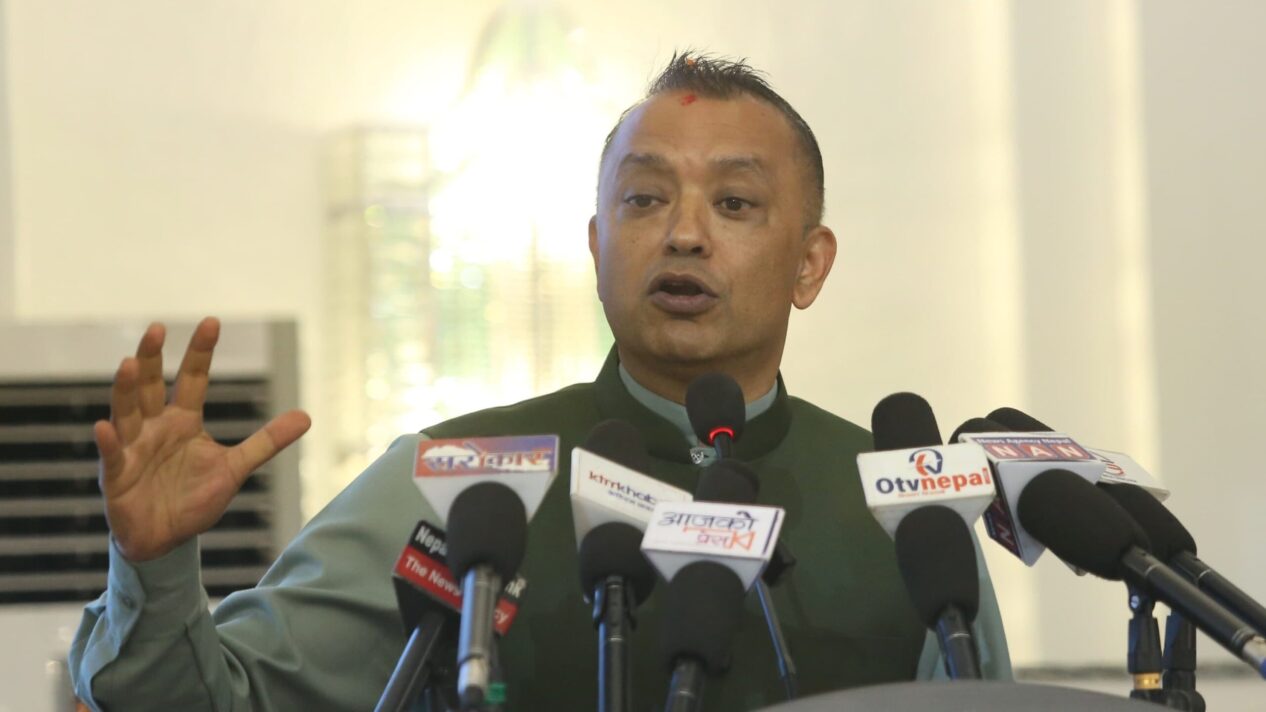
Rather than limiting himself to a factual defence, Dr. Wagle used the floor of Parliament to issue a political warning. If lawmakers continued attacking him, he suggested, he might reveal scandals involving them and previous finance ministers. The remark transformed what was initially a dispute over customs duties into something larger: a question about accountability itself.
That warning did not emerge in isolation. During a heated parliamentary session, Dr. Wagle dismissed news outlets that had been reporting critically on the controversy as “rags,” a term that struck many observers as unbecoming of a senior cabinet minister. He also told the House that if even two rupees of wrongdoing could be proven against him, he would resign not just from the cabinet but from Parliament and from public life altogether. The defiant framing was meant to project confidence. It came across instead as an attempt to silence critics through theatrical stakes rather than through evidence.
What followed deepened rather than resolved the controversy. At the Finance Committee of the House of Representatives, Dr. Wagle went further, alleging that a criminal syndicate connected to Nepal’s largest financial crime was orchestrating attacks against the Prime Minister and himself. He suggested that these forces, panicked by an impending court case, were deliberately manufacturing allegations to destabilize the government and derail the Rastriya Swatantra Party’s governance agenda. The framing was dramatic. It also raised immediate questions: if such a syndicate exists and is actively undermining public institutions, why would the government resist an independent parliamentary investigation that might expose it?
That is precisely the question the opposition has been pressing. Parties across the spectrum, including the Nepali Congress , Rastriya Prajatantra Party, CPN (UML), the Nepali Communist Party and others, have called for the formation of a parliamentary probe committee. Their argument is straightforward: a government investigation into government conduct is no investigation at all. The government has already formed its own committee, comprising officials from the Finance Ministry, the Department of Customs and the Armed Police Force. RPP parliamentary leader Gyanendra Shahi dismissed it with characteristic bluntness, noting that previous governments had followed the same pattern of forming their own inquiry panels, clearing themselves of all charges and then expecting Parliament to applaud. The opposition will not be repeating that applause, he said.
Dr. Wagle’s resistance to a parliamentary probe is itself politically revealing. Under Nepal’s constitution, Parliament has both the authority and the legitimacy to investigate executive conduct. A finance minister who claims he has done nothing wrong should in principle welcome an independent investigation as the fastest path to vindication. Instead, the government has deflected, counter-attacked and characterised every call for a probe as an act of political sabotage. That posture, critics argue, suggests something beyond confidence in one’s own innocence.
In mature democracies, ministers facing allegations of misconduct typically respond by producing documents, timelines and evidence. Threatening to expose opponents’ past misdeeds may be politically effective, but it rarely strengthens a defence. On the contrary, it risks creating the impression that accountability is negotiable and that wrongdoing is merely a matter of whose secrets emerge first.
One aspect of the controversy that drew particular attention was Dr. Wagle’s decision to invoke Prime Minister Balen Shah’s name during parliamentary proceedings in connection with the budget controversy. The peculiarity of this was not lost on observers: the attacks from the opposition, and the questions from the public, had been directed at the finance minister. The Prime Minister had not been accused of any wrongdoing in this specific matter. Why, then, did Dr. Wagle frame the controversy as an assault on both of them?
Part of the answer may lie in political positioning. The Rastriya Swatantra Party, which leads the government, has built its identity around the persona of Balen Shah as an agent of transformation. By linking the budget controversy to an assault on the Prime Minister, Dr. Wagle attempted to elevate a ministerial scandal into an attack on the larger project of governance reform. The move had a dual purpose: to generate solidarity within the party and to cast opposition lawmakers as enemies of change rather than defenders of parliamentary norms. Whether it succeeded is another question. Critics pointed out that dragging the Prime Minister into a row that had not involved him risked associating his administration more deeply with the controversy rather than distancing it.
That perception matters because Nepal’s budget-making process has long suffered from credibility problems. Successive governments have been accused of manipulating tax rates after budget speeches, leaking confidential information to business groups, and designing fiscal policies that favour politically connected interests. The names have changed; the allegations have not.
From former finance ministers accused of quietly revising tax schedules after parliamentary approval to controversies involving customs duties, land deals and business lobbying, Nepal’s fiscal politics has accumulated a reputation for opacity. Every administration has promised reform. Few have escaped similar accusations.
What makes the current controversy particularly sensitive is its connection to the electric-vehicle market, one of the fastest-growing sectors in Nepal’s economy.
Questions have centred on vehicles imported under the Chinese brand BYD. Critics allege that importers obtained advance knowledge of impending tax increases and accelerated customs clearance before the budget took effect, potentially avoiding hundreds of millions of rupees in additional taxes. The government denies wrongdoing.
During parliamentary committee hearings, however, Dr. Wagle surprised many observers by openly defending the reputation of BYD as a global brand. He argued that such a respected international company was unlikely to engage in misconduct and suggested that any irregularities, if they existed, would more likely involve local importers.
The intervention raised eyebrows. Finance ministers are expected to defend public institutions and government policy. They are rarely expected to act, or appear to act, as defenders of specific commercial brands under investigation.
What made the intervention stranger still was Dr. Wagle’s choice of framing. At a Finance Committee session, he described the allegations against BYD as a deliberate ploy to tarnish the image of a reputable Chinese company. The suggestion was that critics were not genuinely concerned about tax irregularities but were using the episode to damage an international brand and, by extension, to embarrass the government. This framing struck analysts as unusual on multiple levels. First, no serious observer had accused BYD the corporation of orchestrating the events in Nepal. The allegations concerned local importers and the domestic customs process. To reframe the controversy as an attack on a Chinese brand was to answer a question that nobody had quite asked.
Second, for a sitting finance minister to volunteer himself as a defender of a foreign commercial brand in the middle of a parliamentary hearing signalled a degree of identification with that company’s interests that fell outside any conventional understanding of ministerial duty.
The issue is not whether BYD itself is guilty of anything. No evidence has publicly established such a conclusion. The issue is whether it is appropriate for a sitting finance minister to appear to shield a particular company or brand while questions remain unresolved.
In most jurisdictions, governments avoid precisely such appearances. Even the perception of favouritism can damage confidence in regulatory neutrality. Markets function best when businesses believe that rules apply equally to everyone. When political leaders appear unusually invested in protecting one company, competitors inevitably begin asking whether the playing field remains level.
The deeper problem extends beyond one minister, one budget or one automaker.
Nepal’s political system has spent decades promising good governance while repeatedly producing controversies that suggest the opposite. Each new administration arrives pledging transparency, institutional reform and a break from old practices. Yet allegations of insider access, tax manipulation and politically connected business interests continue to surface with remarkable regularity.
This explains why the current dispute resonates so strongly. Many Nepalis are not merely evaluating Dr. Wagle’s conduct. They are judging whether a political movement elected on promises of integrity is beginning to resemble the system it once condemned.
The irony is striking. The politicians who built their popularity attacking old political habits now face accusations that sound remarkably familiar. Gyanendra Shahi of the RPP captured this pointedly when he recalled that RSP lawmakers, during their years in opposition, would wear blue ribbons to symbolise their commitment to good governance and demand parliamentary investigations whenever allegations arose against ministers. Those same lawmakers, now in government, appear to have forgotten that chapter of their own history.
Whether those accusations ultimately prove true is a matter for investigation. But the political damage arises long before legal conclusions are reached.
Trust, once lost, is difficult to regain.
That is why calls for an independent parliamentary investigation continue to grow. For critics, such an inquiry is necessary to establish the facts. For supporters of the government, it offers an opportunity to clear lingering doubts.
Either way, the controversy has already exposed a fundamental truth about governance in Nepal. The issue is no longer merely whether tax rates were changed or information leaked. It is whether citizens can trust that the rules of the economy are written for the public interest rather than for those with privileged access to power.
That question now hangs over Nepal’s budget process and over the political future of the minister responsible for it.