Kathmandu
Wednesday, June 17, 2026





Rainfall uncertain in Nepal as the arrival of monsoon is delayed due to the effects of El Niño and westerly winds
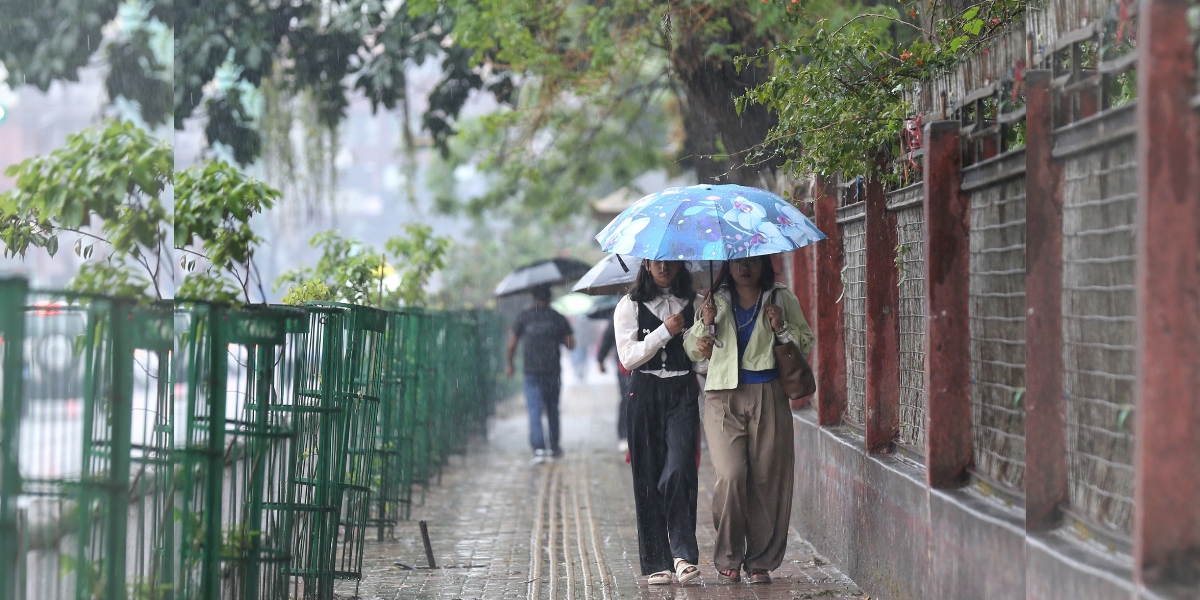
This year, it will take a few more days for the monsoon to enter Nepal. The Department of Hydrology and Meteorology has stated that because the influence of westerly winds persists in the upper atmosphere, the system that initiates the monsoon has not yet developed.
Issuing a statement on Monday, the department indicated that the active westerly winds and the El Niño developing in the Pacific Ocean could affect the arrival of the monsoon. According to the department, in previous years when the El Niño effect was observed—such as 2016, 2019, and 2023—the monsoon entered Nepal later than average.
The average date for the monsoon to enter Nepal is June 13. Last year, however, the monsoon arrived 15 days earlier than the average date and had already spread across the country by this time.
According to the department’s spokesperson, Bibhuti Pokharel, when sea surface temperatures are higher than average, it impacts the global atmospheric system, which can weaken the system that brings the monsoon to South Asia and Nepal.
Pokharel says, “When sea surface temperatures rise, it affects the overall atmospheric system. This can weaken the system that generates the monsoon in Nepal and South Asia.”
Based on the analysis of satellite data and mathematical weather forecasting, she mentioned there is a possibility that the impact of the El Niño developing in the Pacific Ocean could be seen right around the time the monsoon is supposed to start in Nepal. However, she states that El Niño is not the only reason for the delay in the monsoon’s arrival. “Westerly and local winds also have an impact in Nepal. It doesn’t mean the monsoon will be late in every El Niño year,” Pokharel says, “We are constantly monitoring it.”
According to her, a weather system for an immediate start to the monsoon has not yet developed. The activity to bring the monsoon into Nepal from the Bay of Bengal has not been clearly seen so far. She stated that although thunder-bearing moderate rainfall is occurring in the hilly and mountainous areas of Koshi, Bagmati, and Gandaki provinces due to the influence of westerly and local winds, it does not signal the arrival of the monsoon.
“When the monsoon enters through eastern Nepal, rainfall must be measured across a large geographical area of that region,” she says. “On Monday, some rainfall was measured in the Terai region of Koshi Province, but no rain occurred in Taplejung and Okhaldhunga. If the monsoon system were active, an immediate impact should have been visible in the eastern hills as well.”
According to Madan Sigdel, an associate professor at the Central Department of Hydrology and Meteorology at Tribhuvan University, for the monsoon to be considered to have arrived, there must be continuous rain for two to three days, and the influence of easterly winds must be clearly visible.
However, he argues that it is incorrect to say the arrival of the monsoon in Nepal has been blocked right now because of the recently developed El Niño. He explains that since it takes time for the impact of the El Niño developed in the Pacific Ocean to reach Nepal, its effects might mainly be seen in July and August.
“It takes time for the impact of El Niño to appear. There is also a process where the system spreads through the Bay of Bengal,” Sigdel says. “The impact of El Niño in Nepal is seen more in July and August, not right now.”
According to him, the main reason for the delay in the monsoon’s arrival right now is the activity of the westerly winds. Even though the monsoon entered the southern Indian state of Kerala as early as June 4, its arrival in Nepal is being delayed. He mentioned that although easterly winds seem to be starting to become active in the lower atmosphere, the monsoon system has not been able to develop because the influence of westerly winds remains strong in the upper atmosphere.
Sigdel states that the monsoon system will enter Nepal only after the easterly winds become stronger in the upper atmosphere. He assesses that the westerly winds might weaken by this coming Saturday, allowing the monsoon system to move toward Nepal.
Although the Department of Hydrology and Meteorology has stated that the arrival of the monsoon will be delayed, it has not made any official forecast regarding when it will enter.
According to meteorologist Binod Pokharel, when the arrival of the monsoon is delayed, it may also take time to spread across the country. According to him, although there is a possibility of the monsoon entering within the coming week, some weather forecast models have indicated that it could take until June 30–July 1 for the monsoon to reach Western Nepal.
According to Pokharel, there could be above-average rainfall from Koshi to Gandaki provinces until July 30. However, there is a possibility of below-average rainfall in Karnali and Sudurpashchim provinces throughout the entire monsoon period. In the period after July 31, below-average rainfall is estimated across the country.