Kathmandu
Thursday, June 18, 2026





India implements strict new regulations on tea imports from Nepal, major orthodox and CTC manufacturing plants in Ilam and Jhapa halt operations after regional warehouses become completely packed with unsellable stock
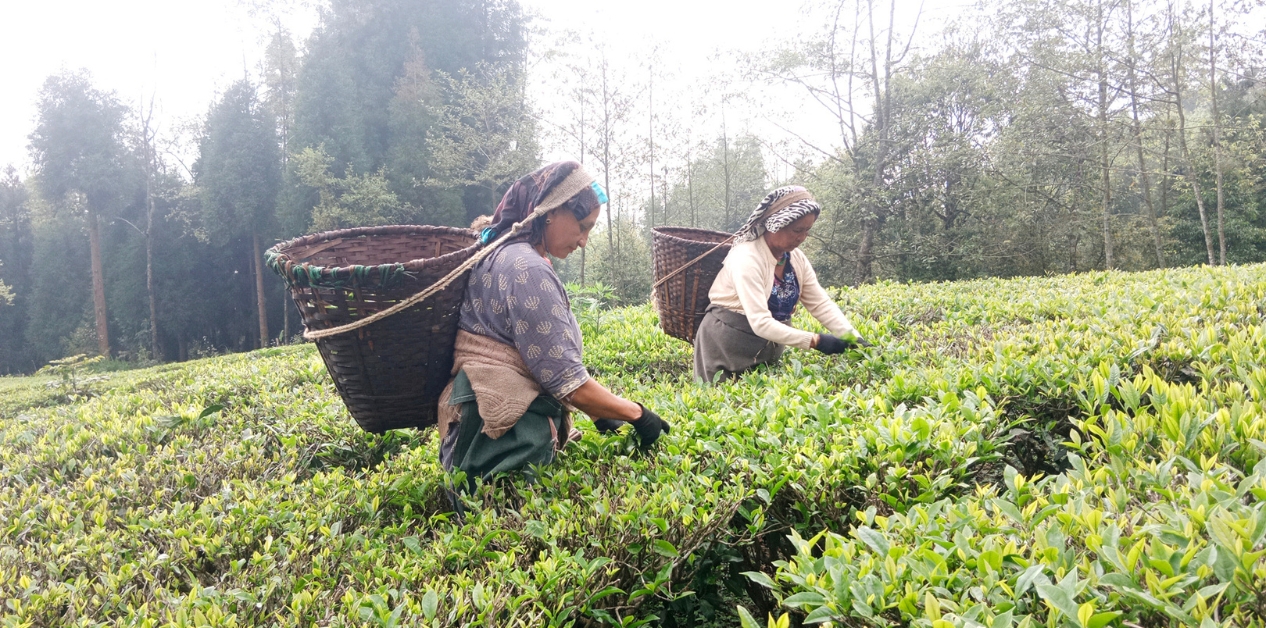
BIRATNAGAR: A devastating combination of factory shutdowns and trade halts has turned the peak harvest season into a crisis for local tea farmers, leaving even the most productive estates completely stranded. The 93,092 square feet (17 Ropani) tea garden of Shyam Krishna Katuwal in Bogane, Suryodaya Municipality-7, Ilam, is currently lush with monsoon growth, but the valuable yield is actively rotting in the fields.
Entering the garden in this season, he used to be overjoyed in previous years. Along with the pleasure of the greenery, there was also a certainty of earning Rs 400,000 to Rs 500,000 annually after deducting expenses. However, this year, even seeing the greenery of the tea garden makes his heart ache.
“It has been three days since I stopped plucking green leaves,” Katuwal says. “Since the factory itself is closed, where do I take the leaves after plucking? The tea of the main season is going to waste in the garden itself.” In his experience, the production of tea is high during this time, and the quality is also excellent. Accordingly, the price used to be good as well.
“The green leaves plucked in this season used to fetch a price of Rs 40 to Rs 60 per kilo,” he says. However, after India implemented the ‘Standard Operating Procedure’ (SOP) on tea exported from Nepal starting from May 1, 2026, he is in distress over the shoots maturing and aging in the garden. In the new SOP, a provision has been made where the tea of each vehicle must be tested separately, it takes more than 20 days for the report to arrive, and sales are not allowed until the results are out. If it fails the test, the tea must be destroyed or brought back.
Due to such a provision, not only Shyam Krishna but also Dambar Katuwal of Suryodaya Municipality-7 is also in similar distress. Standing on the edge of his tea garden, spread across 219,040 square feet (40 ropani), he says, “The investment itself is going to waste. This time, it seems a big hassle will have to be faced.” Another farmer, Chiranjivi Paudel, is also restless as the tea shoots are aging in his 109,520 square feet (20 ropani) garden.
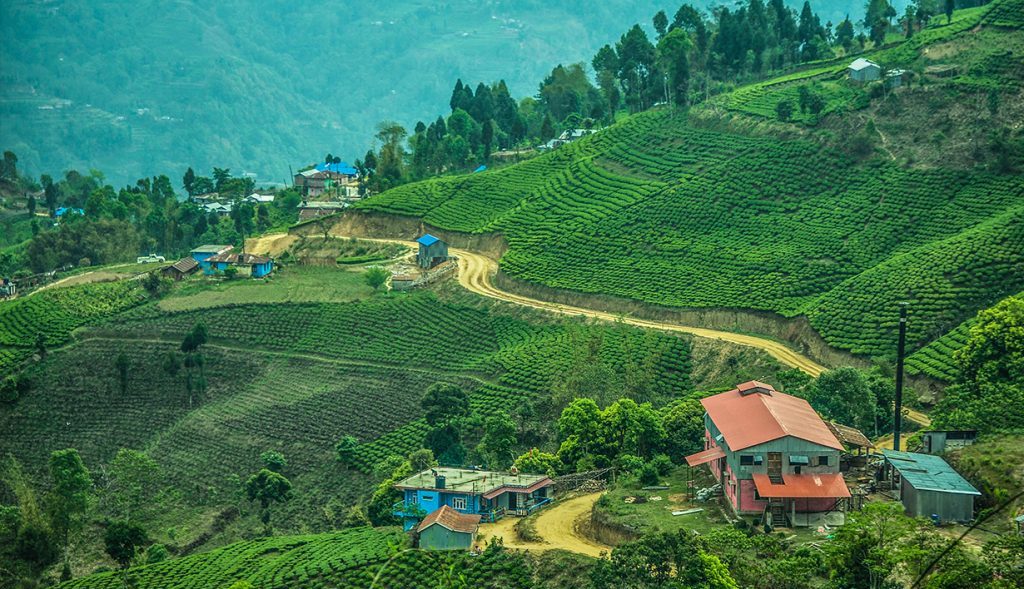
Green tea gardens spread across the hillsides of Ilam. Photo: Social Media
Around 4,800 farmers across the Ilam district are in similar anxiety at this time, among whom more than 2,200 farmers belong to Suryodaya Municipality.
Processing halted
Due to the policy changes made recently by India, the main export destination of Nepali tea, industrialists have completely halted tea processing. 73 orthodox tea industries of Ilam have already closed down since June 15.
According to the vice president of the Suryodaya Orthodox Tea Producers Association, Ilam, Gyani Limbu, the area where millions of kilograms of green leaves are produced daily is now mostly deserted. “The employment of around 65,000 people is linked to the tea sector,” he said, “After the industries closed down, a situation has arisen where the stoves of farmers, laborers, and industrialists are all going to be extinguished.”
The tea industrialists of Jhapa also held a press conference on June 17 and announced that 36 CTC tea industries and plantations of Jhapa will be closed indefinitely from today (June 18).
The general secretary of the Nepal Tea Planters’ Association, Jhapa, Shukra Dahal, states that Nepali tea could not be exported smoothly due to the new standards implemented by India. “We have drawn the government’s attention to solve the problem. Immediate diplomatic and policy initiatives are necessary to save the tea sector,” he says.
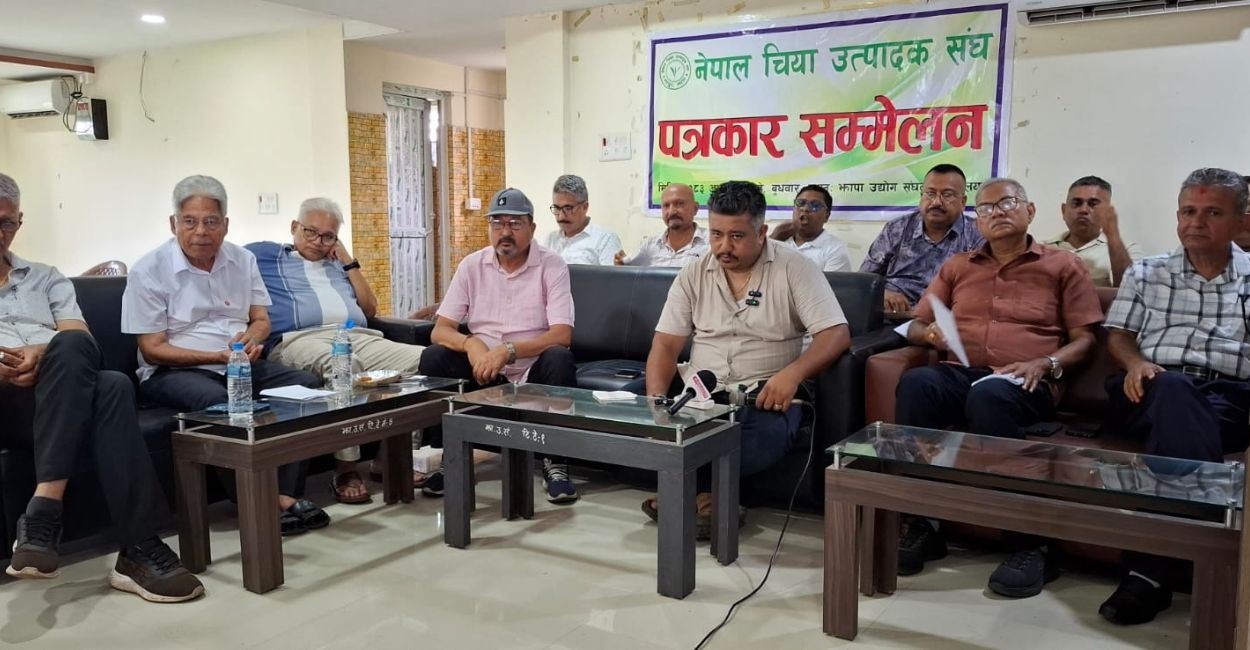
Industrialists hold a press conference regarding the closure of tea factories in Jhapa. Photo: Social Media
The industrialists gave up after the warehouses became full and there was no space to keep new production since the ready tea could not be sold due to the policy decision made by India. The direct impact of this has now fallen upon the farmers.
Intention or rule?
The Tea Board of India has strictly implemented a new rule where after Nepali tea enters India, it is kept in a warehouse, samples are collected, and sales are not permitted until the laboratory report arrives. “Previously, it used to be stopped at the border point; now, after reaching India, it is taken and locked in a warehouse,” tea industrialist Gyani Limbu says, “They take samples only 10 days after the tea reaches Kolkata from here. It takes an additional 20 days for its report to arrive. For some, the report has not arrived even for a month.”
Tea cannot be sold until the report arrives. He states that because of that, industrialists are not in a position to give payments to farmers and purchase new leaves.
The government is also not unaware of this problem, but industrialists complain that it appears indifferent to the solution. Industrialist Dinesh Agrawal says, “It could not be understood why the government has not kept the tea sector a priority or what it is.” Currently, in the warehouses of Ilam alone, around 250,000 kilograms of ready orthodox tea are stocked. When adding CTC as well, the quantity exceeds 300,000 kilograms. Industrialists estimate that around 1.5 million kilograms of tea are in an unsellable state across industries nationwide. Tea industrialist Aditya Parajuli says, “This is not just data; the sweat of farmers, wages of laborers, and millions of loans of industrialists are attached to this.”
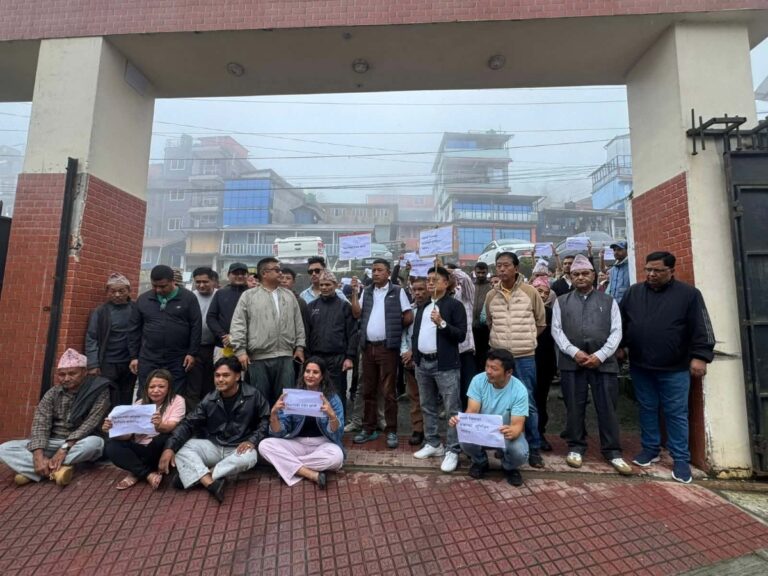
Industrialists from Suryodaya protest following the closure of regional tea factories. Photo: Social Media
Livelihood snatched away
The importance of time is immense in tea cultivation. To maintain the quality of ‘two leaves and a bud,’ it must be plucked at the right time. As soon as it is a few days late, the leaves grow old and the quality decreases. “The tea had become even better because it rained, but since it cannot be plucked, it will become equivalent to grass,” says Suryodaya farmer Shyam Krishna Katuwal.
Such a situation has given equal pain to the laborers as well. The lives of thousands of workers who pluck, carry, and process tea rely on daily wages. Along with the closure of industries, their meals have also fallen into crisis. According to labor leader Bharat Rai, 65,000 jobs directly and indirectly connected to the tea sector are currently in jeopardy. He says, “The evening stove in many laborers’ homes burns from the wage, which is now on the verge of being extinguished.”
Voice in parliament
The escalating tea industry crisis has triggered intense debate in the House of Representatives, with lawmakers demanding immediate state intervention. On June 17 Ilam lawmaker Nishkal Rai sharply criticized the state’s inaction, accusing India of deliberately attempting to dismantle the Nepali tea sector by introducing highly complex quality-testing barriers.

MP Nishkal Rai. Photo courtesy: Kiran Raj Bista/RSS
Rai condemned the government for remaining a passive spectator rather than launching decisive diplomatic counters while the nation’s primary agricultural export collapses. He urged the executive leadership to initiate immediate bilateral talks, warning that raw tea leaves are actively rotting in fields across the country while bankrupt industrialists are completely unable to service their rising bank interest.
Currently, tea cultivation is done on 20,602 hectares in Nepal. There are 120 small and large industries across the country. India itself is 90 percent of the market for Nepal’s orthodox tea and 50 percent for CTC. Only last year, Nepal earned Rs 4.75 million in foreign currency from tea exports. The state has been collecting Rs 1 billion in revenue from this sector, which has an annual turnover of around Rs 14 billion.
However, the recent situation has nudged stakeholders to think about alternatives to the Nepali tea export market. Shukra Dahal, general secretary of the Nepal Tea Planters’ Association, Jhapa, states that only depending on India has proven fatal in this. “Looking at it in the long term, we should not just look towards India. The government must take initiatives to expand the market in third countries like Bangladesh and Pakistan,” he says. “For the immediate term, however, it has become impossible to run the industries until the Indian obstruction is removed.”