Kathmandu
Friday, June 19, 2026





A series of tax and regulatory disputes has delayed payments claimed by government agencies and prolonged some of Nepal’s biggest corporate revenue cases.
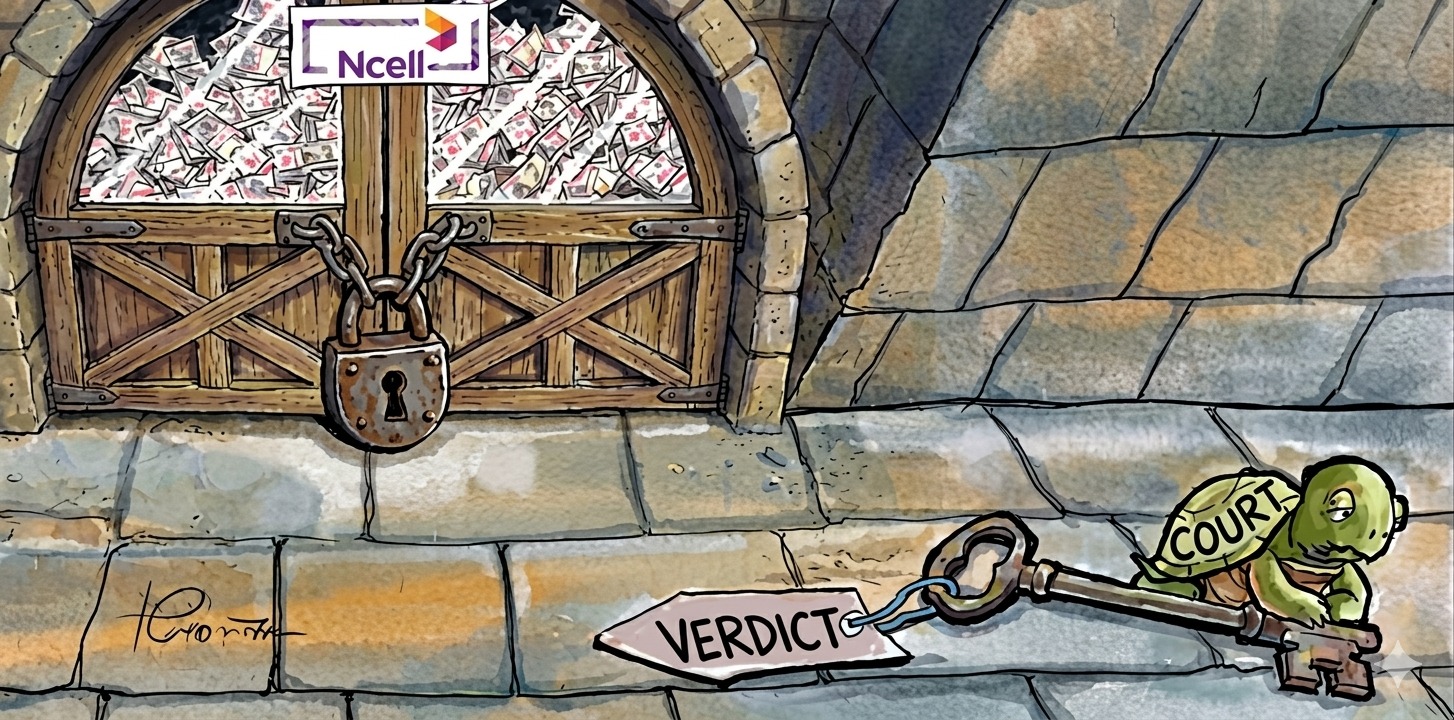
KATHMANDU: On October 19, 2021, the Nepal Telecommunications Authority (NTA) sent a letter to Ncell Axiata, a private-sector telecommunications service provider, directing it to deposit the remaining frequency fee of Rs 840 million into the government’s revenue account within a month. However, nearly five years have passed, and Ncell has not paid the amount. Moving against the Authority’s decision, Ncell approached the court and secured an interim order, which has provided it with an excuse to avoid paying the amount for all this time.
In its correspondence, the Authority had directed Ncell to clear the remaining frequency fees spanning from the fiscal year 2007/08 to 2020/21. Claiming that its fundamental rights were violated, Ncell filed a lawsuit in the Supreme Court on January 11, 2022. Two days later, on January 13, 2022, the Supreme Court issued a show-cause order in the name of the government. This case was recently scheduled for a hearing on June 11, 2026, but was listed under “unable to be heard” due to time constraints. As the case remains unresolved to this day, Ncell’s obligation to pay the fee to the government continues to be pushed back.
There is another illustration of how Ncell’s tax-related cases have been prolonged following Supreme Court orders. After Axiata sold its 80 percent stake in Ncell to Spectrlite UK, the Large Taxpayers Office (LTO) assessed a tax liability of Rs 57.90 billion on January 13, 2021. The office had determined this tax for Ncell under Section 57 of the Income Tax Act, 2002. Section 57 of the Act is attracted if 50 percent or more of a company’s share ownership changes hands.
Prior to that, on April 16, 2019, the LTO had determined that Ncell owed a total of Rs 62.63 billion in taxes, including capital gains tax, fines, and interest. When the office corresponded to collect the outstanding Rs 39.06 billion, the court issued a verdict stating that Ncell must pay Rs 21.10 billion as capital gains tax. Ncell cleared this amount after various complications and procedural delays.
Following the tax assessment by the office alongside the sale of the 80 percent stake, Ncell Axiata approached the court once again, claiming double taxation. The Supreme Court issued an interim order on the lawsuit registered on January 26, 2021. A single bench of Justice Prakash Kumar Dhungana issued an interim order on February 7, 2021, staying Ncell from paying that tax. A final verdict on this case has still not been reached. The interim order continues to remain in effect after the case was listed for a hearing on April 29, 2026, where an order was made to summon the case files. Consequently, Ncell has not had to pay the tax assessed by the LTO.
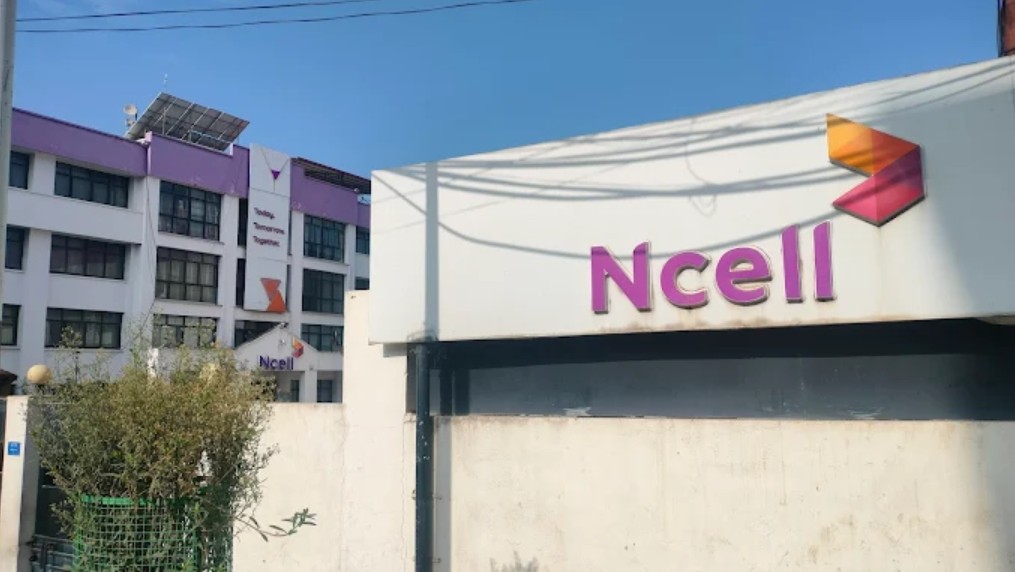
Ncell Corporate Office in Nakkhu.
This is not the only dispute involving Ncell Axiata; ever since it launched mobile phone services in Nepal, it appears to have engaged in maneuvers to avoid paying specified amounts. Ncell has repeatedly knocked on the doors of the Supreme Court with the apparent objective of evading various government fees for as long as possible. To date, the number of cases related to Ncell in the Supreme Court alone has reached 30. Lawsuits involving more than Rs 85 billion that Ncell owes to the Government of Nepal in tax and non-tax revenues remain pending across various levels of courts.
In 2024, a study and investigation committee formed by the government to look into the purchase and sale of Ncell’s shares pointed out that Ncell’s pending cases in court have prolonged its payment timelines. Following directives from a parliamentary committee in 2023 to investigate the suspicious buy-out of Ncell’s 80 percent shares, the government formed a five-member study and investigation committee on December 7, 2023, coordinated by former Auditor General Tankamani Sharma Dangal. The committee submitted its investigation report to the government on January 29, 2024.
The report notes that Ncell has repeatedly engaged in litigation across various judicial bodies and even at the international level regarding the taxes and other liabilities it owes to the government.
Ncell has historically manipulated the taxes it owes to the government. An example of this can be seen a decade ago when it hesitated to pay around Rs 40 billion in capital gains tax. When the Swedish company TeliaSonera sold its 80 percent stake in Ncell to the Malaysian company Axiata for Rs 144.78 billion on April 11, 2016, an attempt was made to evade capital gains tax. The shares held by TeliaSonera in the offshore company Reynolds Holdings were quietly bought and sold on foreign soil. The remaining 20 percent stake in Ncell is held under Bhavana Shrestha’s Sunivera Capital Ventures.
After the seller company TeliaSonera exited without paying the capital gains tax due to the Government of Nepal for that transaction, a civic group approached the Supreme Court. On January 28, 2018, former Government Secretary Dwarikanath Dhungel, former Acting Auditor General Sukadev Khatri Bhattarai, Jagadish Chandra Baral, Bidur Prasad Mainali, and Krishna Prasad Devkota filed a public interest litigation (PIL) naming the tax office, Ncell, and Axiata as defendants, claiming that the tax must be paid. The writ petitioners claimed that national interests were harmed when individuals and companies unrecognized by Nepali law gained control of Ncell and drew profits.
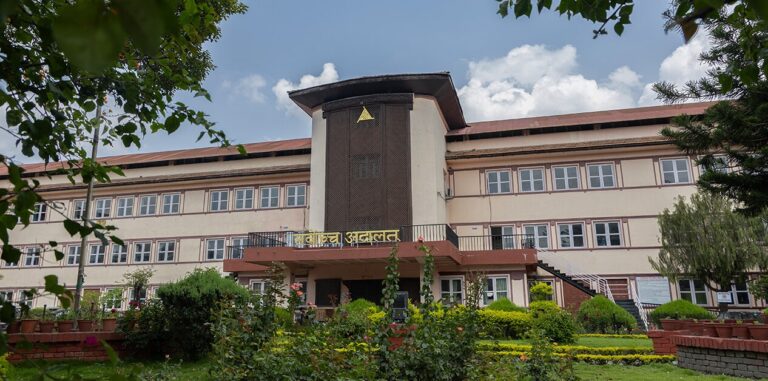
The Supreme Court. Photo: Bikram Rai
Since the buyer Axiata and the seller TeliaSonera were registered abroad, a dispute arose over which of the two companies should pay the tax. In the midst of this, on December 27, 2018, Reynolds Holdings Limited filed a writ in the Supreme Court against the LTO, claiming it was exempt from dividend tax. On February 6, 2019, a Grand Full Bench of the Supreme Court ruled to halt dividend distribution and share sales until the capital gains tax from the Ncell sale was cleared. The Grand Full Bench, comprising the then Chief Justice Cholendra Shumsher Rana and Justices Meera Khadka, Bishwambhar Shrestha, Ananda Mohan Bhattarai, and Tanka Bahadur Moktan, questioned Ncell for failing to implement the state’s revenue collection decision for over a year. It held that the overall tax administration, including the LTO, had failed to fulfill its legal obligation to collect tax and deposit it into the state treasury.
Bhattarai, the former Acting Auditor General and one of the individuals who filed the writ petition for the state’s benefit at the time, states that large taxpayers constantly try to avoid or reduce taxes, and they head to court specifically to push back their payment deadlines. He notes that a nexus exists among those who take cases to court to evade taxes in Nepal. “When taxpayers approach the court to evade or reduce taxes, the court has indeed lowered tax liabilities for some,” he says. “In many such cases, when the court delays its verdict, it benefits the taxpayers.” He adds that while some pay the designated tax, others lean on the court to seek excuses for non-payment.
Senior Advocate Komal Prasad Ghimire, who has argued various cases on behalf of Ncell, contends that no taxes remain outstanding. He states that regarding the initial capital gains tax issue, two cases were registered in the Supreme Court, one of which remains sub-judice. “Ncell is paying all types of taxes in accordance with court verdicts and secures tax clearance every year,” he says. “If it doesn’t pay taxes, it cannot conduct business at all; it must pay what the state prescribes.”
Ghimire claims that rumors are merely spread outside alleging that Ncell does not pay its taxes.
Many Ncell-related cases that have reached the court appear to be linked to taxation. Among them is a pending case concerning additional frequency fees. As determined by the Radio Frequency Policy Determination Committee formed by the government, the NTA sent a letter to Ncell on October 19, 2021, demanding fees for 18 years. The NTA demanded the amount from Ncell in accordance with the provision requiring annual payments equivalent to the minimum fee set through bidding as per the law. Ncell had acquired the frequency after committing to pay according to the rates determined later.
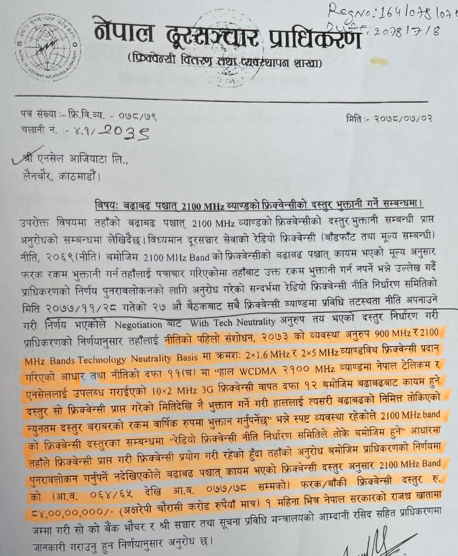
Instead of paying the frequency fee requested by the Authority, Ncell registered a writ petition in the Supreme Court claiming its fundamental rights were violated. Ncell also requested the court to summon and quash the decision assessing the fees. Having historically paid an annual frequency fee of Rs 12 million per MHz, Ncell approached the court claiming it would not pay an additional Rs 3 million, after it was billed at a rate of Rs 15 million per MHz from the fiscal year 2007/08 onward. As this case remains unresolved, the revenue due to the state remains uncertain.
Appealing to the court against the Auditor General’s arrears
The Auditor General’s reports for the fiscal years 2014/15 and 2015/16 had flagged Ncell’s royalty amounts and frequency fees as outstanding arrears. Ncell approached the Supreme Court regarding this matter. The company filed a writ petition claiming that the royalty arrears determined by the Auditor General were unlawful. The report showed annual arrears of Rs 561,194 under the royalty heading.
In the writ, Ncell sought a mandamus order to refund Rs 15.87 million that it had paid to the then Ministry of Communication and Information Technology.
On November 21, 2024, a joint bench of Justices Kumar Regmi and Balkrishna Dhakal ordered the dismissal of the writ petition. The writ was dismissed on the grounds that Ncell’s claim for a refund did not appear reasonable and that no legal or constitutional rights had been infringed.
Rs 17 billion liability reduced by the court
On April 16, 2019, the LTO determined Ncell’s total tax liability—including capital gains tax, fines, and interest—at Rs 62.63 billion. Of this, the company had already paid more than Rs 23.57 billion under various tax headings. The office then corresponded with Ncell to clear the remaining Rs 39.06 billion. Against this, Ncell moved the Supreme Court on April 28, 2019.
The Supreme Court ruled that Ncell owed the government Rs 21.10 billion as capital gains tax. This amount was Rs 17.95 billion less than what the LTO had assessed. A Grand Full Bench comprising Justices Tej Bahadur KC, Purushottam Bhandari, Dambar Bahadur Shahi, Sushmalata Mathema, and Manoj Kumar Sharma delivered this verdict on August 26, 2019. In that verdict, Justice Sushmalata presented a dissenting opinion. She held the view that the demand to exempt fees and interest was against the law. Her stance was that Ncell’s writ should be quashed, as the LTO could legally determine and recover fees and interest according to the law. However, the majority of the bench quashed the office’s tax assessment decision.
Former Acting Auditor General Bhattarai states that large taxpayers treat approaching the court as an opportunity. “Businessmen constantly strive to avoid or reduce taxes. In fact, rogue employees within government agencies are the ones who coach them on how to secure exemptions on major tax liabilities,” he says. “Once they go to court, they do not have to pay the tax until a final verdict is reached, leaving the matter completely on hold in the meantime.”
Bhattarai mentions that although they filed a lawsuit in 2017 claiming Ncell owed Rs 70 billion, the company has paid only Rs 47 billion so far. “The judges reduced the liability by more than Rs 17 billion. An old lawsuit concerning Rs 11.57 billion related to Ncell remains pending,” he explains.
“While the tax regarding Ncell’s 80 percent shares was settled, the Supreme Court failed to deliver a verdict for seven years regarding the 20 percent shares held by Bhavana Shrestha’s Sunivera Capital Ventures.”
Ncell’s tax evasion issues have even reached an international arbitration committee. After the Large Taxpayers Office assessed taxes on Ncell in 2019, Axiata took this case to the arbitration committee of the International Centre for Settlement of Investment Disputes (ICSID), claiming that the taxation violated the bilateral investment treaty between Nepal and the United Kingdom. However, contrary to Axiata’s expectations, ICSID ruled in favor of the Government of Nepal, affirming the state’s right to levy the tax. Following this, Ncell was compelled to pay the tax amount.
Ncell frequently approaches the court against the Large Taxpayers Office, the Ministry of Information and Communications, and the Inland Revenue Department. According to Kedarnath Sharma, Chief Tax Administrator at the LTO in Pulchowk, decisions made regarding any taxpayer are procedurally forwarded to the Inland Revenue Department. Taxpayers are given a 15-day timeline requesting them to clear the amount. If the taxpayer is dissatisfied, they take the case to the Revenue Tribunal. “Taxpayers who disagree with the Tribunal’s decision approach the Supreme Court only after receiving permission to appeal,” Sharma says.
He mentions that exact data regarding cases related to Ncell is unavailable. He states that Ncell clears all outstanding amounts as soon as a court verdict is delivered.
A revenue evasion case stuck for 20 years
There are instances where Ncell approached the court even when required to pay small amounts. On March 23, 2010, the Revenue Investigation Department demanded a fine equivalent to an offense value of Rs 4 million, ruling that the then Spice Nepal (now Ncell) had smuggled equipment through customs. The goods, transported in a truck, were seized at the Thankot checkpoint.
Against this, Spice Nepal filed an appeal with the Revenue Tribunal. The Tribunal upheld the Department’s decision on March 1, 2012.
Ncell moved to the Supreme Court against that decision as well, and after 20 years, a verdict was delivered affirming that the Department’s decision was correct. On July 15, 2019, a joint bench of Justices Ananda Mohan Bhattarai and Kumar Regmi upheld the decisions of both the Department and the Tribunal. However, because the case took 20 years to conclude, Ncell succeeded in delaying its revenue payment.
Currently, seven lawsuits registered by Ncell remain pending in the Supreme Court. The full texts of some decided cases have not yet been released. A verdict is still pending for a case registered by Ncell against the Inland Revenue Department, Lazimpat, on May 25, 2025.