Kathmandu
Thursday, June 18, 2026





A resilient Japan and rising Asian sides signal a changing balance of power after impressive opening-week performances against global heavyweights.

KATHMANDU: In the match held on June 14 at the Dallas Stadium in the United States under the FIFA World Cup 2026, Japan made a splendid comeback after falling behind twice to play a 2-2 draw against the Netherlands. For Japan, which has never progressed beyond the Round of 16 in the World Cup so far, securing such a result against a European powerhouse that has played in the finals three times was meaningful in itself.
The significance of this result becomes even clearer when compared to the past. In the 2010 South Africa World Cup, the Netherlands defeated Japan 1-0 in the group stage. Prior to that, in a friendly match played on September 5, 2009, the Netherlands had registered an easy 3-0 victory. However, in this encounter, Japan did not just appear competitive; they also kept the Netherlands under pressure.
Following the draw, Netherlands coach Ronald Koeman openly praised Japan’s organized gameplay, technical prowess, and winning mentality. “We could have scored a third goal, but Japan turned defensive after scoring their second goal. Therefore, I have no regrets regarding my decision,” he said.

Czech Republic player heading the ball against Japan. Photo: FIFA
In the past, European coaches used to label dropping points against Asian teams as a “disappointing result.” However, nowadays, drawing against teams like Japan is not considered an unusual outcome.
Unbeaten 6 teams
To date, 13 Asian nations have played in the World Cup. Apart from the nine nations participating in this World Cup, Kuwait, UAE, China, and Indonesia (as the Dutch East Indies in 1938) have also played previously. Among them, the nation with the most World Cup appearances is South Korea.
During the World Cup co-hosted with Japan in 2002, South Korea reached the semifinals. Since then, Asian teams have not been able to achieve such an enviable result. In that same tournament, Japan was eliminated from the Round of 16.
In this edition of FIFA World Cup 2026, the biggest stage in world football, the number of teams has been increased from 32 to 48. This provided an unprecedented opportunity for Asia. In the 2022 World Cup, six Asian teams participated, including the host Qatar. However, this time, that number increased to nine.
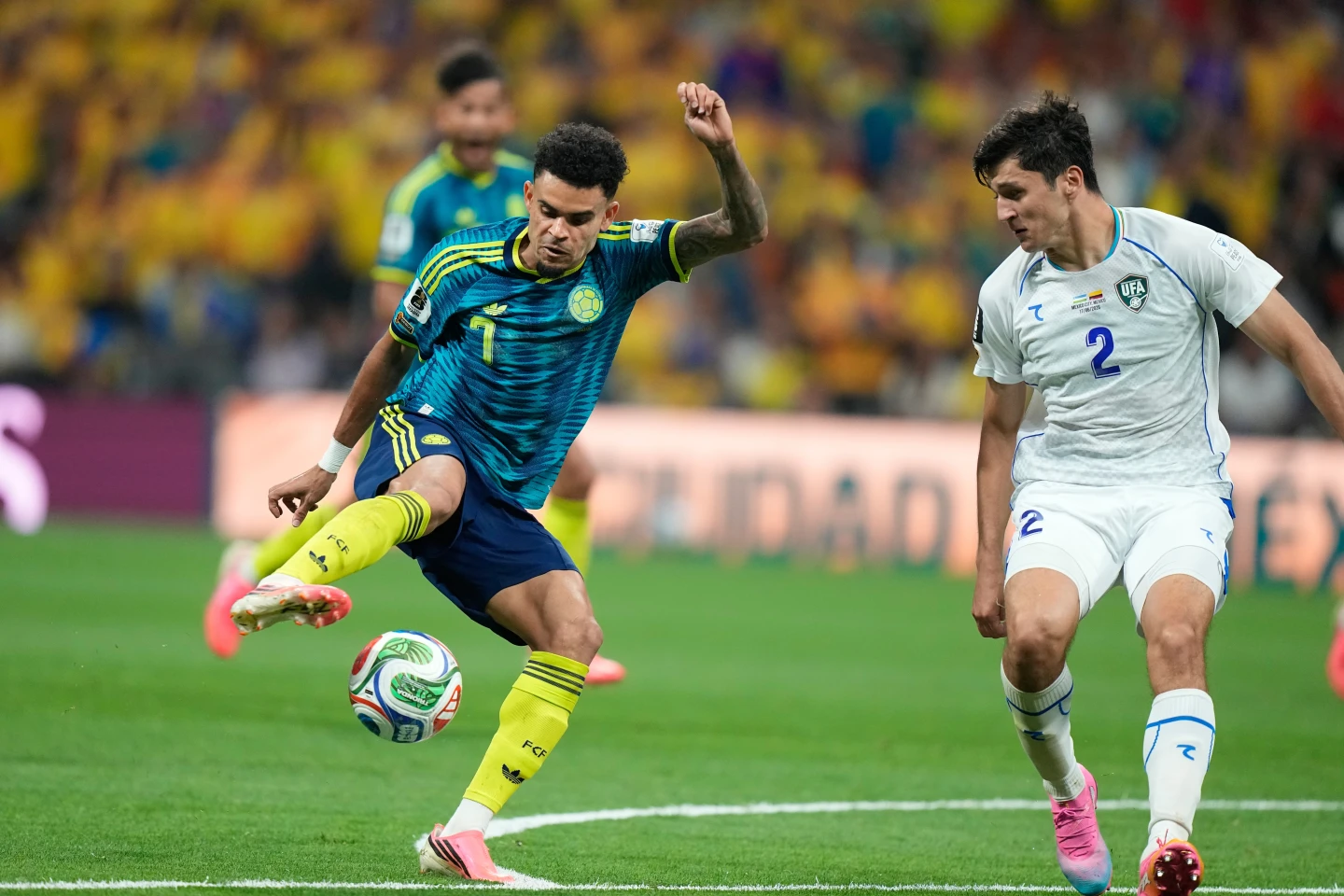
In the World Cup Group K match held in Mexico City, Colombia’s Luis Díaz (left) controls the ball against Uzbekistan’s Abdukodir Khusanov. Photo: Associated Press
In the World Cup Group K match held in Mexico City, Colombia’s Luis Díaz (left) controls the ball against Uzbekistan’s Abdukodir Khusanov. Photo: Associated Pres
Eight nations, including Japan, South Korea, Australia, Iran, Saudi Arabia, Qatar, Jordan, and Uzbekistan, reached the World Cup directly through the qualifiers. Iraq, on the other hand, successfully secured its spot by playing the intercontinental playoff.
The most inspiring stories of this edition were written by Uzbekistan and Jordan. Both nations qualified for the World Cup for the first time in their history. Uzbekistan, in particular, proved the success of its domestic football structure by reaching the World Cup after a long wait. Jordan also reaped the rewards of its investments and structural reforms made in recent years.
Iraq’s comeback was no less significant. They returned to the World Cup after 40 years by defeating the South American team Bolivia in the playoff. For a football system heavily impacted by political and social instability for a long time, this achievement was remarkable. However, everyone harbored doubts about whether these teams could compete against strong European nations. The Asian nations have provided the answer as the first round comes to a close.
Concluding based entirely on the results of the first week of the World Cup might be premature right now. However, initial signs of a shifting balance of power in world football have started to appear.
So far in the tournament, South Korea has defeated the Czech Republic 2-1 and Australia has beaten Türkiye 2-0. Qatar shared points with Switzerland, Iran with New Zealand, Saudi Arabia with Uruguay, while Japan successfully held off the Netherlands. While these five teams secured positive results, Iraq suffered a defeat against Norway, Jordan against Austria, and Uzbekistan against Colombia. Nevertheless, with five teams consistently securing points, a new discussion regarding the standard of Asian football has commenced.
The two biggest matches of this World Cup so far have been Brazil-Morocco and Netherlands-Japan. Both ended in draws. Interestingly, in both matches, the rising teams, Morocco and Japan, dominated the game. Morocco presented confident passing and an attractive game, while Japan continuously pressured the Netherlands through swift attacks, field rotation, and precise combinations. Nonetheless, Japan had only 40 percent ball possession.
Most importantly, the Japanese players did not look panicked at any point. Coach Hajime Moriyasu had been working over recent months to develop this exact mentality in the players. To break through the mindset of his players who have been unable to cross the Round of 16 stage, he maintains that the team must view itself as a World Cup contender.

Netherlands’ Virgil van Dijk celebrating the first goal against Japan. Photo: Associated Press
Concluding based entirely on the results of the first week of the World Cup might be premature right now. However, initial signs of a shifting balance of power in world football have started to appear.
This began with South Korea defeating the Czech Republic. The Czech team appeared slow and confined to an old style, whereas South Korea placed the opponent under pressure through excellent passing and dynamic play. If captain Son Heung-min had been in his peak vintage form, Korea’s victory could have been even wider.
In another match, Australia continued the success of Asian teams by defeating Türkiye. Even so, Türkiye made 30 attempts throughout the match. Before the World Cup, former US player Alexi Lalas had called Australia an average team in a podcast.
However, the goalkeeper of that same team, Patrick Beach, delivered an extraordinary performance to prove his team was above that mark. He made eight crucial saves to secure the win for his team. Australia’s young player, Nestory Irankunda, states that their team was underestimated before the match against Türkiye. “Many considered us weak. But we showed that we can play football,” he said after the first victory. “Türkiye kept the ball a lot. But who scored the goals? We did.”
The draw that Qatar secured against Switzerland, however, was of a different nature. Qatar remained confined to a defensive style for most of the time. Meanwhile, Switzerland failed to capitalize on many opportunities they created. While Switzerland made 26 shots at the post, Qatar made 6 shots. Although an own goal in the final moments earned Qatar a point, looking at the flow of the game, that result was quite unexpected.
Pride in defeat
In the last three matches, Asian nations have not been able to yield good results. Two of these were from the debutants themselves, Jordan and Uzbekistan. In the first match of Group ‘K’ held at Mexico’s historic Azteca Stadium on Thursday, Uzbekistan was defeated 3-1 by Colombia. With this, Uzbekistan became the third Asian nation to suffer consecutive defeats.
Colombia, making its comeback to the World Cup, secured the victory with the help of a stellar performance from Luis Díaz. Colombia, which missed out on the 2022 World Cup, took an early lead towards the end of the first half through Daniel Muñoz’s goal. However, Uzbekistan did not give up, and in the 60th minute of the second half, Abbosbek Fayzullaev scored to bring the game to a tie.
But after that, Colombia regained control. Díaz scored another goal to put his team ahead, while substitute player Jaminton Campaz scored during injury time to seal a 3-1 victory.
Uzbekistan’s head coach, Fabio Cannavaro, expressed pride in his team’s performance. “We are a small team. A 3-1 defeat looks like a big margin. But I liked what I saw on the pitch,” he said.
Uzbekistan, under the tutelage of the Italian coach, will now play against Portugal in Houston. Meanwhile, Group ‘K’ leaders Colombia will face DR Congo in Guadalajara. The match between Portugal and DR Congo ended in a 1-1 draw.
Just like him, Jordan’s Crown Prince Hussein bin Abdullah II is also pleased. He praised the performance displayed by his national team in their first World Cup match. He wrote on Instagram: ‘For a moment, it did not feel like this was Jordan’s first-ever FIFA World Cup match. You gave us a heroic performance to be proud of. This is just the beginning. Greater opportunities lie ahead.’