Kathmandu
Monday, June 22, 2026





Words from the Rana era like Dhoke (gatekeeper), Kothe (room-attendant), Baithake (sitting-room attendant), Bagainche (gardener), Susare (maidservant), and Hukke (hookah-bearer) are either no longer in common use today or are used in a entirely different sense.
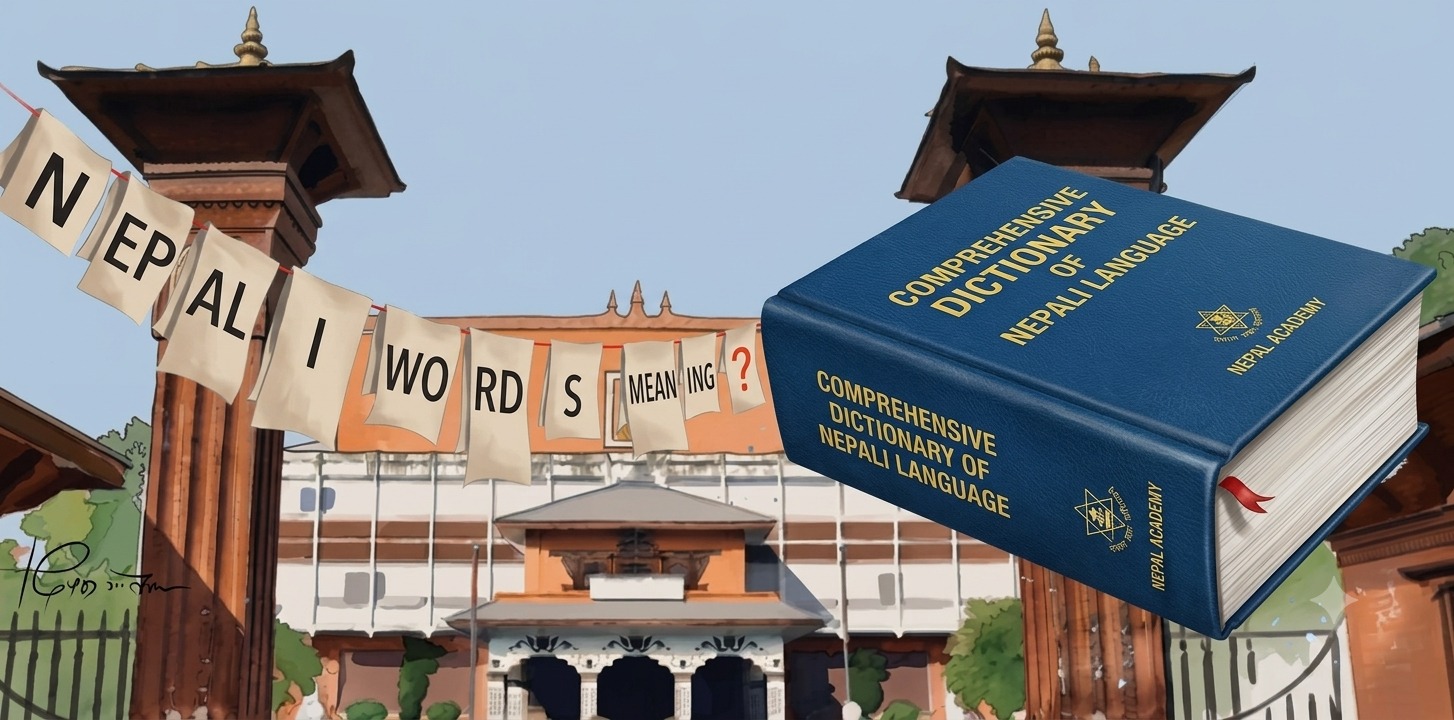
The title might have annoyed you, but please wait a moment.
The Himal Association recently organized a discussion program on why a standardized Nepali dictionary is needed and what it should be like. Participants included journalists active in media editing, editors from publishing houses, and writers. To keep the discussion structured, I was assigned the responsibility of taking a few examples from the Pragya Nepali Brihat Shabdakosh (the comprehensive dictionary by Nepal Academy) to demonstrate why certain entries are unsuitable for a standardized dictionary.
The other presenter was Victor Pradhan. His responsibility was to prepare the background and provide information regarding the previous dictionaries published by the Nepal Academy to justify why a standardized dictionary is necessary. The good elements already present in that dictionary are things that absolutely must be in a standardized dictionary; they are not extraordinary achievements. On the other hand, the organizer’s viewpoint was that the weaknesses found in it are things that should absolutely not exist in a standardized dictionary, and thus, such flaws must be corrected. Consequently, the discussion focused heavily on the shortcomings of that dictionary.
Once I started presenting my views, Basanta Thapa, who was moderating the program, read out the names listed in the dictionary’s editorial board along with their academic titles and questioned, “How can a dictionary edited by such eminent scholars and academics have such flaws?” In that context, I remarked that the scholars whose names are listed at the very top are merely Bhatte Pragya (allowance-collecting academics). The actual editor is the scholar whose name is listed at the very bottom, and that actual editor did not get enough time to edit this dictionary; perhaps he didn’t even get to read through all the entries within the time allocated to him.
The matter did not end there. Later, a participant raised a question: “Isn’t calling an academic Bhatte insulting?” To answer that, I recalled an incident from a while ago, probably sometime before 2013. Tribhuvan University adopted a policy that it would no longer pay the salaries of teachers and staff in cash, but would instead deposit them directly into their respective bank accounts. Until then, I did not have a bank account; I used to receive my salary in cash, put it in my pocket, and run my monthly expenses from it. The appropriate word to describe my situation back then would be Goje (pocket-user), in the sense of ‘keeping money in a pocket (goji/khalto) and managing from it’—though not to be confused with the word Gōnjee prevalent around Arghakhanchi.
After bank accounts became mandatory, I also opened an account. Then I went to the accounting section and told the staff there, “Now I am a Khate (account-holder), please deposit my salary into my account.” Sharing this story at the program, I explained that in Nepali, the -e suffix can be attached to a noun to form an adjective; therefore, calling someone who has an account (khata) a Khate, and someone who receives an allowance (bhatta) a Bhatte, is not an insulting usage. This forms the background of this article’s title.
There are two distinct matters to discuss here: (1) What is the actual role of the scholars whose names are listed on the editorial board of the Nepal Academy’s Nepali dictionaries? and (2) In the context of the constant grumbling by ‘language lovers’ claiming that Nepali has become too Sanskritized, too Hindi-like, or that English is going to finish off Nepali—why shouldn’t we start using simple adjective words formed through organic Nepali word-building processes like Khate, Bhatte, Jhole, Darte (registered), Chulthe (long-haired), Thute (stubby/broken), Banduke, and Dhule (dusty) in a regular, neutral sense instead of a derogatory one, to make the language simpler and inherently Nepali?
Allowance-collecting academics (Bhatte Pragya)
I have occasionally had the opportunity to be involved from the outside in some academic endeavors of the Nepal Academy. During this, a process I observed inside is that a committee is formed to execute a task, and its members are paid remuneration in the form of meeting allowances. However, members of the Academic Council do not take this meeting allowance. This remuneration allowance is given to members of the Academic Assembly, former members of the Academic Council, and outside invitees. In my opinion, this method of paying remuneration after deducting 15% tax at source is probably the best method.
While a meeting-based committee approach is appropriate for policy-making levels of a dictionary, evaluating progress, or providing feedback by reviewing a few entries occasionally, it is highly impractical for the actual editing of a dictionary. Editing is a task that requires a thorough, cover-to-cover review and demands that a group works together continuously over a long period. It seems more fitting for individuals working on a meeting-by-meeting basis to serve as advisors. In doing so, their role remains relevant at the policy, evaluation, and feedback levels, and it is entirely appropriate to pay for their time in the form of an allowance. In such a role, they do not have to be entirely held liable for errors, yet the knowledge and experience of these scholars can be fully utilized and honored.
To put it simply, this approach honors the knowledge and experience of senior scholars while creating a situation where they are not held responsible for the dictionary’s flaws. If the person who actually performs the work takes responsibility for both the merits and demerits of the dictionary, their work becomes far more responsible (how those who actually work this way are remunerated is something I am unaware of).
Looking at the names listed with high titles that Basanta Thapa read out in relation to the aforementioned dictionary, I still believe that if they had genuinely reviewed it line by line, such weaknesses would not have existed in this dictionary. My basis for saying this comes from closely observing their work in the fields of Nepali language, grammar, lexicography, and other areas, and having had the opportunity to work alongside them on several occasions. However, for those who are unaware of this institutional process and only see the titles preceding their names, it is natural to hold them entirely responsible for those blunders.
Therefore, my proposal is that from now on, a tradition should be established where individuals qualified to be editors are given proper remuneration and complete editorial authority and responsibility, while the scholars who provide advice and suggestions during the compilation process on a meeting-allowance basis are respectfully designated as advisors.
Let me reiterate—the word Bhatte used by me simply means ‘one who receives an allowance’. This meaning is by no means insulting from any perspective.
Easy, concise, and enriched Nepali
In Nepali, an adjective used to identify a person or object is formed by adding the -e suffix to nouns or adjectives that signify place, time, work, color, shape, tendency, etc. In Nepali, we have words like Pahade (hill-dweller), Chhattis Sale (born in the year 2036 BS), Dhoke (gatekeeper), Sete (fair-skinned), Chhote (short-statured), and Alchhe (lazy person). Their meanings are respectively ‘one who lives in the hills’, ‘one born in the year 2036’, ‘one who stations at the gate’, ‘one of white/fair complexion’, ‘one of short height’, and ‘one who acts lazy’. There are countless such Nepali words.
Words from the Rana era like Dhoke (gatekeeper), Kothe (room-attendant), Baithake (sitting-room attendant), Bagainche (gardener), Susare (maidservant), and Hukke (hookah-bearer) are either no longer in common use today or are used in a entirely different sense. For example, the word Kothe (room-bound/chamber) is currently used to describe ‘actions or decisions made by a limited number of people sitting in a closed room without understanding the real ground situation’; it is no longer used to mean a room-caretaker or checked (fabric). Nowadays, the English word check is more widely used for checked clothing.
The -e suffix, which is highly fertile in Nepali word formation, has been abandoned simply because it is perceived as inherently derogatory. There is only one specific instance where this suffix is genuinely pejorative: when added to a proper noun (personal name) that does not naturally end in ‘e’—for example, turning Ram into Rame, Hari into Hare, or Krishna into Krishne (Kisne). Based on this isolated rule, assuming that all words ending in the ‘e’ sound (ekarant) are derogatory is completely incorrect.
Among the two words used in the title, Bhatte is not a word commonly seen in circulation, but terms and phrases like Bhatta (allowance), Bhatta dinu (to grant an allowance), Bhatta linu (to take an allowance), Dainik Bhatta (daily allowance), Baithak Bhatta (meeting allowance), Briddha Bhatta (old-age allowance), Khaja Bhatta (tiffin allowance), and Mahangi Bhatta (dearness/inflation allowance) are widely used. If one needs to form an adjective from these terms, words like Bhatta line (allowance-taker), Bhatta paune (allowance-receiver), or Bhattagrahi (allowance-beneficiary) are created. If we use the standard Nepali -e suffix to create an adjective, Bhatta easily becomes Bhatte, and the word does not sound un-Nepali by any standard. Is there any problem with bringing this word into circulation?
The word Khate is indeed in circulation in Nepali, but strictly in a derogatory sense. Its root is Khat. Khat means a pile or heap of anything. Therefore, anything or anyone associated with a pile can be called Khate. However, its popular slang usage denotes ‘someone living on the streets’ or carries a meaning similar to ‘homeless’ in American society. In Nepali, there is a compound word Malkhato used in the Gandaki region, which means a manure pile. The Nepali Brihat Shabdakosh defines it as Malkhaldo (manure pit). Perhaps they altered it to make it sound polite, or perhaps the editors lacked the practical knowledge that a pit isn’t strictly necessary to rot manure. Then again, some are even seen using Malkhad, a compound formed from the synonymous words Mal (manure) and Khad (fertilizer), in this exact sense.
The word Khate used in the title above is not this derogatory street term; it is a word formed by adding the -e suffix to Khata (bank/ledger account). It signifies ‘one who has an account’ or ‘one registered in a ledger’. It can be said that these two Khate words are homophones with entirely different meanings (heterographs/homonyms). Currently, words or phrases like Khatawala, Khatadhari, Khatadharak, Khata hune, or Khata bhaeko are in use to convey this meaning. Among these, the single-word terms are formed either by adding the Urdu-Hindi suffix -wala or the Sanskrit suffixes -dhari or -dharak (which are independent words in Sanskrit), whereas the multi-word phrases belong natively to Nepali. The word Khate associated with an account (khata) is not derogatory from any angle.
A dictionary can only have entries for individual words, not for multi-word phrases—unless the phrase carries a meaning completely distinct from the combined definitions of its individual components. For this reason, Khatawala, Khatadhari, and Khatadharak can make it into a dictionary, but Khata hune and Khata bhaeko cannot be entries. This implies that an adjective formed by applying a native Nepali suffix to Khata will not find a place in a Nepali dictionary; only words utilizing Urdu-Hindi and Sanskrit suffixes become dictionary entries. Right here, my question is: is it appropriate to exhibit this double standard where we refuse to build words using native suffixes, yet continuously complain that ‘the Nepali language has become over-Sanskritized’ or that ‘the influence of Hindi is rising in Nepali’?
To avoid this double standard and preserve the original essence of the language, one effective solution is to maximize the use of the -e suffix. A prerequisite for this is to rid ourselves of the illusion that the -e suffix is inherently derogatory except when applied to personal names. If we do this, countless words like Mandale, Kundale, Mundre, Jhole, Banduke, Latthe, Khate, and Bhatte can be used in their normal, standard sense, enriching Nepali’s unique vocabulary. In fact, adjectives formed by adding -ne and -eko to verb roots are heavily used in Nepali. Shouldn’t we consider these words as valid entries for the dictionary as well?
The discussion I just laid out belongs to pure linguistics, where words simply have meanings. A word in isolation is neither good nor bad, neither polite nor derogatory. When we shift to sociolinguistics, the same word takes on different contextual shades, some positive and some negative. Some are deemed polite (shista) and others impolite (ashista), some honorific (adararthi) and others pejorative (heyarthi), some respectful and others insulting. The same applies to vocabulary. Certain words are socially accepted as polite, while others are branded as crude.
The task of classifying words and meanings into these distinct social tiers belongs to society. As a member of society, every individual is compelled to accept the words of that language in the manner determined by the collective community. This is one aspect of sociolinguistic meaning. The other aspect is that even if it is society that classifies and segregates words and meanings, the process always originates from the usage of a single individual. Society is an abstract unit; the concrete unit is the individual person. When a usage (a new word or a new meaning) initiated by one individual is repeated by others, it gradually becomes part of the entire society. Society plays a pivotal role in semantic processes, whether it is adding words or adding meanings, elevating a word’s meaning to something better (melioration/elevation), degrading it to something worse (pejorative/degradation), broadening a word’s meaning (semantic extension), or narrowing it (semantic restriction).
A large segment of society is heavily influenced by the language used by teachers, journalists, writers, and similar figures. Therefore, I urge all these influential language users to initiate efforts toward concise language usage, semantic elevation, and the normalization of meanings. Society is, after all, a collective group of individuals. If others support a choice initiated by one person, it will not take long for that practice to be embraced by the entire society.
The bag-carrier too
Finally, let me speak briefly about the word Jhole (bag-carrier/crony), which has recently been used exclusively in a pejorative sense. Just recently, the Government of Nepal dismissed officials from universities and academics from various academies alongside other institutions, branding them as Jhole (except for a few who resigned on their own). I see many people rejoicing, believing that these academies and universities will now finally be free of Jholes. I, however, feel disappointed by this, and I find myself wishing that whoever comes next turns out to be a genuine Jhole.
If a scholar leading institutions like a university or an academy stops carrying a bag (jhola), how will their intellect and scholarship be sustained? And how can an academic institution led by a person stripped of scholarship and intellect ever progress? Therefore, I hope the incoming leadership at these institutions consists of people who constantly carry a bag—a bag containing books, notebooks, pens, or, matching the modern era, a laptop or a tablet. I hope they maximize the use of these tools of knowledge from their bag and dedicate that knowledge to the advancement of the institution. I wish that every teacher, every journalist, every writer, and every litterateur becomes a Jhole of this kind.
In the past, politicians used to carry bags. Their bags contained books. They used to read them. They would discuss things for hours—debating society, politics, national and international affairs, and literature. Nowadays, those in politics have stopped reading. The ironic twist is that it was only after politicians stopped carrying bags and stopped reading or writing that they were branded with the label Jhole. It is exactly like the proverb, “The one who lacks horns is named Sharp-Horns.” May those politicians start carrying bags again, and may they start reading.
Hail the Jhole!