Kathmandu
Tuesday, June 23, 2026





Political promises and legal amendments are not enough: FATF demands results on prosecutions, asset recovery and risk supervision.
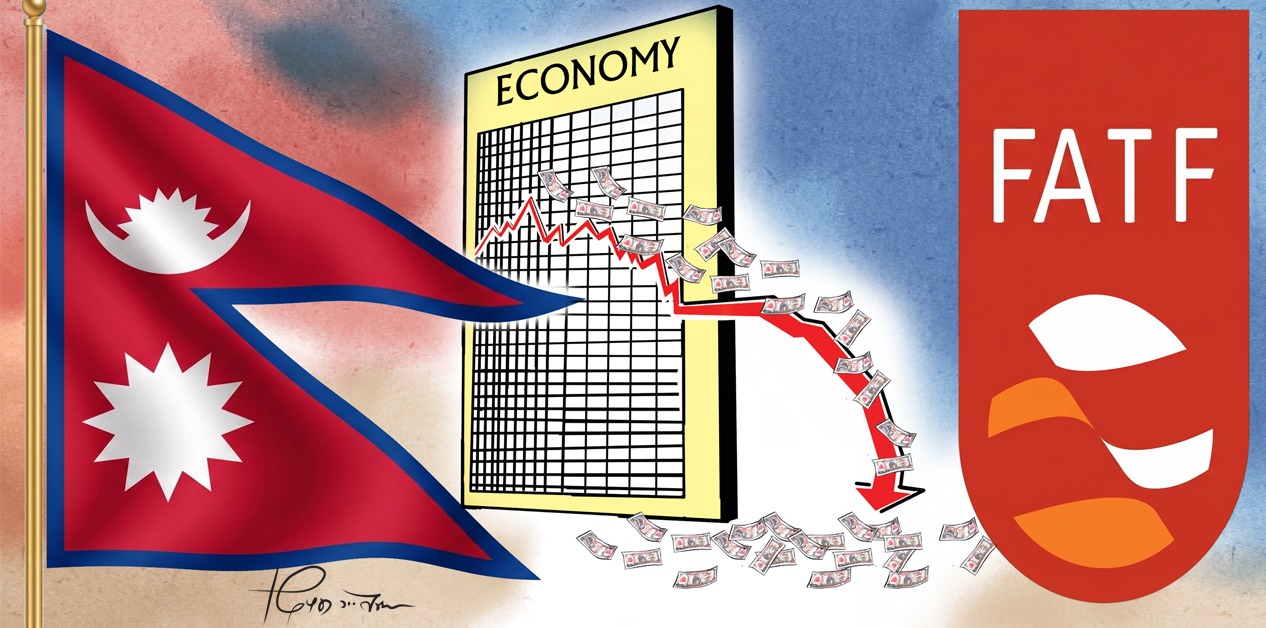
KATHMANDU: Nepal has once again failed to exit the Financial Action Task Force’s grey list. At the FATF Plenary held in Paris from June 17 to 19, the global anti-money laundering watchdog decided to retain Nepal on its list of “Jurisdictions Under Increased Monitoring.”
FATF acknowledged Nepal’s political commitment since February 2025 but said enforcement, prosecution, and asset confiscation remain weak.
The body issued a fresh six-point action plan covering risk-based supervision of banks, cooperatives, casinos and real estate, crackdown on illegal hundi operators, and stronger investigation capacity.
Bosnia and Herzegovina and Iraq were newly added to the 22-country grey list, while Algeria and Namibia exited after reform progress, underlining that Nepal’s path out remains achievable but unmet.
Why is Nepal on the FATF Grey List again?
Nepal was placed back on the grey list in February 2025 after FATF’s mutual evaluation found persistent gaps in its anti-money laundering and counter-terrorist financing system.
At the June 2026 Paris Plenary, FATF reviewed Nepal’s progress and concluded that while the government had shown political will and passed some legal amendments, actual enforcement remained inadequate. Investigators are not pursuing enough money-laundering cases, asset tracing and confiscation rates remain low, and oversight of high-risk sectors such as cooperatives, casinos, and real estate is still weak.
Because these are the same structural problems FATF flagged when it first listed Nepal, the country was kept under increased monitoring rather than removed.
Essentially, Nepal has continued to draft policies and issue directives, but translating those into successful prosecutions, frozen assets, and disrupted hundi networks has lagged behind what FATF’s evaluators expect to see on the ground, which is why the grey-list status persists into mid-2026.
What is the FATF grey list, and why does it matter for Nepal?
The FATF grey list, formally called “Jurisdictions Under Increased Monitoring,” names countries that have agreed to an action plan with FATF to fix weaknesses in their systems against money laundering, terrorist financing, and proliferation financing.
It is not a blacklist or a sanction, but it does mean a country’s financial system is flagged as higher risk in the eyes of global banks, correspondent banking partners, and foreign investors.
For Nepal, this matters because the economy depends heavily on remittances, imports, foreign aid, and a banking sector connected to international correspondent banks. Even without formal sanctions, grey-list status tends to make banks abroad more cautious, slow down due diligence on Nepali transactions, and raise the cost of doing cross-border business.
It also damages reputational standing at a time when Nepal is trying to attract foreign direct investment and graduate economically, making the grey list a meaningful drag on growth ambitions even though no direct punitive measures are attached to it.
How serious is the threat of grey-listing for Nepal’s economy?
The threat is real but gradual rather than immediate or catastrophic. Grey-listing does not cut Nepal off from the global financial system, but it raises the cost and friction of participating in it.
Foreign banks may demand additional documentation for wire transfers, correspondent banks may charge higher fees or slow down processing, and some institutions may simply choose to avoid Nepali counterparties to limit their own compliance risk, a practice known as de-risking.
Over time, this can make imports costlier, slow remittance flows that millions of Nepali households depend on, and discourage foreign investors who already view Nepal as a higher-risk market due to political instability and weak institutions.
The longer Nepal remains grey-listed, the more these frictions compound, potentially affecting GDP growth, foreign exchange reserves, and the government’s ambitious 7 percent growth target for the current fiscal year.
The seriousness, therefore, lies less in immediate shock and more in slow-building economic costs.
Is grey-listing a warning sign of deeper institutional failures?
Yes, most analysts and even FATF’s own language suggest grey-listing reflects deeper institutional weaknesses rather than a narrow technical lapse. FATF’s repeated criticism centers on Nepal’s inability to convert laws into enforcement: weak coordination among the Department of Money Laundering Investigation, the Financial Information Unit, and law enforcement agencies; low conviction rates in financial crime cases; and limited capacity to trace, freeze, and confiscate illicit assets.
These are symptoms of broader governance problems, including political instability, frequent changes in government priorities, under-resourced regulatory bodies, and a culture where enforcement against politically connected individuals in sectors like cooperatives and real estate is historically lax.
The grey list, in this sense, functions as an external mirror reflecting Nepal’s long-standing struggle to build effective, independent institutions capable of consistently enforcing rules rather than just passing them. Until that structural gap between legislation and implementation closes, repeated grey-listing risk will likely remain a recurring feature of Nepal’s relationship with global financial oversight bodies.
How would FATF grey-listing affect foreign investment in Nepal?
Grey-listing raises the perceived country risk for foreign investors, who already factor in Nepal’s political volatility, bureaucratic delays, and infrastructure gaps. International corporate legal and compliance teams typically treat grey-listed jurisdictions with extra caution, requiring enhanced due diligence before approving investments, joint ventures, or loans.
This can lengthen approval timelines, increase legal and compliance costs for both sides, and in some cases lead investors to redirect capital to fully compliant regional markets such as Bangladesh or Vietnam instead.
Development partners and multilateral lenders may also attach additional conditions to financing. While Nepal continues to receive foreign aid and some investment despite the listing, the grey-list tag effectively raises the bar foreign capital must clear before committing, discouraging marginal or risk-sensitive investors.

File Photo
Combined with existing investment climate challenges, this makes Nepal’s effort to attract foreign direct investment, especially in hydropower, tourism infrastructure, and manufacturing, noticeably harder while the listing remains in place.
What are the main compliance gaps of Nepal?
FATF’s June 2026 review identified several persistent gaps. Nepal lacks a sufficiently clear, updated understanding of its own money-laundering and terrorist-financing risks across sectors.
Risk-based supervision of commercial banks, high-risk cooperatives, casinos, real estate businesses, and dealers in precious metals and stones remains weak, meaning regulators are not effectively monitoring the sectors most vulnerable to abuse. Illegal hundi, or informal money transfer networks, continue to operate largely unchecked, undermining formal remittance channels and tax collection.
Investigative and prosecutorial agencies, including the Department of Money Laundering Investigation and the Financial Information Unit, suffer from limited capacity, fragmented coordination, and low caseloads relative to the scale of suspected financial crime.
Crucially, Nepal’s ability to identify, trace, freeze, and confiscate criminal assets remains underdeveloped, meaning even when crimes are detected, the proceeds are rarely recovered. These overlapping gaps span legal frameworks, institutional capacity, and on-the-ground enforcement, which is why FATF continues to flag Nepal despite legislative progress.
How would grey-listing affect banks?
Nepali banks face heightened scrutiny from their international correspondent banking partners, which are the foreign banks that facilitate cross-border wire transfers, trade finance, and foreign currency transactions.
These partners may demand more detailed documentation, conduct enhanced due diligence on Nepali clients, or in some cases reduce the scope of services offered to Nepali financial institutions to limit their own compliance exposure, a phenomenon known as de-risking.
This can slow down international transactions, increase processing fees, and in extreme cases lead some smaller correspondent relationships to be discontinued altogether.
Domestically, Nepali banks must also invest more in compliance infrastructure, staff training, and reporting systems to satisfy both local regulators and international counterparties.
While Nepal Rastra Bank has issued stricter anti-money laundering directives to align with FATF expectations, the additional compliance burden raises operating costs for banks, which can eventually be passed on to customers through higher fees on remittances, trade transactions, and foreign currency services.
Will international transactions become costlier after the FATF grey list?
Yes, to varying degrees. When a country remains grey-listed, foreign banks and financial institutions typically apply enhanced due diligence to transactions linked to that jurisdiction, even though FATF itself states grey-listing does not mandate such measures.
In practice, many banks adopt a cautious, risk-averse approach anyway, leading to longer processing times, additional documentation requirements, and sometimes higher transaction fees for Nepali businesses and individuals sending or receiving money internationally.
Trade-related letters of credit, foreign currency transfers, and investment-related fund movements can all face extra layers of verification. For ordinary remittance senders, the effect may be less direct since FATF has specifically cautioned against disrupting remittance flows, but compliance costs absorbed by banks can still trickle down.
Importers and exporters dealing in larger volumes are likely to feel the cost increase most, since their transactions draw more scrutiny, potentially adding inflationary pressure on imported goods in a country heavily reliant on international trade.
What steps has the government taken to avoid grey-listing or work toward exit?
Since February 2025, Nepal’s government has pursued several measures to demonstrate commitment to FATF’s action plan. Parliament has amended the Assets (Money) Laundering Prevention Act to strengthen the legal foundation for enforcement, with technical support from the International Monetary Fund’s legal department.
Nepal Rastra Bank has issued updated anti-money laundering directives for banks and financial institutions, and authorities have engaged repeatedly with the Asia-Pacific Group on Money Laundering, including hosting an APG delegation in Kathmandu that met the Finance Minister and the central bank governor.
The federal budget for fiscal year 2026/27 explicitly sets exiting the grey list as a policy priority, alongside reforms in foreign investment approval and profit repatriation. However, FATF’s June 2026 review found that despite these legislative and diplomatic efforts, on-the-ground enforcement, including prosecutions and asset confiscation, has not improved sufficiently, meaning the government’s measures so far have addressed technical compliance more than practical implementation.
Which countries are currently on the FATF grey list?
As of the June 2026 Plenary, 22 jurisdictions are under increased monitoring. These include Angola, Bolivia, Bosnia and Herzegovina, Bulgaria, Cameroon, Cote d’Ivoire, the Democratic Republic of Congo, Haiti, Iraq, Kenya, Kuwait, Laos, Lebanon, Monaco, Nepal, Papua New Guinea, South Sudan, Syria, Venezuela, Vietnam, the Virgin Islands (UK), and Yemen.
Bosnia and Herzegovina and Iraq were the two newest additions at this Plenary, while Algeria and Namibia were removed after demonstrating sufficient reform.
Separately, the FATF blacklist, formally called “High-Risk Jurisdictions Subject to a Call for Action,” remained unchanged with only three countries: Iran, North Korea, and Myanmar, which face far more severe restrictions including calls for countermeasures.
Nepal’s continued presence alongside conflict-affected or fragile states such as Haiti, Syria, and Yemen highlights how serious FATF considers Nepal’s institutional gaps, even though Nepal does not face the active instability that several other listed countries are experiencing.
How does Nepal’s situation compare with other grey-listed countries?
Nepal’s profile differs from many grey-listed nations in an important way: it does not face armed conflict, extreme political collapse, or international sanctions regimes the way countries like Syria, Yemen, or South Sudan do.
Nepal’s deficiencies are largely administrative and institutional rather than driven by war or state fragility, which in theory should make reform more achievable. However, Nepal shares with several listed countries a pattern of passing laws without matching enforcement capacity, a problem FATF has also flagged in places like Vietnam, Cameroon, and Haiti, all of which received separate warnings in June 2026 for missing reform deadlines.
Compared to countries like Bulgaria, Cote d’Ivoire, and Monaco, which FATF said had substantially completed their action plans and are awaiting final on-site assessments before delisting, Nepal lags further behind in translating commitments into measurable results such as prosecutions and asset recovery, suggesting its exit timeline may take longer unless enforcement visibly accelerates.
What lessons can Nepal learn from countries that successfully exited the grey list?
Algeria and Namibia’s removal from the grey list at the June 2026 Plenary, alongside the Philippines’ earlier exit, offers a template Nepal could follow.
Successful exits typically involve sustained political commitment that survives changes in government, dedicated and adequately funded enforcement units, measurable increases in money-laundering investigations and convictions, and demonstrated ability to freeze and confiscate criminal assets rather than merely passing legislation.
Countries that exited quickly also maintained close, continuous engagement with their regional FATF-style body, in Nepal’s case the Asia-Pacific Group on Money Laundering, providing regular evidence of progress rather than treating reviews as one-off compliance exercises.
Nepal’s own history shows it managed to exit the list once before, listed in 2008 and exit in 2014, by building legal and institutional frameworks from scratch.
The core lesson is that legal reform alone is insufficient; FATF wants to see institutions actually catching, prosecuting, and penalizing offenders, alongside coordinated action across agencies that have historically worked in silos.
How long do countries typically remain on the grey list?
There is no fixed duration, as it depends entirely on how quickly a country implements its action plan and demonstrates measurable results to FATF’s satisfaction. Some countries exit within roughly two to three years if they show swift, sustained progress, while others remain listed for much longer when reforms stall or political will weakens.
Nepal’s first stint on the grey list, from 2008 to 2014, lasted six years. Its second listing began in February 2025, and as of the June 2026 review, FATF has indicated an action plan timeframe extending toward mid-2027, suggesting Nepal could realistically remain under monitoring for at least two to three years from the initial listing, possibly longer if enforcement gaps persist.
FATF reviews progress three times a year, in February, June, and October, giving countries multiple checkpoints to demonstrate improvement, but each review can also extend a country’s stay if evaluators are not satisfied with the pace of reform.
Are Nepal’s challenges similar to those faced by other grey-listed nations?
In some respects yes, particularly the gap between legislative reform and practical enforcement, which FATF has cited not just for Nepal but for Vietnam, Cameroon, Haiti, and South Sudan, all of which received warnings in June 2026 for failing to meet deadlines.
Weak supervision of high-risk, non-bank sectors such as cooperatives and real estate is also a recurring theme across multiple grey-listed jurisdictions, not unique to Nepal. However, Nepal’s specific combination of challenges, heavy reliance on informal hundi networks, a large cooperative sector with historically poor oversight, and fragmented coordination between law enforcement and financial intelligence units, gives its situation a distinct character.
Unlike conflict-driven cases such as Syria or Yemen, Nepal’s deficiencies are rooted in governance and institutional capacity rather than state collapse, which several analysts argue should make Nepal’s reform path comparatively more straightforward, provided there is consistent political will across successive governments to follow through.
Has Nepal adequately implemented anti-money laundering and counter-terrorism financing laws?
Partially. Nepal has made genuine legislative progress, including amendments to the Assets (Money) Laundering Prevention Act and updated anti-money laundering directives from Nepal Rastra Bank, often developed with technical assistance from the International Monetary Fund.
FATF itself acknowledged in its June 2026 assessment that Nepal has improved technical compliance in areas such as targeted financial sanctions related to terrorist financing and weapons proliferation. However, technical compliance, meaning having the right laws on paper, is different from effectiveness, meaning those laws are actually used to investigate, prosecute, and penalize wrongdoers.
FATF’s evaluation framework weighs effectiveness heavily, and on this measure Nepal continues to fall short: prosecutions for money laundering remain limited relative to the scale of suspected illicit activity, and asset confiscation rates are particularly low.
So while Nepal has not failed to legislate, it has so far failed to demonstrate that those laws are producing real, measurable enforcement outcomes on the ground.
Are Nepal’s regulatory agencies sufficiently equipped to monitor suspicious financial activities?
Not yet to the standard FATF expects. The Financial Information Unit within Nepal Rastra Bank is responsible for receiving and analyzing suspicious transaction reports, but it operates alongside the Department of Money Laundering Investigation and various law enforcement bodies, and FATF has repeatedly flagged weak coordination among these agencies as a structural weakness.
The IMF’s Article IV report has similarly noted that Nepal’s anti-money laundering framework faces capacity constraints and fragmented institutional coordination that limit effective implementation.
Supervision of high-risk, non-bank sectors, including cooperatives, casinos, and real estate businesses, remains particularly underdeveloped, leaving large parts of the financial system inadequately monitored for suspicious activity.
While banks have made progress implementing Know Your Customer norms and reporting obligations, the broader ecosystem of detection, investigation, and follow-through still lacks the staffing, technical training, and inter-agency information sharing needed to catch and act on financial crime at the scale and speed FATF’s standards require.
How quickly can Nepal address FATF’s concerns?
This depends primarily on political consistency and institutional follow-through rather than technical capability alone, since Nepal already possesses much of the legal groundwork.
If the government sustains the political commitment it has shown since February 2025, channels adequate resources to the Financial Information Unit and Department of Money Laundering Investigation, and produces visible results such as increased prosecutions and asset seizures within the next one to two review cycles, Nepal could realistically demonstrate sufficient progress before the mid-2027 deadline referenced by FATF.
However, Nepal’s history of frequent government changes and shifting policy priorities poses a real risk to this timeline, as reform momentum can stall when leadership changes.
FATF’s June 2026 statement specifically noted a lack of visible improvement under the newer government despite earlier pledges, suggesting that unless enforcement actions become more consistent and frequent in the coming months, Nepal risks extending its stay on the grey list well beyond the optimistic scenarios policymakers have floated.
What is FATF’s latest action plan for Nepal?
Following the June 2026 Paris Plenary, FATF outlined a multi-point action plan Nepal must complete to exit the grey list.
Key priorities include deepening Nepal’s understanding of its own money-laundering and terrorist-financing risks across different sectors, and strengthening risk-based supervision of commercial banks, high-risk cooperatives, casinos, real estate businesses, and dealers in precious metals and stones.
FATF also directed Nepal to intensify efforts against illegal hundi operators by identifying and prosecuting them, while explicitly cautioning against disrupting legitimate remittance flows or financial inclusion in the process.
The plan calls for enhancing coordination and capacity among the Department of Money Laundering Investigation, the Financial Information Unit, and law enforcement agencies, and significantly increasing investigations and prosecutions of money-laundering cases.
Finally, Nepal must demonstrate effective mechanisms to identify, trace, freeze, and confiscate criminal assets. FATF stressed that Nepal’s eventual removal depends entirely on timely, effective implementation of these measures rather than further legislative announcements alone.
What exactly did the June 2026 FATF Paris Plenary decide on Nepal?
The FATF Plenary, held in Paris from June 17 to 19, 2026, under the outgoing Mexican presidency, reviewed Nepal’s progress since the February 2025 listing and concluded that Nepal should remain under increased monitoring.
The watchdog credited Nepal with high-level political commitment and some technical compliance improvements, particularly around targeted financial sanctions related to terrorism financing, but found that effectiveness, meaning actual enforcement outcomes, remained insufficient.
The Plenary simultaneously added Bosnia and Herzegovina and Iraq to the grey list while removing Algeria and Namibia, bringing the total number of monitored jurisdictions to 22.
FATF also issued warnings to Vietnam, Cameroon, Haiti, and South Sudan for missing earlier reform deadlines, while noting that Bulgaria, Cote d’Ivoire, the Democratic Republic of Congo, and Monaco had substantially completed their action plans and were awaiting final on-site verification before potential delisting.
This was the last Plenary under Mexico’s FATF presidency, with the United Kingdom taking over from July 1, 2026.
Why has FATF specifically flagged hundi transactions and high-risk cooperatives?
Hundi, an informal, largely undocumented method of transferring money outside the banking system, is a long-standing channel for capital flight, tax evasion, and potentially money laundering in Nepal, making it a natural focus for FATF’s scrutiny.
Because hundi operates parallel to formal remittance channels, it is difficult for regulators to trace funds, identify beneficial owners, or detect links to illicit activity, which directly undermines the transparency FATF’s standards demand.
Cooperatives, meanwhile, have expanded rapidly in Nepal over the past decade with comparatively weak regulatory oversight compared to commercial banks, and several scandals involving misused or unaccounted cooperative deposits have already surfaced domestically.
Casinos and real estate similarly involve large cash transactions and asset transfers that can be exploited to disguise illicit proceeds if oversight is lax.
FATF’s emphasis on these specific sectors reflects its assessment that Nepal’s most significant blind spots lie outside the relatively better-supervised commercial banking sector, in areas where enforcement capacity has not kept pace with sectoral growth.
What is the difference between the grey list and the blacklist?
The grey list, officially “Jurisdictions Under Increased Monitoring,” includes countries that have strategic deficiencies in their anti-money laundering and counter-terrorist financing systems but have committed to a specific action plan with FATF and are actively working to fix those gaps under increased scrutiny.
It does not trigger sanctions, and FATF explicitly states it should not be used to justify blanket de-risking of these countries by global banks.
The blacklist, officially “High-Risk Jurisdictions Subject to a Call for Action,” is reserved for countries FATF considers to have failed to make adequate progress or that pose more severe risks to the international financial system.
Currently only Iran, North Korea, and Myanmar sit on this list, facing calls for countermeasures and far more serious financial isolation, including restrictions that can effectively cut off large portions of international banking access.
Nepal remains firmly on the lesser-severity grey list, meaning it retains a clear, internationally recognized path back to full standing if it implements reforms.
What happens if Nepal is eventually blacklisted?
Blacklisting would represent a significant escalation with much more serious consequences than the current grey-list status.
Countries on FATF’s blacklist face calls for enhanced due diligence or, in the most serious cases like Iran, outright countermeasures from FATF member states, which can include restrictions on correspondent banking relationships, much higher transaction costs, and in extreme scenarios near-total exclusion from segments of the international financial system.
For an import-dependent, remittance-reliant economy like Nepal’s, blacklisting could sharply raise the cost of trade finance, slow remittance inflows that millions of households depend on, deter foreign investment almost entirely, and complicate access to international development loans and aid.
However, blacklisting typically follows a sustained failure to engage with FATF or repeated, serious non-compliance over many years, a scenario quite different from Nepal’s current trajectory of partial, acknowledged progress.
Given Nepal’s demonstrated political engagement with FATF and the APG, blacklisting remains a distant rather than imminent risk, provided reform momentum is not abandoned entirely.
Has Nepal been on the grey list before, and what happened then?
Yes, Nepal was first placed on the FATF grey list in 2008 and remained there until 2014, a six-year stretch during which the country came close to outright blacklisting in 2012 before pulling back through reform efforts.
During that period, Nepal built much of its foundational anti-money laundering legal architecture, established institutions like the Financial Information Unit, and worked closely with the Asia-Pacific Group on Money Laundering to demonstrate sustained progress, eventually earning removal in 2014 alongside countries like Kenya, Mongolia, and Tanzania.
However, FATF’s most recent mutual evaluation, based on an on-site visit in December 2022, found that many of those earlier gains had eroded or proven insufficient against evolving standards, leading to Nepal’s re-listing in February 2025.
This repeat listing has prompted criticism that Nepal failed to institutionalize reforms permanently after its first exit, treating compliance as a one-time fix rather than an ongoing commitment, a pattern officials now say they are trying to avoid repeating this time.
What is the role of Nepal Rastra Bank and the Financial Information Unit in this process?
Nepal Rastra Bank, the central bank, plays a central regulatory role by issuing anti-money laundering and counter-terrorist financing directives that commercial banks and financial institutions must follow, including Know Your Customer requirements and suspicious transaction reporting obligations.
Housed within the central bank but operating independently, the Financial Information Unit serves as Nepal’s financial intelligence agency, established under the Assets (Money) Laundering Prevention Act, responsible for receiving, analyzing, and disseminating financial intelligence to relevant law enforcement and prosecutorial bodies.
The FIU acts as the critical link between raw suspicious transaction reports filed by banks and actual investigations carried out by agencies like the Department of Money Laundering Investigation.
During Nepal’s FATF engagement, central bank officials, including the governor, have directly met with APG delegations to demonstrate commitment.
However, FATF’s continued criticism of weak coordination and low prosecution rates suggests that even with these institutions formally in place, their practical effectiveness and inter-agency collaboration still require substantial strengthening to satisfy international evaluators.
What can ordinary citizens and businesses expect from this grey-list status?
For most ordinary citizens, day-to-day banking, including deposits, withdrawals, and domestic transfers, remains unaffected by grey-list status.
FATF has explicitly urged member states not to disrupt remittance flows or humanitarian transfers because of Nepal’s listing, which should help protect the channel millions of Nepali households rely on for income from family members working abroad.
However, individuals and businesses engaged in international trade, larger cross-border transfers, or transactions involving foreign investment may notice longer processing times, additional documentation requests, or modestly higher fees as banks apply more cautious compliance procedures.
Businesses importing goods may face increased costs as banks and trade-finance providers build in extra verification steps, potentially feeding into consumer prices over time. Entrepreneurs seeking foreign investment or loans may encounter more scrutiny from international partners assessing country risk.
Overall, the impact on ordinary life is likely to be gradual and indirect rather than sudden, but cumulative friction across trade, investment, and banking could weigh on broader economic growth the longer the grey-list status persists.