Kathmandu
Saturday, June 27, 2026





For decades, Nepal’s bureaucracy outlasted every government. Today, it is the bureaucracy-not politicians-that finds itself under pressure. Reforming an entrenched bureaucracy-long shielded by patronage, permanence and political influence-may prove the defining test of new government and of Nepal’s democratic renewal.
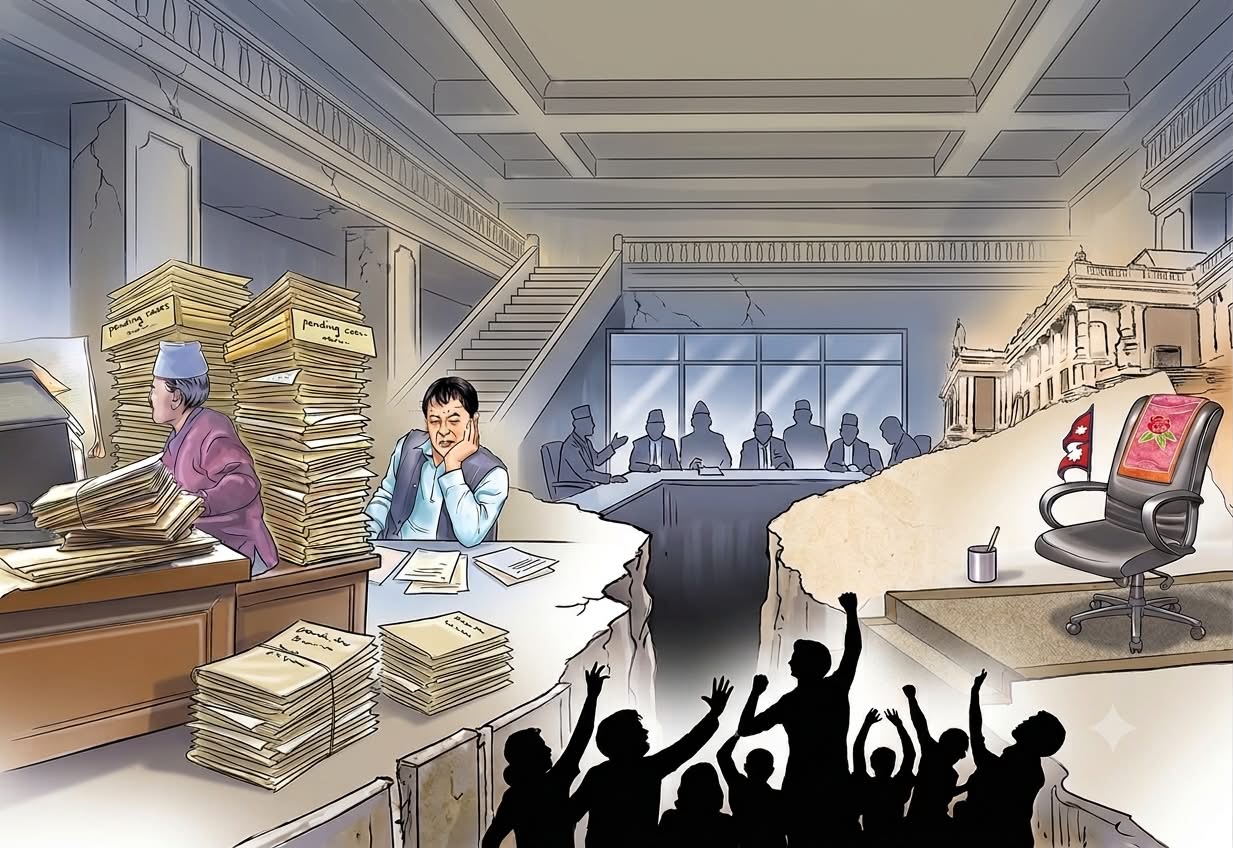
KATHMANDU: Three months into Prime Minister Balendra Shah’s administration, Nepal’s governance agenda presents a study in contrasts. The government has delivered a handful of visible governance reforms, but much of its ambitious promise remains unrealised. Nearly half of its 100 pledged governance initiatives have yet to move beyond paper. Even so, the administration has begun reshaping the state’s relationship with its own bureaucracy—arguably the most consequential battle of its early tenure.
No institution has felt the shock more acutely than Nepal’s civil service. Long insulated from disruptive reform, the bureaucracy now finds itself confronting an unprecedented overhaul.
At the centre of the upheaval is the long-delayed Federal Civil Service Act, legislation that has languished for eight years. Although the government has yet to decide no whether to introduce it through Parliament or by ordinance, its draft alone has unsettled the administrative establishment.
The proposal calls for a one-off compulsory retirement of officials aged 55 or those who have completed 30 years of service, before permanently raising the retirement age to 60. The measure would remove up to 15,000 civil servants in a single stroke-effectively engineering the largest generational reset in Nepal’s bureaucracy in decades.
The rationale is clear: dismantle an ageing administrative hierarchy and create space for younger officials. But the proposal has also exposed the political risks of reform. Instead of waiting for the law to take effect, many senior bureaucrats have begun leaving voluntarily to protect their pension entitlements, fearing future changes to retirement benefits. Others have resigned in protest over controversial transfer decisions. In just nine days, 54 civil servants stepped down—an unusually rapid exodus that reflects mounting uncertainty within the state apparatus.
Unions lose their shield
The government has gone further by stripping legal registration from 12 public-sector trade unions-eight representing civil servants and four representing health workers. The move, executed by the Department of Labour and Occupational Safety, dismantles organisations that have long served as influential political and institutional power centres inside Nepal’s bureaucracy.
For supporters, the decision signals an attempt to depoliticise the civil service and restore administrative neutrality. Critics, however, see it as an assault on collective representation and organised labour. Either way, it marks one of the most assertive interventions in Nepal’s public sector in years.
The administration has paired these hard reforms with a softer political calculation. Alongside structural changes, it has approved a salary increase for civil servants through the national budget, lifting monthly pay to between Rs 40,000 and Rs 100,000. The pay rise appears designed not merely to improve compensation, but to cushion resistance to reforms that threaten long-established privileges.
The government’s first three months therefore reveal a defining paradox. It has moved cautiously on many of its headline governance commitments, yet aggressively where it believes the state itself requires restructuring. Whether this amounts to genuine institutional modernisation or simply a redistribution of bureaucratic power will become one of the central tests of Shah’s premiership.
Why public frustration with bureaucracy
The Gen Z movement in September 2025 was not merely a revolt against political leaders; it was also an indictment of Nepal’s permanent state. Governments changed, prime ministers fell, but the bureaucracy-the country’s unelected and enduring centre of power-remained largely untouched. Public anger was directed as much at government offices as at elected politicians.
For decades, many citizens have experienced the state not through Parliament but through bureaucrats. Delayed files, arbitrary discretion, rent-seeking, political patronage and a culture of impunity have transformed public service into a source of public frustration. Instead of acting as servants of the people, too many officials have behaved as custodians of power, reinforcing a feudal administrative mindset that democracy was supposed to replace.
The deeper problem is structural. Nepal’s bureaucracy enjoys permanence without sufficient accountability. Promotions often reward seniority rather than performance, disciplinary action is rare, and political connections frequently outweigh professional competence. At the same time, political parties have deeply penetrated the civil service through unions and patronage, eroding neutrality and professionalism. The result is a bureaucracy that is neither fully independent nor fully accountable.
Reform therefore requires more than replacing ministers. It demands rebuilding the civil service around merit, transparency and measurable performance. Recruitment should prioritise professional expertise over outdated examinations that reward memorisation instead of competence. Promotions and tenure should depend on results, while regular performance reviews should replace the assumption of lifetime security. Recruitment rules, including reservation policies, should be refined to strengthen both inclusion and merit.
Equally important, the bureaucracy must be depoliticised. Civil servants should implement the law, not political agendas. Transfers, appointments and promotions must become transparent and objective, while anti-corruption institutions should investigate both bureaucrats and politicians with equal independence. Corruption survives because administrative and political interests often protect one another.
Technology should also replace discretion wherever possible. Digital services, transparent procurement, online tracking of files and public performance dashboards would reduce opportunities for bribery while making officials directly accountable to citizens.
The lesson of the Gen Z movement is straightforward. Democracy cannot flourish if elections merely change governments while leaving the machinery of the state untouched. Nepal does not simply need better politicians; it needs a bureaucracy that serves citizens rather than governs them. Until the permanent state becomes as accountable as the temporary government, public frustration will continue to outlive every election.
The bureaucracy that rules-and obeys
Nepal’s bureaucracy suffers from a paradox that has come to define the country’s governance. Politicians routinely denounce an unelected administrative “deep state” powerful enough to frustrate elected governments. Yet the same bureaucracy is equally accused of serving political masters, trading transfers, promotions and public office for patronage and personal gain. Both narratives are true.
Nepal’s civil service is neither an autonomous technocracy nor a captive institution. It has become something more adaptable-and therefore more formidable. Depending on where its interests lie, it can resist political authority, preserve the status quo or collude with those in power. That flexibility, rather than outright dominance or subservience, is what gives Nepal’s bureaucracy its enduring influence.
The roots of this transformation lie in the democratic transition after 1990. The Civil Service Act of 1993 fundamentally altered the balance of power between politicians and bureaucrats. Designed when inexperienced political parties depended heavily on the state machinery, the law insulated civil servants from executive discretion by codifying recruitment, promotion, dismissal and retirement. It weakened politicians’ ability to discipline the bureaucracy while strengthening bureaucrats’ institutional security.
Ironically, the bureaucracy became more independent precisely as Nepal became more democratic. Political instability only accelerated that shift. Governments rose and fell with remarkable frequency, while bureaucrats remained. Ministers became temporary occupants of office; secretaries became the permanent custodians of the state. Institutional memory, policy continuity and administrative leverage increasingly migrated from elected politicians to career officials.
The politicisation of the civil service further entrenched this imbalance. Trade unions affiliated with political parties evolved into parallel centres of influence inside the state, shaping transfers, promotions and appointments as much through political bargaining as through administrative merit. Rather than depoliticising the bureaucracy, Nepal effectively institutionalised partisan competition within it. After dismantled the trade unions there is no another specific motivation plan.
The bureaucracy in Nepal has multiple strategic options. It can obstruct ministers whose orders violate the law, as demonstrated by officials who refused politically motivated tax concessions. Such resistance is a healthy constitutional safeguard. But the same institutional protections also enable less virtuous behaviour: bureaucrats delaying reform, manipulating transfers, protecting vested interests or colluding with politicians for lucrative postings and financial rewards.
This is not simply bureaucratic resistance; it is bureaucratic arbitrage. Officials exploit fragmented political authority while politicians exploit bureaucratic networks. Each depends on the other. Neither possesses enough power to dominate outright, but both possess enough influence to prevent meaningful reform.
That explains why governance reforms in Nepal so often stall. The problem is neither an omnipotent bureaucracy nor an incompetent political class. It is a system in which both have learned to coexist through mutual accommodation.
Prime Minister Balendra Shah’s proposed overhaul of the civil service-including compulsory retirement for thousands of senior officials and the dismantling of party-affiliated trade unions-therefore strikes at the political economy of the state rather than merely its administrative structure. The objective is not simply generational renewal; it is to break entrenched patronage networks that have survived successive governments.
Whether the reforms succeed will depend less on legislation than on political resolve. Bureaucracies rarely surrender power voluntarily, especially when decades of instability have strengthened their institutional position. Yet reformers face their own dilemma: weakening bureaucratic safeguards risks reviving political interference, while preserving the status quo perpetuates administrative inertia.
Nepal’s challenge is therefore not to make its bureaucracy weaker or stronger. It is to make it accountable. A professional civil service should be insulated from partisan pressure, but never insulated from performance. Promotions should reward competence rather than connections; transfers should serve the public interest rather than political patrons; and trade unions should protect labour rights without becoming extensions of party machines.
For three decades, Nepal has built a bureaucracy that is extraordinarily difficult to control-but not always difficult to compromise. That distinction explains much of the country’s governance failure. The state’s greatest obstacle is no longer an overbearing political class or an overmighty bureaucracy alone. It is the equilibrium they have reached together.
The bureaucracy that never fell
Nepal’s bureaucracy is often portrayed as either an all-powerful “deep state” that frustrates elected governments or a pliant instrument captured by politicians. Both diagnoses miss the larger story. Nepal’s civil service is neither master nor servant. It is the institutional heir to three centuries of state-building, palace intrigue and political compromise-a bureaucracy that has repeatedly adapted to changing rulers while preserving its own influence.
Bureaucracies do not emerge from management theory; they are products of history. Nepal’s administrative state was forged not in classrooms or constitutional debates, but on battlefields, in royal courts and through systems of patronage. Modern reforms have altered its legal architecture, but they have barely disturbed its institutional DNA.
Nepal’s bureaucracy was born with conquest. During Prithvi Narayan Shah’s unification campaign, the state’s overriding objective was territorial expansion rather than public administration. The newly conquered kingdoms were not integrated into a coherent administrative system. Local rulers and military commanders governed on behalf of Kathmandu with considerable autonomy, while the centre focused on extracting revenue and sustaining military campaigns.
The decisive turning point came not with victory but defeat. The 1816 Treaty of Sugauli ended Nepal’s territorial expansion. Without new lands to distribute among the elite, power turned inward. Palace conspiracies replaced military campaigns, and Kathmandu became the unquestioned centre of political and administrative gravity. Centralisation was no longer a strategic choice; it became a political necessity. That concentration of authority remains visible today.
The Rana reinvention: Bureaucracy as a family enterprise
The Kot Massacre of 1846 transformed Nepal’s bureaucracy from an instrument of conquest into an instrument of regime survival.
Under Jung Bahadur Rana and his successors, the state ceased to function as a public institution. It became the administrative arm of a single ruling family. Ministries resembled corporate departments serving the Rana dynasty rather than the Nepali people. Revenue collection and internal security dominated official priorities because they protected wealth and preserved power. Public services-education, healthcare and development-were largely irrelevant to a regime whose legitimacy rested on coercion rather than public consent.
The bureaucracy’s purpose was not governance. It was obedience.
The Rana system institutionalised two practices whose influence extends well beyond the regime itself.
The first was Pajani, an annual review that allowed the ruler to dismiss, transfer or reward officials at will. Without tenure or procedural protection, every bureaucrat lived under permanent uncertainty.
The second was Chakari-the ritual of cultivating favour through personal loyalty. In such a system, competence became secondary. Career advancement depended less on administrative performance than on proximity to power.
These practices did more than reward sycophancy; they fundamentally reshaped bureaucratic incentives. Officials learned that taking initiative was dangerous while unquestioning obedience was rewarded. Administrative caution became institutional culture. The Ranas disappeared in 1951. The incentives they created did not.
Modern laws, medieval habits
The democratic revolution attempted to replace a family-owned administration with a professional civil service. Foreign advisers redesigned ministries, while the Civil Service Act sought to institutionalise meritocracy, permanence and political neutrality.
The reforms modernised the bureaucracy’s structure but not its behaviour. The formal rules changed faster than the informal culture. Officials accustomed to avoiding responsibility suddenly found themselves expected to lead development planning and public administration. Risk aversion remained rational because the historical memory of punishment outlived the institutions that created it.
The result was a bureaucracy governed simultaneously by modern legislation and historical instincts.
That contradiction helps explain one of Nepal’s most enduring administrative clichés: Bholi Aaunus-“Come tomorrow.” What appears to citizens as inefficiency often reflects a deeper institutional preference for delaying decisions rather than assuming personal responsibility. In a bureaucracy shaped by centuries of political uncertainty, postponement is frequently the safest administrative strategy.
Democracy strengthened the bureaucracy
Paradoxically, democratisation strengthened rather than weakened Nepal’s bureaucracy.
The Civil Service Act of 1993 insulated officials from arbitrary executive interference, while frequent changes of government steadily eroded political authority. Ministers came and went; secretaries remained. Political instability became bureaucratic continuity.
At the same time, party-affiliated trade unions embedded partisan politics inside the civil service itself. Bureaucrats acquired multiple centres of influence beyond the formal chain of command, allowing them to resist ministers, negotiate with political parties or collaborate with them when convenient.
The bureaucracy ceased to be merely an administrative institution. It became an independent political actor.
Reform means not just laws
Governments tend to rewrite laws, redraw organisational charts and create new commissions. Yet institutions rarely change when the incentives governing behaviour remain intact.
A bureaucracy built for conquest became one built for dynastic survival. That bureaucracy later acquired constitutional protection without fully abandoning the behavioural norms inherited from earlier eras. Today’s civil servants operate within democratic institutions while often responding to incentives rooted in absolutist rule.
Nepal’s bureaucratic crisis is therefore neither legal nor organisational. It is institutional and cultural. A professional civil service requires enough independence to resist unlawful political pressure, but enough accountability to prevent administrative inertia and rent-seeking. Merit must outweigh patronage; performance must outweigh seniority; institutions must outweigh personalities.
Until those incentives change, Nepal will continue to modernise its bureaucracy on paper while preserving its historical logic in practice.
Three centuries after Prithvi Narayan Shah’s unification, the country’s greatest administrative challenge is no longer building the state. It is persuading the state to behave differently from the one history created.
Reforming Nepal’s permanent state
Nepal’s greatest governance challenge is not its revolving politicians but its permanent bureaucracy. Governments arrive with electoral mandates and disappear within five years; the bureaucracy remains, often exercising greater influence over policy than the ministers nominally in charge. When the permanent state outlasts every political cycle without matching accountability, democracy risks becoming a change of faces rather than a change of governance.
The new government’s 100-point reform roadmap recognises this reality. Its pledge to depoliticise the bureaucracy, judiciary and educational institutions strikes at the heart of a system where party-affiliated unions, political patronage and administrative discretion have long blurred the line between public service and political power. A professional civil service should implement the law-not negotiate it with politicians or political parties.
Nepal’s administrative culture has too often rewarded obstruction over execution. Weak governments have frequently found themselves constrained by an entrenched bureaucracy capable of slowing, reshaping or quietly resisting reform. When officials benefit more from delay than delivery, bureaucracy ceases to be an instrument of the state and becomes a centre of power in its own right.
For any reformist government, political will alone is insufficient. The real test is whether it can identify and dismantle bureaucratic resistance without undermining the rule of law. Reform requires performance-based promotions, transparent transfers, digital governance, stronger accountability and the complete depoliticisation of the civil service. A bureaucracy should facilitate investment, public services and economic growth-not obstruct them.
The Gen Z movement demonstrated that public anger was directed not only at politicians but at a state that had become synonymous with delay, discretion and impunity. The election of the RSP reflected a demand to reform the machinery of government, not merely replace its operators.
If the permanent bureaucracy remains unreformed, every elected government-regardless of its mandate-will eventually confront the same invisible barrier. Nepal’s democratic renewal therefore depends not only on changing who governs, but on transforming how the state itself governs.