Kathmandu
Saturday, June 27, 2026





Bridging generational divides, Sushant Ghimire’s unique melodies resonate with everyone from young children to older generations by serving as an intimate dialogue that mirrors both personal introspection and societal truths
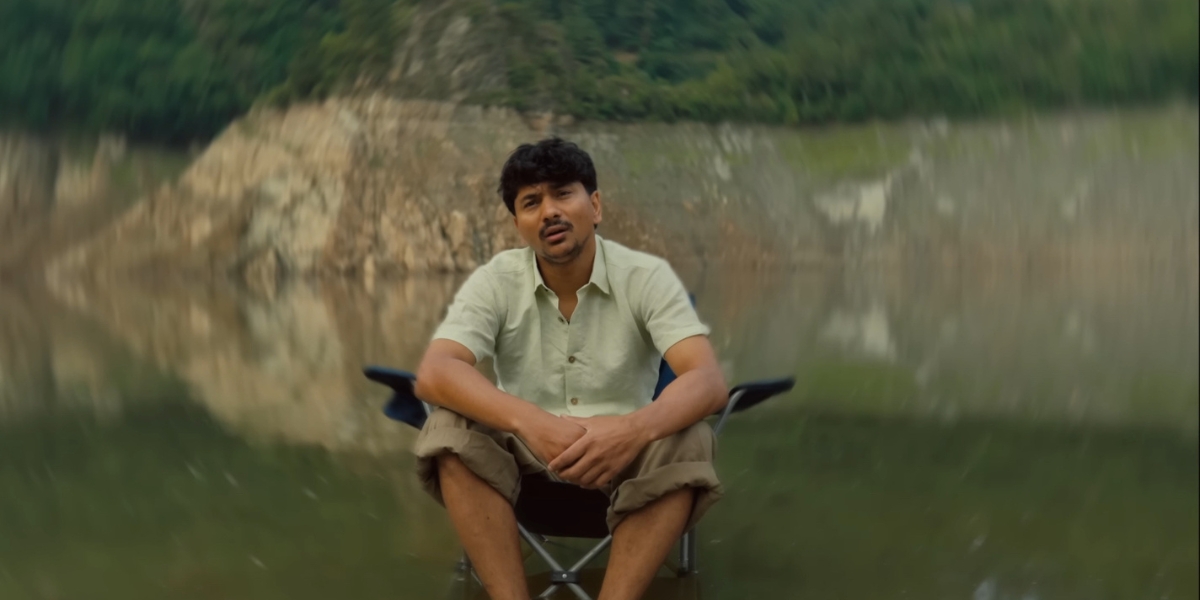
KATHMANDU: Alcohol is a habit that takes a person’s willpower under its control and leaves them helpless. That is why a person who says, “I will not drink anymore,” gets intoxicated again the very next day. And they repeat a false promise to themselves once more: “I will not drink anymore…”
This is not just the character of a single individual; it is the tendency of countless people in our society. Sushant Ghimire’s latest song, Larabara, perfectly captures this exact tendency. The song, dubbed a hangover anthem, says:
Aaba piudina bho
Khoya birke yo
Bholi chhodchhu bhandabhandai
Jeevan beetne bho
Larabara lau ghumayo re…
Translation:
I will not drink anymore.
This bottle is capped with a corncob,
While repeatedly saying I’ll quit tomorrow,
Life is going to pass away,
Slurring and stumbling, oh, it made my head spin…
It will not be surprising if the faces of many real-life characters dance in your mind while listening to or watching Larabara, a story of habit, addiction, and false promises. The sources for Sushant’s song are those very drunkards who do not need a special occasion to drink. Sushant has observed that alcohol has brought crises to the friendships, love lives, and family relationships of many who have a habit of drinking every single day.
“I have seen many people around me who always say, ‘I will not drink anymore.’ But the next day, they drink heavily and pass out. Alcohol has ruined the relationships and health of many people,” Sushant says. “Such people are found everywhere. I created Larabara by blending this shared theme with humor and satire. The listeners and viewers loved it.”

Sushant Ghimire
This is not the first time listeners and viewers have loved Sushant’s song. Almost all of his songs—such as Ajambari Maya, Jindagi Sarara Motorgadima, Man Chari, Pheri Pheri Maya Misaula, Jun Na Heri Timilai Heraula, and Eklo Man—have received love. Popular especially among the younger generation, Sushant’s songs made in an entertaining style, like Jindagi Sarara Motor and Larabara, have even attracted everyone from children to older age groups.
The popularity Sushant has achieved in a short period since formally starting his musical journey in 2017 with the song Pari is enviable. The reason for this is that he makes his own private experiences the subject of his songs. He picks themes from surrounding characters and settings. In Sushant’s experience, songs that are close to real life, or the stories within them, converse directly with listeners. “Because those stories are connected to the listeners’ friends, families, relationships, unions, separations, struggles, and memories,” he says.
Sushant likes to chat with unfamiliar people, understand their backgrounds, and listen to their stories; his songs accommodate everything from the typical colloquial language of the common people to various characters of society. This likely helps him understand the emotions and psychology of the listeners as well.
Kuhukuhu gardai malai sunaune chari
Timisangai udi jaane man laagchha ghari ghari
Bahana khojdai hinde ko ma ghumdai waripari
Tito tito sansaraidekhi tadha dhada paari
Mero aafnai manpari…
Translation:
The bird that sings to me, making a ‘kuhu-kuhu’ sound,
Every now and then, my heart wishes to fly away with you,
Walking around looking for an excuse, wandering nearby,
Far away from this bitter world, across the hills,
Doing as my own heart pleases…
(Manchari)
Baata kati andheromai ujeli dekhaune
Shishir basanta kahi bhumari dulaune
Adhura prashna mera khaali nai uttara
Bhaye dukhi mahala jhupadi sajaune
(Translation:)
Showing light in the darkness of how many paths,
Wandering in a whirlwind somewhere between autumn and spring,
My incomplete questions have empty answers,
If sad, decorating palaces and huts alike…
(Pheri Pheri)
Being able to weave songs that convey such deep meaning in simple words is Ghimire’s specialty. Sushant sings these words of his songs as if he wants to converse rather than just sing, sometimes with the listeners and sometimes with his own inner mind. For example:
Sustari sustari bagne ho ki?
Darauchha yo man, adhoorai chha ni
Thamae, samae yee wegharu
Mayakai tyo mandarai pugne ho ki?
Gharighari yee bhawanaka wegh kina?
Aghiaghi, ae, herchhan, jiskaunchhan jhan!
Translation:
Should I flow slowly, slowly?
This heart is afraid, it is incomplete after all,
I stopped, I held back these momentums,
Is it going to reach that very temple of love?
Why are these surges of emotions happening time and again?
Moving ahead, oh, they look back and tease even more!
(Bujhau Malai)
“For me, music is first and foremost an expression. This is my own language. I cannot say many things clearly in words, but I can say them through a song,” Sushant adds. “No matter what style I adopt or how different the subjects I write about are, ultimately, I am searching for myself.”

Sushant Ghimire
In this search for the inner mind through music, Sushant’s childhood background was bound to be intertwined. Sushant, whose home is in Chatara of eastern Nepal, was born at his maternal uncle’s house in Biratnagar.
While studying in grade three, he climbed onto the stage on Parents’ Day and sang Raju Lama’s song, Timilai Dekhera. According to Sushant, from that very moment, he became a singer in his own eyes and in the eyes of his friends and relatives.
After that, the regular bhajans (devotional songs) held at a temple near his maternal uncle’s house took him into a different musical atmosphere. He began to be sought after to lead the chanting during the annual Deusi Bhailo festival. Singing songs to the people of the house when the electricity went out also became an excuse for him to practice music.
He came to Kathmandu after grade eight, but for a long time, he had no inkling that he would make a career in music. When he failed his exams despite studying engineering with hard work, he became discouraged with his studies.
At that time, he stopped going to college and began enjoying the company of musical jam sessions. It was during that period that he learned the guitar. Following that, without telling his family members, he started doing bar gigs. Later, even while working for a Chinese company, he continued going to bars until midnight to sing and play.
He says, “In that process, while singing others’ songs, after getting the opportunity to release my own song, my path completely diverted toward music.”
While the philosophy of life and spirituality within bhajans was already woven into Sushant’s background, the environment of Thamel also made him understand the dimensions of Western music. Today, a blend of all these aspects is found in his music.
Sushant, who likes books like Nayan Raj Pandey’s Ular and Loo and Buddhisagar’s Karnali Blues, used to write blogs at one point.

Sushant Ghimire
“Books that depict the complex experiences of life and the reality of society in simple language forced me to evaluate my own writing,” he says. “Looking back now, the influence of that same storytelling style can be seen in the blogs I wrote as well. I used to enjoy telling stories by mixing imagination with my own experiences.”
In today’s time, visuals have become just as important an aspect as lyrics and music. Sushant’s audience knows that music videos presented in a narrative style are his strong suit. Sushant, who even acts in several of his music videos, had also acted in the play Kohi Kina Barabad Hos, directed by Che Shankar. Influenced by the theater since then, he even took acting training for some time. That is why theater actors have also performed in his music videos.
“A song says one thing, but many layers of meaning are hidden within it,” Sushant says. “When making a video, we choose one of those stories. We try to present it in a visual language so that it looks like real characters from society.”
According to Sushant, he does not create by forcing himself to make a new song. First, the melody comes. He enjoys playing with words within the tune. Therefore, the song and the tune usually develop together. “Each of my songs is the result of a different experience,” he says. He mixes the colors of different ages and different times into his songs.
Some influences are also found in these experiences. At a raw age, Sushant had felt the interconnectedness between spirituality and music through devotional music. Its influence is found more or less in every song of his. That is why he sounds like Bhakta Raj at times and like Kailash Kher at others. He is also influenced by the Irish musician Damien Rice, who keeps multiple layers of meaning within a single song using a poetic style for subtle emotions. Carrying multidisciplinary characteristics from pure folk to Sufi, Sushant loves to experiment in music.
He says, “Working in the same style for a long time bores me. I try to do something new in every new work. When making a new song, there is always a curiosity about what I can do differently from the audience’s expectations.”
In today’s intensely competitive musical environment, merely making a song is not enough; creators must be able to do their own branding to reach the audience. Sushant appears aware of this too. Under the name of the band ‘Sushant Ra Raga,’ he is directly connected with listeners through concerts across the country and abroad.

Sushant Ghimire
Sushant’s inclination was toward music since childhood. Due to his company and spiritual gatherings, music never left him. However, he hesitated to dream of surviving solely on singing. For him, having studied ethnomusicology after leaving his engineering studies incomplete, music is not just a business. Even though it is a medium to express himself, he is not far from the competition of the market.
Social media, algorithms, and digital platforms are the realities of today’s time. He holds the view that it is not possible for today’s artists to completely ignore them. And he confesses, “Sometimes there is also pressure to follow trends. The understanding of what art, popularity, and viral content are can influence creative decisions. An artist should have no confusion about this difference. I am clear on this.”