Kathmandu
Saturday, June 27, 2026





Fresh and budget-friendly pumpkin shoots dominate the market right now, but repetitive cooking styles often kill the appetite of teenagers and adults alike. Discover the diverse global preparations that can keep your family excited for every single meal
KATHMANDU: “Yuck! Pumpkin shoots again today!” If you have teenage children at home, you have undoubtedly heard this complaint this season. Scroll through your phone, and you will find countless viral reels of youths teasing their mothers about the culinary monotony, joking, “How many pumpkin shoots can one mom cook?” or “We will probably be stuck eating this until another green vegetable debuts around the Dashain festival.” But are pumpkin shoots truly that unappetizing, or is it simply a case of not knowing how to unlock their full culinary potential?
When the same food is eaten every day, the desire to eat it dies out, and gradually, the food stops tasting good. If pumpkin shoots are always cooked in the exact same manner, one will certainly start getting tired of the uniform taste. Then, let alone the Gen Z youth, others too will start wandering toward junk food just for a change of taste. Therefore, let us do some experiments with pumpkin shoots.
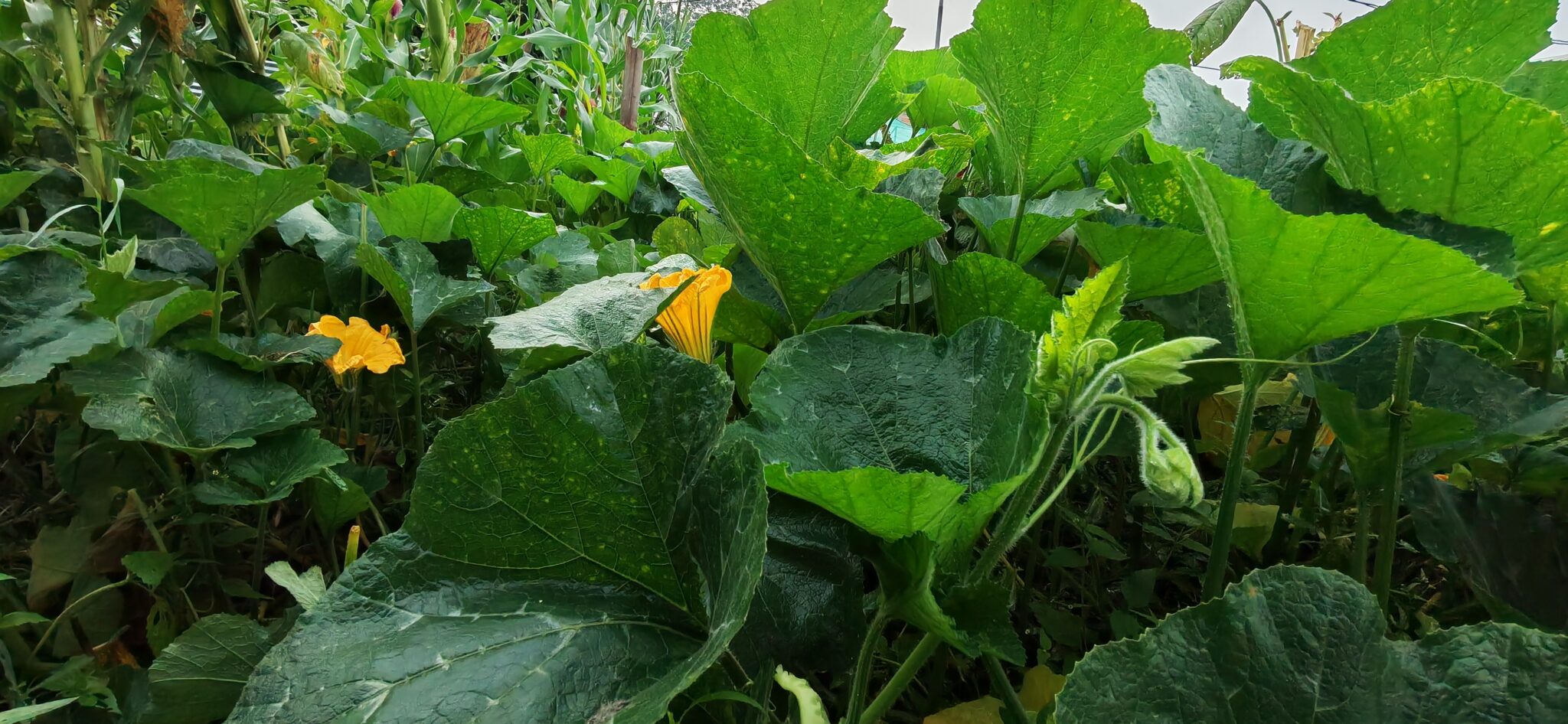
Pumpkin shoots growing in a kitchen garden
But before that, speaking of the history of pumpkins, according to the University of Nebraska-Lincoln in the United States, pumpkin was the first wild plant introduced into the American continent for human consumption through cultivation and breed improvement. Archaeologists have found the oldest domesticated pumpkin seeds in the Guila Naquitz cave located in the mountainous region of Oaxaca, Mexico. Those seeds are up to 10,000 years old. However, selective breeding work took place over thousands of years to develop it into the taste and orange-colored pumpkin that we see today.
Once the Native Americans got the taste they desired, they utilized every part of the pumpkin, including its seeds, pulp, flowers, and leaves. They ate the pumpkin whole by roasting it over a fire, ate it cut into pieces and boiled, ate it as a soup curry, made roasted flour by drying it, and enjoyed it during the off-season. They even made mats and cushions by drying the long vines of the pumpkin.
Today, from Africa to South America, various dishes made by mixing pumpkin shoots, flowers, and leaves into flour to make flatbreads, cooking them into porridge, or turning them into sauces and pickles are widely popular. In Thailand, Vietnam, and Cambodia, communities eat the curled shoots and tender leaves of the pumpkin just like Nepalis do. These shoots are quickly sautéed in a hot wok with garlic, small hot chilies, and oyster sauce, then served while they are still crunchy.
However, the ones who eat it most similarly to Nepalis are the Bengalis. They call it Kumro Shak and prepare many kinds of dishes from it. One popular dish is the Paturi Pakoda, where fish or a spiced paste is wrapped tightly inside large, whole pumpkin leaves into a bundle and eaten entirely after being steamed or pan-fried. Another traditional dish is Kumro Shak Er Chorchori, where chopped pumpkin leaves and shoots are simmered over a slow fire with pumpkin pulp, potato pieces, and pointed gourd pieces. Ground mustard paste, raw mustard oil, and lentil nuggets are then mixed in to finish the dish.
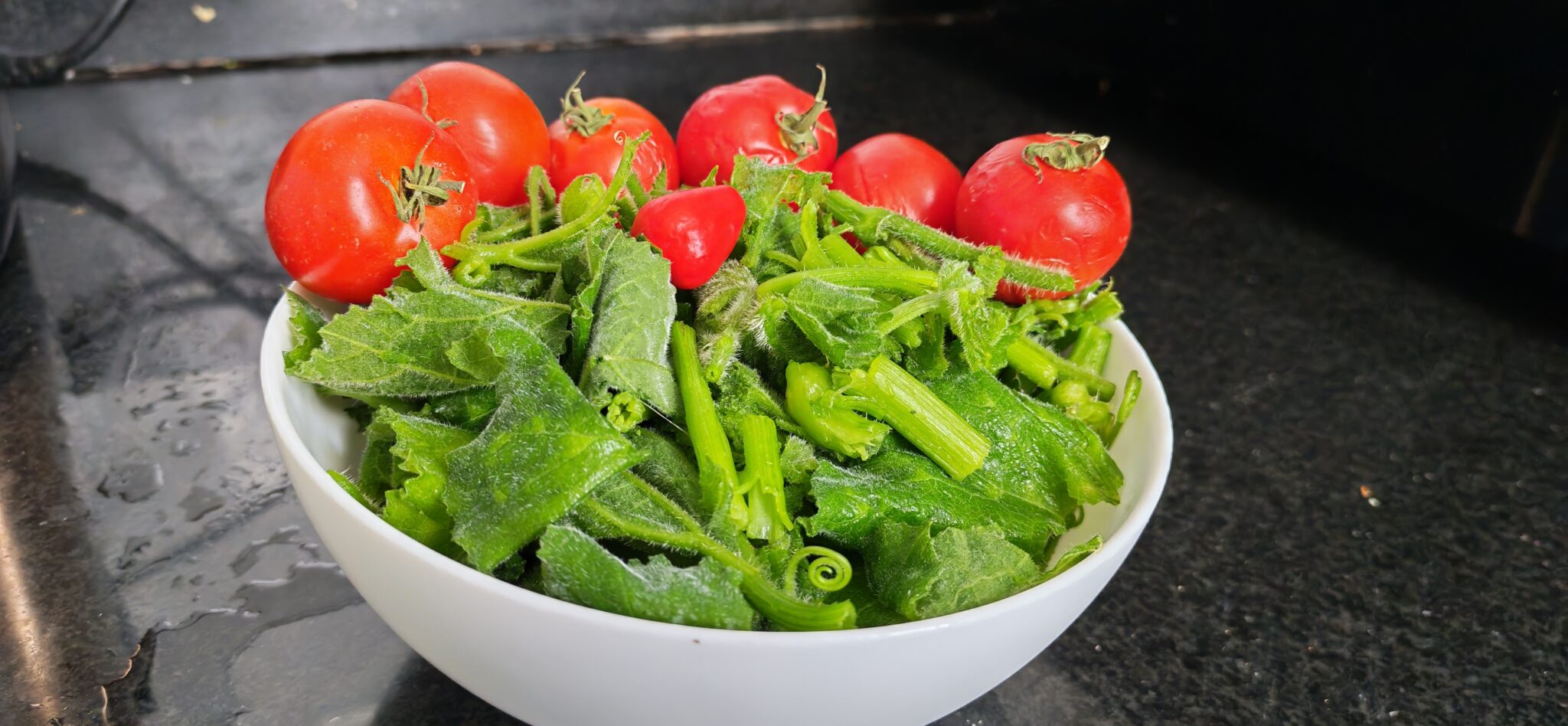
Fresh tomatos and pumpkin shoot
In Nepal, many people cook pumpkin shoots just like regular vegetables. They cook it by adding everything from ground ginger and garlic to cumin-coriander. In this method, after the plucked pumpkin shoots and leaves are washed in clean water, they are left in a colander to dry. Heat two spoons of ghee in a wok. Once the ghee is hot, splutter half a spoon of cumin and half a spoon of fenugreek seeds in it. Immediately after, add two dried chilies and finely chopped garlic, and sauté until lightly red. When the garlic turns red, add half a spoon of turmeric, and immediately after, put the pumpkin shoots into the wok and stir well.
Add salt according to taste, stir once again, cover the wok with a lid, and let it cook over medium heat for five to six minutes. After that, open the lid and stir the vegetables again. Add one spoon of cumin powder and finely chopped ginger to it and mix well. To allow the flavor of the spices to soak well into the shoots, cover them with the lid again and cook for an additional five minutes or so over low heat. This is the method currently in practice. However, doing so brings out more flavor from the spices rather than the pumpkin shoots.
The easiest way, however, is to heat ghee, sputter one chili, pour in the plucked pumpkin shoots, and add a little salt. Cover the cooking vessel for a short while. Remove the pumpkin shoots while they are still green so that they remain crunchy when eaten. When cooked this way, only the aroma of the pumpkin shoots mixed with ghee comes out. There is no need to go through any hassle of adding spices or crushing and grinding ginger and garlic.
Some people even add water to make a soup curry. To cook pumpkin shoots with soup, heat mustard oil or ghee in a wok and spatter fenugreek seeds and garlic. Add the shoots into it and sauté for a while. After the shoots wither a little, add turmeric, salt, and a little cumin powder. Now, pour sufficient water (or the water used to wash rice) into this and let it boil thoroughly. To make it even tastier, some people also add a little ground mustard seeds or soybean powder. Once the shoots and stems are thoroughly cooked, the hot soup can be enjoyed with rice.
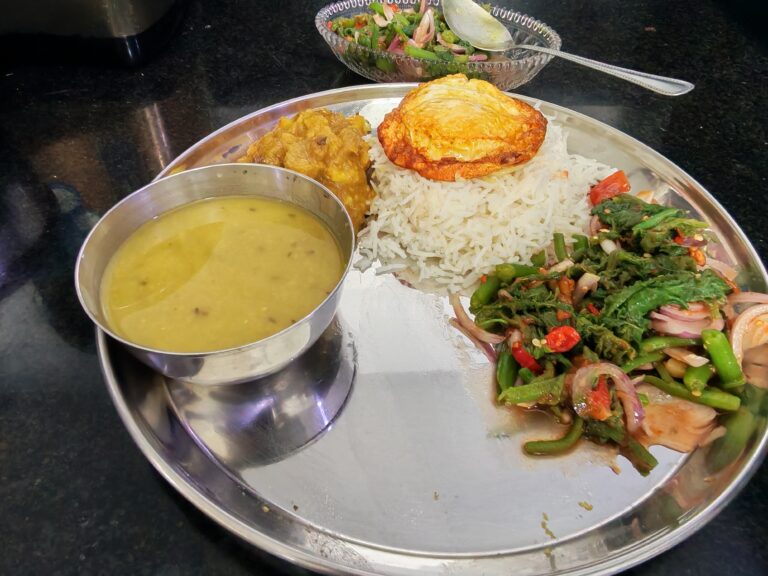
A variation of typical Nepali cuisine, alongside sautéed pumpkin shoots served
When it is a bit expensive, the vegetable made by mixing potatoes with pumpkin shoots is also quite popular among Nepalis. For this, heat two spoons of ghee in a wok. Once the ghee is hot, splutter fenugreek and cumin seeds, and then sauté finely chopped onion and green chilies for a while. After the onion is lightly sautéed, add the pieces of potato. Add turmeric and salt according to taste, and stir well. After that, cover the wok with a lid and let the potatoes cook for two to three minutes.
Open the lid, add ginger-garlic paste and cumin-coriander powder, and mix. Immediately add chopped tomatoes, stir well again, and cook covered until the tomatoes melt. Once the tomatoes are well cooked, add the cleaned pumpkin shoots and stir to mix all the ingredients well. Cover it with the lid again and cook for two to three minutes over low heat. Once the pumpkin shoots are thoroughly cooked, the hot and delicious potato and pumpkin shoot vegetables are ready to be eaten.
In our culture, the pakora or chop made of yellow pumpkin flowers is considered very popular. An easy way to make this is the method of making Japanese tempura. For that, wash the pumpkin flowers with clean water and remove the hard part inside, the pistil. Place gram flour or rice flour in a bowl. Add salt, turmeric, cumin-coriander powder, a little ginger-garlic paste, and water to prepare a thick batter. Now, heat mustard oil in a wok. Dipping the flowers into that batter one by one, drop them into the hot oil and fry until both sides are lightly golden and crispy or crunchy. The Nepali tempura of yellow pumpkin flowers is ready.
If you want to go for a slightly different taste, pumpkin shoots can also be cooked and eaten with eggs, just like in the Kathmandu Valley. In Cambodia, Vietnam, and Laos, there is a tradition of eating pumpkin shoots cooked with eggs. The Bengali style of that same tradition is Kumro Shak Dim Bhaji, which means pumpkin greens and egg vegetables. This cooking method is also simple. Heat one spoon of mustard oil in a wok; once the oil is hot, crack two eggs into it. Adding a little salt, stir and fry the eggs just like making egg bhurji or scrambled eggs.
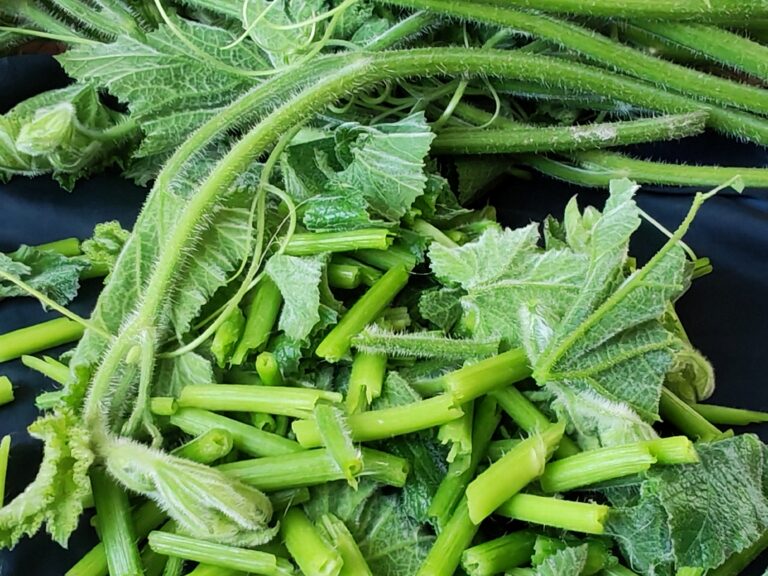
Freshly plucked and ready-to-wash pumpkin shoots
Once the eggs are lightly cooked, take them out into a bowl and keep them aside. Add one spoon of oil to the remaining oil in the same wok. Once the oil is hot, splutter nigella seeds, crushed garlic, and green chilies in it. After that, add chopped onion and sauté until the onion turns brown. Now, add turmeric and salt according to taste into the wok. Add the plucked pumpkin shoots and stir well.
Pumpkin shoots release their own water, so there is no need to add separate water. Stirring occasionally, cook until the pumpkin shoots become soft. Once the pumpkin shoots are well cooked and dry, mix the previously fried eggs into it. Stirring the eggs and shoots over medium heat, fry them for an additional one to two minutes, and Kumro Shak Dim Bhaji is ready.
If you are looking for an even different taste, you can make a pickle out of pumpkin shoots. For this, get pumpkin shoots, boiled potatoes, tomatoes, oil, fenugreek seeds, dried and green chilies, turmeric, salt, roasted sesame powder, and lemon juice ready. Spluttering fenugreek seeds, dried chili, and turmeric in oil, sauté the boiled potatoes for 1 minute.
After that, add the pumpkin shoots and salt, and cook for about two minutes. After adding tomatoes, covering, and cooking for three minutes, the roasted sesame powder, green chilies, and lemon juice are mixed in. If one potato is mashed into powder, the pickle becomes well-coated and even tastier.
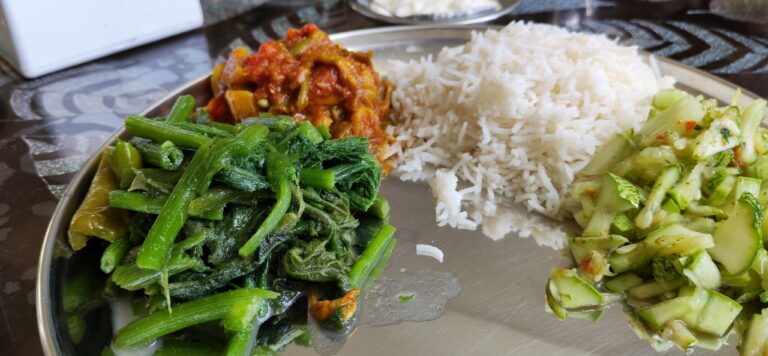
Another variation of typical Nepali cuisine, alongside sautéed pumpkin shoots served
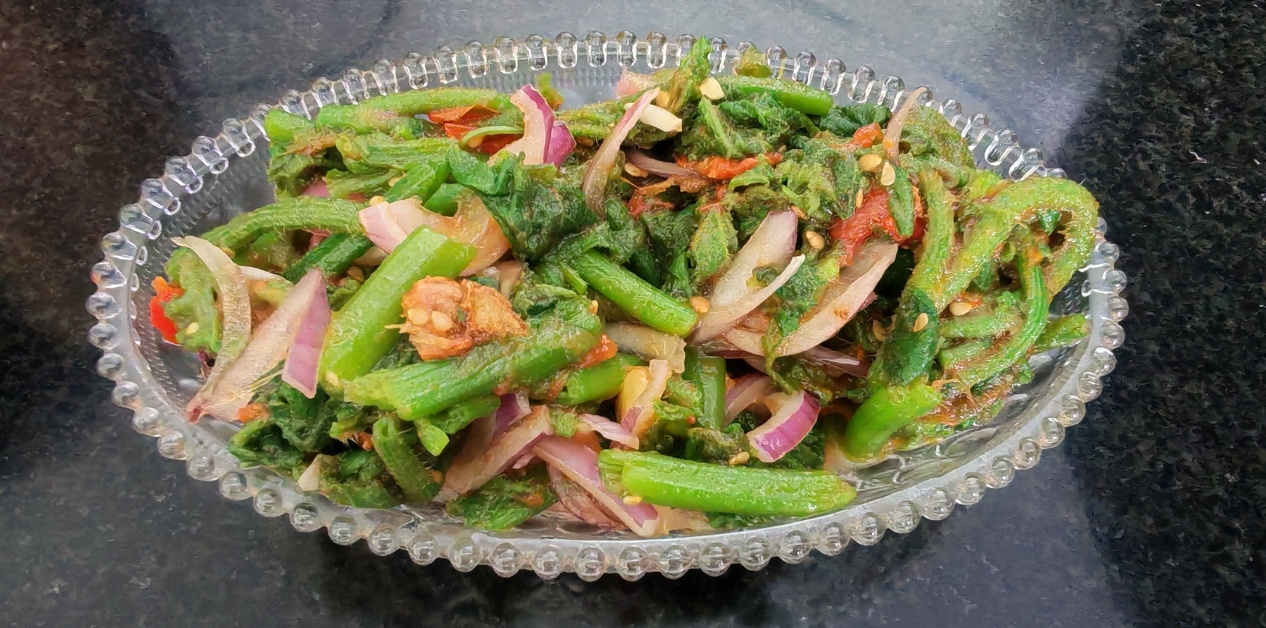
Now, the final recommendation is the marinated (Sandheko) pumpkin shoots. For this, add the plucked pumpkin shoots into boiling water and let it boil for about 2 minutes. After that, take it out, place it in cold water, and squeeze it well with your hands to remove the water. In a large bowl, place roasted tomatoes, onion, chili powder, roasted chilies, cumin powder, salt, and ginger-garlic paste, and mash them thoroughly with your hands to make a thick paste. Add the squeezed pumpkin shoots into the prepared paste. Now, heat oil in a pan, spatter cumin, fenugreek seeds, and garlic, and temper the greens with that oil. Add a little raw roasted mustard oil from the top and gently mix all the ingredients well with your hands. The spicy and delicious marinated pumpkin shoots are ready.
With these many options available, family members surely won’t feel annoyed even if pumpkin shoots are cooked for every single meal. Or will they, though?