Kathmandu
Thursday, July 2, 2026





Education systems across the world are moving toward more digital forms, and Nepal is not an exception. In fact, in many urban schools and universities, this shift is already visible in everyday practice. Online classes, messaging groups, learning management systems, and constant connectivity between teachers, students, and institutions are becoming part of normal academic life.
This transformation is often presented as progress, and there are clear advantages. Information flows faster. Students can access materials more easily. Communication between teachers and students becomes immediate.
Learning is no longer fully tied to physical classrooms or fixed hours. In a country like Nepal, where geography and infrastructure have always shaped access to education, digital tools also open important possibilities for inclusion and expansion.
However, alongside these benefits, there is a need to think carefully about what kind of educational culture is gradually being formed. The concern is not only about technology itself, but about how it reshapes relationships, expectations, and everyday habits of teaching and learning.
One possible direction is that education becomes less structured around shared learning time and more organized around continuous interaction. In such a situation, the relationship between teachers and students slowly shifts. Instead of a stable classroom relationship built around preparation, discussion, and reflection, it begins to look more like a constant flow of questions and answers.
Teachers become expected to respond at any time. Students become used to asking questions at any time. The relationship becomes less about a learning journey and more about immediate responsiveness.
We can already observe small examples of this in daily academic life. A student sends a message late at night asking for clarification on an assignment. A teacher, while resting or doing personal work, feels the pressure to reply quickly. Another message arrives shortly after, followed by another clarification. Even when no formal rule requires immediate response, the expectation begins to form quietly.
Over time, both sides start to treat this continuous availability as normal. What begins as convenience slowly becomes habit. Teachers begin to check messages repeatedly during the day, even outside working hours. Students begin to expect quick replies as part of “good teaching.” The boundary between teaching time and personal time becomes less clear.
Teaching is no longer only something that happens in classrooms or scheduled hours; it becomes something that follows the teacher throughout the day.
In this process, a subtle shift also takes place in how teaching itself is understood. The value of teaching starts to be measured not only by content, preparation, or depth of explanation, but also by speed of response. A “good teacher” may increasingly be seen as someone who replies quickly, stays available, and remains connected.
This may seem like a small change, but over time it can influence how teaching is defined and experienced. This is where a broader structural change begins to appear. Digital systems do not only connect people; they also make interactions visible. Messages show when they are read. Platforms record activity.
Communication becomes traceable. Once visibility is introduced, it quietly creates expectations. If someone is seen as active, they are expected to respond. If someone responds quickly once, it becomes a reference point for future expectations.
Institutions also begin to adapt to these patterns. Even without formal rules, responsiveness can become part of informal evaluation. Teachers who are more available may be seen as more efficient or more committed. Students may also evaluate teaching quality based on how quickly their questions are answered. Over time, responsiveness becomes a kind of invisible performance indicator.
If we step further into the future, especially as education systems around the world become more digital, data-driven, and increasingly supported by artificial intelligence, this tendency may intensify.
Learning environments may become more immediate, more interactive, and more constantly connected. In such systems, it becomes technically easier to expect instant responses. At the same time, it becomes socially harder to delay them.
This raises an important question: what kind of educational relationship are we building through these changes?
One possible outcome is that education gradually shifts toward what can be described as an “enquirer–responder” model. In this model, students are primarily enquirers who ask questions, and teachers are responders who provide answers. The interaction becomes efficient, fast, and continuous. But it also becomes narrower. It risks reducing education to immediate problem- solving, rather than a broader process of intellectual development.
Education, however, has always been more than response. It includes waiting, thinking, revisiting ideas, discussing slowly, and sometimes not having immediate answers. These slower processes are important because they allow students to develop deeper understanding, independence of thought, and critical reflection. If education becomes too focused on immediate response, these dimensions may gradually weaken.
There is also a wider social dimension to consider. Schools and universities are not only places for knowledge transmission. They are also spaces where students learn how to relate to others, how to engage with time, how to deal with uncertainty, and how to develop patience in thinking.
These are civic capacities, not just academic skills. A purely responsiveness-driven system risks shaping students into individuals who expect instant answers everywhere, rather than individuals who can also think independently and engage with complexity.
In Nepal, this discussion is particularly important because we are still in a transition phase. Digital education is expanding, but it is not yet fully stabilized. Urban schools and universities are adopting global models, platforms, and practices, but the long-term cultural effects are still open. This creates an important moment of reflection.
We are not simply adopting technology; we are also shaping how it will define education in our context. Once certain patterns become normalized, constant messaging, immediate expectations, continuous availability, they are difficult to reverse. That is why it is important to think not only about efficiency and access, but also about boundaries, balance, and purpose.
The goal is not to resist digitalization. That would neither be realistic nor useful. The goal is to guide it in a way that supports education as a deeper process. Technology should support learning, but it should not fully redefine what teaching and learning mean.
If we are not careful, there is a risk that education slowly becomes organized mainly around responsiveness. In such a system, the most valued skill may become speed of reply rather than depth of understanding. Teachers may become primarily responders rather than educators in a broader sense. Students may become mainly enquirers rather than learners engaged in reflection and inquiry over time.
A more careful approach would be to preserve space within education for slower forms of engagement. This includes respecting time boundaries for teachers, encouraging thoughtful rather than immediate interaction, and designing systems that support learning without demanding constant availability. It also includes recognizing that not every question requires an immediate answer, and not every interaction needs to happen in real time.
Education should remain a space where students learn not only how to ask questions and receive answers, but also how to think, how to wait, how to reflect, and how to engage with ideas in depth. These capacities are essential for civic life in a complex and changing world.
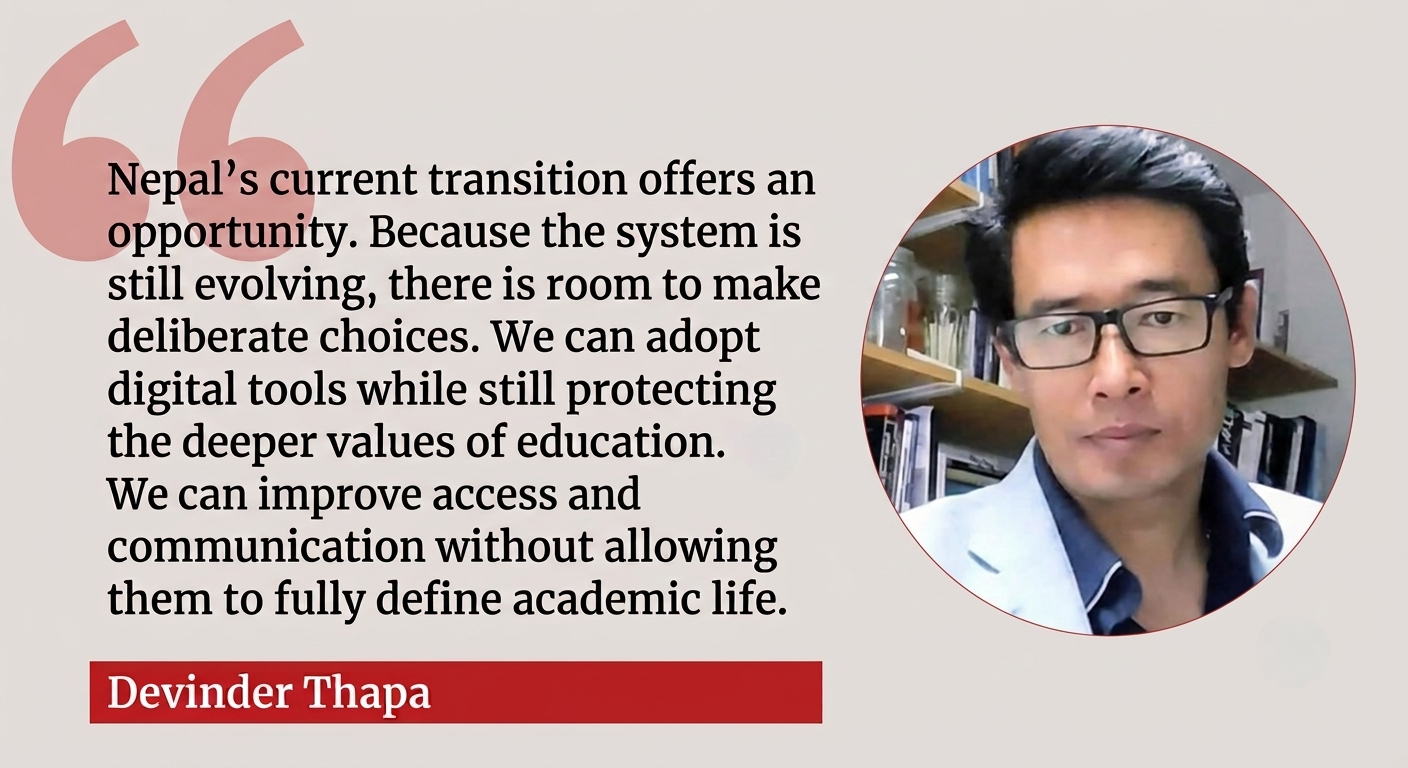
Nepal’s current transition offers an opportunity. Because the system is still evolving, there is room to make deliberate choices. We can adopt digital tools while still protecting the deeper values of education. We can improve access and communication without allowing them to fully define academic life.
The challenge ahead is therefore not simply technical. It is conceptual and cultural. It is about deciding what kind of educational relationships we want to build in a digital future.