Kathmandu
Friday, July 3, 2026





Bill would allow students aged 13–21 to receive military-style training and serve as national volunteers, drawing criticism over child rights, militarization, and the Nepal Army's role.
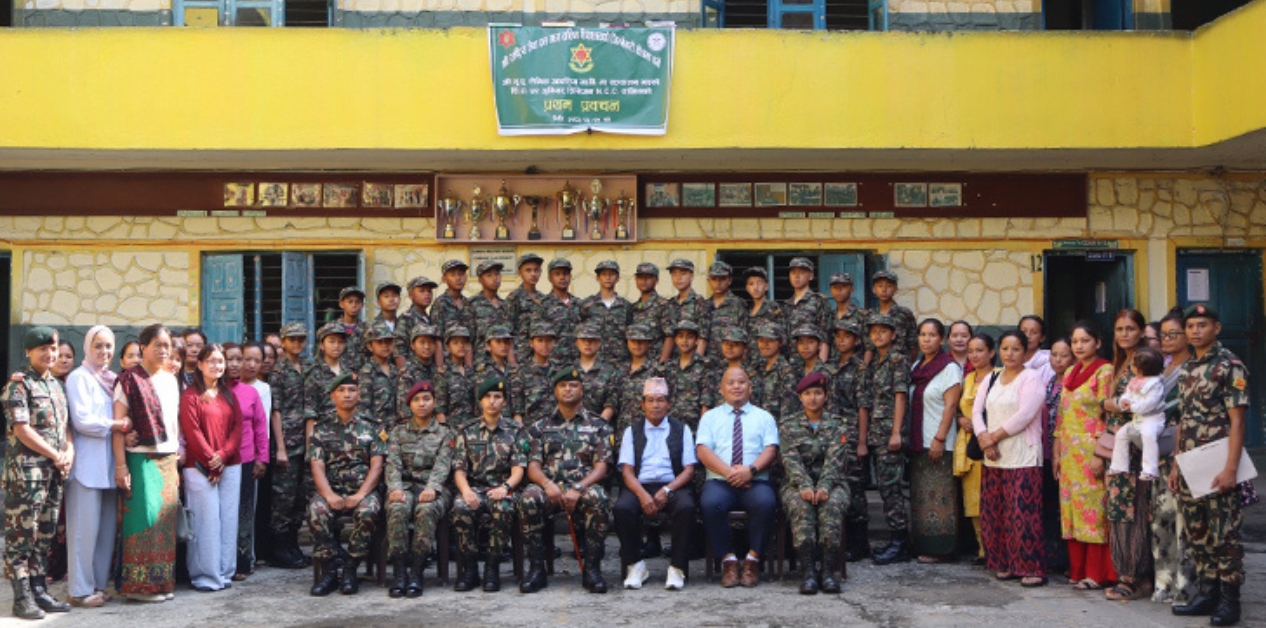
The government has tabled a bill in parliament to arrange training for school-level students through the National Service Corps (NCC). The bill will prepare the legal foundation to train students as “cadets” and deploy them as volunteers in national service when necessary.
On June 30, the “Bill Formulated to Amend and Integrate the Law Related to the National Service Corps” was registered in the House of Representatives. Registered on behalf of Prime Minister and Minister for Defense Balendra Shah, the bill proposes provisions for conducting National Service Corps training and deploying the trained human resource in service to the nation.
According to the bill, the National Service Corps will remain under the Ministry of Defense, and students studying in community and institutional schools will be selected and trained based on specified criteria. Students from classes 8 to 10 who have completed 13 years of age and have not exceeded 18 years will be allowed to participate in the Junior Division. Students studying in classes 11 and 12 who have completed 16 years of age and have not exceeded 21 years will be eligible for the Senior Division.
It is mentioned in the bill that the main task of the Service Corps will be to make school-going students patriotic, public-serving, moral, and disciplined human resources through training. A provision has been proposed making the Prime Minister the Chief Patron and the Defense Minister the Patron of the Service Corps. Along with students, the government can also provide training to other individuals and institutions based on necessity. Those receiving training must wear uniforms as prescribed by the Nepal Army.
To make policy decisions regarding the operation of the Service Corps, there will be a Directive Committee under the chairmanship of the Defense Minister. The Chief of Army Staff of the Nepal Army, the Defense Secretary, the Secretary of the Ministry of Education and Sports, the Chief of Staff of the Army, and the Director General of the Service Corps will be members of the committee. The Director General of the Service Corps will function as the Member-Secretary.
As the bill is currently under discussion in the House of Representatives, its final shape will be determined only after the parliamentary process. It remains to be decided whether parliament will pass it as it is or move it forward with amendments.
Basis and objectives of the bill
The bill mentions that the government’s objective in creating separate legal provisions for the Service Corps is to prepare human resources possessed of a spirit of service toward the country and high morale. The government argues that such a provision is necessary for the effective implementation of the policy related to national unity and national security under Article 51 of the Constitution.
The bill aims to make citizens ready and capable of serving the country in accordance with national needs. The government’s policies and programs for the fiscal year 2020/21 included programs related to youth mobilization, and the decision of the meeting held on May 6, 2020, under the chairmanship of the then Chief of Army Staff Purna Chandra Thapa has also been mentioned as a basis for the bill.
Provisions have been proposed to mobilize volunteers through the Service Corps in public service, infrastructure development, disaster management, epidemic control, nature and environmental conservation, culture and heritage conservation, security, sports, and other areas deemed necessary at the time. Such volunteers can be deployed as prescribed under the command of the Nepal Army.
The bill states: “To prepare human resources filled with national sentiment and high morale for the Nepal Army, other security agencies, and various services of the government; and to develop a sense of cultural harmony and national unity by instilling a sense of pride toward national values, original civilization, traditions, and culture.”
Questions of child rights and militarization
Since the bill makes provisions to train students through a military structure, questions have been raised about its objectives and scope. Security affairs expert Shobhakar Budhathoki states that the proposal for the Service Corps seems to enter into matters outside the organization, jurisdiction, nature, and structure of the Army.
“The issue of training children through a military structure is entirely different. This raises the question of whether it aims to inspire students toward militarization,” Budhathoki says. “This is not like the training given in the Scouts. Training provided through military methods is not appropriate for children.”
He adds that raising public awareness is not the core responsibility of the Army. In his view, it would be more natural for the Nepal Police to provide training regarding social issues, crime-free societies, drug awareness, traffic awareness, or anti-addiction campaigns.
“There is an absence of sufficient clarity in the Act. It will be discussed in parliament, and we do not know how it will be passed,” he says. “The question also arises whether there is an unseen objective rather than the visible one. This must be viewed seriously from the perspective of child rights and the Convention on the Rights of the Child, to which Nepal is a party.”
The Supreme Court has also recently cautioned the government against involving children in military activities. On June 12, in a lawsuit filed by Lenin Bista, a former child soldier of the armed conflict, against Pushpa Kamal Dahal and the Government of Nepal, the Supreme Court issued a directive order in the name of the state to formulate a law completely prohibiting the inclusion or use of children under 18 years of age in military forces.