Kathmandu
Tuesday, July 7, 2026





The party's fourth amendment expands the chairman's powers over party structures, election tickets and parliamentary affairs, prompting fresh debate over internal democracy

KATHMANDU: The Rastriya Swatantra Party endorsed its fourth statute amendment at its first general convention in Chitwan in June 2026. The revised charter expands the Central Committee to 158 members, formalizes a chairman-nominated bloc of 51 seats, and, most consequentially, ties the survival of the party’s “parliamentary party leader,” the post currently held by Prime Minister Balendra Shah, to compliance with policy direction issued by party chairman Rabi Lamichhane.
The changes have reopened debate over how power is now distributed between Nepal’s two most visible RSP figures.
What exactly did the RSP endorse in Chitwan, and why does it matter beyond party circles?
The RSP’s general convention formally adopted the fourth amendment to the party’s foundational statute, the internal charter that governs everything from membership rules to how the party selects a prime minister. This matters well beyond internal party bookkeeping because the RSP currently leads Nepal’s federal government with close to a two thirds majority in the House of Representatives, meaning the internal rules that bind its lawmakers effectively shape how the country is governed.
The fine print of this document has direct bearing on the stability of the national government. A revision that concentrates authority in the party chairman therefore has consequences that ripple into Singha Durbar, parliament, and the council of ministers, not merely into the party’s central office in Kathmandu.
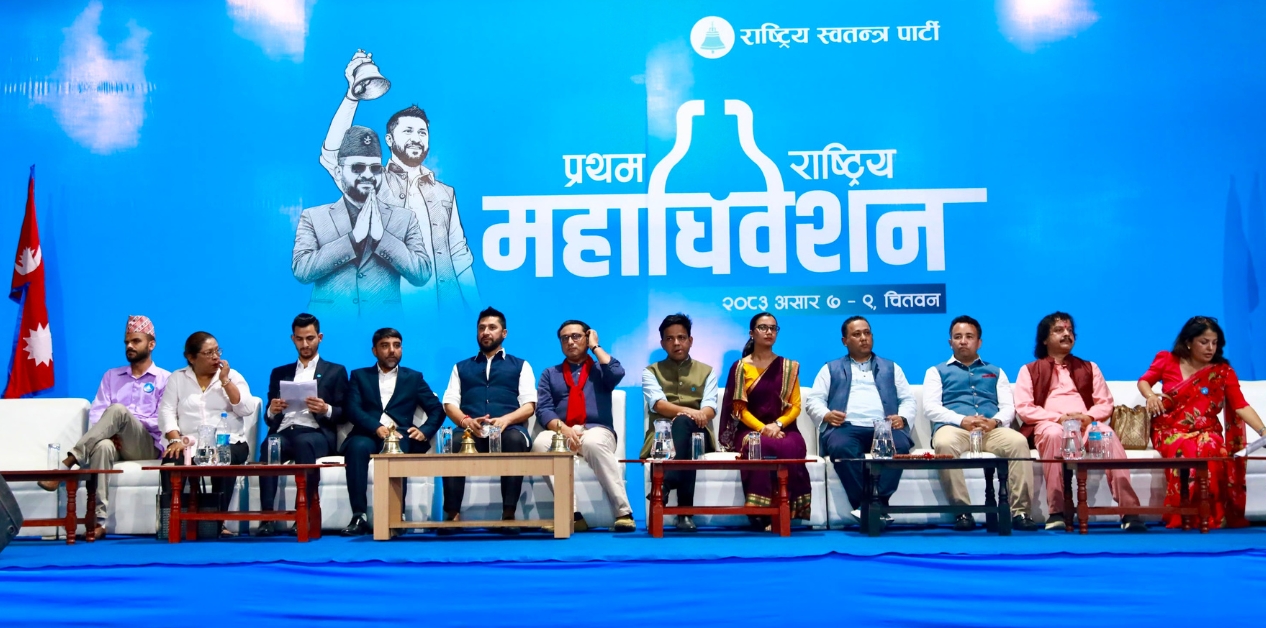
Leaders participating in the closed session of the RSP in Chitwan. Photo: Nepal Photo Library
When and where was the statute endorsed, and what prompted this particular revision?
The RSP’s first general convention took place in Chitwan from June 21 to 26, 2026, and the party’s own printed statute records the amendment date as June 23, 2026. The revision was driven by the party’s rapid transformation from a four-year-old movement into the country’s largest political force.
Party leaders said the existing framework no longer reflected the party’s expanded base, with proposed revisions centered on enlarging the leadership structure, adjusting internal representation, and accommodating members who had joined through recent mergers and political realignments.
In effect, a statute drafted for a small insurgent outfit was being rebuilt for a party now running the national government, and the convention was billed by RSP officials as the moment the party matured from a movement into a structured, institutionalized political organization with settled internal rules.
What political philosophy and vision does the amended statute set out for the party?
The statute’s early chapters lay out a fairly detailed ideological and policy self-description rather than a bare list of slogans. It commits the party to disciplined, value-based politics aimed at ending corruption and impunity through rule-based governance, and to a “social democracy” model balancing public, private, and cooperative sectors toward inclusive prosperity.
On foreign policy it commits to sovereignty, territorial integrity and a non-aligned, balanced diplomatic posture toward neighbors and the wider international community, invoking the Panchsheel principles by name.
It also dedicates a clause to environmental protection and sustainable development given Nepal’s geography.
Separately, the document commits the party to replacing a traditional manifesto with what it calls an “electoral covenant,” a document meant to carry legally and morally binding timelines, budgets and delivery roadmaps, with annual public review of implementation, rather than being treated as a one-time campaign document that is forgotten after voting.
How is the party organized from the ward level up to the national center?
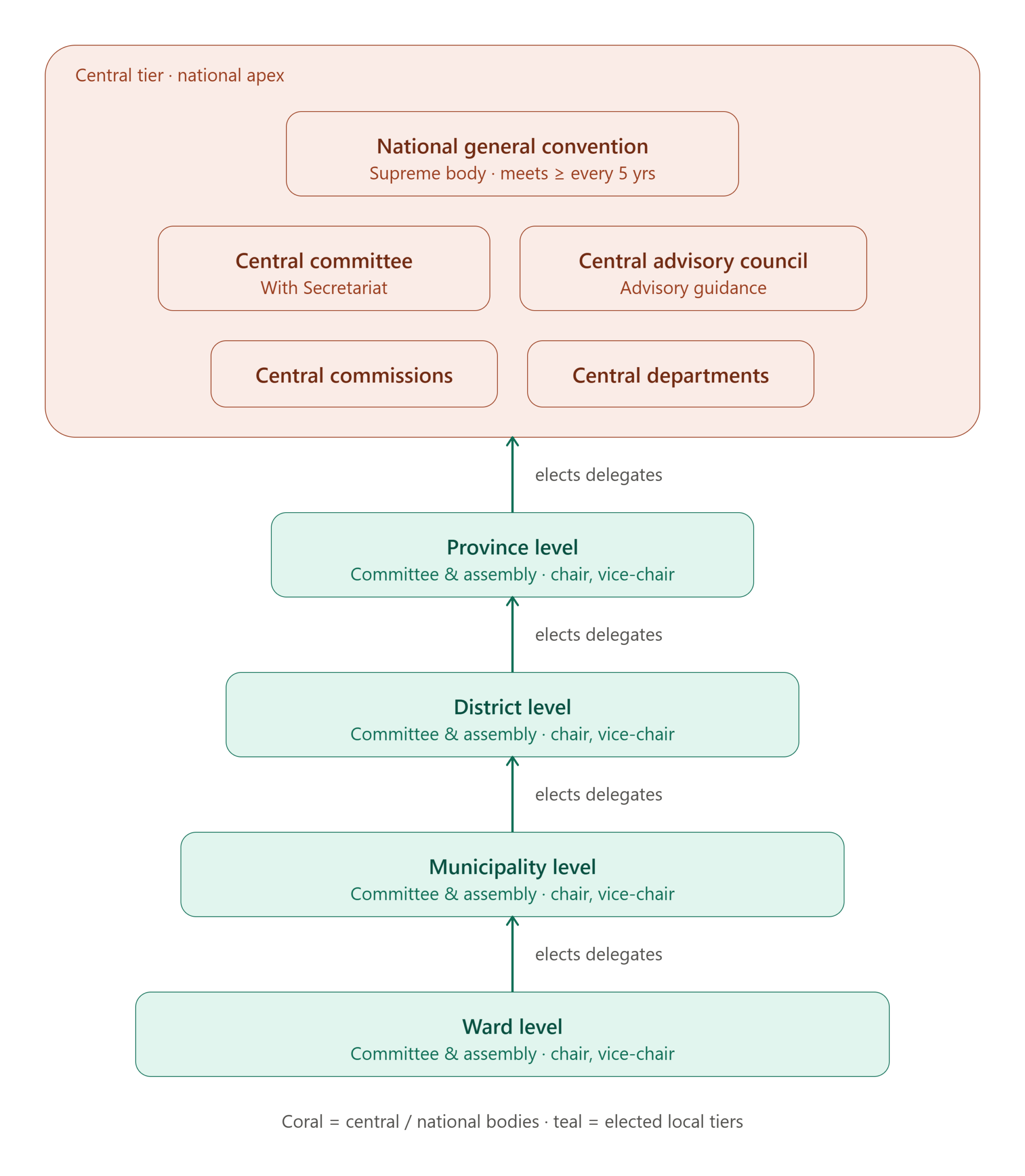
The statute lays out a four-tier organizational pyramid. At the base sit ward committees and ward assemblies, followed by municipality-level committees and assemblies, then district committees and assemblies, then province-level committees and assemblies, each with its own chair, vice chair, and periodic assembly that elects the tier above it.
At the apex sits the central tier, comprising the National General Convention, the Central Committee together with its Secretariat, a Central Advisory Council, central commissions, and central departments.
Structurally, this means authority flows upward through a chain of elections, where local units elect representatives to district assemblies, district assemblies feed into provincial assemblies, and provincial structures in turn send delegates to the National General Convention, which is constitutionally the party’s supreme policymaking body and is required to meet at least once every five years.
What does the new 158-member Central Committee actually look like?
The Central Committee, described in the statute as the party’s highest executive organ, is now fixed at 158 seats. Of these, one is the chairman, directly elected by convention delegates; 99 are ordinary central members elected directly by convention delegates, split between a national list and provincial lists; 51 are nominated directly by the chairman after his own election; and 7 are ex officio seats reserved for the chairs of the party’s seven provincial committees.
This means that roughly one third of the entire Central Committee, the party’s top decision-making body, owes its seat directly to the chairman’s personal choice rather than to any election, a design that political analysts have said reflects a clear pattern of concentrating power in the hands of the chairman, carrying the risk of making party leadership autocratic and undermining internal democracy over time.
How is the party chairman elected and what happens to a candidate who loses?
Any candidate for chairman must have already served a full term as a Central Committee member, and the post is filled through a first past the post ballot of convention delegates, meaning whoever wins the largest share of valid votes is declared elected outright, with no runoff requirement.
The statute then adds an unusual cushion for internal unity: whichever losing candidate secures at least 10 percent of the total valid votes cast is automatically granted a seat on the Central Committee regardless of the outcome.
This “runner up” guarantee is explicitly designed to prevent internal splits or breakaway factions after a contested leadership race, essentially buying the loser continued relevance and a formal seat at the table rather than leaving them and their supporters outside the tent. In the 2026 convention this provision was moot in practice, since Lamichhane ran unopposed and was re-elected without a contest.
What day to day executive powers does the statute grant the party chairman?
The chairman is defined in the statute itself as the party’s supreme executive chief, its principal ideological guide, and the living symbol of party unity, a description that goes well beyond a ceremonial or purely presiding role. Concretely, the chairman convenes and presides over the National General Convention, the Central Committee, officebearers’ meetings and the Secretariat, and casts the deciding vote whenever a meeting he chairs ends in a tie.
He supervises implementation of decisions taken by every subordinate committee, department or commission and can issue binding directives to enforce them. Within limits set by the statute, he appoints, reshuffles and reassigns the heads and members of central level committees, departments and commissions, and he leads and signs off on the final selection and official nomination of every candidate the party fields in federal, provincial or local elections, giving him effective control of the party’s election ticket.
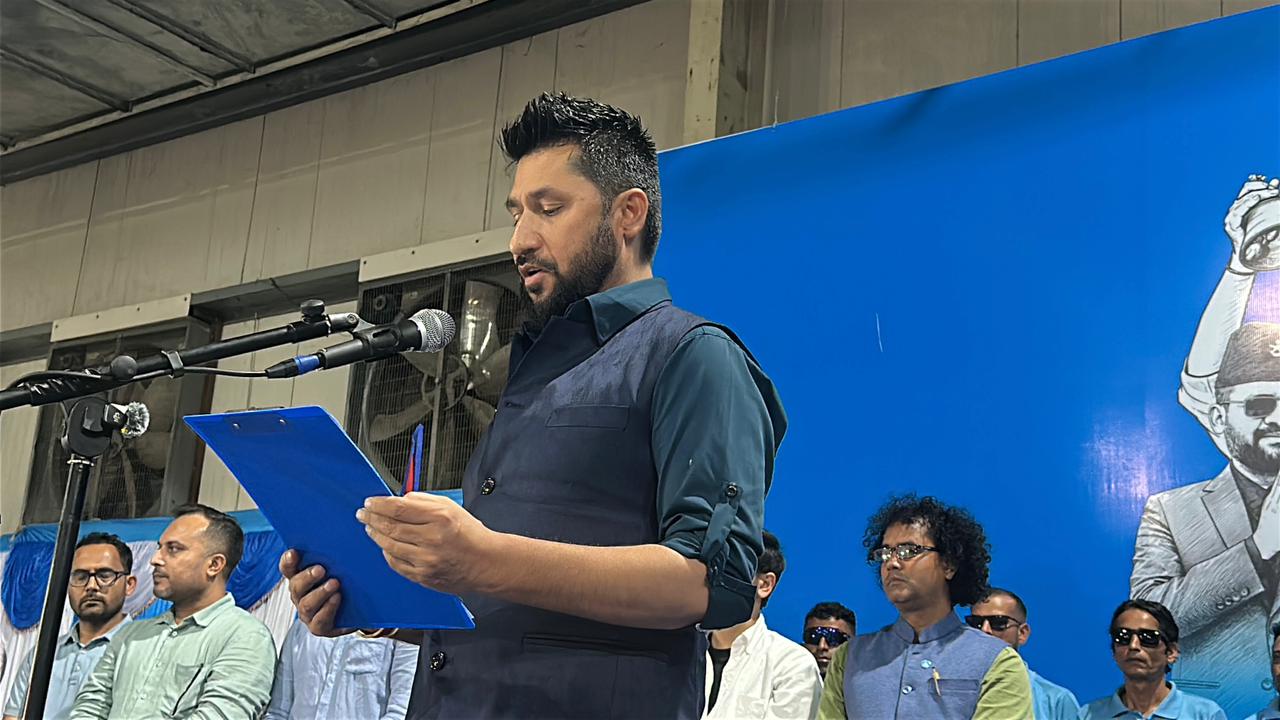
Newly elected RSP chairman Rabi Lamichhane
What is the chairman’s “reconsideration privilege” and does it function like a veto?
Yes, in substance it operates as a suspensive veto. The statute grants the chairman a specific “privilege of reconsideration” over any decision taken by the Central Committee or by any other party organ, if in his judgment that decision seriously harms the party’s core principles, its statute, or the national interest.
Where this applies, the chairman can decline to implement the decision once and send it back for reconsideration along with his stated reasons, effectively freezing it. The only way to overcome this is for the Central Committee to repass the identical decision by a two thirds majority of its currently serving members, at which point the chairman is bound to accept it.
The statute also separately gives the chairman power to immediately suspend any member or office-bearer at any level on preliminary findings of indiscipline or reputational harm to the party, subject only to later Central Committee confirmation, and power to name an acting chairman or acting officebearer whenever a post falls vacant or its holder is unavailable.
How does the statute define the “parliamentary party” and how does it relate to the wider organization?
The statute defines the parliamentary party as the organized body of the party’s elected or nominated members sitting in the federal parliament, meaning the House of Representatives and National Assembly together, or in a provincial assembly.
Its stated purpose is to translate the party’s electoral covenant, policies and principles into law and national policy through parliament, to keep members bound to party discipline and whip so the party presents a unified and effective front in the chamber, and to maintain continuous coordination between the party’s central leadership and its lawmakers.
A separate federal parliamentary party and provincial parliamentary party are formed after each relevant election, each with its own leader, deputy leader, chief whip, one or two whips (statutorily required to be of different genders when there are two), and a treasurer and each body’s term automatically expires when the underlying parliament’s own term ends.
Under the statute, who actually becomes prime minister when RSP leads the government?
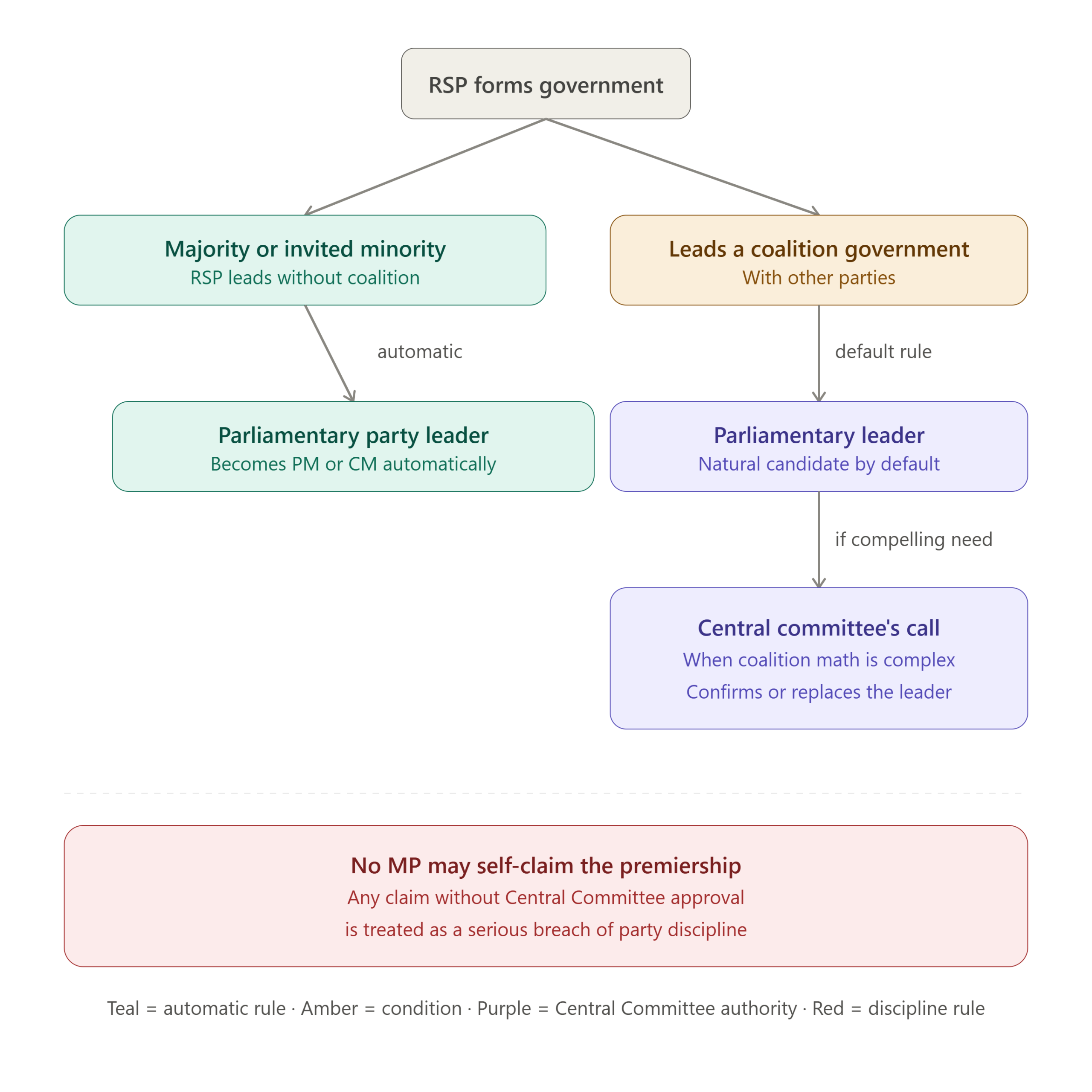
The mechanism is deliberately close to automatic in the simplest case. Where the RSP wins a clear single majority in the House of Representatives or a provincial assembly under the relevant constitutional provision, the person who has been chosen as leader of the parliamentary party automatically becomes prime minister or chief minister, with no further internal party decision required.
Where RSP emerges as the largest party but without an outright majority, and is invited to lead a minority government, the same rule applies, the sitting parliamentary party leader becomes the head of government by default.
The statute is explicit that no individual member of parliament may stake an independent claim to the post of prime minister or chief minister without the Central Committee’s prior institutional approval, and doing so without it is treated as a serious breach of party discipline, closing off any freelance bid for the top job.
What happens if RSP has to lead a coalition government rather than govern alone?
Here the statute carves out an explicit exception that hands final say to the party’s Central Committee rather than to parliamentarians themselves. In the ordinary course, if RSP forms a coalition with one or more other parties and gets to lead it, the parliamentary party leader remains the natural candidate for prime minister or chief minister.
But the statute then states that if the complex political circumstances of coalition-building, the underlying balance of power, or strategic considerations create a compelling need to send someone other than the parliamentary party leader to head the government, the final decision on that question belongs solely to the party’s Central Committee.
This is a meaningful reservation of power: it means that even a sitting parliamentary party leader is not statutorily guaranteed the premiership the moment coalition math gets complicated, and the Central Committee, where the chairman’s influence is heaviest, holds the last word.
Under what conditions can a sitting parliamentary party leader, in effect the prime minister, actually lose that post?
The statute lists several trigger conditions under which the post becomes automatically vacant: the leader’s own written resignation or death; losing one’s seat in the relevant house, whether through expulsion or the end of a term; leaving the party voluntarily or being expelled from it; losing a floor vote of confidence while heading a government; a passed motion of recall or no confidence within the parliamentary party itself; and, notably, failing to follow policy direction issued by the party chairman under the specific chairman’s powers clause discussed below.
Beyond automatic vacancy, the statute separately provides a formal recall process, in which at least one quarter of the relevant parliamentary party’s sitting members can register a motion, the leader is guaranteed a hearing to defend himself, and a subsequent secret ballot of only that chamber’s party MPs, not ordinary party members, decides the outcome by a simple majority of those MPs.
Where exactly is the chairman’s leverage over the parliamentary leader’s job security written into the statute?
This is the clause the party’s internal politics is really organized around. In the chairman’s powers section, the statute specifically provides that whenever the chairman himself is not the parliamentary party leader, he retains the authority to issue the parliamentary party necessary policy direction to ensure the party’s official positions, principles, decisions and outlook are effectively represented and implemented in parliament, and it explicitly states that following such direction is a mandatory duty binding on the parliamentary party as a body, on its leader, and on its individual members.
The statute’s separate list of automatic vacancy grounds for the parliamentary leader then cross-references this exact provision, making a documented failure to follow the chairman’s policy guidance one of the specific conditions under which the parliamentary leader’s post is automatically treated as vacant, without requiring the full recall vote described above.
What does this mean concretely for the working relationship between Chairman Rabi Lamichhane and Prime Minister Balendra Shah?
It creates a structural asymmetry that predates this amendment but is now written more explicitly into the charter. Balendra Shah became parliamentary party leader, and therefore prime minister, after a joint meeting of the Central Committee and Parliamentary Party unanimously approved Lamichhane’s proposal to make him party leader, following a prior seven point agreement in which Lamichhane would remain party chairman while Shah would be the party’s prime ministerial candidate.
That arrangement already positioned Lamichhane as the party’s institutional gatekeeper. The new statute goes further by making adherence to the chairman’s policy direction a codified condition for Shah’s continued hold on the premiership, and by giving the chairman a suspensive veto over Central Committee decisions more broadly.
Commentary around the convention has noted that this consolidation of power theoretically leaves Lamichhane able to challenge the prime minister at any time, even as both men’s convention speeches were read by party insiders as signaling that Lamichhane will focus on running the party while Shah runs the government.
An earlier flashpoint, the RSP’s disciplinary commission-driven removal of a minister widely read as a proxy contest between the Rabi and Balen camps, showed this dynamic already playing out in practice before the fourth amendment was even finalized.
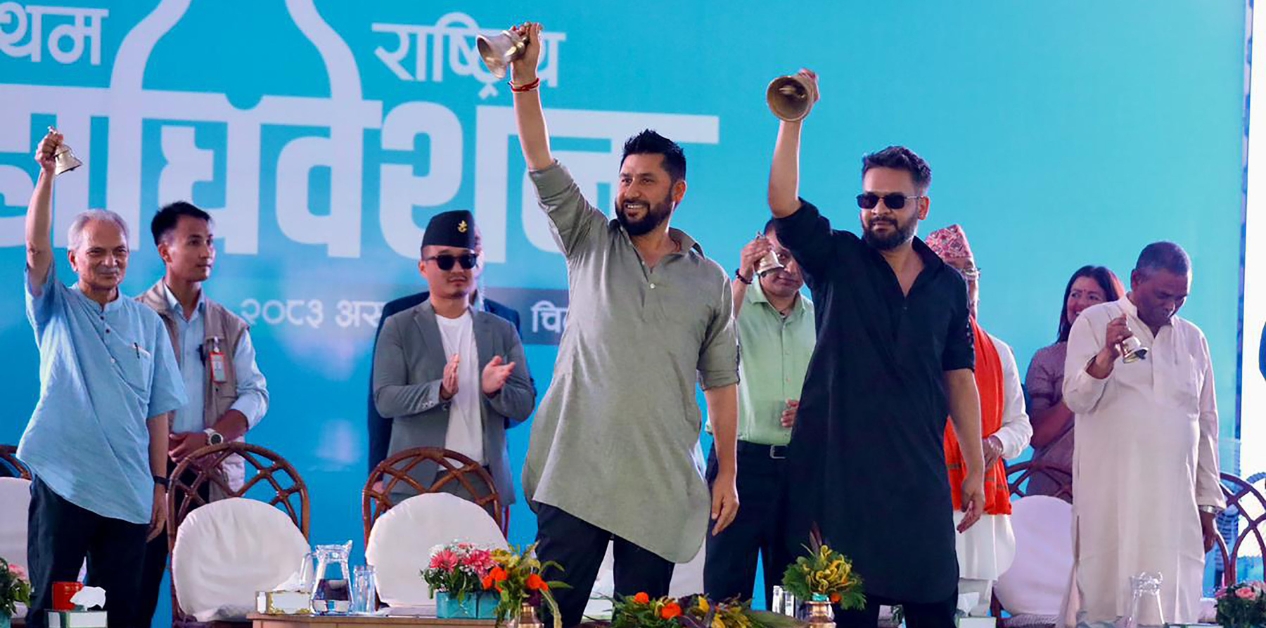
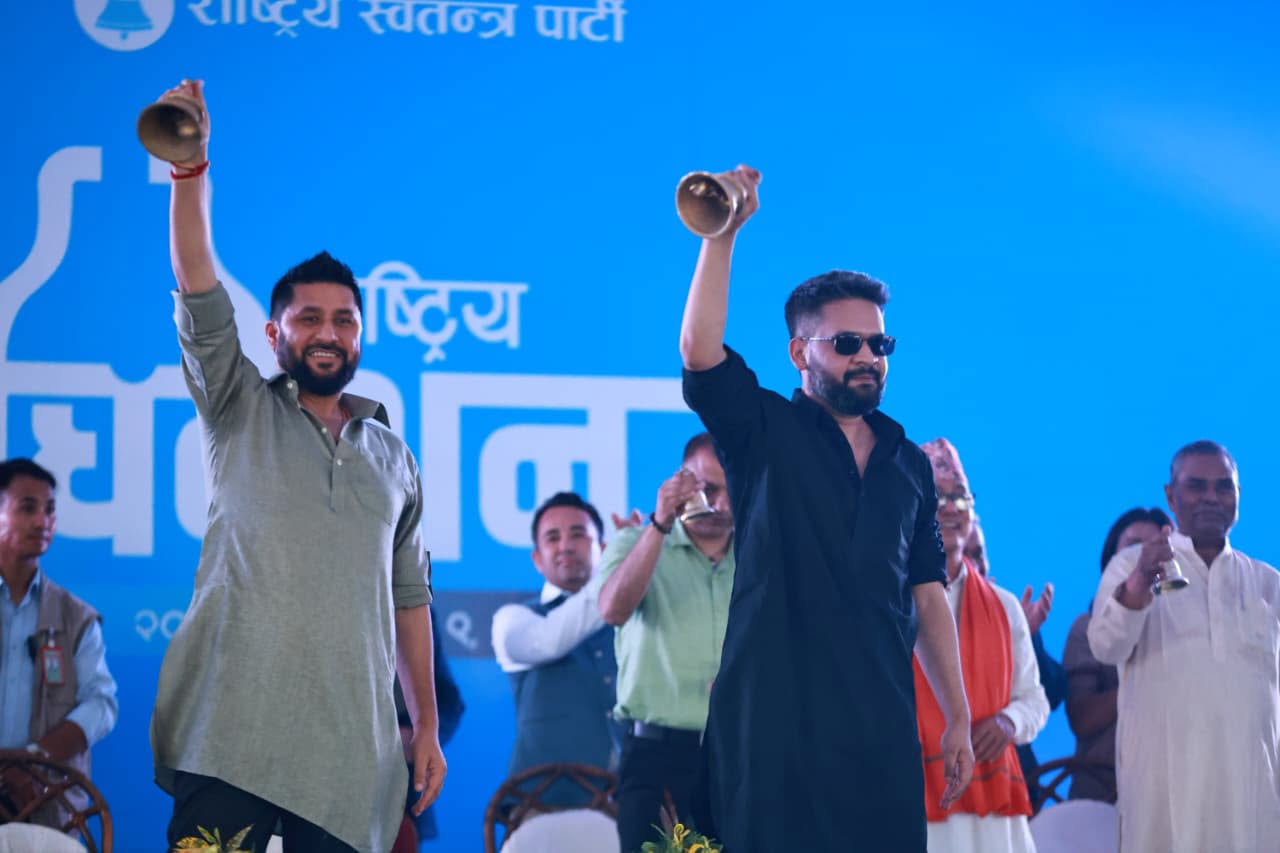
Chairman Rabi Lamichhane, Senior Leader Balendra Shah, and other leaders inaugurating the first general convention of the Rastriya Swatantra Party by ringing the bell. Photo: RSS
Does the statute give ordinary voters or party members any recall power over elected officials generally, separate from the prime minister specific process?
Yes, this is a distinct and long-standing RSP provision, not new to this amendment. Article 69 of the statute grants party members the authority to recall representatives if their performance is deemed unsatisfactory, and the mechanism differs by how the representative was elected.
For lawmakers elected under the first past the post system, the authority to initiate a recall lies with the party’s ordinary members in that specific constituency, whereas for lawmakers elected through proportional representation, the power to recall rests with the party’s central committee, which can act if a PR member works against party interest or performs poorly.
In practice, replacing a PR lawmaker is administratively simple since the party can nominate a replacement from its pre-submitted closed list, while removing a directly elected first past the post lawmaker is legally harder because it requires an actual by-election, making that route riskier and more costly for the party to pursue even where the statute permits it.
What new candidate selection and membership development structures does this statute introduce?
Beyond formal membership tiers (general, active, life, and honorary members, each with different rights and obligations), the amended statute creates a “Candidate Club” and a “Leadership Academy” as mandatory gateways into elected office.
Anyone hoping to stand as an RSP candidate at any level must first formally register with the Candidate Club, and only party members who meet time-in-party and eligibility thresholds set by a separate candidate selection framework may apply, although the Central Committee can approve a “lateral entry” route for outside experts or established public figures in special circumstances, provided they still complete the full vetting process.
Everyone in the Candidate Club must then complete mandatory training through the Leadership Academy, and passing its competency assessment is a binding precondition before a prospective candidate can advance to the next stages of evaluation and a mandatory internal primary election, which the statute makes compulsory for every level of election the party contests.
What criticism has this power concentration drawn, and how do RSP leaders defend it?
The core criticism, voiced by outside analysts and echoed quietly within the party, is that the chairman’s growing authority to nominate a third of the Central Committee, control candidate nominations, suspend officials unilaterally, and hold a reconsideration privilege over Central Committee decisions risks tilting an avowedly anti-establishment, reformist party toward the same personality-centered, top-down control it built its identity opposing.
Political analysts have warned that such arrangements carry the risk of making party leadership autocratic and of jeopardizing internal democracy, while urging the RSP to ensure this authority is used constructively rather than misused.
Party leaders counter that the changes were driven by practical necessity rather than personal ambition, arguing that centralized nomination powers help absorb factions that joined the party through recent mergers and prevent splits, and pointing to newly added inclusion guarantees, such as the runner up’s automatic Central Committee seat and mandated women’s representation among office-bearers, as evidence the amendment also strengthens rather than only narrows internal democracy.
![Law enforcement fails inside Singha Durbar [Photo Feature]](https://english.nepalnews.com/wp-content/uploads/2026/07/Sihadarbar_Parking_-654-768x512-1.jpg)