Kathmandu
Saturday, July 11, 2026





Chronicling the local resistance and heavy corporate penalties faced by families when the government uprooted the traditional administrative hub of Bandipur
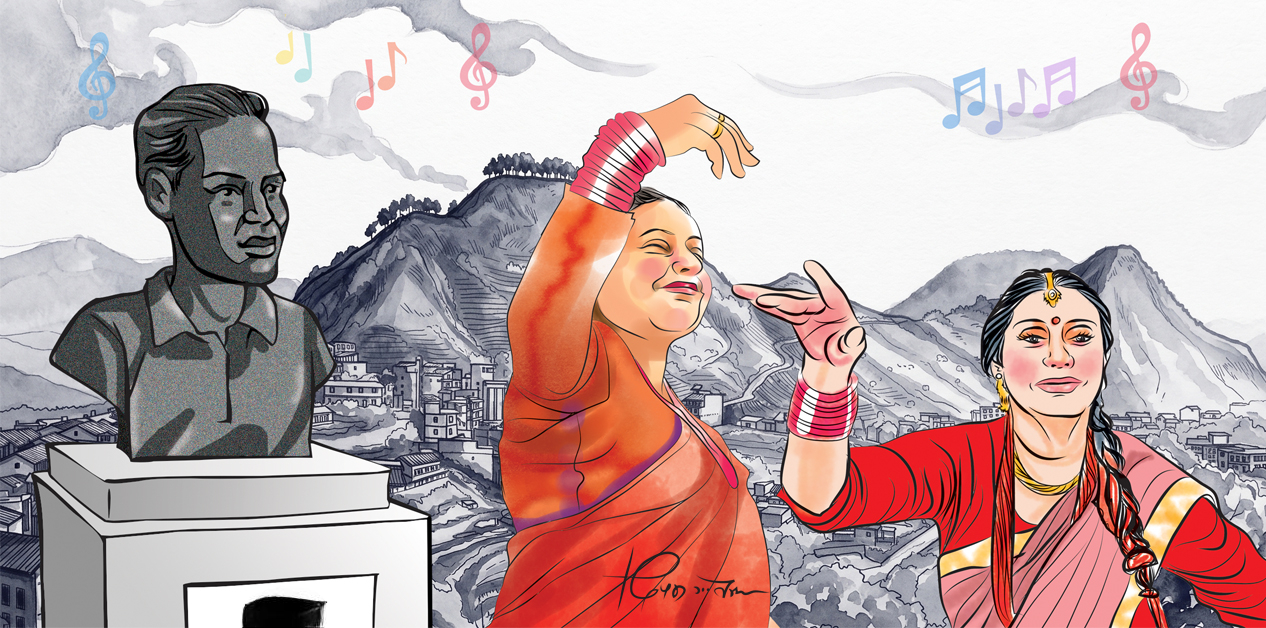
For households in the Gandaki region, Chitwan District used to be the first choice for migration. There is a significant presence of people in our area who descended from Lamjung-Tanahun to Chitwan in this manner. The place under Bharatpur Metropolitan City where the office of Ward No. 7 is currently located is known by the name Shami ko Chautaro. A little further from there is 13 Saal Chowk. Since there was a majority of people who descended to Chitwan around the year 1956, the name of the intersection itself was kept as 13 Saal, which is the Nepali year in the Bikram Sambat calendar. On the threshold of festivals, singing and dancing competitions used to take place at places like Shami ko Chautaro, 13 Saal Chowk, and Buddha Chowk, among others. Young men and women adorned in Magar attire would reflect memories of migration through songs while enjoying the following:
Jau na nani Chitaune phataima
Ke po chha ra pahade kanthaima.
Which roughly translates to:
Let’s go, guys, to the plains of Chitwan
There is nothing here on the hills’ edges.
Perhaps in search of plain plains and an easy livelihood, our family migrated down from Lamjung to Chitwan. In this same manner, our maternal grandparents, along with their entire family, had come from Tanahun to become our neighbors. All the daughters of my maternal home knew a song by heart:
Lyauna ta lyaye baba, Bulli Khola tarera
Bhat ko chhoro Nirmal ko jainai marera
Which roughly translates to:
They did bring it, father, crossing the Bulli River
By taking the very life of Nirmal, the son of Bhat.
On the threshold of Teej, this song would reverberate loudly. They would sing the sorrowful melody in sweet voices. When I was young, what was the underlying meaning contained in the words of the song? There was no question of being concerned. When thinking about it later, it felt as if this song carried some terrible historical event along with it. Especially, curiosity was added as to where the context of Bulli River and the individual Nirmal connected. During the past Teej, amid a casual gathering with sisters, the context of this song was raised again. However, no one close to us had information about this.
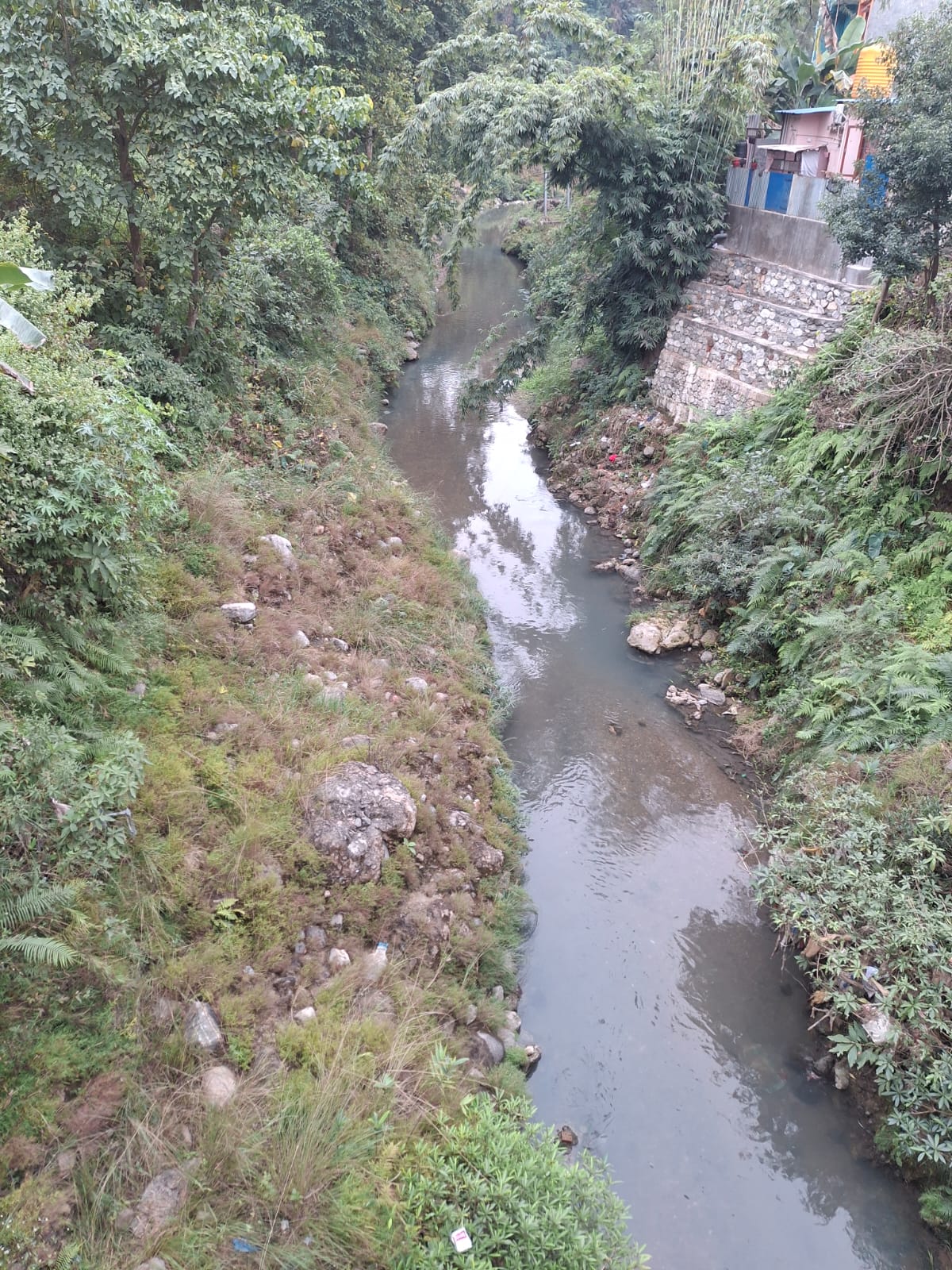
Shrinking Buldi River
A few months ago, while traveling around Damauli, I came face-to-face with the Bulli River used in the song above. Bulli actually turned out to be Buldi. They say it used to be called Buldi even earlier. In the Magar language, the meaning of ‘di’ is water. The Buldi Khola is attached right next to Damauli, the district headquarters of Tanahun. Bhadgaun is situated near the district headquarters, Damauli. The Buldi Khola flows, cutting through the Prithvi Highway, and then heads toward another settlement here, Bhadgaun. Finally, it meets the Madi River. Meanwhile, my eagerness to know the relationship between the two words in the song snippet above Buldi Khola and Nirmal kept increasing.
Recently, I had some work that required going to Damauli. During a stay of a few days, I was trying to reach the very roots of this song. One morning, while strolling around the market, I met Dirgha Bahadur Darai near Bhadgaun. He has a grocery shop there where miscellaneous items are found. He was drinking tea, standing in the courtyard. I sang that sorrowful melody carried by the Buldi River to him. I asked, what is the narrative inside this?
He began to ponder deeply, remembering the third week of the month of November 1968. Until then, the district headquarters of Tanahun was Bandipur. In the year 1967, the construction of Prithvi Highway started with the assistance of China. The planning and survey were initiated to directly connect Kathmandu-Chitwan with Pokhara. For this very reason, the administrative decision was made to shift the district headquarters from Bandipur to Damauli. However, the people of Bandipur took a stance that they would not let it shift under any circumstance. On this side, the people of Damauli, Gunadi, Kamalbari, and surrounding areas came surging forward, and they immediately climbed up to Bandipur. They were roused to take out all the materials and properties of the office and bring them to Damauli. The people of Bandipur were trying to stop it by any means.
A clash began between the people of Bandipur and those determined to shift the office to Damauli. Bandipur is at an altitude of 1,344 meters above sea level. The people of Bandipur began raining down bricks, stones, logs, and whatever materials they had from above. Falling into that violent crush, a 15-year-old adolescent, Nirmal, lost his life. His surname happened to be Ranabhat. The sorrowful Teej song was born from the heat of that very incident remembering Nirmal. Then, this sigh of the Buldi Khola, along with the flow of the Madi, caught the path of the Narayani River and reached an echo even in the houses and villages of Chitwan.
During the process of shifting the district headquarters, Nirmal was killed in vain. Yet, he still remains in the minds of many. In memory of that very Nirmal, locals have been running Nirmal Secondary School near the district headquarters. It was Dirgha Dai himself who brought up the matter of Nirmal School.
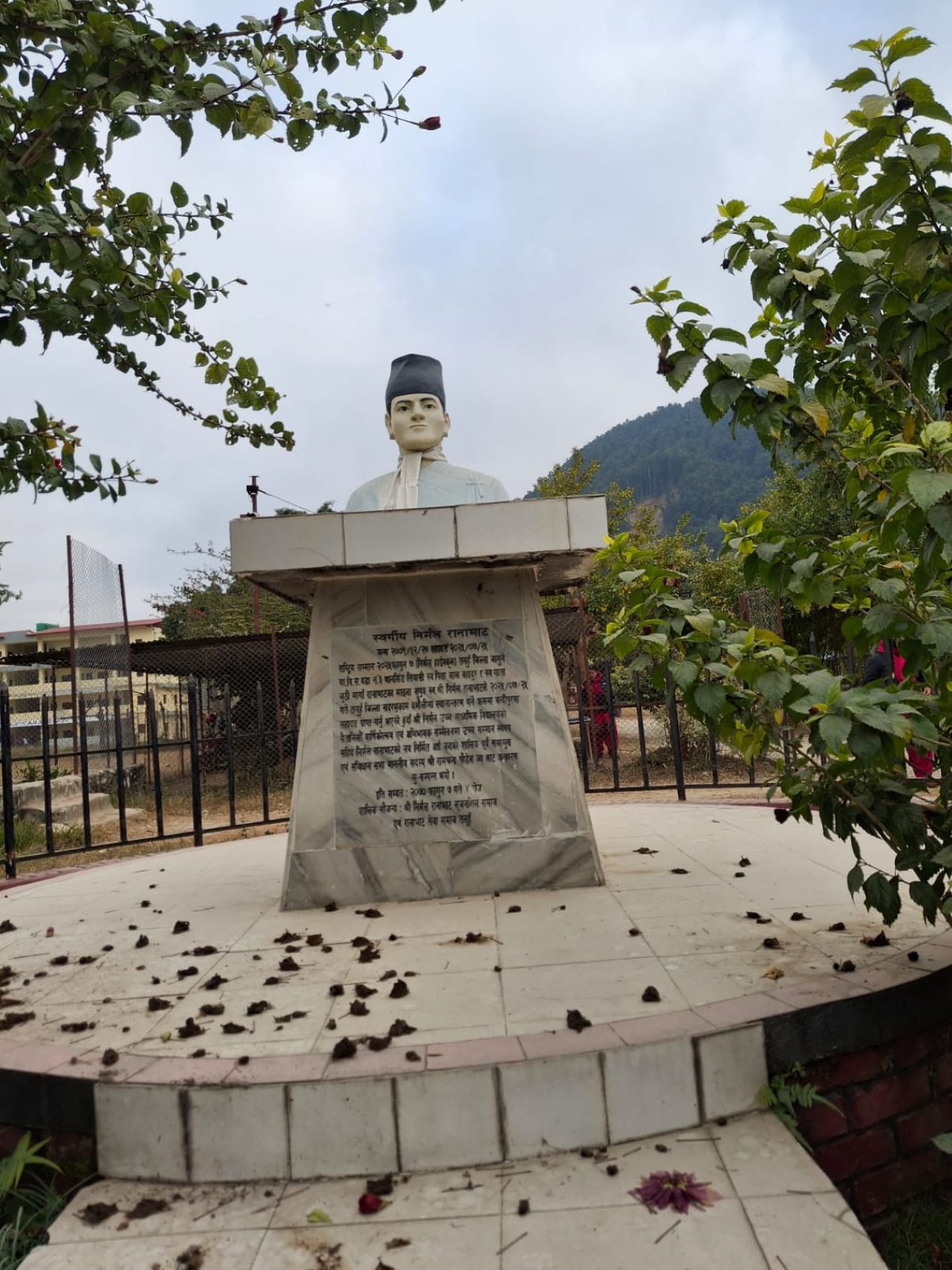
Statue of Nirmal Ranabhat
That same afternoon, I entered the said school premises. A football competition was going on between two teams of male students. The majority of the spectators were men. I got introduced to a team of five teachers who were watching the game and clapping every now and then. Among them was Deepak Pantha, a teacher who teaches information technology. Teacher Deepak took me near a statue close by and said this was Nirmal, and he lives along with this statue. And he keeps reminding us of an unpleasant past.
“Since the late Nirmal Ranabhat, the second son of the late father Lal Bahadur and late mother Juthi Maya Ranabhat, residents of Thansing, the then Jamune VDC Ward No. 3, Tanahun District, attained martyrdom in Bandipur on November 10, 1968, during the process of relocating the Tanahun District headquarters to Damauli…”
The text above, written beneath the half-body statue unveiled on February 19, 2014, stands as a witness to a tragedy of that time to this day.
It was through Teacher Dipak that I learned that, for the purpose of shifting the district headquarters at that time, an order was issued stating that one person from every house in Damauli and surrounding areas had to go to Bandipur; otherwise, a fine of Rs 500 would have to be paid. Around the year 1968, Rs 500 was a substantial amount of money. Paying that much money as a penalty was certainly not easy for an ordinary family. Nirmal’s parents were not at home; they had gone on a pilgrimage somewhere. Nirmal Ranabhat was the second son of the family. His elder brother was also not at home. The others were small. Therefore, representing his home, he joined those going to Bandipur. In this way, this adolescent ended up becoming a martyr of shifting the district headquarters.
After the news of his death spread, the people of Bandipur flinched. Then, the central office reached Damauli without any further hindrance. After this incident, many people of Bandipur scattered away to different places. Once the Prithvi Highway came into use, Damauli began to flourish as a commercial hub. Then, Bandipur began to fall even further into the shadows. Consequently, the somewhat affluent people of Bandipur went to the nearby Dumre Bazaar and Narayangarh in Chitwan to start trades and businesses. However, for many years after that incident took place, Bandipur landlords were rarely found in Damauli.
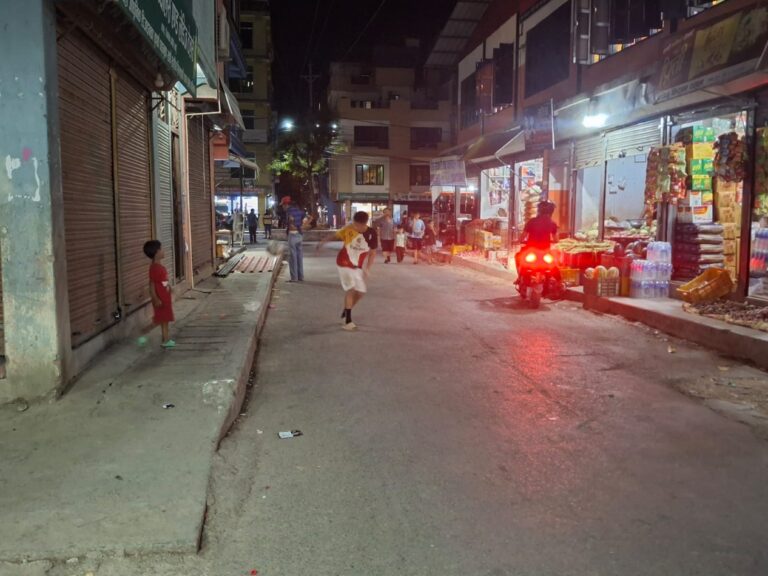
The eastern part of Damauli market in the evening
Nirmal School opened almost immediately after his death. Teacher Deepak Pantha mentions that an arrangement for a scholarship in the name of Nirmal has also been made in this school. Every year, the Nirmal Samagri is published. The content published in the fiscal year 2018/19, however, was published as his memorial issue. In this manner, this adolescent who was killed at a tender age continues to live on through the initiative of the local residents: in monuments, in the statue, and even in songs.
In Narayanghat of Chitwan District, which is a center of movement, literary activities are frequent. Pokhara, of Kaski, has already become a beautiful city, falling as the top choice for visits by internal and external tourists at all times. Situated between Narayanghat and Pokhara, Damauli of Tanahun is not that bustling, from both creative and commercial angles. Located in a gorge, this market remains chilly during winter, covered by surrounding hills, including Manahungkot. It is difficult to see the sun until late.
However, Manahung Hill, located at a distance of seven kilometers from the district headquarters and at 1,080 meters above sea level, completely overshadows Damauli and is currently transforming itself into a local destination for tourism. It has become the ‘selfie hill’ of choice for the locals. A little below Ghansikuwa, which keeps reminding one of Bhanubhakta and Ghansi, there is a pleasant place that has recently become an attractive spot for travelers as a ‘viral hill.’
Apart from that, historical Tanahunsur can also be reached in one to one-and-a-half hours. Vyas Cave is located near the district headquarters. But perhaps due to a lack of publicity and promotion, Tanahun and the district headquarters, Damauli, are rarely a priority as tourist destinations. Bandipur, on the other hand, is always the choice of many tourists due to its old Newar settlement and pleasant geography.
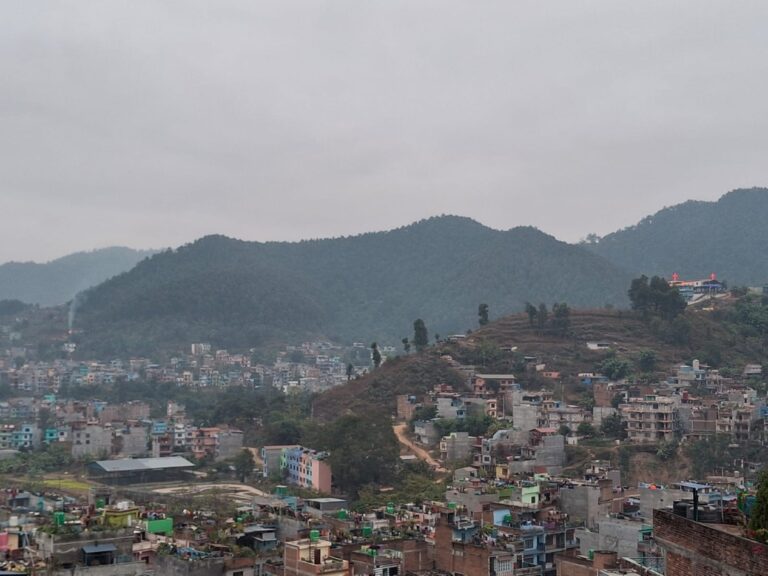
Aerial view of Damauli
At that time, there was a majority of Darai people in the Damauli market. Just like Damauli, there are many such names, like Ratyauli, Kharkauli, and Atrauli, among others. All of them were brought into practice from the Darai language, Dirgha Dai was adding officiality. The old residents here are all aware of the hardships of shifting the district headquarters and the historicity connected to it.
Such riots and incidents that occurred during the process of shifting district headquarters might exist elsewhere too. Around the year 1998, when I reached the district headquarters of Dailekh for drinking water work, I got a chance to reach its old district headquarters, Dullu. There were only some ruined palaces of old chieftains and a few remains there. Just like in Damauli, the city residents used to tell stories of scuffles, beatings, and stampedes that took place during the process of shifting the district headquarters from Dullu to Dailekh Bazaar (currently Narayan Municipality).
The naming of Khotang, a district in the Majh Kirat region, was actually done from its old district headquarters. Previously, the district headquarters was Khotehang, which shifted to Diktel around the year 1968, says Navanidhi Dahal, a current resident of Kapan, Kathmandu, who states Khotang as his ancestral home. He indicated, “But the relocation of the district headquarters was completed smoothly. I have not heard of any untoward incident happening.”
The old headquarters of Lamjung, a neighboring district of Tanahun, turned out to be Kunchha, which was later shifted to Besishahar. Bhabi Neupane, whose ancestral home is in Lamjung and who makes a living driving an auto-rickshaw in Damauli, was telling me this one evening. However, he remembers that no particularly bad incident occurred.
There is a history that the district headquarters of other districts of the country have also changed during different eras. During the Panchayat era, district headquarters were changed in that very manner through royal decrees. Those intense times when changes were made must have certainly been uneasy in many places. This chest of other occurrences that took place while changing district headquarters will slowly open up like this.