Kathmandu
Sunday, June 28, 2026





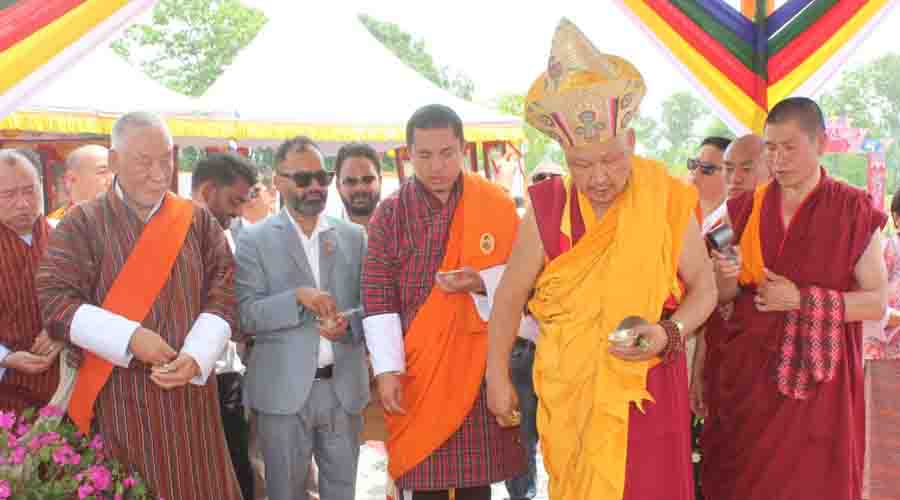
BHAIRAHAWA: The formal foundation stone-laying ceremony for the Bhutanese monastery to be constructed by the Government of Bhutan was held today at Lumbini, the birthplace of Lord Gautam Buddha.
The construction of the monastery was initiated following special religious rituals in the presence of Bhutan’s Home Minister Lyonpo Tshering, Bhutan’s religious leader and Deputy Chief Abbot (Dorji Lopen Rinpoche), and the Government of Nepal’s Minister for Culture, Tourism, and Civil Aviation, Khadga Raj Paudel (Ganes).
During the foundation-laying program, Bhutanese Lama gurus performed religious rituals and conducted the Bhumi Pujan (land worship). The construction of the monastery is being viewed as a historic step to further fortify the cultural, religious, and diplomatic relations between Bhutan and Nepal.
Magsud Ozme, the Director General of the Department of Culture and Dzongkha Development under the Ministry of Home Affairs of the Government of Bhutan, stated that starting the construction of the Bhutanese temple in Lumbini is an extremely important and historic achievement for Bhutan. She said, “We are gathered here to seek the blessings of the Earth Goddess to begin the construction of the new Bhutanese temple within the Lumbini premises. This project will connect Bhutanese Buddhist tradition and culture with the birthplace of Buddha.”
Last year, a Memorandum of Understanding (MoU) regarding the construction of the monastery was signed between the Government of Bhutan and the Lumbini Development Trust. She mentioned that the construction process has been pushed forward, implementing the commitment to start the project within the current year as per the agreement.
Under the first phase of the project, the construction of the boundary wall of the monastery premises has already been completed, and work on the main temple has now begun. Ozme stated that the Government of Bhutan aims to complete the entire construction within the next two years.
The proposed monastery is said to incorporate Bhutan’s traditional architecture, religious art, and cultural features. Structures in the Bhutanese style, prayer halls, a cultural exhibition area, and the necessary infrastructure for religious activities will be built.
According to Director General Ozme, once the construction of the monastery is completed, Buddhist pilgrims and tourists from across the world visiting Lumbini will be able to directly experience Bhutanese culture, art, and spiritual traditions.
“As a Buddhist nation, we want to showcase our unique architecture and reverence for Buddha here,” she said. “This will help establish Lumbini as an even more international and multicultural Buddhist center.”
Alongside the foundation stone-laying ceremony, a bilateral meeting between high-level government representatives of Nepal and Bhutan was also concluded in Lumbini. The discussions between Minister for Culture, Tourism, and Civil Aviation Khadga Raj Paudel and Bhutan’s Home Minister Lyonpo Tshering centered on tourism, cultural exchange, and further strengthening relations between the two countries.
According to Gyanin Rai, the Acting Member Secretary of the Lumbini Development Trust, Nepal placed two important proposals before the Bhutanese side during the talks. Minister Paudel emphasized the need to operate direct flights between Bhutan’s Paro International Airport and Gautam Buddha International Airport in Bhairahawa.
According to Acting Member Secretary Rai, the Nepali side expressed that developing a Paro–Lumbini–Bodhgaya religious tourism circuit would create new possibilities for South Asian Buddhist tourism. In the context that Bhutan’s national flag carrier, Drukair, currently operates Paro–Kathmandu flights, the Nepali side pointed out the necessity of connecting Lumbini directly to the international Buddhist destination network via air transport.
The second proposal was regarding the Sustainable Development Fee (SDF) that Bhutan applies to foreign tourists. Currently, Nepali citizens visiting Bhutan are required to pay a fee equivalent to USD 100 per person per day.
Taking into account the historic, cultural, and religious relations between the two countries, Nepal requested the removal of this fee or the provision of special concessions for Nepali citizens. Citing examples of separate arrangements made for tourists from India and Bangladesh, the Nepali side requested that accessible entry be provided to Nepali tourists.
Bhutan’s Home Minister Lyonpo Tshering stated that the issues raised by Nepal were taken positively and committed to further discussing them at the necessary government levels. On behalf of the Government of Bhutan, he expressed gratitude to the Government of Nepal for providing the land and support for constructing the Bhutanese monastery in Lumbini. He also pledged to increase cooperation in preserving Buddhist heritage, promoting pilgrimage tourism, and expanding people-to-people relations while further solidifying the religious ties between Lumbini and Bhutan.
From the Nepali side, Member of Parliament elected from the Lumbini region, Towfeeq Ahmad Khan, and Member of Parliament elected from Rupandehi-4, Kanhaiya Baniya, participated in the bilateral meeting. Similarly, from the Bhutanese side, Bhutan’s Ambassador to Nepal, Major General Vetsop Namgyel, and the Home Secretary of the Government of Bhutan, among others, were in attendance.