Kathmandu
Monday, July 13, 2026





Deuba faction's sets a deadline, maintaining open doors for party reconciliation from July 17 to August 16 before moving forward with a new political party
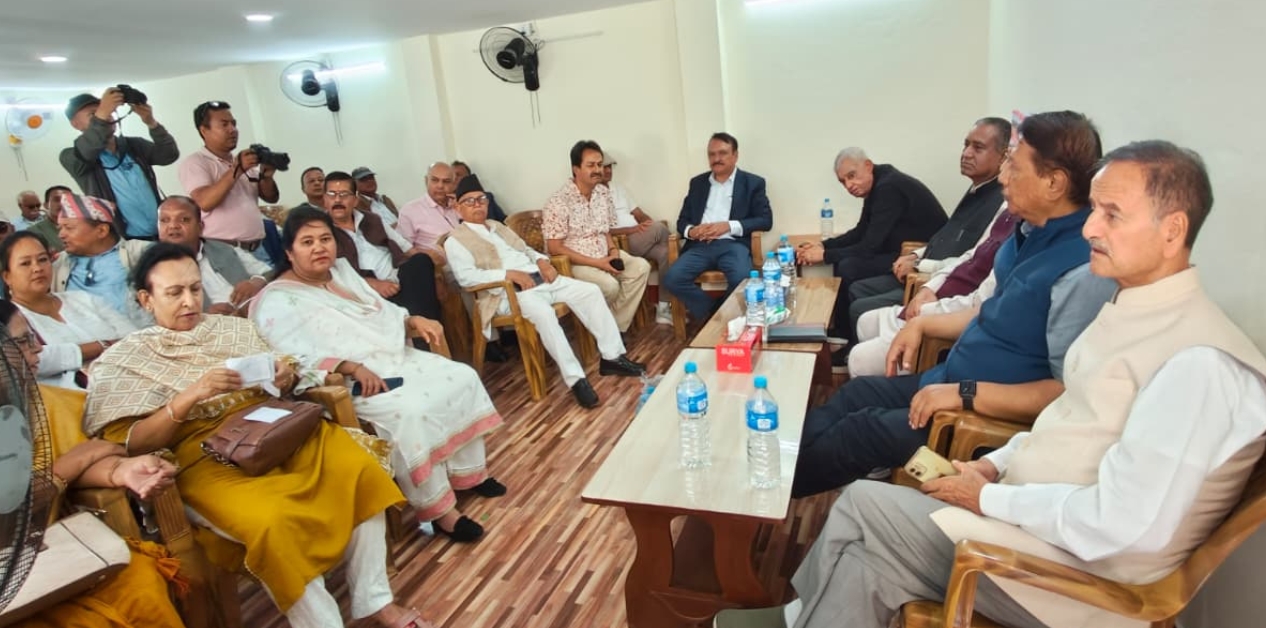
KATHMANDU: The Deuba faction of the Nepali Congress has focused on the option of forming a new party. After the dialogue with the establishment side could not reach a conclusion, the group started groundwork on the concept of a “New Nepali Congress.”
However, the group has stated that they have kept party unity as the first priority. The group’s strategy is to keep the door of dialogue open throughout the month of Shrawan and take the final decision regarding the formation of a new party only after that.
Leader Min Bishwakarma says that dialogue has been kept as the first priority and the formation of a new party as the second priority.
“The leaders who did not participate in the special general convention have established a contact office. Discussions are being held there regularly,” Bishwakarma says, “As far as possible, we will achieve party unity. If no way works, we will form a new party.” Leaders state that in the discussions held after the Deuba faction established a contact office in Chundevi on July 6, an understanding was formed to wait for the response of the establishment side throughout Shrawan.
Outgoing Vice President Purna Bahadur Khadka and leaders including Krishna Prasad Sitaula, Bimalendra Nidhi, Prakash Man Singh, and Shashank Koirala are conducting regular discussions at the office.
“The first priority of the meetings so far is party unity itself,” Bishwakarma says, “A strategy has been formed to be flexible to the utmost extent for unity, to make initiatives, and to be ready even if one has to accept or sacrifice something for it.”
According to the leaders of the other faction, the party leadership at Sanepa has not held any formal and concrete dialogue so far. They claim that although Vice President Bishwa Prakash Sharma and General Secretary Gururaj Ghimire held discussions with the leaders, no progress was made from that. “Sanepa has not cared about the things discussed in the dialogue,” Bishwakarma says, “We will wait throughout Shrawan. If it is not cared for even after that, there will be no option left but to form a new party.”
For the immediate term, however, the group is focused on the preparations for the BP Memorial Day on Shrawan 6 (July 21, 2026) and the national gathering, former Vice President Bimalendra Nidhi states. He says, “We are celebrating BP Memorial Day at the Nepal Academy, popularly known as Pragya Pratisthan. From right there, we will announce the date of the national gathering. After that, other matters will move forward.”
Politics is like the injury time of a football match. A goal can happen even at the final moment. As long as a 1 percent possibility remains, one can hope.
The Chundevi office has been called the contact office of the leaders who did not participate in the special general convention but are in favor of the regular general convention. Former General Secretary Shashank Koirala is one of the leaders who is regularly present there. From the very beginning, he had opposed the special general convention and taken the side of the regular general convention. “He is ready to play any role and take any responsibility for party unity,” Bishwakarma says.
The other side complains that the leaders of the establishment side tend to go out of contact after holding talks. They claim that although Sharma and Ghimire returned saying that an agreement had been reached after the discussion, they did not come into contact after that.
“Politics is like the injury time of a football match. A goal can happen even at the final moment,” Bishwakarma says, “As long as a 1 percent possibility remains, one can hope. We are optimistic, but the progress so far is not reliable. The leaders of the establishment side say everything is sorted out, and after that, they go out of contact. They do not search for it, so how much should only we search for unity?”
Increased distance after the special general convention
The special general convention of the Nepali Congress was held on January 11 this year. The special general convention organized by the Gagan Thapa faction had dissolved the central committee led by the then President Sher Bahadur Deuba.
After that, the dispute regarding the official status of the Congress reached the Supreme Court via the Election Commission. Both the commission and the court had given recognition to the special general convention.
Although the Deuba faction accepted the legitimacy of the special general convention, it has been demanding that the establishment side must take initiative to bring the divided party to one place. Both Deuba and the centrist leader Shekhar Koirala faction have made party unity a primary issue.
Meanwhile, both factions are dissatisfied, saying that the establishment side has advanced the process of the 15th general convention without unity. Koirala, who has been taking the side of unity, has increased discussions with the Deuba faction, although he has not made a concrete decision public so far.
Groundwork begins on a ‘New Congress’ as the Deuba faction sets a strict Shrawan deadline for the establishment side to respond to unity efforts.
The Deuba faction, on the other hand, has moved one step forward by discussing separate gatherings, operating a contact office, and the possibility of forming a new party.
In preparation for holding the 15th regular general convention around September/October this year, the establishment side had started the work of new membership, renewal, and data updating from May 16. Adding time four times, the central office has extended the final deadline for membership updating up to July 19. In addition, a circular has been issued to the related leaders to be present at the office themselves and submit the details. However, most of the leaders of the Deuba and Koirala factions have not participated in the updating process. The establishment side is preparing to take a decision from the central committee meeting even after the deadline expires and provide an opportunity for updating until one or two months before the general convention.
“If anyone is missed in the membership updating of the Congress, it does not mean that he will not be allowed to participate in the 15th regular general convention,” General Secretary Pradip Paudel says, “The central committee will give a chance. Such a decision could happen one or two months before the general convention.”
The Deuba-Koirala faction, however, has been keeping the stance that membership updating should not be made a mandatory condition and the renewal done after the 14th general convention itself must be given recognition.
The other faction demands that the committees elected from the special general convention and the 14th general convention must be adjusted, and all sides must be included in the discipline, election, active membership, and investigation committees.
Koirala had proposed that while adjusting, both committees should be included exactly as they are. If that could not be done, his proposal was to form a political mechanism for the 15th regular general convention without adjusting anyone.
Koirala’s argument was that a fair general convention would take place when the disputed issues are settled by the political mechanism. The establishment side, however, has not accepted the said proposal.
Dialogue with Shekhar to Make ‘Genuine Congress’
Most of the leaders of the Deuba faction, claiming that the original political legacy of the Congress lies with them, have started to hold the opinion that a new party should be formed with the identity of the ‘Genuine Congress.’ The opinion that a ‘New Congress’ should be built in a way that continues the political legacy of BP Koirala is becoming strong within the group. Bishwakarma warns that since the leaders who spent a long time in the history of building the Congress are in favor of the regular general convention, a new Congress will be formed if one moves forward by ignoring that entire line. “If such a situation comes, we will form a new party on the political foundation of the Nepali Congress itself,” he says, “The new party will be formed with the sentiment that we are the genuine Congress continuing the legacy of the Congress.”
With the Koirala legacy in play, informal talks shift toward former General Secretary Shashank Koirala as the potential leader of the breakaway faction.
Informal discussions have also started within the group regarding who will lead the party if a situation comes where a new party must be formed. Due to the political legacy of BP Koirala and the representation of the Koirala family, Shashank Koirala is being looked at as a potential alternative.
The names of Bimalendra Nidhi and Prakash Man Singh are also being discussed as potential leadership. Bishwakarma states that formal discussion regarding the leadership, party name, or election symbol has not started yet. “So far, no formal discussion or decision has been taken on those matters,” he says, “Since a situation has arisen where we have to go down an alternative path, informal discussion might have taken place regarding the potential leadership.”
The Deuba faction has also started dialogue with the centrist leader Shekhar Koirala regarding an alternative political path. Leader Prakash Sharan Mahat reached Biratnagar on Saturday and met with Koirala. Mahat said that a discussion was held with Koirala regarding what the political path would be if the possibility of party unity becomes weak. “Currently, we are in the preparation of the program of July 22,” Mahat says, “Further consultation will take place after Shekhar ji comes to Kathmandu.”
Koirala, however, has not made his views public regarding the discussion held with the Deuba faction about the new political alternative. “There is a talk that he will come to Kathmandu in two to three days,” Koirala’s personal secretary Dinesh Chandra Thapaliya says, “However, the secretariat has no information regarding him being in discussions about forming a new party.”