Kathmandu
Thursday, July 16, 2026





The death of a ride-sharing worker after a parking dispute has reignited debate over aggressive municipal policing, disproportionate fines, inadequate public parking, and the blurred lines of authority in Kathmandu's street management.
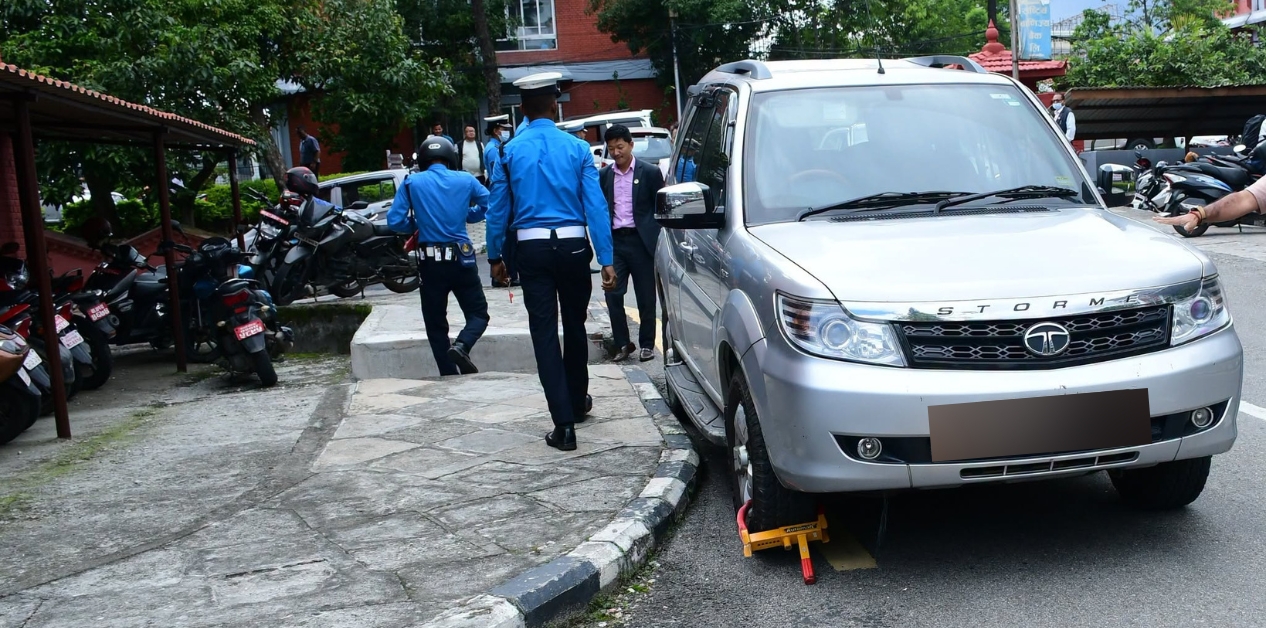
On July 9, 25-year-old Ganesh Nepali from Soru Rural Municipality-1 of Mugu had just parked his motorcycle in front of the Department of Passports in Tripureshwar, Kathmandu. After a female municipal police officer from the Kathmandu Metropolitan City told him not to park there, a brief argument ensued between the two. Right then, the municipal police placed a ‘wheel lock’ on Ganesh’s motorcycle. Nepali, who supported his wife and a daughter by doing ‘ride-sharing’ work with the motorcycle, pleaded to let it go, but the metropolitan police refused. As the dispute escalated, in a fit of impulse, he poured petrol on his body and took his own life.
Ganesh, who had participated in the Gen Z protest the previous year, carried the hope that change would come to the country and things would become easier for youths like him. He was in the process of trying to go to Dubai for foreign employment. Amidst financial, family, and mental pressure, a single ‘wheel lock’ incident pushed him to the decision of ending his life. The fine the metropolitan city sought to charge was Rs 1,000. However, rumors that the government was preparing to increase such fines further had created additional discomfort among youths who depend on daily income like him.
Following Ganesh’s death by self-immolation, the government led by Balendra Shah has been facing fierce criticism for imposing unnecessary harshness on citizens in the course of law enforcement. Voices are being raised that the state should not become insensitive and brutal toward its citizens in the name of implementing rules and regulations.
Following allegations of inhumane treatment toward riders, three metropolitan police officers have been arrested. After this, the metropolitan police have stopped appearing in public parking spaces. The metropolitan city itself, citing security reasons for the time being, has stopped sending municipal police out onto the streets.
Nabin Manandhar, spokesperson for Kathmandu Metropolitan City, states that since a probe committee has been formed by the Ministry of Home Affairs, the municipal police have not gone out for vehicle management duties in public spaces. “Deploying them could even pose a security risk; how the municipal police will be deployed will be decided once the probe committee’s report arrives,” he says.
On Sunday, July 12, street vending on sidewalks and vehicles parked in a way that obstructed the streets were seen in New Road. Voices in favor of traffic rules were heard on social media, claiming that street discipline had broken down when the municipal police backed away. The day after the chaos was witnessed in the New Road area, on July 13, vehicles were found parked and left in front of the offices of several media houses and in public places. Suspicions arose that individuals close to the leadership were mobilized to unleash ‘parking terror’ to answer for the Ganesh Nepali self-immolation case, divert attention from the criticism directed at the government, and intimidate the media.
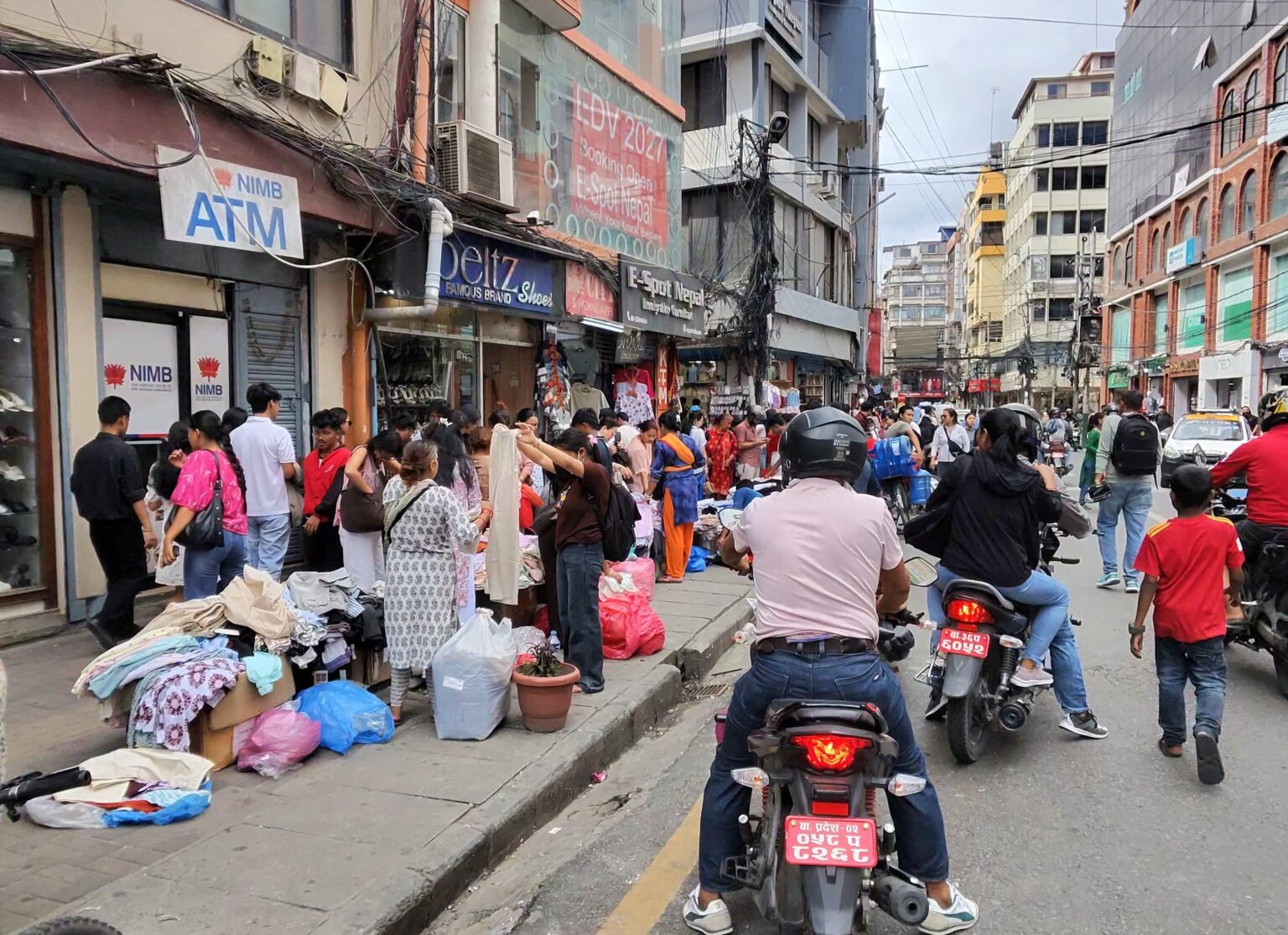
Merchants crowd the sidewalk on New Road. Photo: Nepal Photo Library
The police, who had initially remained unresponsive on this matter, used cranes to remove those parked vehicles after public outcry and pressure escalated. Stating that it would conduct an investigation, the District Police Range Kathmandu sent those vehicles to the Kathmandu Valley Traffic Police Office. However, no further investigation was conducted against any vehicle owner after that. The traffic police released the vehicles after fining them Rs 500 each for violating traffic rules.
This has raised questions about the investigation process itself. This is because the jurisdiction of the traffic police is generally limited to fining traffic rule violations and managing vehicles. The responsibility to investigate the motive, planners, or individuals involved in the coordinated blocking of public places with vehicles lies with the District Police Range itself. But after the case was sent to the traffic police, further investigation did not move forward at all. Superintendent of Police (SP) Pawan Kumar Bhattarai, spokesperson for the District Police Range Kathmandu, however, states that no complaint has been registered regarding this matter. He says, “The police fulfilled their duty of removing the vehicles from public places and the traffic police took action according to the law.”
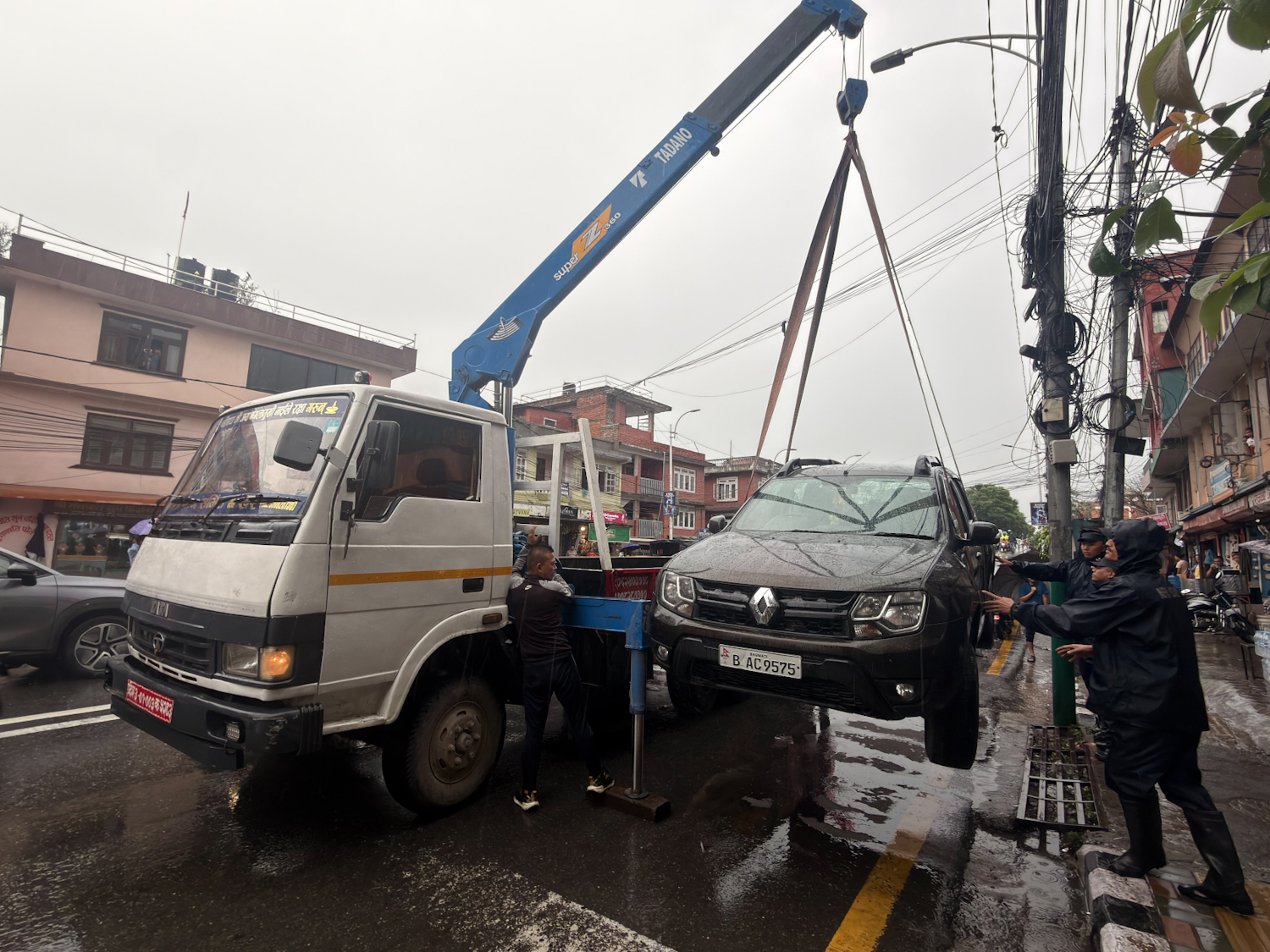
A vehicle left in front of the residence of Nepali Congress President Gagan Thapa being removed. Photo: Nepal Photo Library
Whether or not the vehicles were blocked in a planned manner to defuse the public outrage that erupted after Ganesh’s self-immolation case remains unanswered as no formal investigation was conducted, the involved vehicle owners were released with a minor fine, and no conclusion regarding the objective of the incident has been made public, giving rise to numerous questions.
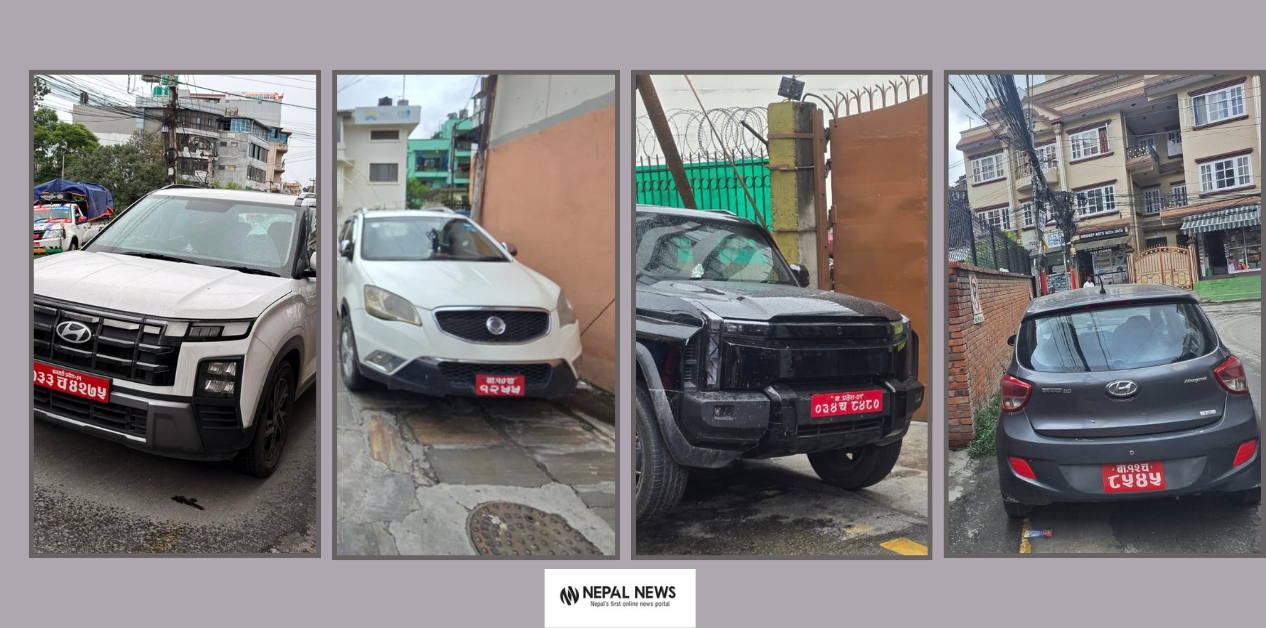
Vehicles parked at the gates and streets of various media houses in Kathmandu. Photos: Nepal Photo Library
This very chain of events has also exposed a rift in the relationship between the Kathmandu Metropolitan City and the central government. The dispute that started from a ‘wheel lock’ ultimately seems to have spread to self-immolation, public outrage, criticism of the metropolitan city, questions about the police investigation, and the government-metropolitan relationship.
Questions are being raised on social media and news media regarding how and on what basis the municipal police applied wheel locks and fines. There is a dispute within the metropolitan city itself regarding the wheel locks and fines imposed by the Metropolitan Police Force. Chini Kaji Maharjan, the ward chairman of Kathmandu Metropolitan City-22, says the time has come to reconsider the act of putting wheel locks on vehicles. He witnesses the parking chaos in the New Road area daily but has been arguing that ‘wheel locks’ are not the solution. “I have been opposing the act of applying wheel locks right in the executive meetings; here, the leadership seems to have made the municipal police work outside the policy of discretion according to its own needs,” he says.
According to him, those who violate traffic rules can be handed over to the traffic police for action. However, going a step further to make the metropolitan police use the authority to apply wheel locks and collect fines is an issue linked to the discretion and policy priorities of the leadership.
Narrow interpretation of wheel locks by the court and judges
The legal basis for deploying municipal police in street management is not new. The Local Government Operation Act, 2017 allowed local levels to deploy municipal police for street governance. Following that, after Balendra Shah became mayor, Kathmandu Metropolitan City brought the Metropolitan Police Act, 2023.
Chapter-3 of the Act mentions the functions, duties, and powers of the metropolitan police. According to it, the metropolitan police can supervise and manage markets and vehicle parking lots. However, nowhere in the Act is the authority to ‘apply wheel locks’ or collect fines for parking violations explicitly mentioned. The metropolitan city, however, made such arrangements through its Financial Act and began deploying municipal police on the streets with ‘wheel locks’ and bundles of fine receipt books. Currently, the metropolitan city is fining two-wheelers Rs 1,000 and four-wheelers Rs 2,500.
According to Ward Chairman Maharjan of Kathmandu Metropolitan City-22, complaints are also received that the municipal police exceed their limits of authority during enforcement actions. “In the New Road area, there are even complaints that licenses were confiscated,” he says.
The practice of municipal police applying ‘wheel locks’ and fining has been controversial from the beginning. Following Ganesh Nepali’s self-immolation, however, the sharpest questions have been raised against this very practice. While it appears to be deployed for street governance on the surface, the aggressive working style of the municipal police itself seems to have become the cause of the dispute.
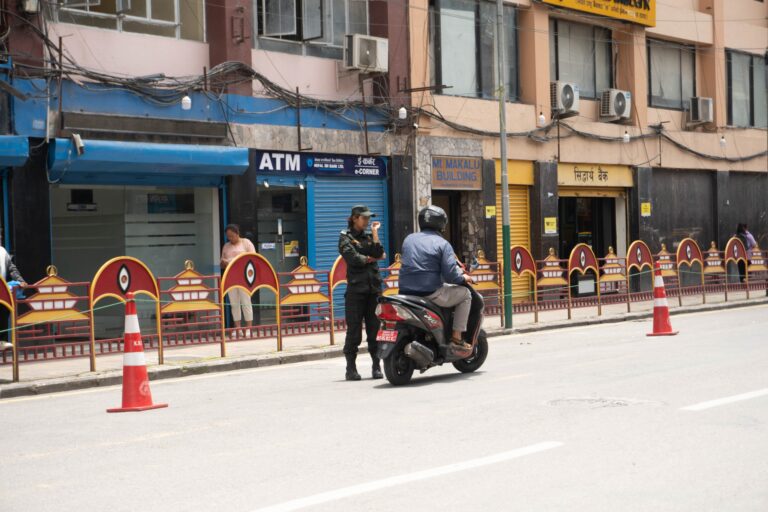
Metropolitan Police. Photo: Aabhas Ranjit/Nepal Photo Library
The metropolitan police do not limit themselves to wheel locks. The police have also been practicing arbitrarily impounding and towing away vehicles on the charge of parking violations. This very issue had reached the Supreme Court. However, the court did not evaluate and interpret the entire subject matter thoroughly either.
Ashik Keshari of Kathmandu Metropolitan City-11 had gone to Mahabouddha on November 14, 2025, with his motorcycle numbered Ba 72 Pa 8706. A student at the Nepal Law Campus, he stopped the motorcycle for a short while to buy some goods. According to him, there was no ‘No Parking’ board there. When he returned, the motorcycle was nowhere to be found. Later, when he reached the traffic police office, the municipal police returned the motorcycle only after making him pay a fine of Rs 1,000, claiming unauthorized parking.
Following that, three individuals, including Keshari, filed a writ petition in the Supreme Court. They demanded the refund of the fine and a declaration of the municipal police’s action as illegal, arguing that no law, including the Local Government Operation Act, 2017, the Metropolitan Police Act, 2023, and the Financial Act, 2025, gave the municipal police the authority to take control of and carry away vehicles, but only the authority to fine. However, on January 8, 2026, a bench of the then judge and current Chief Justice Manoj Kumar Sharma and Judge Sunil Kumar Pokharel dismissed the writ petition.
The bench, basing its decision on the Local Government Operation Act, 2017, the Metropolitan Police Act, 2023, and the Act made to implement financial proposals of the Metropolitan City, 2025, interpreted that the metropolitan police have the authority to perform necessary regulation for parking management. The verdict states: ‘There is a provision that the authority to supervise and manage markets and vehicle parking lots shall belong to the metropolitan police. The Act made to implement financial proposals provides that a fine of Rs 1,000 can be imposed if parking is done outside the designated places. Under the same legal provision, the metropolitan police can regulate and manage unauthorized parking.’
The bench mentioned that in areas with high traffic volume like the Kathmandu Valley, it is the responsibility of the concerned driver to keep track of designated parking spaces and prohibited areas. ‘Clearing street obstructions, minimizing vehicle accidents, and organizing the movement of the general public is the legal obligation of the state. Parking outside the designated area is also a violation of traffic discipline,’ the verdict states. Nevertheless, the court seems to have confined itself to a narrow interpretation of legal provisions without analyzing the overall situation of available parking infrastructure, population density, commercial activities, and the actual parking crisis in the Kathmandu Valley.
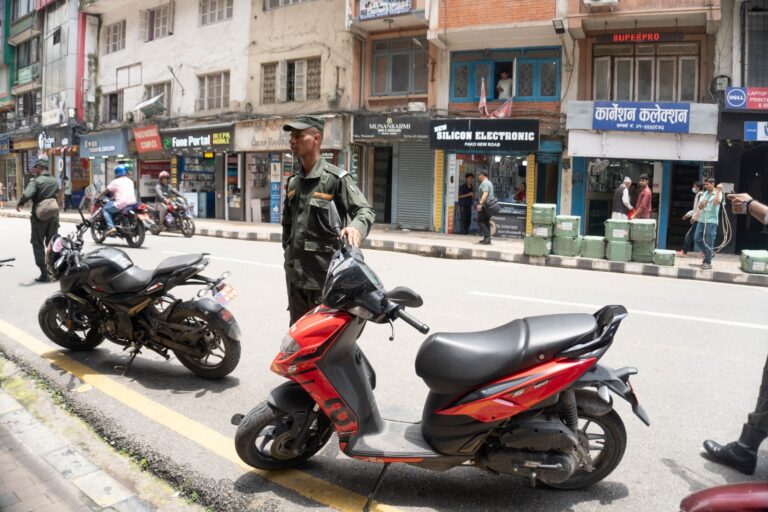
Metropolitan police removing a vehicle parked haphazardly in the New Road area. Photo: Aabhas Ranjit/Nepal Photo Library
According to Nurnidhi Adhikari, information officer of the metropolitan city, the letter regarding the implementation of the Supreme Court’s verdict was received by the metropolitan city on June 26. After the existing practice of fines and wheel locks was upheld by the court itself, the metropolitan police have gained encouragement. Adhikari says, “Neither the law nor the Supreme Court’s interpretation has called wheel locks and fines illegal.”
Police officials, however, say that the work of the metropolitan police should focus on enhancing the beauty of the city, removing footpath encroachments, protecting metropolitan property, and preventing embezzlement, but focusing on traffic management has invited disputes. “The Vehicles and Transport Management Act has explicitly given a mandate to the traffic police; when two agencies are active in the same place, there is confusion as to whose jurisdiction lies where,” says former Deputy Inspector General (DIG) of Police Keshav Adhikari. “Clear law is imperative to end such confusion.”
According to him, when two types of agencies are deployed in traffic management, coordination issues and confusion remain between them. Furthermore, the police are given specialized training in traffic management. Comparatively, the municipal police have less training in traffic management. He states that disputes arise in the course of maintaining professional efficiency and discipline under such conditions.
Focus on penalties and fines rather than infrastructure
Amidst the dispute over wheel locks and parking management, another crucial question is the lack of public parking infrastructure. Although the number of vehicles in the Kathmandu Valley has increased rapidly, public parking spaces are extremely limited.
In Kathmandu, the area in front of Dharahara is used as a public parking space. In Lalitpur, parking is managed on one side of the street from Jawalakhel to Kumaripati. In Bhaktapur, due to the lack of separate public parking spaces, drivers park vehicles according to necessity and availability.
Without making adequate arrangements for public parking, the metropolitan city has permitted private parking businesses to operate in only limited areas. Although parking facilities are available in some shopping malls in Kathmandu, those are all private parking lots. The metropolitan city has fixed a fee there of Rs 15 per 30 minutes for two-wheelers and Rs 25 per 30 minutes for four-wheelers.
However, specific ‘pickup’ and ‘drop off’ areas for public transport passengers to board and alight have not been effectively designated either. Consequently, most public vehicles board and alight passengers right on the street, making traffic management further complicated.
Superintendent of Police (SP) Naresh Raj Subedi, spokesperson for the Kathmandu Valley Traffic Police Office, says, “Public parking spaces in the valley are very low. Shopping malls and a few limited parking spaces are not in a position to handle the current traffic volume.”
The direct impact of this lack of infrastructure is seen on small business owners, delivery riders, and two-wheeler drivers. They are often forced to stop vehicles on the street when delivering goods or when they need to stop for a few minutes. In doing so, there is a risk of action from both the traffic police and the municipal police. If deemed defiant, wheel locks are applied and fines are charged.
Ganesh Nepali’s self-immolation did not just expose the pain of an individual; it also raised questions about Kathmandu Metropolitan City’s model of street management. The lack of public parking, disputes over explicit legal interpretations, increasing authority of the municipal police, and their harsh style of working seem to have made street governance punitive rather than citizen-friendly.
The fines imposed by the metropolitan police are heavier than those imposed by the traffic police. The traffic police penalize and fine street violations according to the Motor Vehicle and Transport Management Act, 1993. The Act provides for a fine of Rs 500 to Rs 1,500 for those who violate vehicle rules. The traffic police fine Rs 500 for the first violation, Rs 1,000 for the second time, and Rs 1,500 for those violating for the third time. SP Subedi says, “If a fare higher than the seating capacity and fixed rate is charged, if actual number plates are not placed, and if a vehicle is driven by changing its original shape, there is a provision for a fine of Rs 7,500 to Rs 15,000; the traffic police do not take such action but send it to the Transport Management Office.”
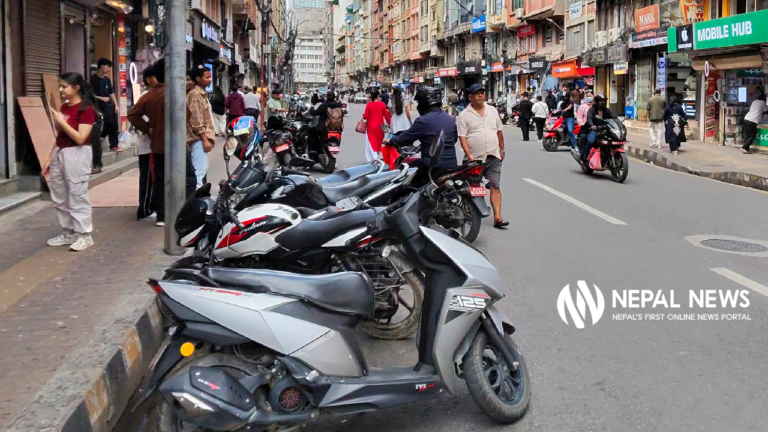
However, the metropolitan police do not fine a motorcycle Rs 500, but straight away charge Rs 1,000, while they collect Rs 2,500 from four-wheelers. The fines collected by the municipal police are deposited into the revenue of the metropolitan city. They and the traffic police coordinate occasionally. “In terms of enforcement, the actions we take and the actions taken by the metropolitan police are separate,” Subedi says.
According to Ward Chairman Maharjan, many positive changes have been seen when deploying the municipal police. Public space disorders have reduced, and encroached lands have been cleared. “Particularly, the Metropolitan Police Force became visible and audible after Balen came as mayor. When deployed according to the oral orders and discretion of the leadership as per necessity, the municipal police have been taking the credit and blame,” he says.
To address the parking shortage in the Kathmandu Valley, the traffic police are preparing a new proposal. In addition to Dharahara, the Valley Traffic Police, in coordination with the respective municipalities, are conducting a study to manage public parking in areas like in front of Nepal Airlines, Gatthaghar, Tilganga, Balkhu, Kalimati Corridor, Budhanagar, Radheradhe, Tokha, Sallaghari, Gwarko, among others. “We expect that if parking can be done in some such locations, the existing shortage can be alleviated,” SP Subedi says.
In Lalitpur Metropolitan City as well, the metropolitan police are active in traffic management. They are also deployed equipped with wheel locks. However, the rate of punishment there is lower than that of Kathmandu Metropolitan City. Lalitpur Metropolitan City charges a fine of Rs 500 for two-wheelers and Rs 1,000 for cars. Moreover, the arrangement for paying fines has been made convenient. A system has been developed there to pay fines on the spot via QR codes and unlock the vehicles’ wheel locks. Sita Ram Hachhethu, chief of the Municipal Police Force of Lalitpur Metropolitan City, states that because vehicle rule compliance has been made easy in Lalitpur, no major dispute has arisen so far. “We do not impound and carry away vehicles, the fine is low, and when enforcement is prioritized in a situation where parking facilities are inadequate, it invites disputes,” he says.
Under Bagmati Province, there are a total of 2,018,434 vehicles. Among them, motorcycles number 1,551,701. This is the data for the fiscal year 2024/25. A five percent annual increase is estimated in this data. The pressure of vehicles is extreme in Kathmandu, Bhaktapur, and Lalitpur of Bagmati Province. The total population of the valley is estimated to be five million.
The valley covers an area of 899 square kilometers. The length of the roads here is 2,292.23 kilometers. The manpower of the traffic police in the valley is 1,113. One traffic police officer is responsible for 1.38 kilometers of road and 1,223 vehicles. The valley police penalized 501,144 vehicles in the fiscal year 2025/26. Out of this, a fine of Rs 372 million 737 thousand and 562 was recovered. In the fiscal year 2024/25, the police had penalized 762,597 vehicles. Out of this, a fine of Rs 393 million 777 thousand 634 had been recovered.