Kathmandu
Friday, July 17, 2026





A string of high-profile money laundering cases has fueled concerns among legal experts that suspects are being arrested before investigators establish the predicate offenses needed to support the charges, raising questions about due process, legal overreach, and the potential for political misuse.
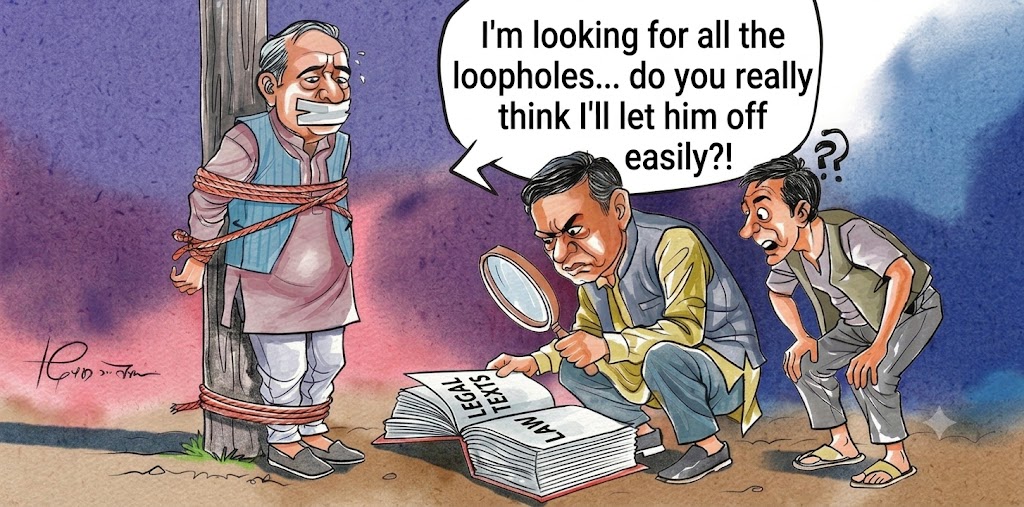
KATHMANDU: On June 22, the Department of Money Laundering Investigation arrested Bishnu Paudel, Vice Chairman of the CPN (UML) and former Finance Minister, in Surkhet. Arrested without prior complete investigation, his custody was extended five times by the court for further inquiry. Finally, on July 16, a money laundering case was filed against him. Based on the department’s investigation report, the Special Government Attorney’s Office filed the case at the Special Court, claiming Rs 209 million in fines and assets recovery.
Money laundering is the act of turning illegally earned black money into white (legitimate) assets through various transactions or processes. However, prosecutions for money laundering have also been initiated in offenses related to insurance and securities. On June 12, the Department of Money Laundering Investigation filed a case at the Kathmandu District District Court against 26 individuals, including prominent businessmen Deepak Bhatta and Sulav Agrawal, seeking over Rs 107 billion in asset recovery, fines, and imprisonment.
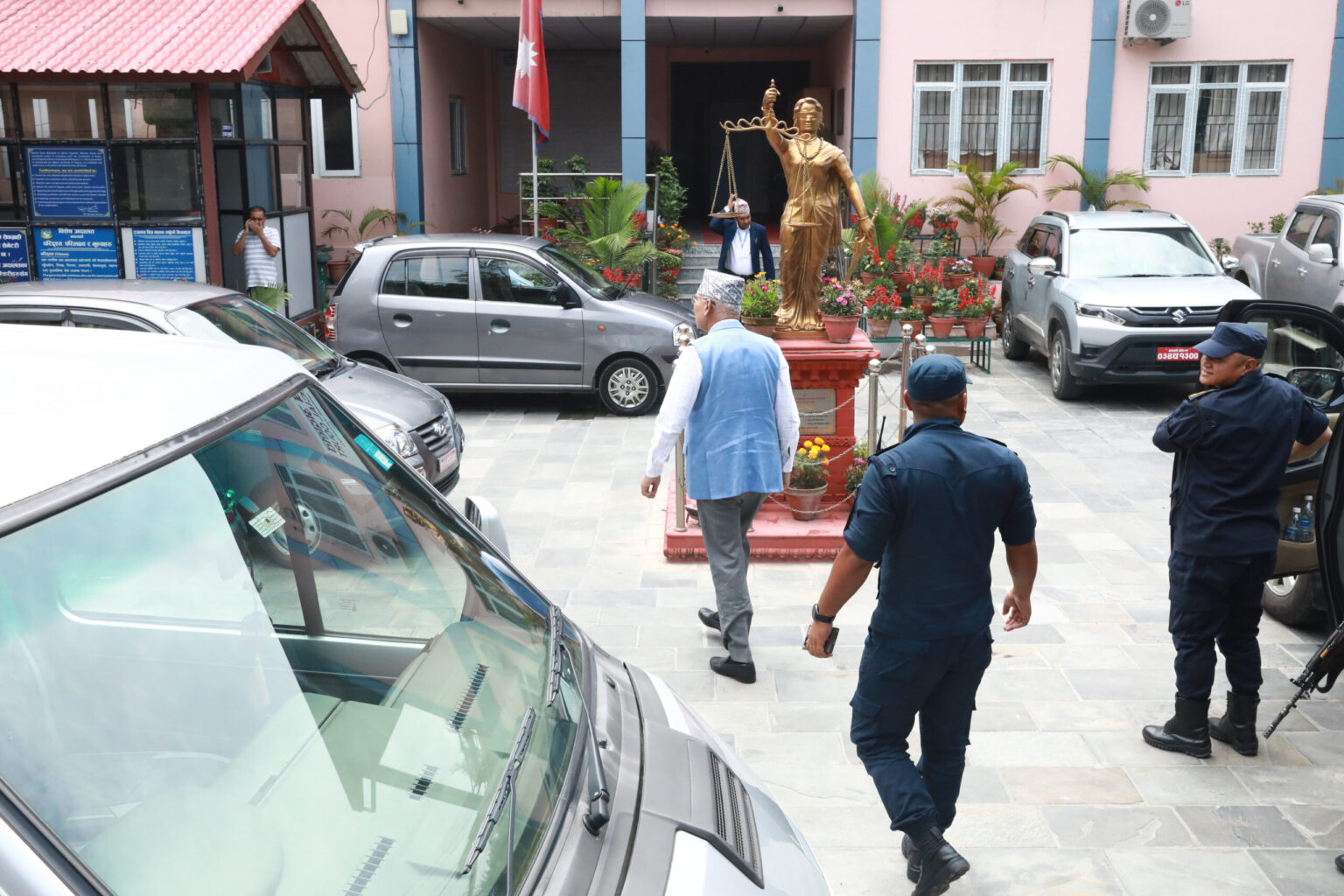
CPN (UML) Vice Chairman and former Finance Minister Bishnu Prasad Paudel at the Special Court. Photo: Nepal Photo Library
In another instance, the Department of Money Laundering Investigation has initiated an investigation into Jaiveer Singh Deuba, son of former Prime Minister and former President of the Nepali Congress, Sher Bahadur Deuba. The department had issued a public notice on July 8, directing him to appear at the department within seven days for a statement. However, he has not appeared yet.
Experts point out that the government has misused money laundering cases as a tool to settle political scores, and has begun detaining individuals first before searching for the source of their wealth. Senior Advocate Satish Krishna Kharel says that for money laundering to be established, there must be a predicate offense. He notes that Supreme Court precedents and the principles of international law dictate that money laundering is not an independent offense on its own. “A narrative has been developed here—similar to how the Commission for the Investigation of Abuse of Authority used to round up employees for earning disproportionate wealth—where the practice of arresting any person and demanding they show the source of everything they own has evolved,” he says, adding, “This tendency benefits neither the government nor the public.”
Legal experts are concerned that the government has started utilizing money laundering as a tool for detention with the intent of harassing people it dislikes. They point out that the government has moved forward in a biased manner by even amending laws to achieve this. On the other hand, Uttam Kumar Ghimire, Information Officer at the Department of Money Laundering Investigation, maintains that the department is working in accordance with the law.
In a brief summary of main works and achievements released on July 4, marking 100 days of the government’s formation, the government included financial crime and money laundering investigations. Point 1(b) states: “Individuals involved in the exploitation of state coffers and policy-level settings have been brought under the legal ambit for financial crimes and money laundering offenses by the Department of Money Laundering Investigation.” It is mentioned that since the formation of the government on March 27, adopting a zero-tolerance policy against corruption, the department has filed seven cases, naming 101 defendants and claiming Rs 118 billion in asset recovery and fines.
Senior Advocate Krishna Prasad Sapkota argues that for money laundering to occur, the primary source of the assets must be illegal. He states that laws must be followed even to prove an offense has been committed. He says, “They call it money laundering, but the state has not been able to show that the assets are illegal. The primary source of the shown assets does not appear illegal. For laundering to happen, the primary source itself must be illegal. Financial irregularities in mobilization do not constitute laundering.”
Sapkota points out that instead of conducting a thorough investigation first to determine whether money laundering has occurred, the current practice seems to be detaining the individual first, then hunting for assets and initiating investigations. “There might have been irregularities, and arrests may be necessary; one cannot say arrests should never be made. However, an offense is being investigated as money laundering,” he says. “Investigations can take a long time. What does the state gain by rushing to detain people just for show?”
He adds that arbitrary roundups of businesspersons and investors disrupt the investment climate, directly impacting the country’s economy.
Senior Advocate Kharel also mentions that as the government continues to spread fear of money laundering investigations, it discourages investment in Nepal, leading to a situation where both businesses and capital are fleeing. “Currently, banks are flush with money, and there are hardly any borrowers,” he says. “Those who can take money out of Nepal will do so, and instead of keeping it in banks, they will invest in gold. This achieves nothing economically.”
However, Advocate Tika Bahadur Kunwar, President of the Special Court Bar Association, does not agree with the claim that the government is filing money laundering cases arbitrarily. “Since the government has investigated and registered some high-profile cases in accordance with prevailing laws, extensive media coverage has made it appear as though too many cases are being filed unexpectedly,” he says.
Doubts over legal amendments
The government brought an ordinance to amend the Money Laundering Prevention Act on April 30. Since the ordinance was not passed by parliament, it was forwarded as a bill. The “Money Laundering Prevention (Third Amendment) Bill, 2026” was then passed by the Federal Parliament. Enacted after being authenticated by President Ram Chandra Paudel on July 9, the bill has already come into implementation as a law. Legal practitioners argue that the government has targeted certain individuals and incidents through this legal amendment.
Kunwar, President of the Special Court Bar Association, says the amendment reinforces suspicions that officials can at any time file money laundering cases against opponents to settle political scores. “Analyzing some of the cases currently under investigation strengthens this suspicion. In the coming days, money laundering offenses could become a weapon to settle scores with leaders of rival political parties,” he says.
The Department of Money Laundering Investigation filed a chargesheet seeking the largest recovery amount in history, claiming that the source of assets in insurance was being altered, evaded, and hidden. The department filed the case at the Kathmandu District Court against 26 named individuals, including Deepak Bhatta and Sulav Agrawal, seeking over Rs 107 billion in asset recovery, fines, and jail time.
In the case registered at the Special Court on June 12, the department demanded Rs 26.63 billion as recovery from Bhatta along with an equivalent fine. It also demanded Rs 25.59 billion as recovery from Sulav Agrawal; Rs 2.73 billion from Shekhar Golchha and other board members of Himalayan Re-Insurance; an additional Rs 525 million separately from Shekhar Golchha; Rs 6.04 billion from four individuals including Himalayan Re-Insurance Executive Director Upasana Paudel; and Rs 597.5 million from three individuals including Nepal Micro Insurance Director Ashish Shrestha. They are accused of embezzling funds belonging to insurers, including Himalayan Re-Insurance, Nepal Micro Insurance, and Himalayan Large Cap Fund.

Businessman Deepak Bhatta at the Special Court. Photo: Nepal Photo Library
Senior Advocate Kharel says that the amendment of laws via ordinance regarding insurance and securities, and the current practice, will disrupt economic activities and the investment environment. He says, “The law was amended targeting specific individuals. Their cases appeared to be related to insurance and securities transactions. The law was brought in a way that includes those transactions under money laundering to file cases at the Special Court.”
Senior Advocate Sapkota argues it is necessary to be clear on which law applies to financial offenses. He analyzes that financial crimes affect the general public. “For example, if a large trader running a business on bank loans is unfairly implicated in a case, it also affects the workers employed in his industry. If the company collapses, the public deposits in the bank also sink. The state must look at it from this perspective too,” he says. “If prevailing laws have been violated, it must fall within the definition of a crime. However, if it is not a heinous crime, the case should be prosecuted under the relevant law according to the offense.”
By amending the Money Laundering Prevention Act, 2008, the scope of investigation for this crime was widened. An amendment on April 12, 2024, allowed agencies like the Nepal Police and the Commission for the Investigation of Abuse of Authority to also investigate and prosecute money laundering offenses. Previously, only the Department of Money Laundering Investigation had the authority to investigate such offenses. Provisions were added allowing 13 agencies, including the Police, CIAA, Forest Office, Department of Revenue Investigation, and National Parks, to investigate money laundering as an associated offense.
Cases against 119 individuals in one year
The Department of Money Laundering Investigation registered 20 cases in the fiscal year 2024/25. The department named 119 defendants, claiming Rs 79.42 billion in asset recovery. Towards the end of the fiscal year 2025/26, a single case has demanded more recovery money than the total amount demanded in the entire previous year. The department filed cases related to revenue leakage, foreign exchange, banking offenses, fraud, human trafficking, drug trade, and insider trading.
Of the two cases decided by the Special Court, only one resulted in a conviction. From the establishment of the department until 2024/25, a total of 121 cases were registered. In those cases, a total of Rs 93.69 billion was claimed as recovery. Out of those, 99 cases have been decided, with 80 cases (81 percent) resulting in convictions, as mentioned in the fiscal year 2024/25 annual report of the Department of Money Laundering Investigation.
“Analyzing some of the cases currently under investigation strengthens this suspicion. In the coming days, money laundering offenses could become a weapon to settle scores with leaders of rival political parties,” he says.
After the CPN (Maoist) joined the peace process and entered the government, the then Finance Minister Baburam Bhattarai, through the budget of the fiscal year 2008/09, introduced a provision allowing individuals to legitimize any disproportionate or hidden wealth earned from any source by paying a designated tax. Recalling that time, Senior Advocate Kharel says that people who had hidden earnings from various activities paid taxes and invested their wealth. “That increased economic activity. Now, it seems like a matter of harassing a few individuals out of anger. This constrains the economy. The stock market went down. People do not take loans from banks. Who will start a new industry in Nepal now? I feel the investment climate will completely deteriorate,” he says.
Baburam Bhattarai served as the Finance Minister in the government led by Pushpa Kamal Dahal (from August 2008 to May 2009). During his tenure, he decided to allow people to legitimize assets earned from any source by paying tax once. That decision was both criticized and praised.
Withdrawal of Lamichhane’s money laundering cases
Cases of money laundering and organized crime against Rabi Lamichhane, Chairman of the ruling Rastriya Swatantra Party (RSP), have been withdrawn. Legal practitioners had commented that invoking money laundering against him was also an act of revenge. Claiming that the government was acting out of political vendetta against Lamichhane, RSP had also run a nationwide signature campaign.
Even before the cases registered in court could be decided, the then Attorney General Sabita Bhandari decided to withdraw the prosecution. Following this, government attorneys initiated the process to withdraw the cases related to money laundering and organized crime pending in the Kaski District Court and other places. The government attorney registers the case and also files the petition to withdraw it. The time, resources, and means of the government attorney appear to be revolving around the same issue of prosecuting and then withdrawing cases against the same person.
Charges related to cooperative fraud, organized crime, and money laundering had been registered against Lamichhane in Kaski, Kathmandu, Rupandehi, and Parsa District Courts. While upholding the charges related to cooperative fraud, all four courts amended the charges related to organized crime and money laundering. All four courts gave permission to withdraw the cases through similar orders.
Precedents related to laundering
From the perspective of money laundering, the prosecution must be able to prove that money withdrawn from a bank account was invested elsewhere for the purpose of laundering. There is a precedent of acquittal because the prosecution could not prove under the Money Laundering Prevention Act that investment was made elsewhere with the intention of changing the nature of the assets.
On October 24, 2024, the Supreme Court acquitted Abhishek Giri of Morang and his wife Anisha Giri in a money laundering case. Stating that facts and evidence did not show illegal acquisition of assets and their transfer, transformation, or investment elsewhere to legitimize them, the Supreme Court upheld the Special Court’s decision of June 19, 2018, and acquitted them.
“That increased economic activity. Now, it seems like a matter of harassing a few individuals out of anger. This constrains the economy. The stock market went down. People do not take loans from banks. Who will start a new industry in Nepal now? I feel the investment climate will completely deteriorate,” he says.
A full bench of Justices Sapana Pradhan Malla, Hari Prasad Phuyal, and Bal Krishna Dhakal ruled that the money deposited in the bank account was received from various individuals, family, and loans, and was earned from their own small business and work. The Department of Money Laundering Investigation had filed a chargesheet against the Giri couple at the Special Court, claiming they laundered Rs 29.44 million and seeking confiscation of their house and land.
There is another precedent in a money laundering case where Madhav Kumar Bhagat was the defendant and the Government of Nepal was the plaintiff. The court stated that the party claiming they received money from business or another person without the intention of money laundering must prove it with objective evidence. “After unusual assets are recovered from a defendant, the legal obligation to show the source of asset acquisition lies with them,” the decision stated.
‘Amended law increases risk of settling political scores’
Tika Bahadur Kunwar
President, Special Court Bar Association
The government seems to have prosecuted many people for money laundering recently; is this normal or unexpected?
One cannot agree that money laundering cases are being registered arbitrarily. Since the government has investigated and prosecuted in accordance with prevailing laws and high-profile cases are sub-judice, wide media coverage and discussions in the public sphere have made it appear as though many cases were registered at once, making it seem unexpected. Interpreting the responsible state agency’s fulfillment of its designated duties as unusual registration of cases is an incomplete conclusion.
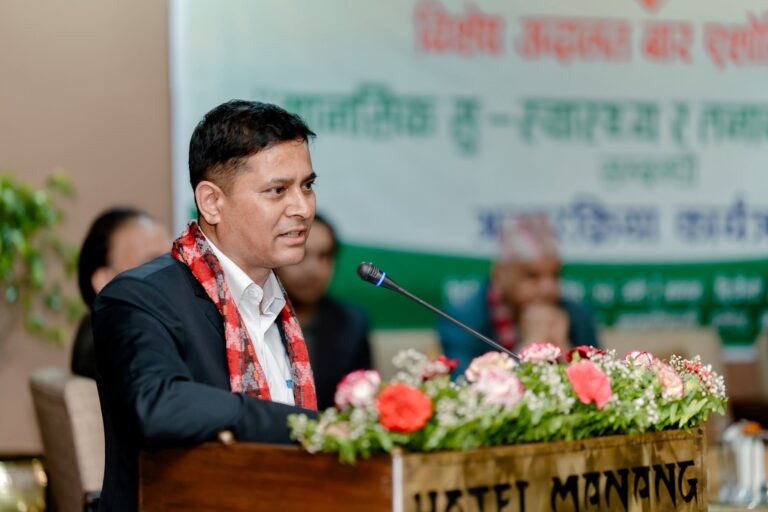
Advocate Tika Bahadur Kunwar. Photo: Social Media
Investigating money laundering, tracing assets earned from offenses, and collecting evidence is complex. Since money laundering is a white-collar crime, investigating and prosecuting it requires significant time and resources. Since the individual can use the money earned from offenses or the financial investments made from it in various transactions and even hide them outside the country, the investigating officer must conduct effective investigations and search for evidence accordingly. Since such complex investigations cannot easily reach conclusions, the view that money laundering cases are registered unusually is a superficial understanding.
The law on money laundering has been amended; what does this mean?
An attempt has been made to widen the scope of the previous narrow provisions on money laundering. Looking at the amended provisions, they allow prosecuting money laundering cases in any associated offense. This provision reinforces suspicions that officials and political leaders of rival factions can be prosecuted for money laundering at any time to settle political vendettas.
Can the legal amendment then be a weapon to settle scores?
Analyzing some of the cases currently under investigation, such suspicion cannot be ruled out. In the coming days, money laundering offenses could become a weapon to settle scores with leaders of rival parties.
What could be the reason for emphasizing money laundering investigations even in matters that can be covered by laws like corruption, insurance, and securities?
Money laundering is the process of whitening black money earned through illegal and criminal acts. It is taken as the process of converting or hiding assets obtained from offenses to show they were received from a legal source. For a money laundering offense to occur, there must be a predicate offense. Not all assets obtained or earned from any criminal act fall under this.
Is money laundering an associated offense in itself?
Money laundering is not an associated offense in itself, but it is a co-offense as a by-product of the main offense. It can be taken as a multi-dimensional financial crime of laundering to hide assets earned from the main offense, i.e., the associated offense. Associated offenses can include corruption, insurance, securities, drugs, etc. Attempts are made to legitimize the money earned from such offenses by using it in financial transactions, layering, and integrating the received money or income.