Kathmandu
Tuesday, July 21, 2026





Community-built bridges in Bhojpur show how collective effort is solving local problems—while challenging claims that voluntary labor began with today's political movements.
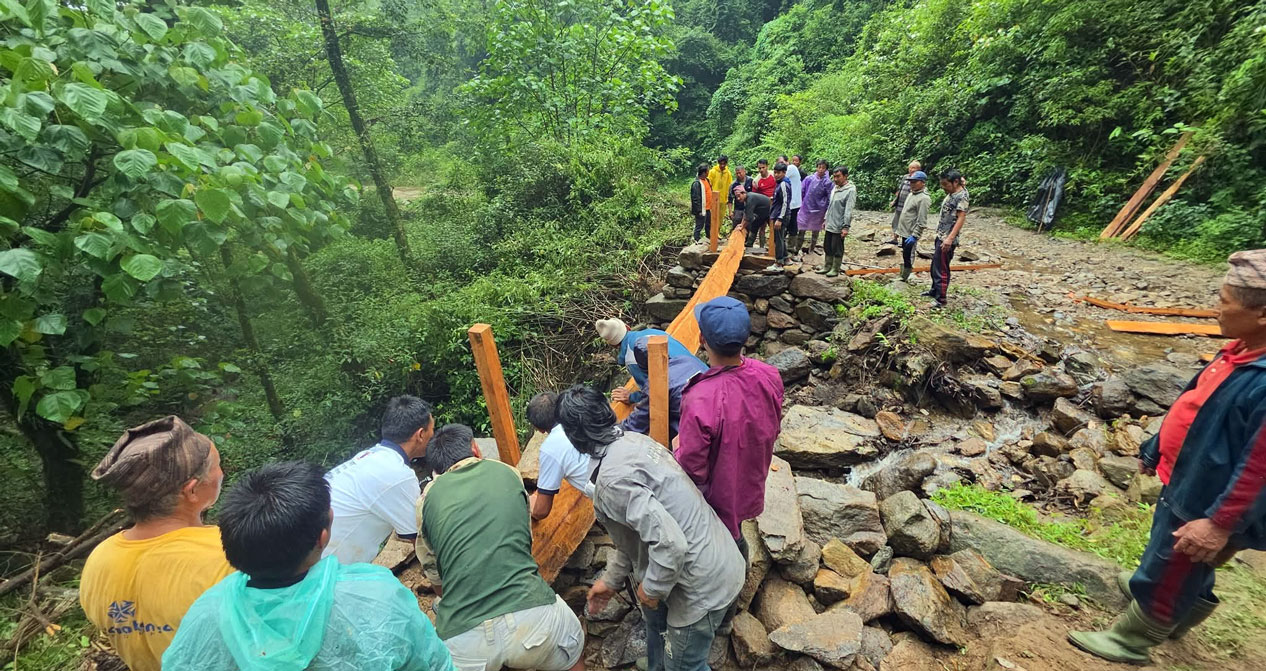
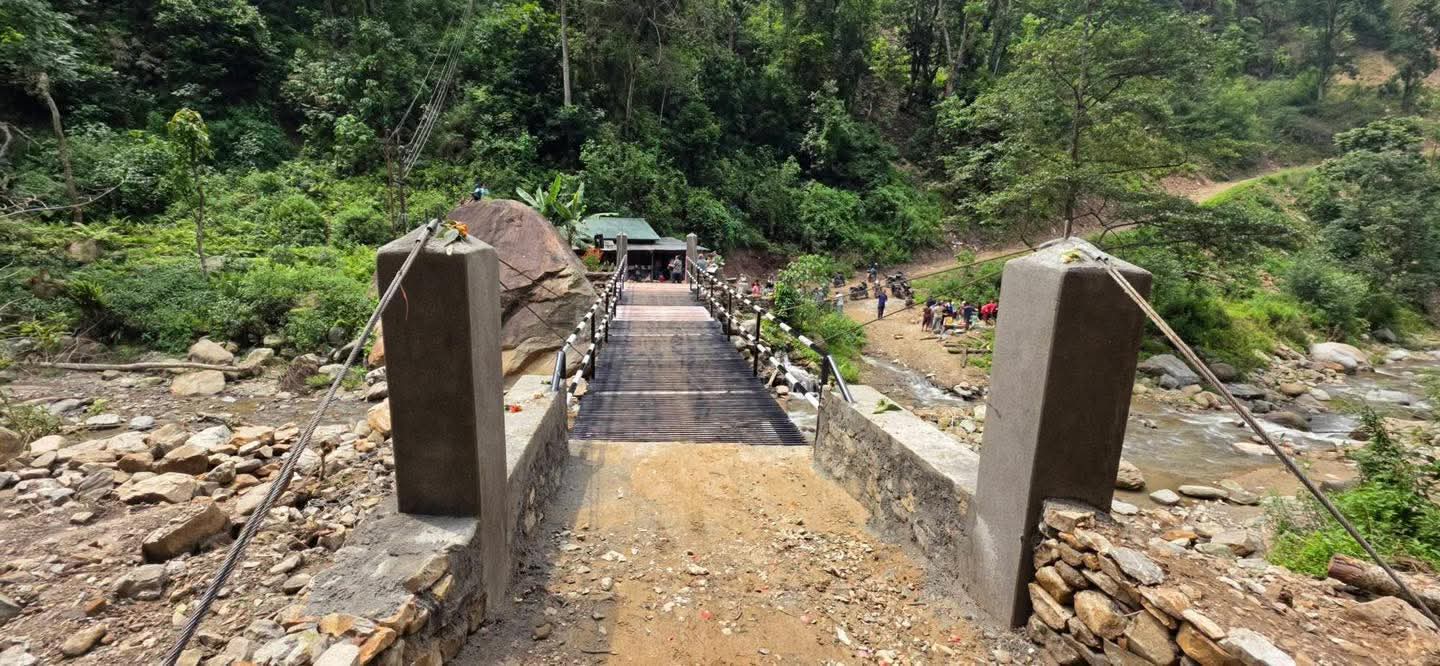
Between Pangkha and Mangtang in Ward No. 1 of Temkemaiyung Rural Municipality, Bhojpur, lies Khoyyuwa, a stream descending from Maiyung. The stream does not even hold an armful of water. In the winter, it flows as narrow as a fist, but during the rainy season, it runs wild almost day and night. Its source area is covered by dense forest, where it rains significantly more than in the surrounding areas. The terrain is steep, causing flash floods to surge violently and creating severe difficulties for anyone attempting to cross. In the past, it has swept people away and taken lives.
Currently, a rough dirt road has been constructed by cutting across the stream. Before the road was built, the villagers from both sides traditionally joined hands to construct a temporary log-and-bamboo bridge every year, sometimes up to two or three times within a single season. The government agency responsible for bridges never felt that a bridge was needed at that location. The road was somehow built along the pedestrian trail, but a motorable bridge has not yet been constructed. Looking at the pace of development in the country, a bridge will not be built there for at least another decade. Until then, the floods from the stream will continue to plague the residents. Most seriously, students studying at Timma Secondary School are forced to wait for hours daily during the rainy season for the floodwaters to recede.
To break free from this problem, the villagers from both sides consulted with one another. Led by Som Rai of Pangkha, the villagers joined hands in voluntary labor. Within three days, they prepared a 25-foot-long wooden bridge. For the bridge, not only was the labor volunteered, but the timber, nails, skilled manpower, and daily snacks and water for the laborers during work hours were also provided free of charge. Though it appears to be a mere 25-foot bridge, this wooden structure, specifically targeted at school children, is sturdy enough to cross motorcycles when floods block the road. A month prior to this, a iron bridge was constructed through voluntary labor to connect Ward No. 3 Patigaun and Ward No. 5 Kerabari of Temkemaiyung. This has made it easier for small vehicles, including motorcycles and auto-rickshaws, to cross the Wachimle River. No assistance had been received from any government or non-governmental agency for that project either.
The legacy of ancestors
According to Charles Darwin’s evolutionary theory, struggle is the main foundation of evolution. Various species of creatures are born in nature, and those that fail in the struggle for existence become extinct over time. According to Marxist theory, labor is the main foundation of development. The difference between other creatures and humans exists precisely because of labor. It is labor that brought humans to their current state. Therefore, labor held great importance in society since the time of our ancient ancestors. Before the formation of feudal society, everything was collective. Labor was also collective. With the beginning of the feudal era based on private property, the dividing line between physical labor and intellectual labor grew wider. Along with this, the era of labor exchange emerged from voluntary labor. In the capitalist era, society fell under the control of capital. Everything began to be measured by its monetary value, and voluntary labor vanished.
Nepalese society did not move forward at the same pace as Europe. Even when the global capitalist and consumerist era reached its peak, the fundamental character of Nepalese society remained based on collectivism. The state could not dominate everywhere, and the momentum of society continued autonomously. Collective efforts for the collective good persisted, with voluntary labor remaining the primary foundation of these collective endeavors.
Following the establishment of democracy in 1951, a wave of education swept the country. The number of schools opening increased. The state only performed the job of granting permission, while physical infrastructure development had to be done through voluntary labor. Schools, roads, and water taps were built and maintained through voluntary labor. Capitalism entered the lower levels along with the penetration of the state. Contract systems arrived alongside the state’s development budget. The contracting system entered personal tasks as well, making voluntary labor unnecessary for contract work. The culture of voluntary labor, which had been passed down for a long time as a legacy of our ancestors, gradually disappeared. The voluntary labor that vanished from cities long ago reached the brink of extinction in villages as well.
Efforts to institutionalize
In 1994, a minority government of the CPN (UML) was formed. Bharat Mohan Adhikari, the Finance Minister of Nepal’s first communist government, introduced the “Build Your Village Yourself” program through the budget. Under this program, the government made a provision to grant Rs 100,000 to each Village Development Committee (VDC). This amount was later increased to Rs 300,000. Its main feature was voluntary labor: purchasing materials using the government budget and managing everything from transportation to construction through voluntary labor. Many school buildings, local community halls, and footpaths were constructed as a result.
Although subsequent governments changed the name of the program, they continued to increase the funds. In recent times, a large portion of that budget began to be spent by political parties on recruiting their cadres under the pretext of placing teachers in local schools.
Following the enactment of the Local Self-Governance Act, 1999, VDCs and municipalities introduced policies where the government contributed a larger share of the budget and the local consumers contributed a smaller share. This was named cost participation, featuring arrangements of 60-40, 70-30, or 80-20 percent between the government and consumers. Both programs were informal attempts to formalize the voluntary labor culture that had continued uninterrupted since the time of our ancestors and to institutionalize voluntary labor directly from the state level. Data showed that the program was most successful in the then Dharan Municipality. During the time when Dhyan Bahadur Rai and later Manoj Menyangbo served as mayors of Dharan, almost all the alleys were paved. The roads built through cost participation at that time still exist today, whereas roads constructed later have already deteriorated.
Even now, the portion for local consumer contribution is never left out in local-level projects, but the actual contribution from consumers is not sought. The consumer committee itself has become the contractor, and the culture of voluntary labor has disappeared.
Ingratitude takes hold
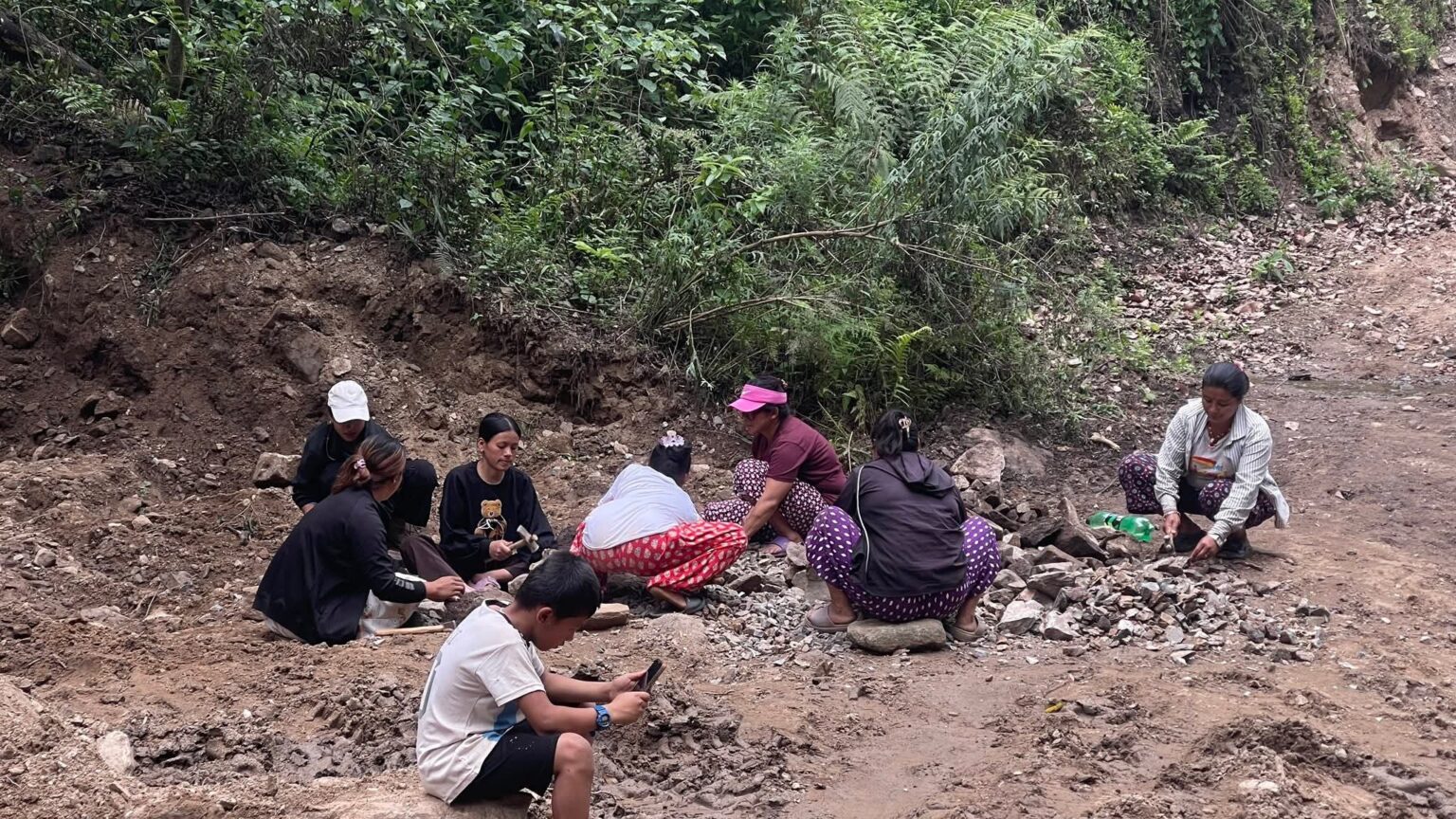
After Harkaraj Rai (Sampang), who built an identity as a social activist, was elected to the post of mayor of Dharan Sub-Metropolitan City, he ran a voluntary labor campaign. The entire city of Dharan joined in voluntary labor. Its influence expanded across the entire country, not just in Dharan, triggering a wave of voluntary labor. In Dharan, which carries a history and background of being proven excellent across Nepal in voluntary labor and consumer participation for development construction during 1997–2002, Harka has emerged as the “Father of Labor.”
Those inspired by Sampang’s Dharan model seem to be growing across the country. They are spontaneously joining hands for public and collective works, and are also engaged in helping the helpless and the poor. This has brought a resurgence of the voluntary labor culture, which had been handed down as a legacy of our ancestors but was pushed toward extinction by the contractor system.
The voluntary labor culture, which the nine-month UML government, subsequent governments, and any political party failed to politicize, has been heavily politicized by those involved in the voluntary labor campaign inspired by Harka Sampang. They claim that voluntary labor did not exist in the world at all and that the word itself was invented by Harka. A tendency is developing among current volunteer laborers to discount any voluntary labor as illegitimate if it is performed without wearing a T-shirt bearing Sampang’s image or if it is carried out by an opposing group. Sampang, the chairman of the Shram Sanskriti Party, has already declared himself the “Father of Labor,” and his party workers have blindly echoed this claim.
Furthermore, institutional structures of the state were ignored by Sampang while pushing voluntary labor forward, which is incorrect. While serving as the mayor of Dharan, he faced allegations of working in a way that weakened the institutional structure and power of the local government he led. The tendency to formulate plans and plunge into voluntary labor completely outside of state mechanisms can turn out to be counterproductive in the long run. Normal problems can be solved temporarily through voluntary labor, but the role of the state remains primary for long-term solutions.
Another major aspect is that no one should be ungrateful to the ancestors who nurtured the culture of voluntary labor. Voluntary labor was not invented during Sampang’s time. The practice of voluntary labor began as an integral part of human civilization during the primitive communist era. Being grateful to our ancestors is our tradition and culture. Voluntary labor is not something an individual invented in a few days, nor is it something that can be invented that way. Therefore, it is essential to be grateful to our ancestors.