Kathmandu
Wednesday, July 22, 2026





Operation of the direct cargo train service from Kolkata Port to Biratnagar is expected to lower freight expenses, streamline import-export operations, and open up new trade opportunities for Eastern Nepal's industries
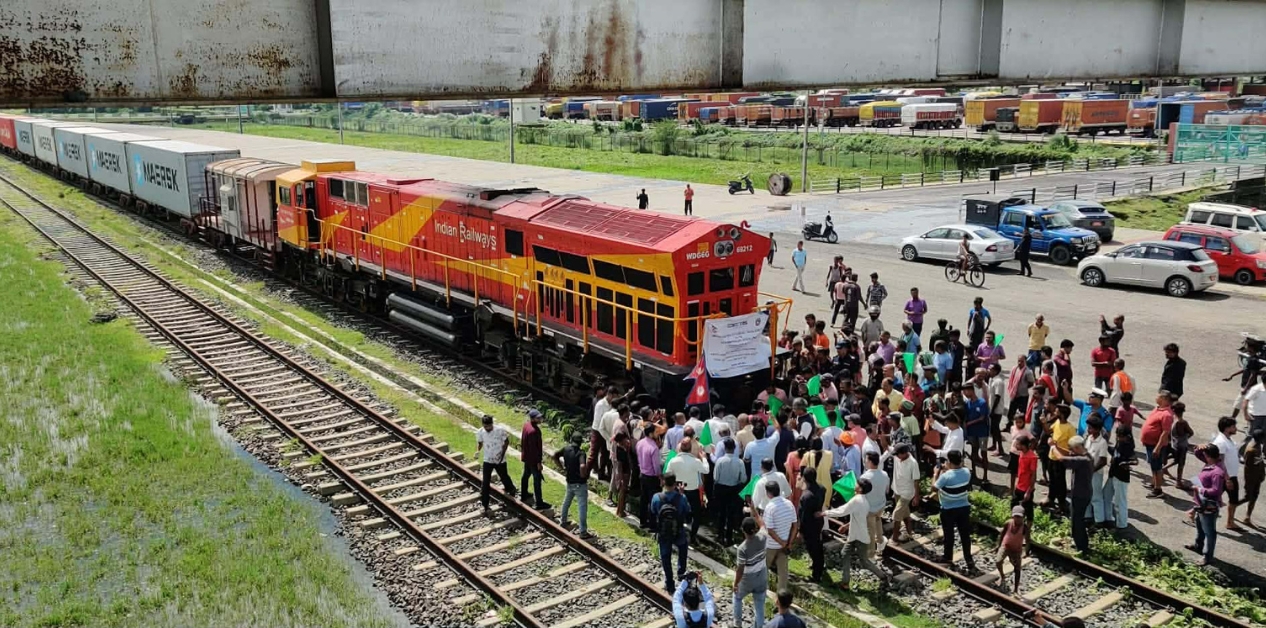
BIRATNAGAR: A cargo train carrying 40 containers from Kolkata Port, India, entered the Nepal Custom Yard located in Biratnagar-18 at 2:00 PM on July 20. The following day, after a trade facilitation program involving representatives of government agencies from Nepal and India, the containers were unloaded with the help of a crane, and the goods were delivered to the respective industries. In the first consignment, the train carried raw materials imported by Swastik Oil Industries.
About three years ago, a cargo train had also arrived in Biratnagar for a test run. However, due to cumbersome procedures and a lack of coordination, it did not gain continuity. This time, industrialists and businessmen in Biratnagar have taken the train arriving with raw materials imported from third countries as an important beginning toward the operation of regular cargo services.
Until now, the rail cargo facility was mainly concentrated at the Birgunj border point. With the extension of the service to Biratnagar, businessmen expect that the transportation cost and time for industries in eastern Nepal will decrease and imports and exports will become easier.
When then-Prime Minister Pushpa Kamal Dahal visited India around mid-2023, a new transit treaty was signed between Nepal and India. The treaty was moved forward in accordance with an agreement reached between then-Minister for Industry, Commerce, and Supplies Ramesh Rijal and his Indian counterpart Piyush Goyal.
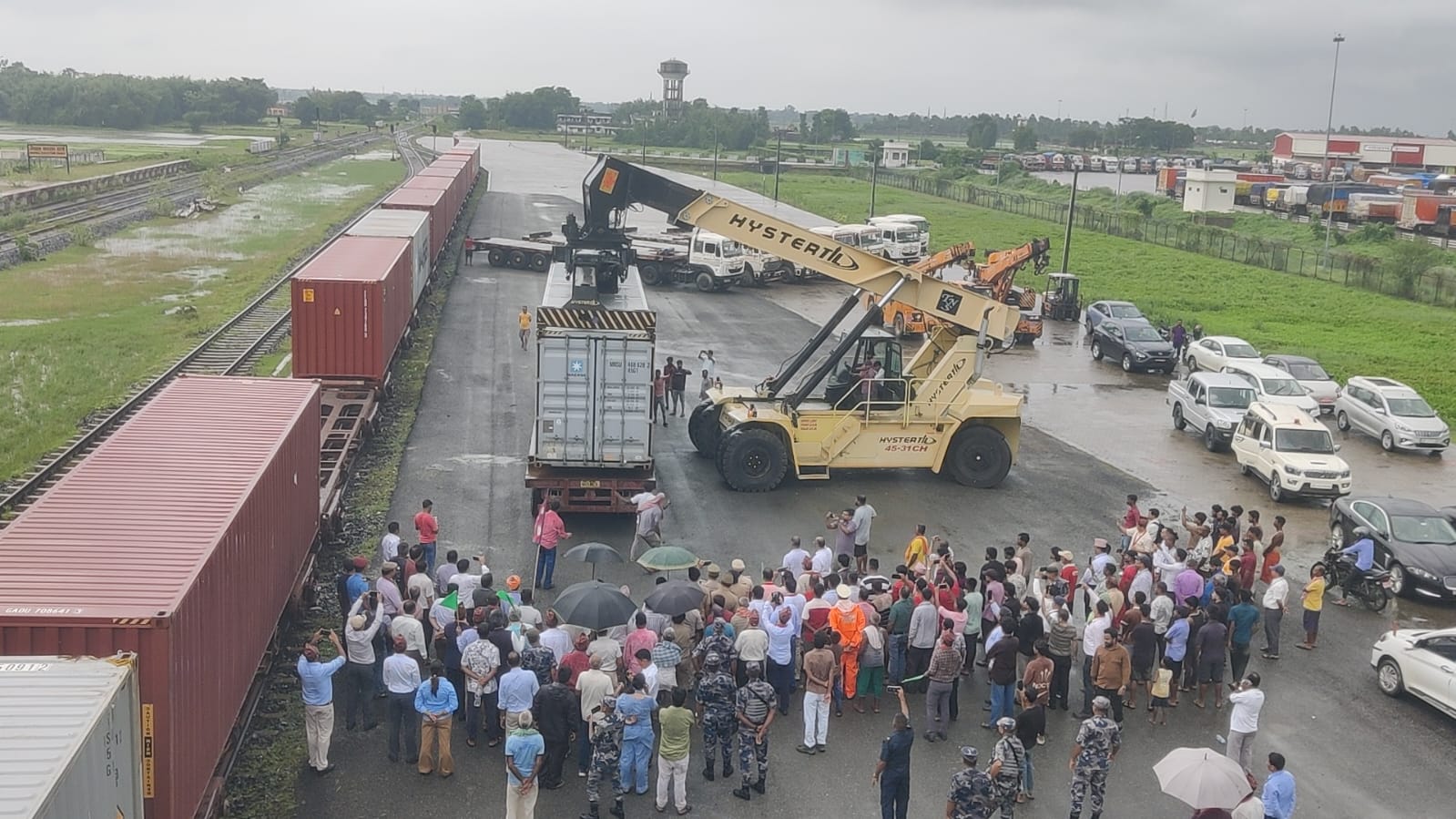
Crane unloading containers from the cargo train at the Nepal Custom Yard in Biratnagar on July 21
However, the treaty did not open the way to bring all goods imported from third countries by rail to the Nepal Custom Yard located at the Biratnagar ICP. Under that provision, only four types of goods, cement, clinker, chemical fertilizer, and coal, could be brought.
Due to this very provision prohibiting the carriage of raw materials and other goods by rail, an environment for operating regular cargo services up to Biratnagar was not created. Later, by amending the transit-related provisions, the way was opened to bring all types of goods via rail.
Only after that did the cargo train carrying raw materials from Kolkata Port arrive in Biratnagar. Nearly two years after the new transit treaty, Biratnagar has received a cargo train carrying goods imported from third countries. The “Electronic Cargo Tracking System” (ECTS) is installed on the train carrying Maersk Line containers. Through this system, information regarding the location and security of the containers can be obtained electronically.
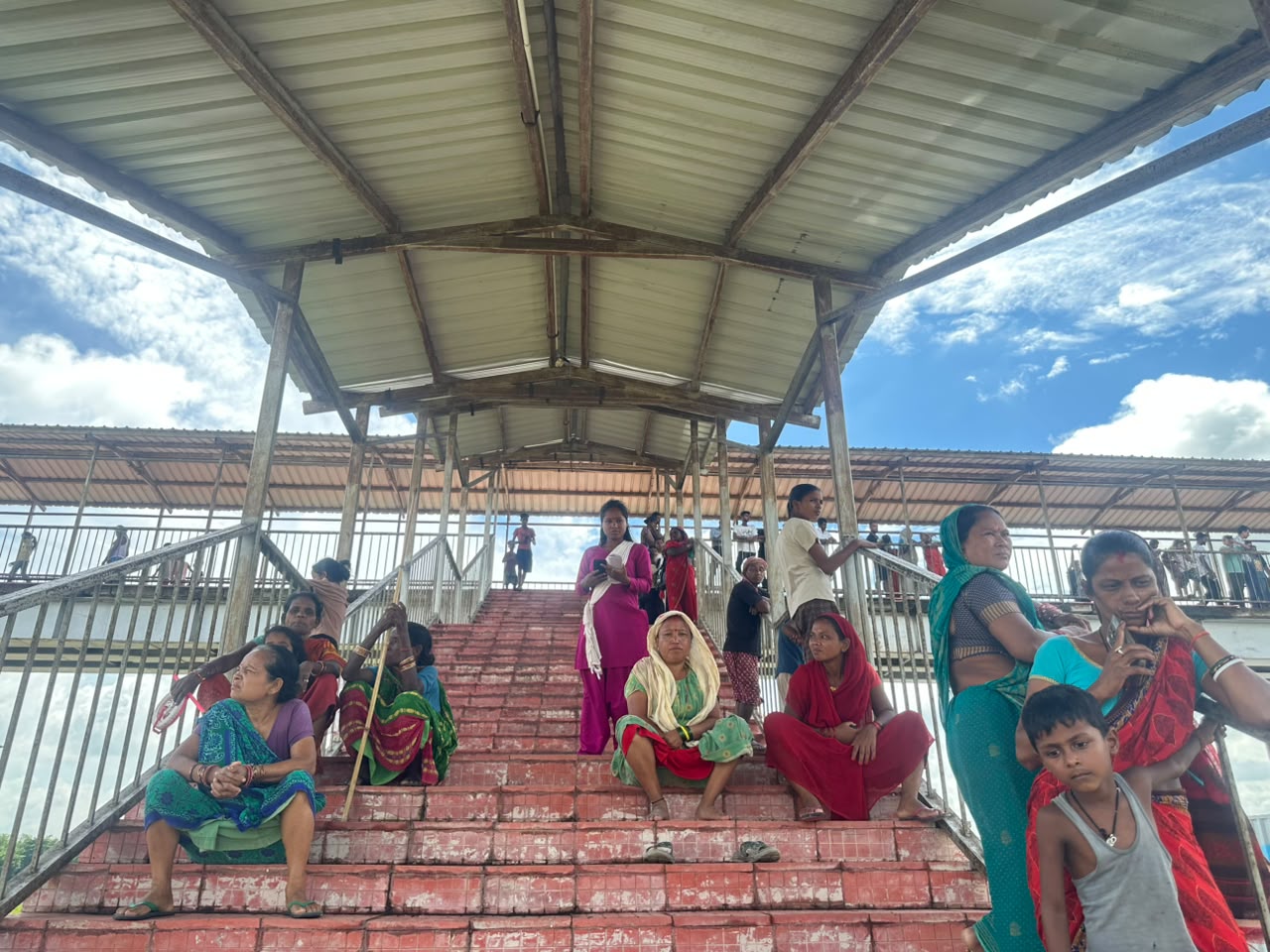
Local residents looking at the cargo train at the Nepal Custom Yard in Biratnagar
From Kolkata to Biratnagar in 24 hours
President of the Federation of Nepalese Chambers of Commerce and Industry (FNCCI), Koshi Province, Rajendra Raut, states that bringing cargo trains directly to the ICP has been a long-standing demand of industrialists in eastern Nepal.
“Previously, bringing goods via the road route through the Jogbani border point used to cost a lot of time and money,” he says, “Due to traffic jams and customs procedures, covering a five to six hour route used to take two to three days. Now, goods can arrive safely in Biratnagar from Kolkata within 24 hours.”
Raut states that the rail service will reduce transportation costs as well as lower the risks of road accidents, theft, leakage, and en route hazards. However, he says that the regularity of the service is more important than its launch. “Just starting the service is not a big deal; making it regular is the main challenge,” he says, “Proper management of the yard must be done to protect goods during the monsoon season, and the work up to Katahari, the final destination of the railway, must be completed immediately.”
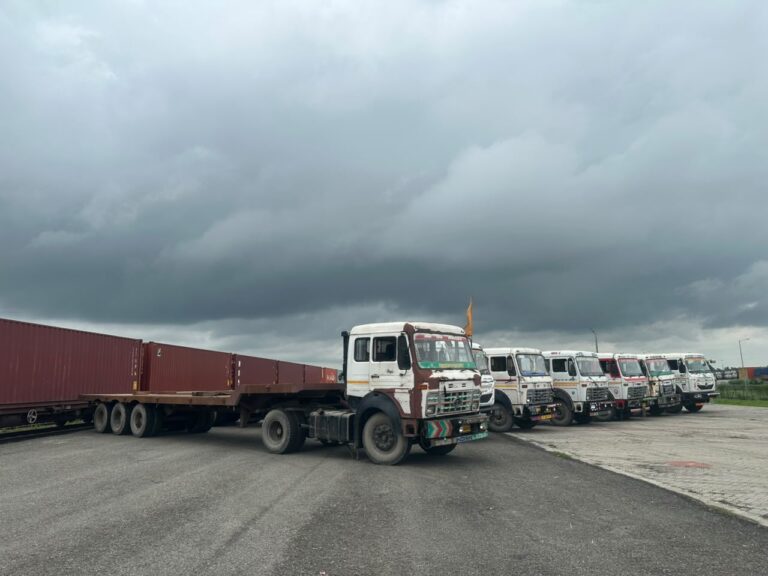
Freight trucks lined up in the Biratnagar Customs premises to transport containers
He demands that the current “CIF Kolkata” provision, meaning the arrangement where transportation and insurance costs up to Kolkata are included in the price of goods, be extended to Biratnagar. He also suggests opening liaison offices of major shipping lines in Biratnagar itself.
Estimated reduction in transportation costs
Industrialists and businessmen in eastern Nepal estimate that bringing goods via rail will save 30 to 40 percent in costs compared to road transportation.
President of the Confederation of Nepalese Industries (CNI), Koshi Province, Pawan Kumar Sharda, states that the cargo train will give industries in Biratnagar a foundation to compete with industries in Birgunj and Bhairahawa.
“For an industry, even a 1 or 2 percent profit is important,” he says, “Transportation expenses here appear to decrease by up to 30 percent. Due to expensive transportation, we were unable to compete with industries in Birgunj and Bhairahawa. Now, our products can be delivered across the country at competitive prices.”
He also mentions that transporting goods via rail makes it easier to maintain product quality. “When sugar or other raw materials were brought in trucks, there was a risk of dust and moisture,” he says, “Now, coming directly and safely by rail, there is no need to compromise on quality.”
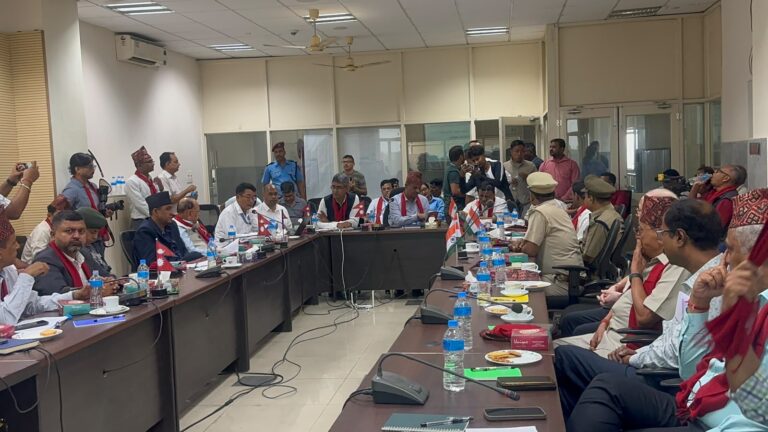
Government officials from Nepal and India attend a trade facilitation event via Nepal-India rail links at Biratnagar Customs
Sharda states that this service will also be useful for exporting Nepali products like garments, noodles, and biscuits to third countries.
Demand to reduce handling charges
President of the Morang Industry Association, Nand Kishor Rathi, considers the cargo train service an important achievement for the Morang-Sunsari Industrial Corridor. Since rail transport is cheaper compared to road transport, he states that it will help reduce production costs and enhance the competitive capacity of Nepali goods.
However, he says that unloading and handling charges are expensive. “The main problem right now is the unloading and handling charges,” Rathi says, “The rate determined by the Intermodal Transportation Development Committee is somewhat expensive. It should be revised to make it competitive with the rates in Birgunj.”
According to him, four to five racks have already been booked to bring goods via cargo train. He states that this shows industrialists are ready to use the service.
Expectations of opening the way for ‘CIF Biratnagar’
Chief Customs Officer of the Biratnagar Customs Office, Umesh Shrestha, considers the cargo train operation an important step in Nepal-India trade facilitation. According to him, the train service became possible through joint initiatives of Indian Customs, Indian Railways, the Consulate General of India, and the Nepali private sector.
“We estimate that this will reduce logistics costs by about 40 percent,” Shrestha says, “Now businessmen can bring goods under the concept of ‘CIF Biratnagar.’ When the price, including transportation and insurance of goods, is fixed up to Biratnagar, many intermediate procedures and hassles will be eliminated.”
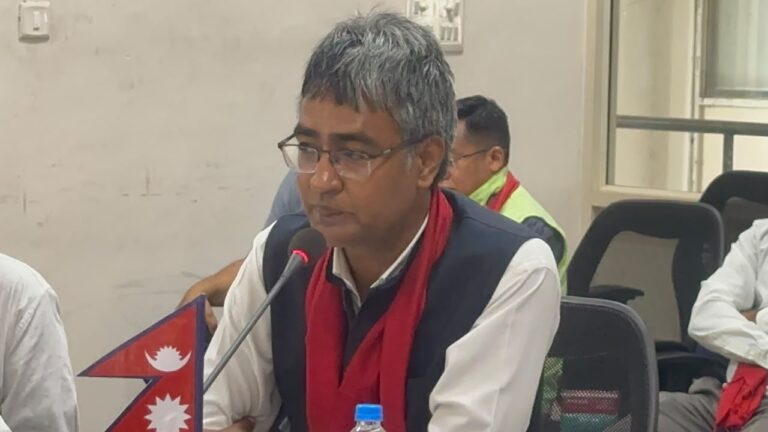
Chief Customs Officer Umesh Shrestha of the Biratnagar Customs Office
He further states that studies are underway regarding the possibility of bringing goods directly from Visakhapatnam Port in India to Biratnagar in the future.
President of the Biratnagar Customs Agents Association, Devaki Sharma, says that lessons must be learned from the experience of the train that arrived earlier for a test run and failed to gain continuity.
“About three years ago, a train had come for a test run as well, but due to cumbersome procedures, it did not come again after coming once,” he says, “The main challenge now is to prevent the service from shutting down again.”
He states that a liaison or public relations office is necessary in Biratnagar to coordinate among the railway, customs, shipping companies, and businessmen.
He believes that the rail service will reduce theft, leakage of goods, and unnecessary delays that occur during truck transportation.
The goal up to Katahari
The distance from Bathnaha, India, to the ICP Railway Station in Biratnagar is about 8 kilometers. A test run on this section was conducted in late 2018. Due to technical and procedural problems, regular cargo transportation could not take place. A test run was conducted again on June 1, 2023.
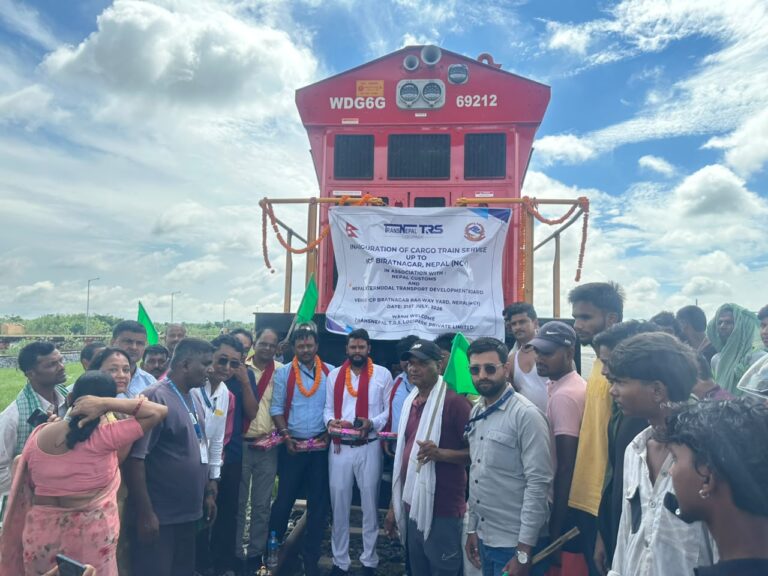
Representatives of government agencies from Nepal and India taking a group photo in front of the cargo train that arrived at the Nepal Custom Yard in Biratnagar
The total length of the Bathnaha-Biratnagar-Katahari railway is 18.1 kilometers. The project, started in 2011, is being constructed with financial and technical assistance from the Government of India worth INR 3.73 billion.
Of the railway line being constructed by the Indian company Ircon, about 13 kilometers lie in Nepal and 5 kilometers lie in India.
With the arrival of the cargo train, discussions regarding the possibility of operating passenger trains have also begun. However, to run passenger trains, the remaining railway construction up to Katahari and the final station construction must be completed.
Construction in the Katahari area was affected due to compensation disputes over some land plots. The Department of Railways states that through initiatives of the local administration, the dispute is heading toward resolution and work is ongoing as per the target of bringing the train up to Katahari.
Industrialists say that if the cargo train becomes regular, costs for industries in eastern Nepal will decrease, the market for Nepali products will expand, and it will help attract new investments. For that, they emphasize that competitive handling charges, sufficient yards, coordination among stakeholder agencies, and timely completion of the remaining construction up to Katahari are essential.