Kathmandu
Saturday, July 25, 2026





A personal journey through Vincent van Gogh’s art and pain, discovering that love is the ultimate power that teaches us to rise after losing to the world
KATHMANDU: “Euta jiban chha, jiban ko naum ma
Euta aafai chhu, harayeko anjaan sahar ma.”
Which translates to:
“There is one life, in the name of life,
There is one me, in an unknown lost city.”
For a few days, a fire has been burning intensely inside me. I am burning in the heat of this fire, but it has not turned me to ashes. It has, however, certainly wounded me. It is peeling away old scabs.
What is sorrow? What is its definition? To burn! To prick! To hurt! To die! Or to be unable to die? I do not have answers to these.
“Euta aakha chha sansar herne,
Euta sansar chha aakhale chiyaune.
Herchhu, aakha birsinchhu,
Baanchhu, aafai birsinchhu.”
Which translates to:
“There is one eye to see the world,
There is one world to peep through the eye.
I look, I forget the eye,
I live, I forget myself.”
One evening, in front of my eyes, I saw the Dutch painter Vincent van Gogh staying still on a shelf in an old bookstore. Looking at his chapped, dry lips, red stubble beard, and the deep lines dancing across his face, it felt like Van Gogh was looking at me. I felt as if he called out, saying, “Free me from this dust, give me a home.” Without thinking, I lifted him firmly with both my hands and brought him with me just like embracing a lover in a hug.
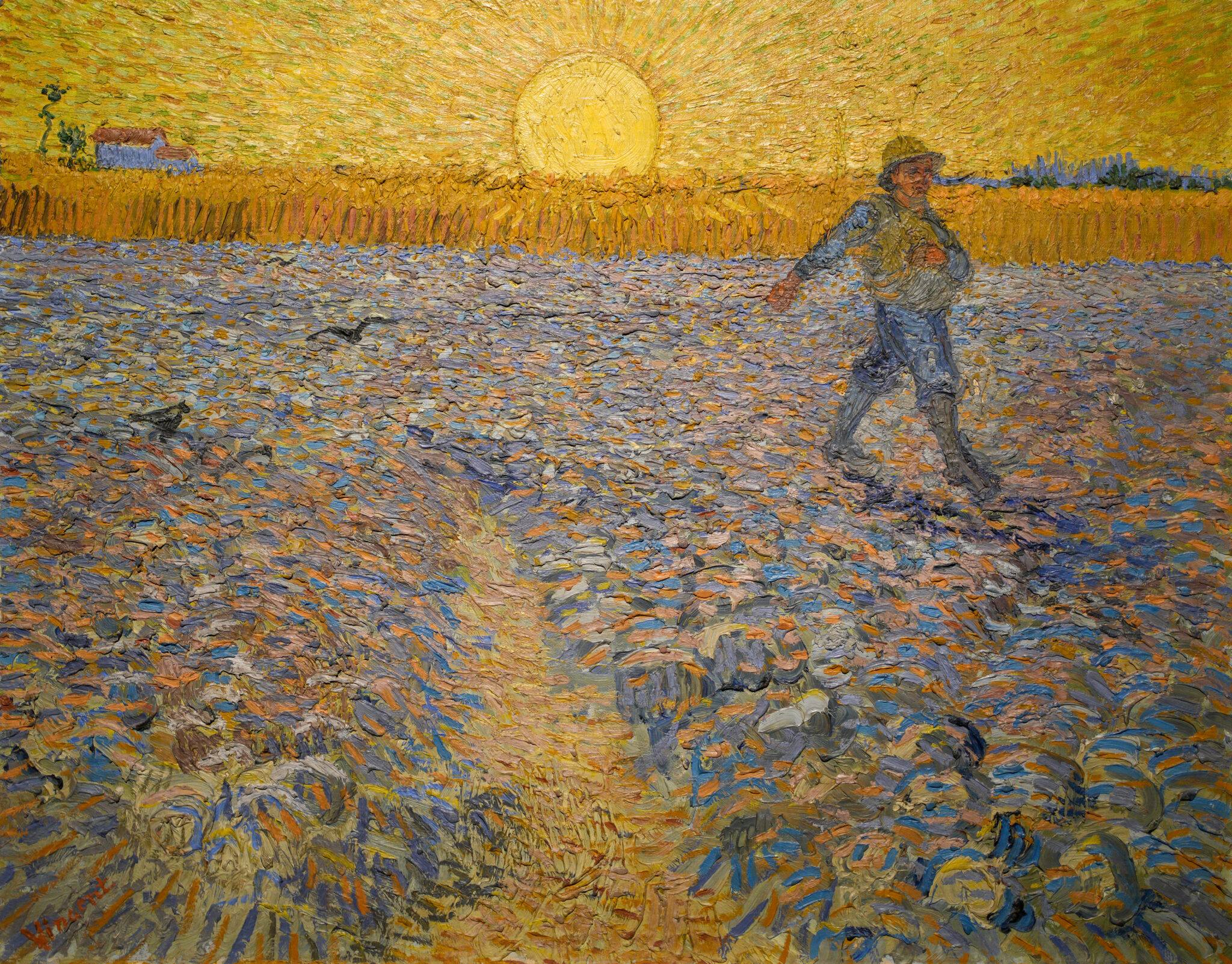
Photo courtesy: Photo courtesy: Wikimedia
Bringing it home, I stared at the book. van Gogh was not happy. He was not sad either. My gaze reflected no change on his face. Even when taken out from the bookstore’s dust-filled shelf and placed on a clean table at home, he did not smile. He kept looking neutrally and calmly. We both looked at each other.
While my questions went through various paths and kept getting stuck on van Gogh’s understanding of life, Gogh was enjoying his own world. He was enjoying a carefree life. He neither cared about the dust nor the sun. I tried to understand by looking at him, but I could not. I gave up.
“Euta pahaad chha uklinu, jiban ko naum ma,
Ma nirantara jharirahechhu, ananta bagar ma.”
Which translates to:
“There is one mountain to climb, in the name of life,
I am continuously falling, on an endless riverbank.”
I kept turning the pages. Tears kept flowing like a mountain stream. Just as a river swells after a flood arrives, so does the mind swell. Just as love letters are torn after love ends, so was the heart being torn apart. If one must choose, people usually do not want to choose sorrow. Man chooses happiness, chooses pleasure, but that book in my hand was telling a different reality.
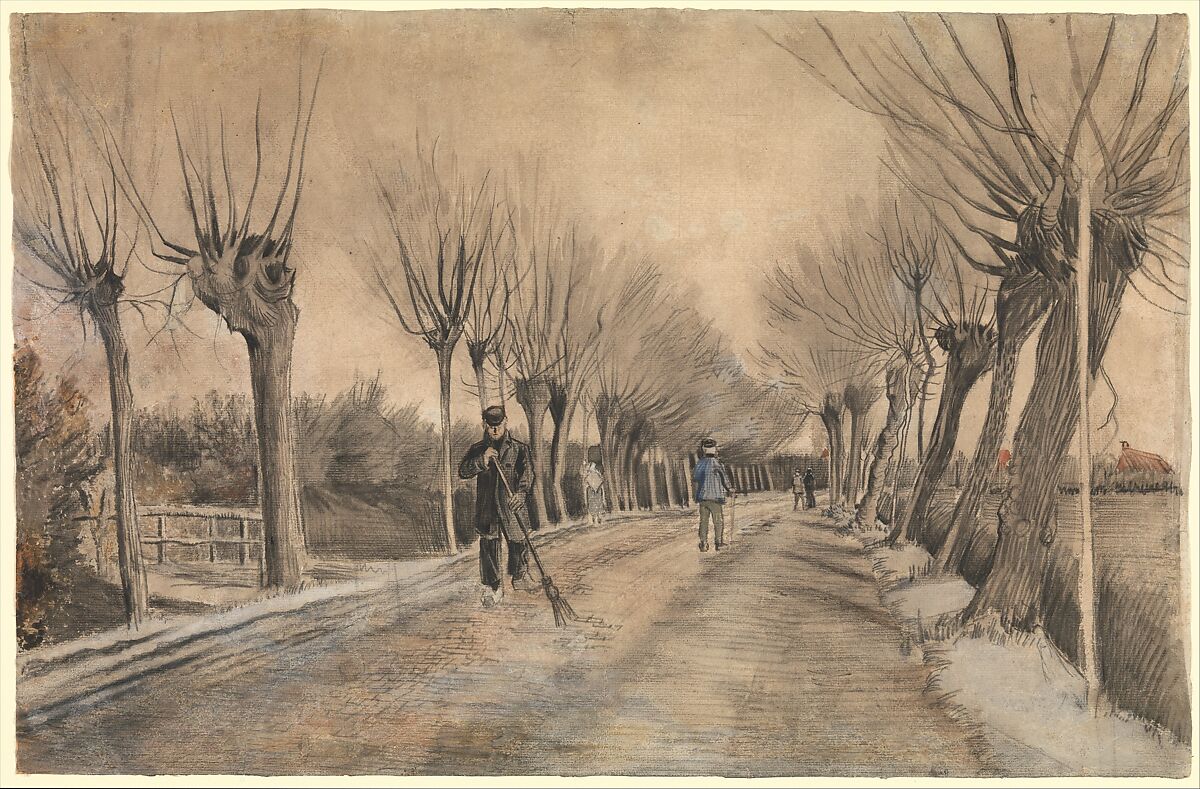
‘Road in Etten, 1881’. Photo credit: The Metropolitan Museum of Art, New York, Robert Lehman Collection, 1975
“Haanschhu haansna birsiera
Baanchhu baanchna birsiera
Sukhaisukha chha, dukkha ko naum ma,
Ma dukkhi chhu anjaan sahar ma.”
Which translates to:
“I laugh, having forgotten how to laugh,
I live, having forgotten how to live,
There is only joy, in the name of sorrow,
I am sad in an unknown city.”
I finished reading it in a few days. I dedicated the drops of tears in the name of Van Gogh. Gogh kept following me all day long.
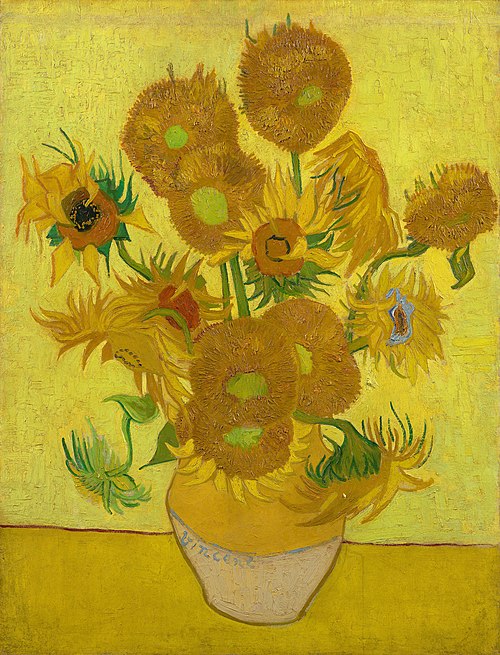
Vase with Fifteen Sunflowers is a famous oil painting by Vincent van Gogh created in August 1888. Photo courtesy: Wikimedia
Irving Stone writes in Lust for Life that this famous painter of Holland made friends with sorrow despite wanting, thinking, and understanding. It would not be much different to say he “chose sorrow.” He found the essence of life by climbing the mountain of sorrow itself. Although born into a famous art-dealer family, his perspective on art was completely different. For van Gogh, creating art and talking about art or trading art were not the same thing. He used to say, “A man either creates art or talks about art. He cannot do both at the same time.” Man has immense power to create within himself. But for that to fully blossom, madness is needed. Hunger is needed. An element beyond life is needed. Fire is needed. van Gogh had that element beyond life, had madness, had hunger, had that fire.
“Mero pagalpan mero sampatti,
Mero pagalpan mero bipatti.
Mero pagalpan mero jiban,
Mero maran euta pagalpan.”
Which translates to:
“My madness, my wealth,
My madness, my disaster.
My madness, my life,
My death, one madness.”
Vincent had a madness for making paintings. He lost to the world many times, but he never lost to the artist within himself. Even when the world was entirely hostile, he made colors and paintings his friends. What did he not go through? People were frightened and stayed away seeing his face. He never received the full love of any woman. He was living a life beyond society-made concepts.
Vincent van Gogh did not hold a job throughout his life. Because of this, his family was not happy with him either. Everyone called him “mad.” He was different from others in society. Therefore, other people could not understand him. In response, he did not answer either. Vincent van Gogh considered the senior painter Paul Gauguin a teacher. Once, a disagreement arose between them regarding paintings. In that rage, the incident of van Gogh cutting off his left ear is famous. After that, he was taken through the police station to an asylum.
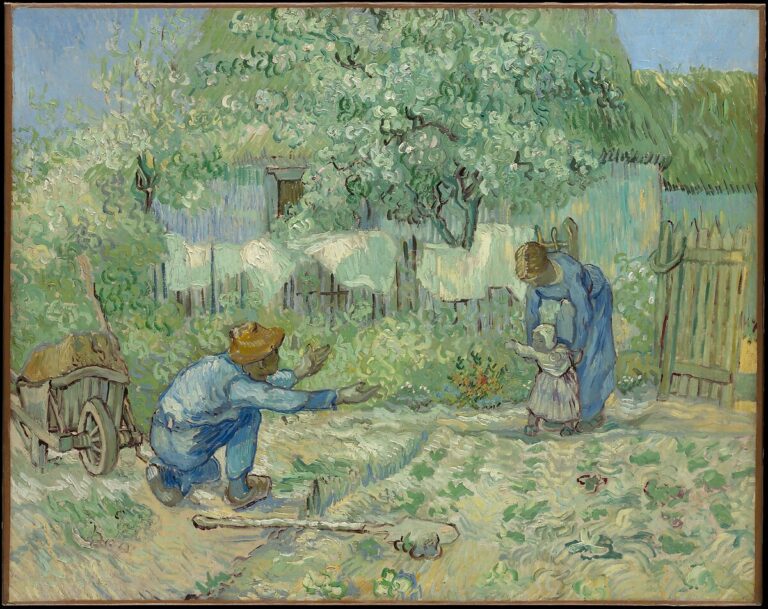
First Steps, after Millet. Photo credit: The Metropolitan Museum of Art
Before being taken to the asylum, he had asked his physician, “I am not mad. Nobody understood me. If you must take me, take me. But can I make paintings there too?”
“Bhetera talau, dubna chaahanchhu,
Bhetiinchha talau? Ma janna chahanchhu.
Mrityu chha, tyahi gahiraima,
Pheri jiban kaha chha?
Aljhai ma?
Euta satya chha sunauna nasakne,
Malai tyaha dubnu chha niskanai nasakne.”
Which translates to:
“Finding a pond, I want to drown,
Will a pond be found? I want to know.
Death is there, right in the depth,
Where is life again?
In entanglement?
There is one truth that cannot be told,
I have to drown there, unable to come out.”
Vincent van Gogh forgot everything while making paintings. He had no awareness of hunger, nor of thirst. Sometimes he forgot to eat, sometimes to sleep. But if there was one thing he did not forget in life, it was only making paintings. He went outside, sketched nature. He stayed inside, sketched life. From the house table, the water glass, to the sunflower placed in the vase, he brought them alive on canvas.
Such paintings are called “still life,” meaning the depiction of inanimate objects. “Sunflowers” is one of van Gogh’s most famous and world-renowned paintings. Today, when we think of paintings, we remember van Gogh. But if that fire, that hunger, that madness were not inside him, would he have become a painter worth remembering? Even dying every day, he lived, but from every pain, he squeezed out the essence of life. Wow, Vincent! You went taking the essence of life by going mad, and I am squeezed by that very essence.
I think the most important lesson of life is learned at that time when love mesmerizes a person. Love gives a person that power that teaches them to rise again even after losing to the world.
In van Gogh’s life as well, his brother Theo played that unique role. Theo loved Vincent. He asked for nothing in return. For years, he kept sending money from his own pocket every month so that Vincent could keep his dream of making paintings alive. If anyone supported van Gogh’s madness the most, it was his brother Theo.
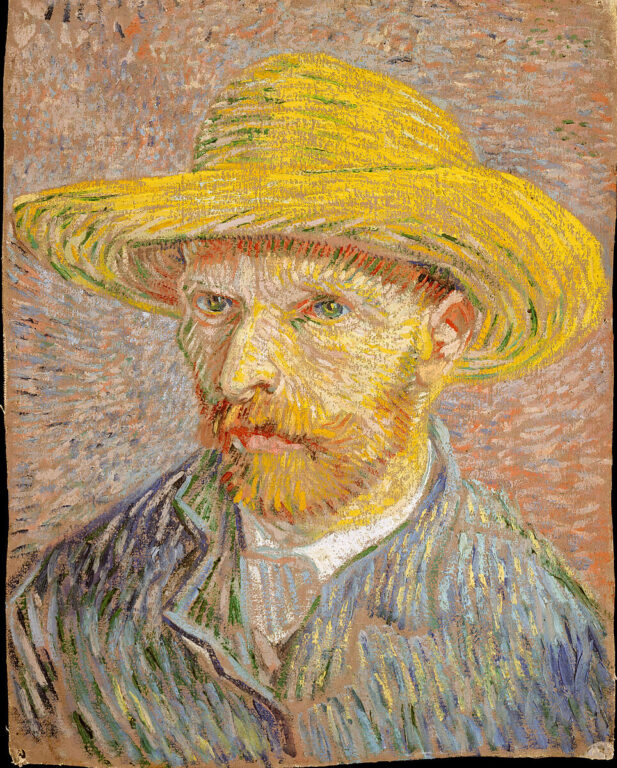
Vincent van Gogh painted over 35 self-portraits during his career as a way to practice painting people, save money on models, and explore his own identity
During a bad time in life, after cutting off his own ear and struggling between life and death in a hospital in France, when van Gogh opened his eyes, he saw Theo standing in front of him with eyes full of tears. Theo placed his hand on Vincent’s hand but said nothing. He only gave encouragement that “I am here.” In that silent touch lay the deepest definition of love. Theo had love for everything from Vincent’s shoes to his dirty canvas. For Theo, the most beloved person in the world was Vincent himself. In whose hands are life and death anyway? Between these two points, it is love that makes life meaningful.
Brother Theo was Vincent’s backbone. When nobody bought his paintings, van Gogh used to be extremely sad. He wanted the paintings to sell so that the hard work done by his brother and the money sent could be returned. One day, a letter and some money arrived in van Gogh’s hand, which Theo had sent. On the envelope, it was written that an art lover had bought the painting named “The Red Vineyard” and the money was for that. van Gogh was extremely happy.
However, those who know van Gogh do not have a single opinion on this. In many places, it is mentioned that the painting was sold. But the opinion of some is that the painting was not sold, and that his brother Theo had lied just for consolation. Be that as it may, the irony is that until the great painter Vincent lived, he did not receive as much respect as he deserved because of his art.
“Euta jindagi chha jindagi ko naum ma,
Maile bachnu chha aafnai naum ma.”
Which translates to:
“There is one life, in the name of life,
I have to live in my own name.”
Even while fluctuating with the many waves of life, Theo’s love for Vincent never diminished. Vincent cut off his own ear, struggled with mental instability, and did not achieve significant financial success throughout his life. van Gogh had a relationship with Sien Hoornik, who was a former prostitute and single mother. They lived together for about two years, which was considered unusual in European society at that time.
Vincent kept running continuously, kept flowing. He crossed the limits of madness. Even so, Theo always stood by him as a shadow with love and faith.
In July 1890, Vincent van Gogh shot himself. Two days later, at the age of 37, he died. About six months after that, Theo, grieving for his brother, also passed away. Theo, who supported Vincent financially and emotionally on his final journey, was later buried next to his brother. Visitors still offer sunflowers at their burial site in Auvers-sur-Oise, Paris, today.
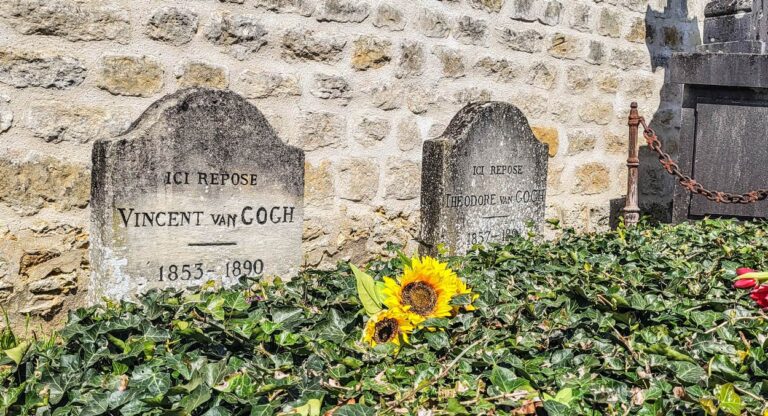
After Vincent’s death, a new era began in painting. But at the foundation of that era, Theo’s selfless love, sacrifice, and invisible support were equally indelible.
Is love like this? Selfless? Beautiful? Carefree? Perhaps it is. Perhaps man lives for love rather than sorrow and happiness. Sorrow and happiness are paths to walk on. They are mandatory lessons of life. But above all those, most necessary is love itself. It must be.
One day, I too will ask my lover some deep questions of love. I will say without hesitation, love me in the way Van Gogh loved colors. Lose yourself in me in the way that mad painters used to forget the entire world immersed in his paintings.
Sitting under the open sky on red soil, while painting, without even realizing that the hot sun has turned your head red, just like dissolving in creation, can you too lose yourself in me like that?
Am I worthy of such deep love? Can you be mine from the morning chill to the evening silence?
If that fire of love that sprouted inside you for me is not yet burning intensely, forgive me, I cannot melt in your love. I cannot make you melt. Because I have come before you only after the fire inside myself was ignited. This fire of surrender will never extinguish.
Can you love me like that?