Kathmandu
Monday, July 27, 2026





Hospitalized after launching his 24th hunger strike, Dr. Govinda KC says political appointments, conflicts of interest, and the government's failure to fully implement medical education reforms continue to undermine a cause he has championed for more than a decade.
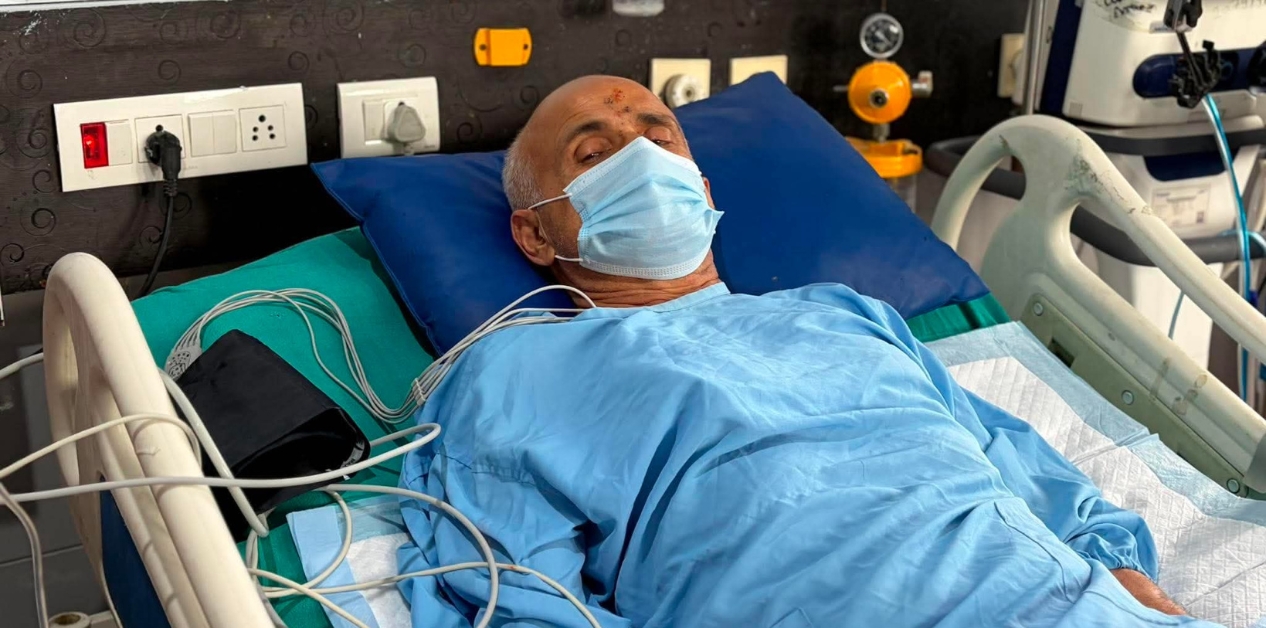
KATHMANDU: On Thursday morning (July 23), 70-year-old Dr. Govinda KC went on a hunger strike again at the guest house of Krishna Temple in Dhangadhi, Kailali. This is the 24th satyagraha he has started, demanding medical education reforms. However, this hunger strike appeared different from previous ones. Less than 24 hours after beginning the satyagraha, problems appeared in his health. As his health condition deteriorated, he had to be admitted to the ICU of Seti Provincial Hospital in Dhangadhi on Friday. Even now, he is undergoing treatment there.
According to Dr. KC’s aide Amrit Jaisi, Dr. KC’s main demand is the immediate annulment of the appointments of the Vice-Chancellor and Registrar of the Shahid Dashrath Chand University of Health Sciences located in Dhangadhi, Sudurpashchim Province. On July 15, the government had appointed Prof. Dr. Sunil Kumar Joshi as Vice-Chancellor and Dr. Bhim Bahadur Chand as Registrar of the university.
Dr. KC’s hunger strike was not a sudden decision. On July 17, two days after the government appointed the Vice-Chancellor and Registrar of the university, he issued a statement from Kathmandu making public a three-point demand. Giving a five-day ultimatum to the government to address the demands, he warned that he would start a satyagraha if they were not met. Listed first among the demands was that “the appointments of officials made to regulatory bodies of medical education, including medical universities, in a manner that creates a conflict of interest contrary to established rules, values, and norms, must be immediately annulled.”
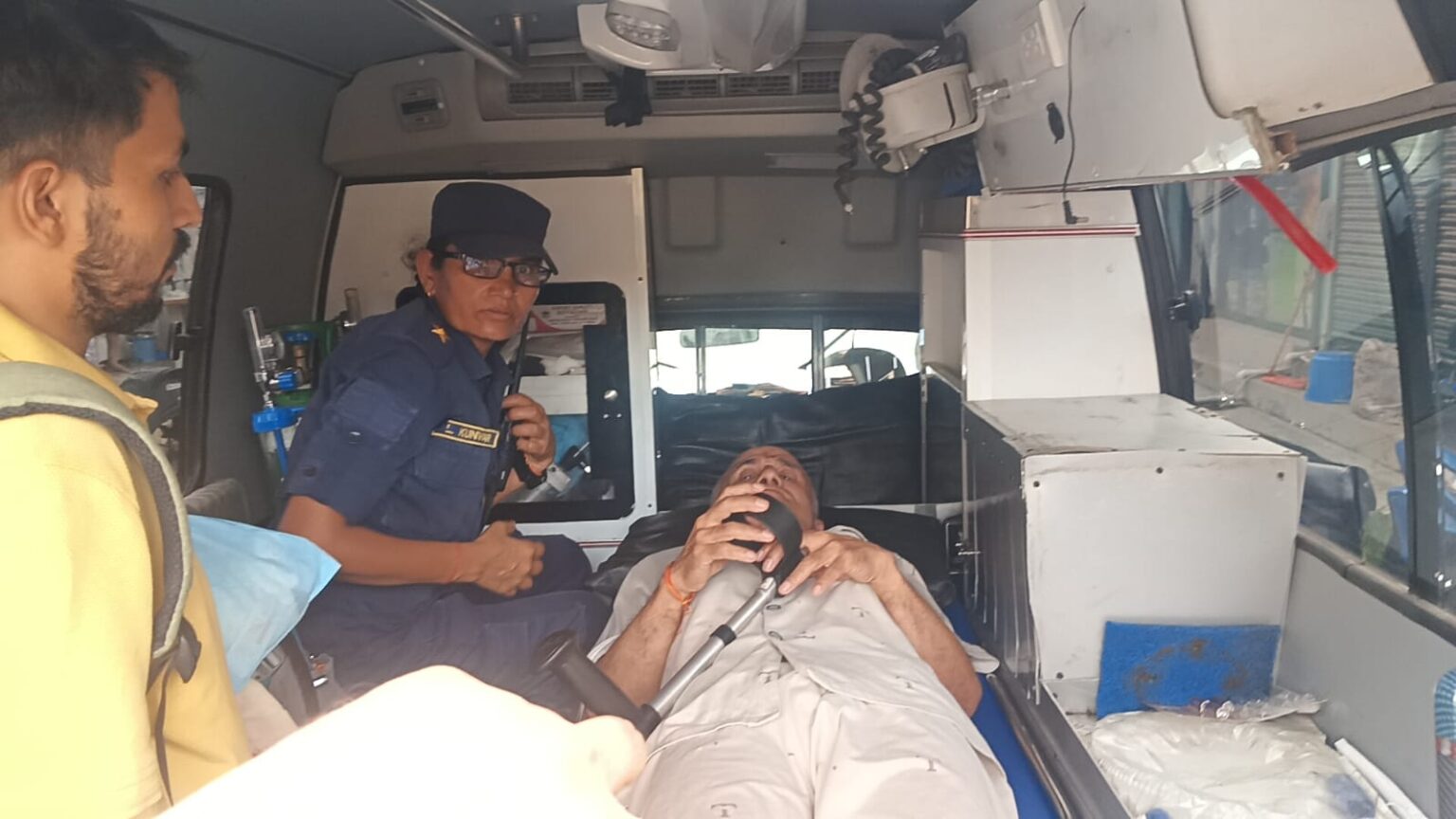
Dr. Govinda KC, who is on a hunger strike in Dhangadhi, being taken to Seti Provincial Hospital after his health condition deteriorated. Photo: Lavdev Dhami/Nepal Photo Library
After receiving no response from the government, he went to Sudurpashchim Province. Reaching Darchula, he issued another statement on July 22. He accused the government of completely ignoring the five-day deadline he had given and announced that he was forced to go on a satyagraha. The following day, on July 23 at 3:00 PM, he held a press conference at the guest house of Krishna Temple in Dhangadhi and started his 24th hunger strike.
Vice-Chancellor and registrar appointment controversy
Shahid Dashrath Chand University of Health Sciences is a health science university established by the government. Established with the objective of expanding medical education, health science-related study and research, and health services in Sudurpashchim, the university is located in Godawari Municipality-5, Geta, Kailali. The establishment of this university in Geta progressed as a result of repeated satyagrahas conducted by Dr. KC.
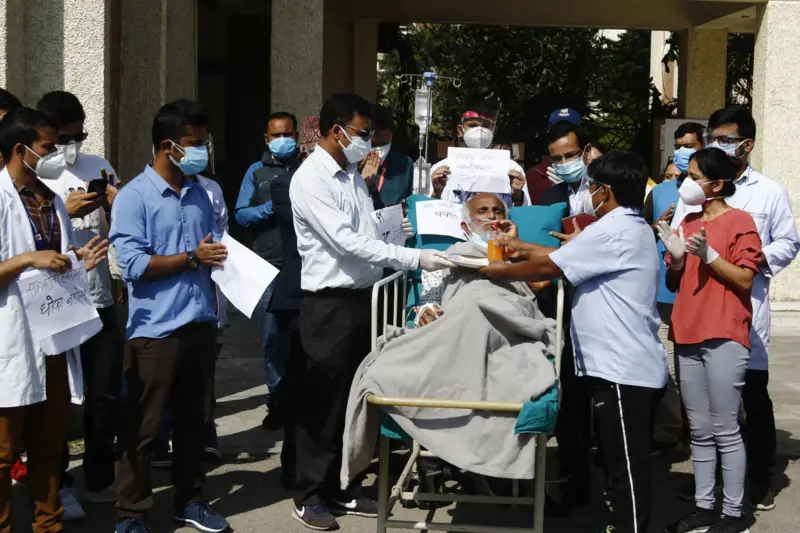
Dr. KC breaking his 19th hunger strike by drinking juice. Photo: RSS
During talks when Dr. KC was on satyagraha, the government would reiterate its commitment to establish a medical college in Geta. However, it remained limited to paper. The government, which had not implemented it for years, finally moved it forward in the formal process only on May 18, 2025. After the bill was passed by the House of Representatives, it was authenticated by the President on June 18, 2025, and subsequently published in the Gazette, bringing the ‘Shahid Dashrath Chand University of Health Sciences Act, 2025’ into implementation.
The government has planned to build a 300-bed hospital in Geta. Although the government stated in the budget of the last fiscal year 2025/826 that the university would be brought into full operation, it has not been able to do so yet. Dr. KC’s aide Jaisi says, “Although it was said that a teaching hospital would be operated, the government has not taken concrete steps regarding how to run it, despite claiming that sources of funding have been secured in the budget.” Dr. KC has demanded that the government take immediate steps to operate the university. “His demand is that after starting MBBS studies, other courses should be operated gradually,” says Jaisi.
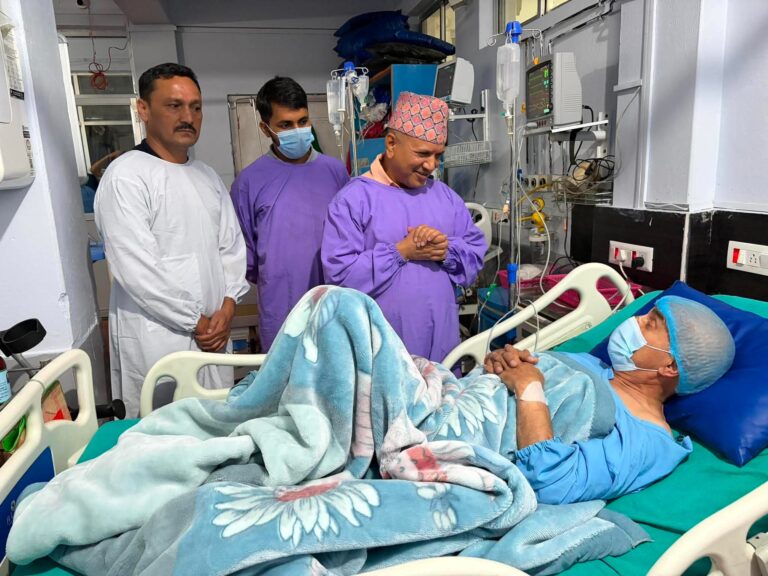
Government talks committee member Education Secretary Chudamani Paudel meeting Dr. KC. Photo: Dr. Amrit Jaisi
Even though structures are ready, government interest has not been seen in appointing the manpower required for MBBS studies. In appointing the Vice-Chancellor and Registrar, however, the government appears ahead.
Prior to being removed from office through the ‘Special Provisions Relating to Vacating Office of Public Officials Ordinance, 2026’ brought by the Balendra Shah-led government on May 3, Sunil Kumar Joshi himself was the Vice-Chancellor of Shahid Dashrath Chand University of Health Sciences. He had been appointed Vice-Chancellor on January 6, 2026, by the then-Sushila Karki-led government. At that time, when applications were solicited twice, nobody applied. When applications were solicited for the third time, only Joshi’s application was received.
After the university became vacant of officials due to the ordinance, the recommendation committee solicited applications. Once again, only Joshi’s application was received. Following this, the Senate meeting of the university held on July 15 appointed Joshi as Vice-Chancellor.
Dr. KC charges that Joshi is not a qualified person for Vice-Chancellor. According to him, the appointment standards of Dashrath Chand University are not transparent like those of Patan Academy of Health Sciences or Kathmandu Medical College, Dhulikhel. The criteria are of a nature where only a limited number of individuals can apply. Dr. KC’s demand is that this should be amended to make it possible for a maximum number of people to compete.
Dr. KC has alleged that Joshi has connections to private institutions. Joshi is a person who has previously served as a professor at Kathmandu Medical College. Dr. KC maintains that when a person previously associated with a private institution receives an appointment again, a “conflict of interest” prevails.
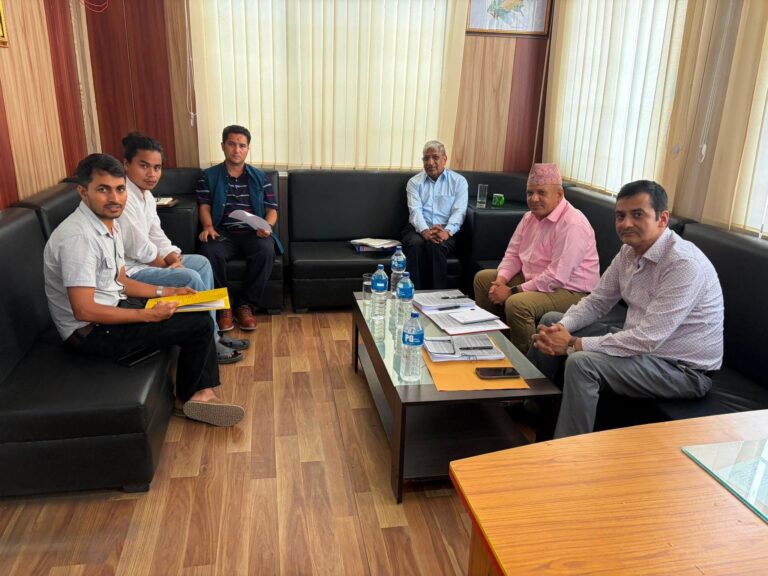
A meeting between members of Dr. KC’s talks team and members of the government talks team.
When Joshi was first appointed Vice-Chancellor of Dashrath Chand University, he made Dr. Bhim Bahadur Chand the key decision-maker. “The government made the appointment in a way that showed a conflict of interest; when demanded to correct it, after not being heard, Dr. KC was forced to start the satyagraha,” says Jaisi.
Joshi had even applied to become the Vice-Chancellor of Kathmandu University. His name was ranked 11th on the list of 35 people whose applications were approved. He withdrew his application to become Vice-Chancellor at Dashrath Chand University.
Dr. Bhim Bahadur Chand’s political connections are visible with both new and old parties. At the time when the Ministry of Education was drafting the bill to make a ‘Health Science Academy’ in Geta, then-Prime Minister Pushpa Kamal Dahal arrived in Sudurpashchim on a visit on February 17, 2023. The “special” person Dahal took along in the government helicopter was Chand himself. Chand was also the CEO of Peoples Dental College in Kathmandu and a member of the management group of Kathmandu Medical College (KMC). Reaching Geta, Dahal suddenly announced, “Now, not an academy, but a university will be built here.”
After the process to establish the university began, Chand’s involvement grew even further. When drafting the university’s act and regulations, he would frequent the Ministry of Education. He is accused of having legal loopholes inserted into the act so that the Registrar could be made powerful and the Vice-Chancellor controlled.
Sources claim that those currently supporting Chand include Rastriya Swatantra Party (RSP) Member of Parliament KP Khanal and another leader from the same party, Anand Bahadur Chand. Sources state that MP Khanal and Anand Bahadur pushed the hardest to appoint Bhim Bahadur Chand as the university’s Registrar. Sources claim Khanal visited the Prime Minister’s Office and the Ministry of Education to pressure for Chand’s appointment as Registrar. It is rumored that Chand himself put forward current Vice-Chancellor Joshi to serve his own interests.
Even before receiving the appointment, Chand had already sat at the university, frequented the ministry, and taken charge of administrative command. Regarding these allegations, Joshi says, “I won’t sit around answering such allegations. I am also a person who was recommended for the Vice-Chancellor position at Kathmandu University.” Stating that he is also a person who has been a professor at Oxford University, he claims that questions about his qualifications are unfounded because he demonstrated in three months at Geta work that had not been done in two years at other universities.
The second point among the three-point demands put forward by Dr. KC this time states, “The proposal to cut scholarships through the Medical Education Commission and increase seats for private colleges again without standards and infrastructure must be immediately revoked.” Similarly, the third demand states, “The legal provision to make medical education completely non-profit must be implemented swiftly.”
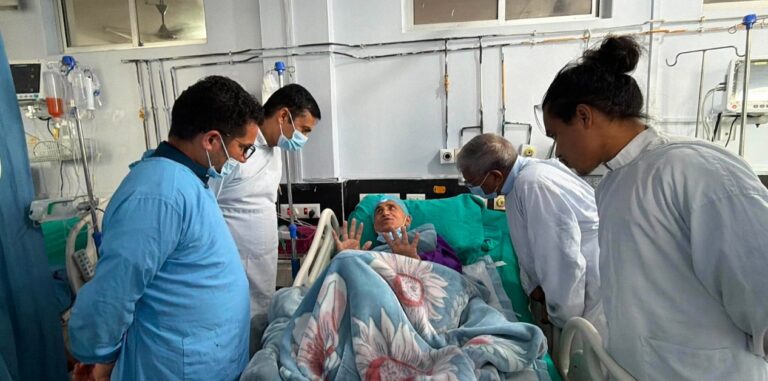
Government talks committee member Dr. JP Agrawal and others meeting Dr. Govinda KC at Seti Provincial Hospital. Photo: Dr. Amrit Jaisi
According to Dr. Jivan Chhetri, who has been alongside Dr. KC’s satyagraha for a long time, there are 27 medical colleges in Nepal. Among them, five are government medical colleges. The government itself had stated in the budget speech for the current fiscal year 2026/27 that seat numbers for teaching MBBS in medical colleges would be increased. Last year, the Medical Education Commission increased the seat limit for private medical colleges from 100 to 130. Chhetri claims that this time the Commission has adopted a policy to increase it further to 150 seats. He says, “Seat numbers should be determined after evaluating the spirit of the Act, college standards, expert advice, and supervision; however, the Commission has turned a blind eye and taken a policy to significantly increase the seat numbers of private medical colleges.”
The National Medical Education Act, 2019 aims to make medical education completely non-profit starting from the year 2028/29. However, the government has been increasing MBBS seat numbers targeting private medical colleges that operate for profit. He states that despite allegations of irregularities in the fees being collected by private medical and dental colleges, instead of investigating and taking action, the government is taking a policy of increasing seats in colleges that lack standards and infrastructure.
On July 7, the government appointed Dr. Devendra Khatri as Vice-Chairman of the Medical Education Commission. Khatri, a former Major General of the Nepalese Army, was a person who had worked at Birendra Military Hospital. Dr. KC charges that immediately following his appointment, the Medical Education Commission proposed cutting scholarships and increasing seats in private medical colleges. However, Commission member Dr. Badri Rijal states that no such proposal has come before the Senate meeting so far. “Whether it is because he understood inner preparations or whatever, I don’t know, but the proposal has not come to the Senate,” he says.
Dr. KC has demanded that because the appointments made in both institutions are “conflict-ridden,” they must be immediately annulled, and controversial provisions of the Act must be amended swiftly. Until the Act is amended, KC has demanded that interim leadership without conflicts of interest be arranged to maintain continuity of leadership. KC has demanded the swift implementation of legal provisions under the National Medical Education Act, 2019 to make medical education completely non-profit. He has also demanded the implementation of written agreements made with past governments.
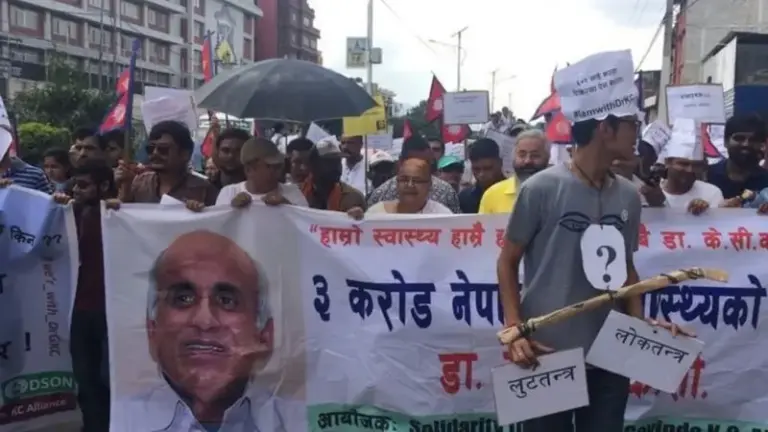
A demonstration held in support of Dr. KC.
While the government appears ready regarding other demands raised by KC, it has indicated that the appointments of officials cannot be annulled immediately. On behalf of the government, Prime Minister Balendra Shah’s health advisor Dr. JP Agrawal, Education Secretary Chudamani Paudel, and Health Secretary Dr. Bikas Devkota are conducting talks with KC. During talks on Sunday (July 26), KC maintained his stance that he will not end the satyagraha until the appointments are annulled.
Commission Vice-Chairman appointment always in controversy
After the formation of the Medical Education Commission, the appointment of the Vice-Chairman fell into the shadow of controversy from the very beginning. The government had appointed Dr. Shri Krishna Giri as the first Vice-Chairman on September 12, 2019. That decision itself became controversial. The Nepal Medical Council raised questions stating that according to the National Medical Education Act, 2019, he lacked the required qualifications. The Act provides that a person who has obtained a postgraduate degree in any subject of medical science from a recognized university and has at least 20 years of experience in the relevant field can become the Vice-Chairman.
At that time, the recommendation committee led by then-Public Service Commission Chairman Umesh Mainali had forwarded the names of Dr. Surendra Sherchan, Dr. Shambu Pahari, and Dr. Shri Krishna Giri to the Cabinet. However, according to the Nepal Medical Council, none of the three recommended persons had completed the required 20 years of experience as a specialist physician or professor. Their postgraduate registrations with the Council were 2015 for Sherchan, 2008 for Pahari, and 2003 for Giri, respectively.
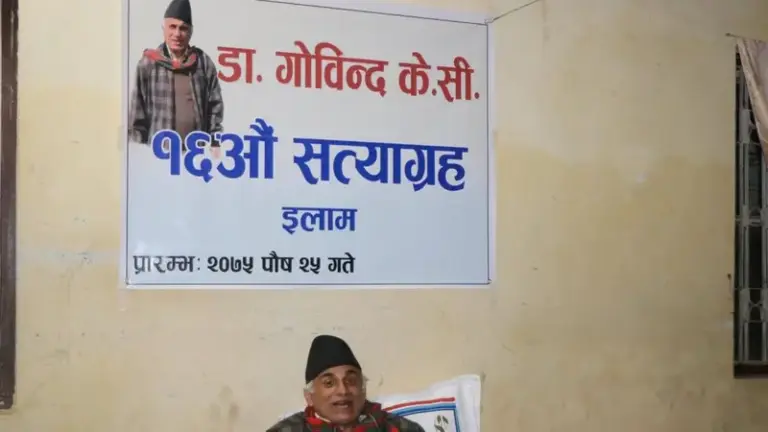
Dr. KC’s 16th satyagraha. Photo: Social Media
Amidst the controversy, the Cabinet appointed Giri as Vice-Chairman. Giri was considered close to then-Education Minister Giriraj Mani Pokharel. As Giri’s four-year term was nearing its end, the government appointed Dr. Anjani Kumar Jha as Vice-Chairman on September 7, 2023. Prior to that, the recommendation committee had recommended the names of Dr. Pravin Mishra and Dr. Shri Krishna Giri alongside Jha. Jha was known as a person close to the then-ruling Nepali Congress.
This time as well, the appointment process could not remain free of controversy. While RSP was in government, the names of Dr. Devendra Khatri, Dr. Pramod Yadav, and Dr. Shri Krishna Giri were recommended. Without making the recommendation list public, the government appointed former Nepalese Army Major General Dr. Khatri as Vice-Chairman. After Dr. KC went on a satyagraha accusing Khatri’s appointment of being a conflict of interest, the appointment of the Commission’s Vice-Chairman was dragged into controversy.
The unfinished movement
Dr. KC first went on a hunger strike in July 2012. His satyagraha was not against a single position or individual; it was a rebellion against the anomalies deeply rooted in the country’s medical education and healthcare system. He had initiated the satyagraha taking a stand that the appointment of the Dean of the Institute of Medicine (IOM) should be based on seniority.
At that time, affiliations, seat numbers, and fees for all medical colleges were set by IOM. Dr. KC concluded that making appointments based on personal interests at IOM increased irregularities in the medical sector. On the other hand, nearly half a dozen private medical colleges around Kathmandu were awaiting affiliation. Fearing that while the number of medical colleges would rise, the foundation for producing quality doctors would grow even weaker, KC would go on satyagraha.
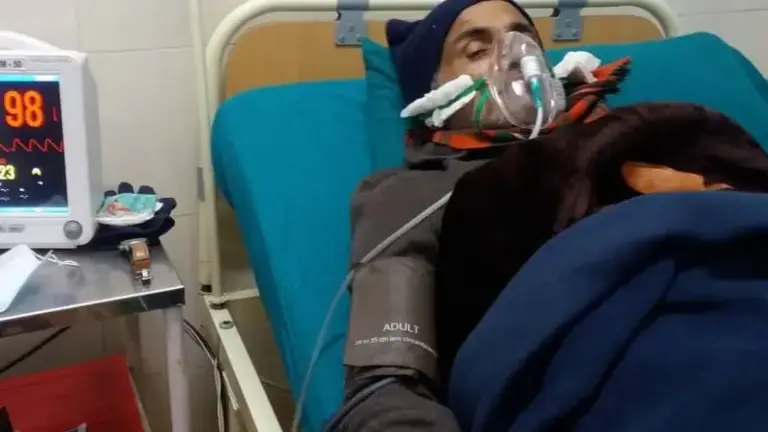
Dr. KC’s 16th satyagraha. Photo: Social Media
When he started his satyagraha, four Kathmandu-centric medical colleges—Manmohan Medical, Peoples Dental, Kathmandu National, and Nepal Police—were awaiting affiliation. There were 12 additional medical colleges that had received Letters of Intent (LOI) from the Ministry of Education. If Dr. KC had not sat on hunger strikes, all those colleges would have already come into operation. Medical colleges would have increased the number of doctors, but there would have been no quality.
A system was instituted requiring students going abroad to study MBBS to also meet the qualifications set in Nepal. Previously, students unable to pass the entrance examination in Nepal would return with degrees from abroad and repeatedly fail the Nepal Medical Council’s licensing examination. Today, that loophole has been closed to a large extent.
Following Dr. KC’s satyagraha, a merit system was institutionalized in medical education. The anomaly of being deprived of study despite passing the entrance examination was eliminated. The practice of buying seats based on money at one time was ended. The door to study MBBS opened even for economically weak yet talented students.
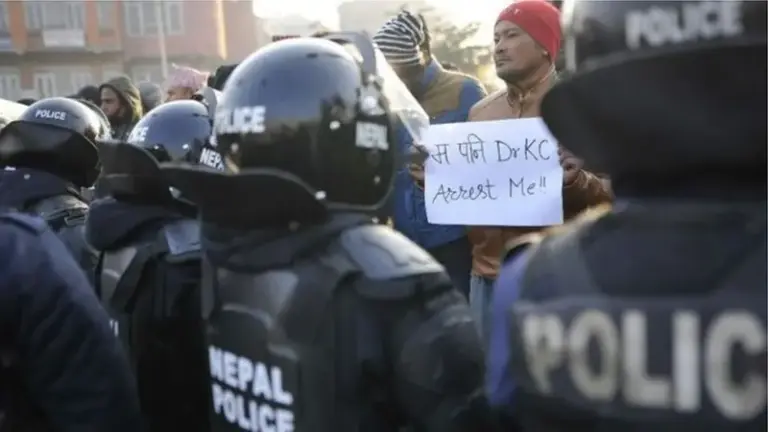
Demonstration held in protest after Dr. KC was arrested on charges of contempt of court on January 9, 2018. Photo: Social Media
Free study at the MD and MS levels is also an achievement of Dr. KC’s movement. Previously, one had to spend anywhere from Rs 2 million to Rs 10 million for specialist studies. Now, doctors studying for free are required to serve for at least two years in remote areas specified by the government. This has laid the groundwork for expanding specialist health services outside Kathmandu.
It was following the pressure of KC’s satyagraha that the National Medical Education Act, 2019 was enacted, and the Medical Education Commission was formed. An autonomous body became active with the Act within IOM’s scope of work. Nevertheless, stating that all his suggestions were not incorporated into the Act, he is still demanding amendments. It is when those in power make conflict-ridden appointments in this autonomous body that Dr. KC protests.
Dr. KC has repeatedly prioritized the same subject in his satyagrahas: that quality health services be expanded to remote areas. From bringing Karnali Academy of Health Sciences, the medical college in Geta, and Rapti Academy of Health Sciences into full operation to establishing a government medical college in every province, it is his contribution. The government has indicated in its budget speech preparations to operate a government medical college in every province.
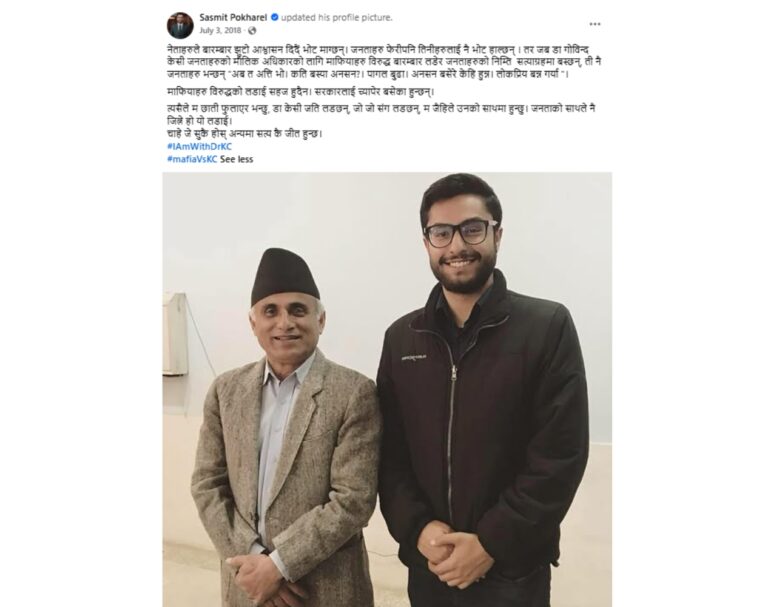
A Facebook status written in support of Dr. KC by current Education Minister Sasmit Pokharel on July 3, 2018.
KC, who worked as a senior orthopedic specialist at T.U. Teaching Hospital, travels every year to remote villages of Karnali and Sudurpashchim carrying a bag of medicines. Without publicity, a team, or any fanfare, his journey of walking in search of patients has spanned more than three decades.
Former Vice-Chancellor of Tribhuvan University Kedar Bhakta Mathema states that the fact that Dr. KC, who made medical practice a service rather than a job, is forced to sit on repeated fasts-unto-death is proof of the state’s failure. “A physician over 70 years old still has to demand quality health services in remote areas, an end to the commercialization of medical education, and equal opportunities for rich and poor alike. None of these are issues of personal interest; they are fundamental duties that the state itself should fulfill,” says Mathema. “Through his hunger strikes, KC has exposed the true face of the health sector before the country. The question is not why KC is repeatedly going on hunger strikes, but why the state is still standing in the same place.”