Kathmandu
Friday, July 24, 2026





From Warsaw to Kathmandu, the modern attack on democracy doesn't start with tanks, it starts with the Supreme Court.

KATHMANDU: Kathmandu has spent the last three months absorbed in a dispute that looks, on the surface, like an argument over seniority lists and quorum numbers inside a single institution. Look closer and it is something far more familiar to students of comparative constitutional law. What is unfolding around the Supreme Court of Nepal, the ordinance rewriting how the Constitutional Council votes, the elevation of a justice fourth in line over three seniors, and now the reported pressure on those three justices to resign under the shadow of impeachment, belongs to a genre of political engineering that has appeared, with local variations, in Poland, Hungary, Turkey, Pakistan, Sri Lanka, Venezuela and India over the past two decades. The tools differ. The underlying logic does not.
A government that cannot easily remove a court decides instead to reshape who sits on it, and if that fails, to make the cost of independent judgment high enough that judges reshape themselves.
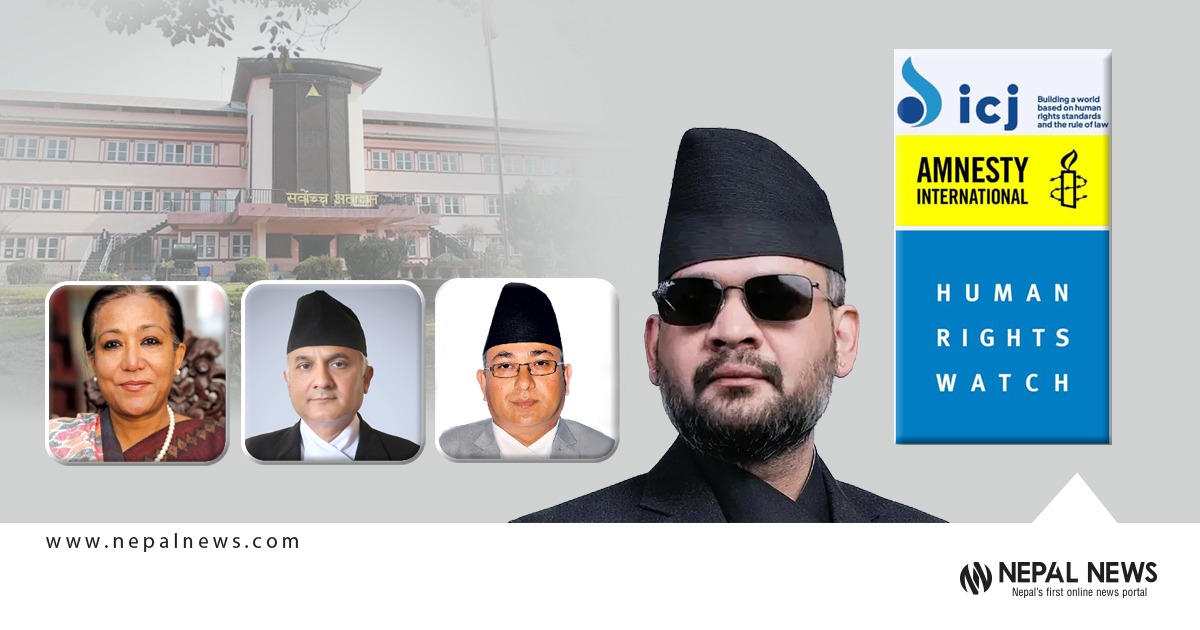
The joint statement issued on July 24 by Amnesty International, Human Rights Watch and the International Commission of Jurists should be read against this wider backdrop, not as a diplomatic courtesy extended to a small Himalayan republic but as a warning shot fired because the pattern has become recognisable enough that international monitors know what tends to happen next.
The architecture of a captured court
Montesquieu’s warning in The Spirit of the Laws, that there is no liberty if the power of judging is not separated from the legislative and executive powers, has become something close to a cliche in constitutional theory classrooms, repeated so often that it risks losing its force. But clichés earn their status by being true across contexts, and Nepal’s Constitutional Council saga is almost a textbook illustration of what happens when that separation is treated as an inconvenience rather than a structural safeguard.
The mechanism used in Kathmandu, an executive ordinance lowering the quorum of the body that recommends judicial appointments from five members to four, and permitting a decision by three votes rather than requiring broader consensus, is a governance trick with a long pedigree. It does not touch the constitution’s text. It does not abolish the council. It simply changes the arithmetic of control inside a body where the ruling coalition already holds a majority of seats.
Alexander Hamilton, writing in Federalist No. 78 to defend the design of an independent judiciary in the fledgling American republic, argued that the courts have neither force nor will, only judgment, and that this made permanence in office indispensable to their firmness. His argument was that judicial independence is inherently fragile precisely because courts have no army and no purse, only the authority that flows from being seen as impartial. Anyone seeking to weaken that authority does not need cannons. They need arithmetic, and Nepal’s ordinance supplied exactly that.
The parallel with Poland is almost uncomfortably precise. Between 2015 and 2018, the Law and Justice government in Warsaw did not storm the Constitutional Tribunal or the Supreme Court. It changed the rules governing who could be appointed to them, lowered the retirement age to force out sitting judges, and created new disciplinary chambers staffed by judges loyal to the ruling party. The Venice Commission, the Council of Europe’s own advisory body on constitutional matters, concluded in its opinions on the Polish reforms that the cumulative effect of these changes was to place the judiciary under the political control of the legislative and executive powers, thereby endangering the separation of powers and the rule of law.
The European Court of Justice eventually ruled that Poland’s disciplinary regime for judges was incompatible with EU law, but by the time that ruling arrived, years of institutional damage had already been done and dozens of judges had been forced out or intimidated into compliance.
The lesson Warsaw’s experience offers Kathmandu is blunt. Legal remedies, even when they eventually succeed, tend to arrive long after the political objective has already been achieved on the ground.
Turkey offers an even starker version of the same logic, though delivered with more force and speed. After the failed coup attempt of July 2016, the government of Recep Tayyip Erdogan dismissed or suspended more than four thousand judges and prosecutors within weeks, a purge so vast that entire benches had to be reconstituted almost overnight. The Council of Europe’s Group of States against Corruption, GRECO, and multiple United Nations special rapporteurs on the independence of judges and lawyers documented in subsequent years how the mass removals were followed by a restructuring of the body responsible for judicial appointments, giving the executive branch decisive influence over who would fill the vacated seats. The Turkish case is instructive precisely because it shows the endpoint of the process Nepal’s rights groups fear is only beginning: once a government controls both the exit door, through disciplinary or removal mechanisms, and the entry door, through appointment bodies it dominates, judicial independence stops being a legal guarantee and becomes a matter of executive discretion.
Nepal’s situation, to be clear, has not reached that scale. No mass dismissals have occurred. But the analytical building blocks, control of the entry door through the Constitutional Council ordinance, and now reported pressure at the exit door through the threat of impeachment against three sitting justices, are the same two levers that turned Poland and Turkey’s judiciaries into far more pliant institutions than they once were. The scale is different. The mechanism is not.
The seniority convention and why unwritten rules matter
One of the more intellectually interesting aspects of the Nepali dispute is that the norm being violated, the elevation of the senior most sitting justice to chief justice, was never written into the constitution at all. It was a convention, the kind of unwritten rule that legal scholars have long argued does much of the real work of constraining power in systems that rely on more than bare textual command. The British constitutional theorist Ivor Jennings, in his classic study of constitutional conventions, argued that such practices bind political actors because breaking them would be seen as improper, even though no court could enforce them directly. Their power lies in shared expectation, not judicial remedy.
That is precisely what makes the Nepali episode so corrosive to institutional trust even though, strictly speaking, no black letter law was broken by choosing a justice fourth in seniority. Once a government demonstrates that a stabilising convention can be discarded whenever it proves inconvenient, every future appointment becomes a live political contest rather than a predictable, rules based succession. Judges who might once have expected promotion through the ordinary passage of years now understand that their future depends on staying in the good graces of whichever coalition happens to control the Constitutional Council at the relevant moment. That is a corrosive incentive to build into any judiciary, because it invites judges to calibrate their rulings not against the law but against political winds.
Tom Bingham, the former senior law lord whose book The Rule of Law remains one of the most widely read distillations of the concept for a general audience, wrote that ministers and public officers must exercise the powers conferred on them reasonably, in good faith, for the purpose for which the powers were conferred and without exceeding the limits of such powers. An ordinance that exists to solve a genuine quorum problem is one thing. An ordinance that exists to guarantee a predetermined outcome in a specific, high stakes appointment is another, and the distinction between the two is precisely the kind of question Bingham’s formulation invites courts and citizens alike to ask.
Impeachment as a instrument rather than a safeguard
The most alarming element of the July 24 statement is not the ordinance itself but the allegation that three senior justices have been quietly pressured to resign under threat of impeachment, without any publicly disclosed allegation that would meet the constitutional bar for such proceedings. This is where Nepal’s crisis moves from a structural critique of institutional design into something closer to intimidation of individuals, and it is worth pausing on why international lawyers treat this distinction as so significant.
The United Nations Basic Principles on the Independence of the Judiciary, adopted by the General Assembly in 1985 and still the most widely cited global reference point on this subject, state that judges shall be subject to suspension or removal only for reasons of incapacity or behaviour that renders them unfit to discharge their duties, and that all disciplinary, suspension or removal proceedings shall be determined in accordance with established standards of judicial conduct. The principle behind this language is not that judges are above accountability. It is that accountability mechanisms designed to police genuine misconduct become dangerous the moment they can be deployed, or even credibly threatened, in response to a judge’s role in an inconvenient political outcome rather than any wrongdoing. A mechanism intended as a scalpel becomes, in the hands of a government willing to use it that way, closer to a cudgel.
Pakistan’s recent judicial history offers a cautionary parallel here that Nepali commentators have not yet drawn as often as they might. In 2007, General Pervez Musharraf suspended Chief Justice Iftikhar Muhammad Chaudhry on charges of misconduct that were widely seen, both domestically and internationally, as a pretext for removing a justice who had begun ruling against the government on politically sensitive matters, including disappearances linked to the security services. The move triggered the Lawyers’ Movement, a mass mobilisation of the legal profession that eventually forced Chaudhry’s reinstatement and became one of the defining episodes in Pakistan’s constitutional history.
The parallel to Nepal’s Bar Association staging lantern protests over the treatment of Acting Chief Justice Sapana Pradhan Malla is not exact, the stakes and the scale differ considerably, but the underlying grievance, that a formally available disciplinary tool was being used for what looked like political convenience rather than genuine cause, rhymes closely enough to be instructive.

Sapana Pradhan Malla. File photo
Sri Lanka’s 2013 impeachment of Chief Justice Shirani Bandaranayake follows an even more direct line to what Nepal’s rights groups now describe. Bandaranayake was impeached by parliament after her court issued rulings inconvenient to the government of Mahinda Rajapaksa, including a decision questioning the constitutionality of a major infrastructure bill. Bar associations across South Asia and international legal bodies, including the International Commission of Jurists, the very organisation now raising alarm over Nepal, condemned the process as a case in which impeachment had been deployed not to address judicial misconduct but to punish a judge for the substance of her rulings. Bandaranayake herself later described the episode, in interviews and public remarks, as an attempt to bring the judiciary under executive control through intimidation rather than open confrontation. Sri Lanka’s Supreme Court later held her removal to be void, though by then a successor chief justice had already been installed and the practical damage to judicial confidence had been done, a sequencing problem that echoes what may await Nepal regardless of how its own pending litigation eventually resolves.
The India comparison and the road not taken
There is a more hopeful comparison available too, and it comes from Nepal’s southern neighbour. In 2015, India’s Supreme Court struck down the National Judicial Appointments Commission Act, a constitutional amendment that would have given the executive and parliament a formal role in appointing judges alongside the judiciary itself. The court held, in a judgment that runs to hundreds of pages across multiple opinions, that primacy of the judiciary in its own appointments was part of the basic structure of the Indian constitution and could not be altered even through a validly enacted constitutional amendment. Whatever one thinks of the collegium system that India’s judiciary has used to appoint its own judges since, a system that has attracted its own serious criticism for being opaque and insular, the 2015 ruling demonstrated that a apex court with sufficient institutional confidence can push back hard against executive attempts to reshape the appointments process, even when those attempts arrive dressed in the language of accountability and reform.
Nepal’s Supreme Court, so far, has not shown anything close to that institutional assertiveness.
The Constitutional Bench ruling in June that upheld the rejection of the writ petition challenging Sharma’s own appointment, delivered with Sharma himself sitting on the bench that decided a case touching directly on the legitimacy of his own elevation, is precisely the kind of self dealing that erodes public confidence regardless of the legal reasoning behind it. Judicial ethics codes around the world, including the Bangalore Principles of Judicial Conduct adopted under United Nations auspices in 2002, hold that a judge shall disqualify himself or herself from participating in any proceedings in which the judge is unable to decide the matter impartially or in which it may appear to a reasonable observer that the judge is unable to decide the matter impartially. Whether or not Sharma’s participation violated the letter of any Nepali procedural rule, it plainly fails the appearance test that the Bangalore Principles were designed to enforce, and appearance, in matters of judicial legitimacy, often matters as much as substance.
Why the international statement matters, and why it might not be enough
Critics of statements like the one issued on July 24 sometimes argue that international rights organisations lack any enforcement power and that their interventions amount to little more than moral commentary from outside actors who do not have to live with the political consequences inside the country concerned. There is something to this criticism. Amnesty International, Human Rights Watch and the ICJ cannot compel Nepal’s parliament to repeal an ordinance or prevent a coalition with a comfortable majority from filing impeachment motions if it chooses to.
But the history of similar interventions elsewhere suggests they are not purely symbolic either. International pressure played a documented role in Pakistan’s Lawyers’ Movement gaining momentum abroad, in sustaining diplomatic attention on Poland’s judicial reforms even as domestic remedies stalled, and in keeping Sri Lanka’s impeachment of Bandaranayake a live international embarrassment long after her formal removal. Governments that care about their standing among trade partners, development lenders and diaspora communities do, over time, absorb some of this reputational cost, even when they never publicly acknowledge doing so.
The absence, so far, of any detailed on the record response from Prime Minister Shah’s office to the July 24 statement may itself be a form of calculation, a bet that silence draws less attention than rebuttal, but it leaves Nepal in the same position Poland and Turkey occupied in the early stages of their own judicial disputes: a government hoping the story fades before institutional damage becomes irreversible.
The stakes for Nepal specifically
What makes Nepal’s version of this global pattern particularly consequential is timing. The Supreme Court is currently hearing multiple constitutional challenges to the government’s own decisions, including disputes connected to the very ordinance at the centre of this controversy. A bench thinned by the suspension of three senior justices, each of whom would be removed from active adjudication the moment any impeachment motion is formally registered regardless of its eventual merits, would be adjudicating challenges to executive power with a composition the executive itself had a direct hand in shaping. That is not merely an appearance problem. It is a structural conflict of interest built directly into the machinery of judicial review at precisely the moment judicial review matters most.
Baron de Montesquieu observed centuries ago that all would be lost if the same body of men exercised the power of making laws, executing public resolutions and judging crimes and disputes among individuals. Nepal has not fused all three powers into one body. But the events of the past three months, an ordinance authored by the executive that reshapes judicial appointments, a chief justice selection that bypassed seniority under that reshaped process, and now reported pressure on the justices displaced by that selection, together sketch a trajectory in which the boundary between who makes the rules and who is judged by them grows thinner with each successive step.
Whether Nepal’s parliament, its Bar Association and its own Supreme Court find the institutional courage to reverse that trajectory, or whether the country simply joins the growing list of democracies where courts learned to police themselves before anyone had to remove them by force, remains the open question the coming months will answer.