Kathmandu
Friday, July 24, 2026





Masked by remittance-funded consumption and paper-thin re-exports, Nepal’s widening trade gap exposes a structural economic model that is rapidly running out of road ahead of LDC graduation.
KATHMANDU: Every year around the same time, the Department of Customs releases a set of figures that has become almost ritualistic in its predictability. Imports climb. Exports climb too, but by less. The deficit widens. Officials note the widening with concern, sometimes with real alarm, and then life carries on largely unchanged until the same numbers reappear twelve months later, a little worse than before. This year’s figures, showing a trade deficit of roughly Rs 1.78 trillion against total exports of just Rs 315.29 billion, fit that pattern precisely. What deserves closer attention than the size of the gap itself is what sits underneath it, because the composition of Nepal’s trade tells a more uncomfortable story than the headline number alone.
Start with the plainest fact available. Nepal imported roughly six and two-thirds rupees of goods for every single rupee it managed to earn from exports in fiscal year 2025/26. That ratio has been worsening steadily, not sharply but consistently, year after year, in a way that points to something structural rather than a one-off shock. A single bad year could plausibly be explained away by a poor harvest, a currency movement, or a temporary surge in fuel prices. A multi-year, near-uninterrupted widening trend is much harder to wave off, and that is precisely what Nepal’s trade data has shown for close to a decade now.
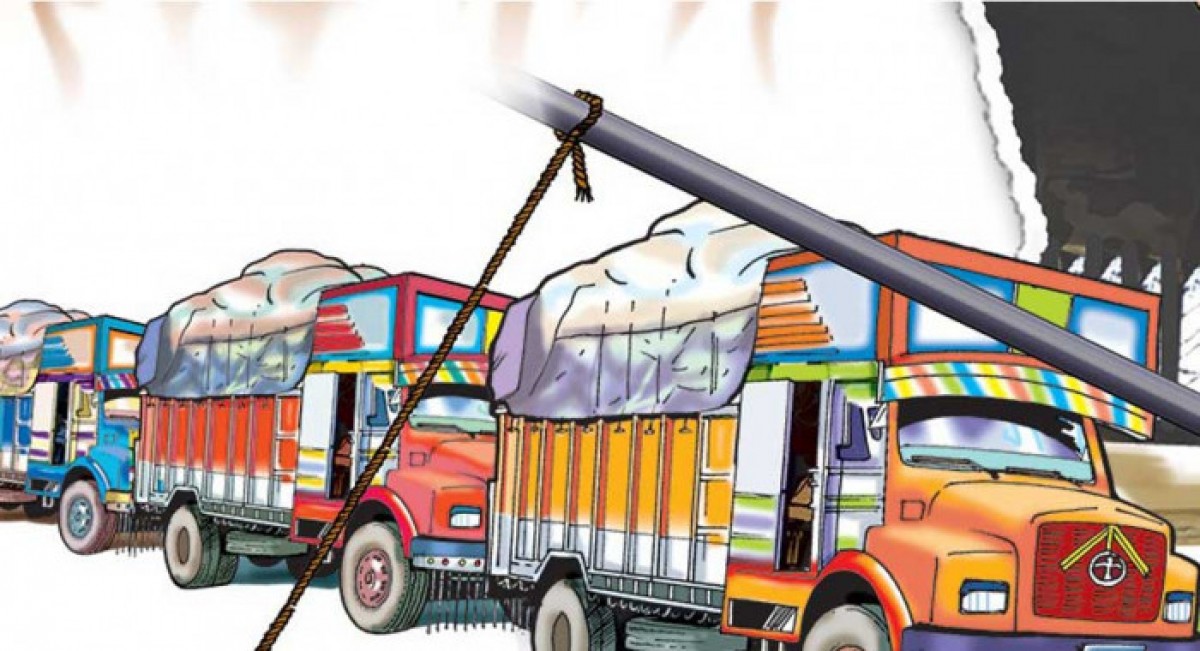
Representational image
This is where the trade figures need to be read alongside the other great pillar holding up Nepal’s external accounts. Nepal’s foreign exchange reserves have generally held up reasonably well in recent years, and the current account has occasionally shown surplus quarters, not because the country earns enough from selling goods and services abroad, but because money sent home by an estimated two to three million Nepali workers overseas plugs almost the entire hole left by the trade deficit. It is a workable arrangement in the narrow sense that banks stay liquid, the currency peg to the Indian rupee holds, and the lights stay on. Calling it a sustainable growth model, though, requires a fairly generous reading of that word.
Consider what actually sits at the very top of Nepal’s export list. Processed soybean oil, at roughly forty-one percent of total exports, is not really a Nepali product in any deep industrial sense. It begins life as Argentine or Brazilian crude oil, travels halfway around the world, gets refined in Nepali factories, and is then sold almost entirely to a single buyer next door. The value Nepal adds along that chain is genuine but thin: refining margins, some labor, some logistics and packaging. This activity does create real jobs and real industrial output domestically, so it would be unfair to dismiss it purely as an accounting artifact. But it is not the kind of export growth that builds durable competitive advantage, and it is unusually exposed to a shock in the source commodity’s price, a shift in Indian import policy, or the loss of trade preferences Nepal currently enjoys as a landlocked, least developed country.

That last point matters more this year than in most previous ones, because Nepal stands close to graduating out of least developed country status, a transition currently scheduled for late November 2026 alongside Bangladesh and Laos, though Nepal has separately asked the United Nations for a deferral to 2030, citing exactly this kind of underlying economic fragility. Whatever the outcome of that request, the tension it points to is real. Graduation carries genuine prestige and reflects decades of hard-earned development progress. It also strips away preferential market access arrangements that Nepali exporters, particularly in the garment and handicraft sectors, have relied on for years in destinations such as the European Union. An economy that already runs a chronic and widening trade deficit, financed largely by labor migration rather than by competitive export industries, is not obviously well positioned to absorb the loss of those preferences without some real pain along the way.
Layer onto that the current state of American trade policy. A baseline ten percent tariff now applies to Nepali goods entering the United States, and the United States happens to be Nepal’s second-largest export market and, more specifically, the dominant destination for two of the three products the government has just built a dedicated five-year action plan around: chhurpi (Himalayan cheese) and woolen carpets. The timing here is not especially fortunate.

Commercialized globally as organic dog chews, the traditional Himalayan dairy product (chhurpi) brought in roughly Rs 4.19 billion in fiscal year 2025/26. File photo
The ministry is aiming to roughly triple chhurpi exports to Rs 15 billion within five years, largely by deepening penetration of the American pet food market, at almost the same moment American tariff policy has grown less hospitable to imports from smaller trading partners like Nepal. None of this makes the export promotion plan pointless. It does mean its ultimate success will depend as much on how Nepali trade diplomacy manages a shifting external environment as on how well domestic producers modernize their own operations.
Now turn to the import side, because that is really where the harder truths sit. Diesel alone cost Nepal roughly Rs 172.43 billion in the year, and once petrol, cooking gas and aviation fuel are added in, fossil fuel imports run into the hundreds of billions of rupees annually, a bill Nepal pays every single year regardless of harvest quality, exchange rate movements or global demand for Nepali goods. This is not a variable Nepal can easily control in the way export competitiveness can theoretically be improved through policy.
The country sits on enormous hydropower potential that could, in principle, substitute for a meaningful share of imported fuel over time, particularly in transport through electric vehicles and in industrial energy use, and Nepal has in fact made real progress on electricity generation, even exporting surplus power seasonally to India during the monsoon. But the pace of that substitution has been slow relative to the size of the fuel import bill, and until it accelerates meaningfully, this single category alone will keep exerting steady downward pressure on the trade balance almost regardless of what happens elsewhere in export policy.

Then there is gold, worth roughly Rs 26.78 billion in imports, and smartphones, worth close to Rs 48.69 billion, with more than 2.26 million handsets entering the country in a single year. These are not productive imports in the way fertilizer or industrial machinery are. They are largely consumption goods, purchased by households whose spending power is itself substantially underwritten by remittance income. In other words, money earned by Nepali workers in the Gulf, in Malaysia, and increasingly in Europe, Japan and South Korea flows back home, and a meaningful share of it then flows straight back out again to pay for imported phones, gold jewelry, and fuel for vehicles that are themselves largely imported. It is a closed loop that generates the appearance of economic activity, even measurable GDP growth, without necessarily building the kind of domestic productive base that would eventually let Nepal export its way toward a healthier balance rather than borrow its way there through migrant labor year after year.
The geography of Nepal’s trade dependence deserves scrutiny in its own right. Roughly fifty-eight percent of everything Nepal imports comes from India, and more than eighty-two percent of everything it exports goes back to India. Add China to the import side and that concentration climbs to close to seventy-eight percent of total imports coming from just two neighboring countries. This is not, by itself, a sign of bad policy; small, landlocked economies naturally trade heavily with large neighbors, and Nepal’s open border with India in particular carries genuine efficiency benefits that a more artificially diversified trade pattern would sacrifice. But concentration of this scale is also a vulnerability, and Nepal has felt that vulnerability directly and painfully before, most notably during the border disruptions of 2015, when fuel and essential goods effectively stopped moving for months.
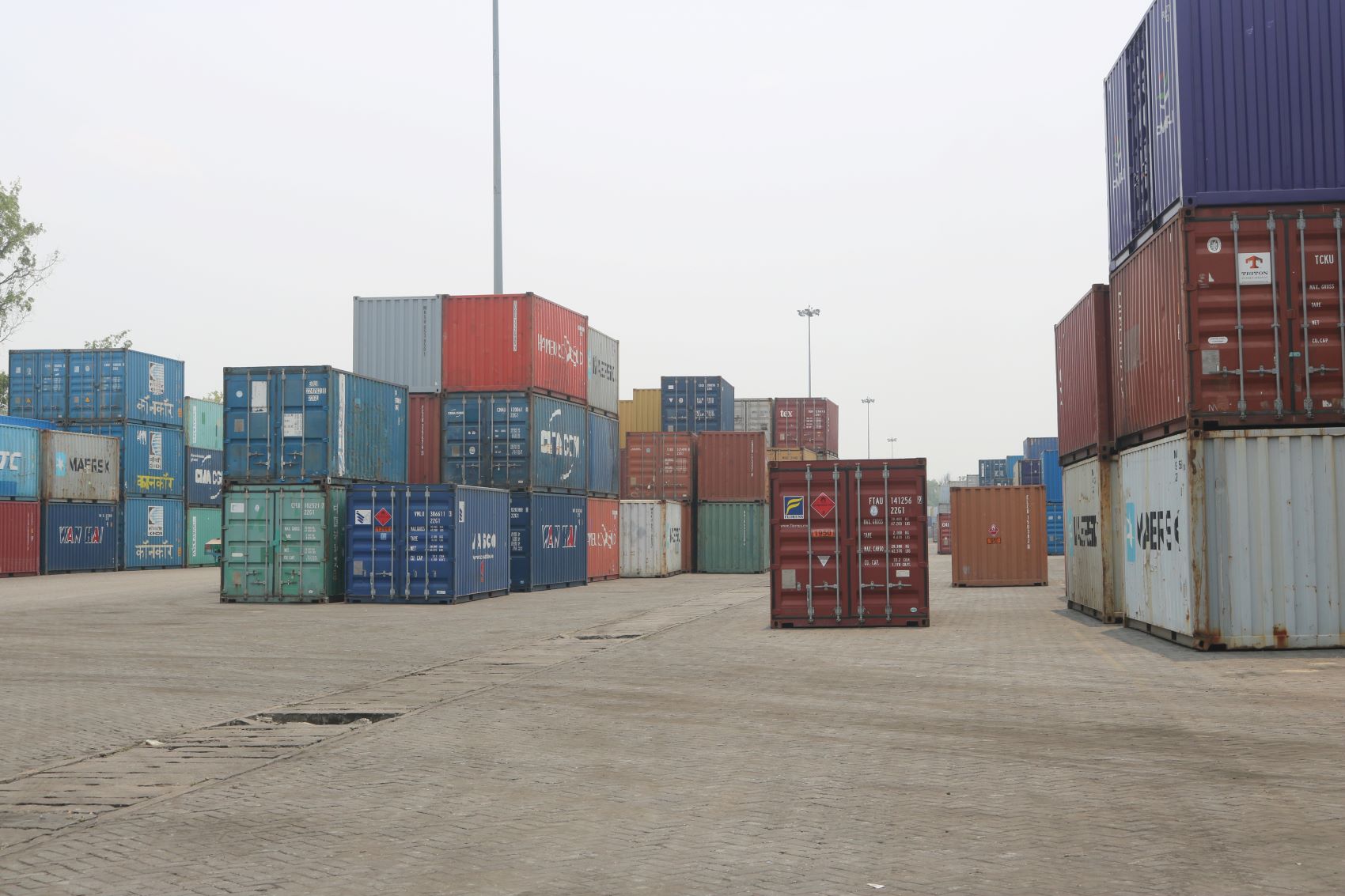
Container yards at the Birgunj Dry Port, through which nearly 47 percent of Nepal’s total import value passed in FY 2025/26. File photo
The ginger trade offers a smaller but recurring version of the same story: close to ninety-five percent of Nepali ginger exports depend on Indian buyers, and Indian authorities have periodically closed that market on quality or phytosanitary grounds, leaving Nepali farmers holding produce they cannot sell with no meaningful alternative buyer to turn to. A national trade strategy that leaves this kind of single-market dependence largely unaddressed, even while doing careful work on niche products like chhurpi and carpets, is only solving part of a much bigger problem.
It would be unfair, though, to read all of this purely as policy failure or government indifference. The Ministry of Industry, Commerce and Supplies has, in fact, been reasonably active on paper over the past decade and a half: the Nepal Trade Integration Strategy has gone through three iterations since 2010, the priority export list expanded from twelve items to thirty-two in its most recent version, and now a dedicated five-year action plan exists specifically for chhurpi, ginger and carpets, with genuinely detailed diagnostic work on issues like customs code confusion, certification gaps and raw material dependency.
Accelerating hydropower-based substitution for imported fossil fuels, building genuine manufacturing capacity rather than thin-margin re-export processing, diversifying export markets so that a single tariff decision in Washington or a single quality dispute in New Delhi cannot derail an entire product category overnight
Compared with a decade ago, the technical understanding of what actually ails these sectors has clearly improved. The persistent gap has always sat between diagnosis and execution. Industrialists who spoke around the rollout of the new plan were candid that Nepal has tried variations of this exercise before and watched them quietly gather dust, undermined by weak coordination between agencies, slow disbursement of promised incentives, and a private sector that has grown understandably wary of government follow-through after repeated disappointments.
What would it actually take to move the needle on a deficit this large? Certainly not any single policy. Export promotion strategies focused on niche products like chhurpi and carpets can genuinely help specific communities and specific supply chains, and there is no good reason to dismiss them as theater; a tripling of chhurpi exports to fifteen billion rupees, should it actually happen, represents real income for hill farmers who currently have few comparable livelihood alternatives. But set against a total deficit measured in trillions of rupees, even a fully successful execution of this particular plan would move the aggregate national number only marginally.
The larger levers sit elsewhere: accelerating hydropower-based substitution for imported fossil fuels, building genuine manufacturing capacity rather than thin-margin re-export processing, diversifying export markets so that a single tariff decision in Washington or a single quality dispute in New Delhi cannot derail an entire product category overnight, and, perhaps hardest of all, gradually weaning the domestic economy off remittance-financed consumption in favor of investment that builds productive capacity rather than simply fueling further import demand.
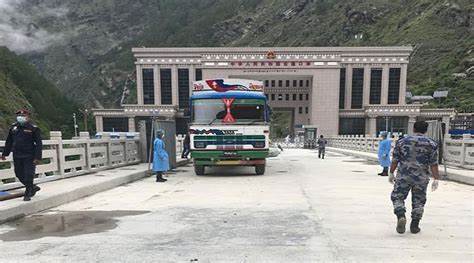
Freight truck crosses the Rasuwagadhi border point connecting Nepal and China. China ranks as Nepal’s second-largest import source, supplying goods worth approximately Rs 425.24 billion in fiscal year 2025/26. File photo
None of that is likely to happen quickly, and none of it fits neatly inside a five-year action plan with cleanly assignable government responsibilities. Nepal’s trade deficit is, in the end, something of a mirror held up to the broader development model the country has run for roughly two decades now: export labor rather than goods, import consumption, let remittances square the difference, and hope that gradual industrial upgrading eventually narrows the gap from the production side rather than the money-transfer side. It has kept reserves adequate and the currency peg stable, which is not a small achievement.
But, as LDC graduation is in limbo, as global trade politics grows less forgiving toward smaller exporting economies, and as the deficit itself keeps widening rather than narrowing year after year, that model is being asked to bear more weight than it was originally built to carry. The chhurpi, ginger and carpet strategy is a sensible, reasonably well-researched piece of a much larger puzzle.
Whether Nepal’s economic managers can assemble the rest of that puzzle with comparable seriousness, and actually see it through this time rather than letting it join the pile of earlier plans that never quite left the drawer, is the real question this year’s trade data is asking, whether or not anyone in Kathmandu particularly wants to answer it directly right now.