Kathmandu
Tuesday, July 28, 2026





KATHMANDU: Climate warming has such consequential implications for the people and for the institutions created to meet their needs that it is inevitable thinking of new mechanisms aimed at tackling it.
Like artificial AI, whose rapid and uncontrolled development is risking jeopardizing the whole social contract upon which the foundations of relationships among the state, the citizens, the private sector and labor rely, also climate change ultimately requires a drastic rebooting of the current governance model.
Even if this summer is proving that the heating of the planet is an equalizer, hitting both the North and South of the globe hard, developing nations and their citizens are often those who pay the highest price.
Yet a central question arises: if the massive injection of additional financial resources are indispensable especially in the forms of climate assistance by developed nations as per article 2.1 (c) of the Paris Agreement that obliges developed nations, do climate vulnerable developing nations have the appropriate governance infrastructures in place to deliver their own obligations under the same framework?
As the fight against climate warming is often centered on financing, having in place strong and climate “retrofitted” policies and structures will matter.
This “infrastructure” will make the difference not abstractly but in very practical ways because states’ achievements in fighting climate, basically saving their citizens ‘lives, will demand new institutions.
In other words, the issue of climate governance, creating better and stronger political institutions to tackle this daunting challenge, will be consequential.
Around the world, there have been examples of new institutions at the heart of national governments’ fight against climate warming.
Climate Councils are assuming a foundational role in a new climate governance and their unique strength lies in being statutory bodies outside the purview of the executive.
The International Climate Council Network, the global umbrella organizations created to ensure some forms of coordination among them, defines them as “expert bodies officially mandated to advise their governments on climate policy”.
In practice, these institutions have two features in common: independence and authoritative expertise.
There are now 32 of these councils, mostly at national levels but also at sub national governance , particularly at provincial/state levels.
There is another essential element that provides these institutions with a robust mandate.
The vast majority of them are anchored into climate focused legislations that legitimize the work and equip them with a wide range of tools to carry out their functions.
The International Climate Council Network, the global umbrella organizations created to ensure some forms of coordination among them, defines them as “expert bodies officially mandated to advise their governments on climate policy”.
The web site of the ICCN provides also a list of defining principles that guide their work.
First of all, a “robust grounding in the latest climate science, as exemplified by the assessments of the Intergovernmental Panel on Climate Change (IPCC), supported by strong expertise across relevant economic, physical, ecological and social sciences”.
Second, “a mandate to provide independent, evidence-led advice to and assessment of action by Government and stakeholders on climate mitigation and/or adaptation, with sufficient resources to deliver on that mandate”.
Third, “a remit to produce advice on the socioeconomic aspects of the climate transition” to ensure that it is procedurally and substantively fair”.
Fourth, “a consultative and impartial approach to engaging stakeholders to help develop consensus and steer policy action, particularly in critical and/or challenging areas”.
Finally, a “sharp focus on strengthening and aligning adaptation, mitigation and just transition efforts, and improving their integration – all three are essential to effective climate action”.
For example, the Net Zero Advisory Board established by the Canadian Government, defines itself as an “expert evidence-led organization to guide and oversee delivery of climate change mitigation and adaptation”.
Australia, a major exporter of fossil fuels, has worked hard to have in place the right climate institutions.
The Climate Change Authority in Australia is an independent statutory body established under the Climate Change Authority Act 2011 to “provide expert advice to the Australian Government on climate change policy”.
Among the top responsibilities of the CCA is to advice on “setting greenhouse gas emissions reduction targets to be included in new or adjusted nationally determined contributions (NDC)”.
It is interesting to know that the Federal Government in Canberra, formally the Commonwealth, is also obliged to prepare the Annual Climate Change Statement to Parliament with the latest updates on its progress in the field of climate action.
This formal exercise in climate accountability is not optional but it is a legal requirement under the Climate Change Act 2022 and the CCA provides independent advice to the Commonwealth for the preparation of this central document.
In an example of climate accountability, the Annual Statement prepared by the Commonwealth, must also include the Australian Government’s full response to the Climate Change Authority’s recommendations expressed through the CCA’s Annual Progress Reports.
It is interesting to know that the Federal Government in Canberra, formally the Commonwealth, is also obliged to prepare the Annual Climate Change Statement to Parliament with the latest updates on its progress in the field of climate action.
In addition, the CCA prepares its own Annual Progress Report that offers its own independent analysis of progress and shortcomings, in essence a state of play on overall government’s efforts in the field of climate action.
Having a stringent legislation in place is what enabling this “climate governance ecosystem” to deliver.
Climate Change Act 2022 aims to “sets out Australia’s greenhouse gas emissions reduction targets and obliges to advance an effective and progressive response to the urgent threat of climate change drawing on the best available scientific knowledge”;
Importantly the Act also “sets out Australia’s greenhouse gas emissions reduction targets which contribute to the global goals of:(i)holding the increase in the global average temperature to well below 2°C above pre-industrial levels; and (ii)pursuing efforts to limit the temperature increase to 1.5°C above pre-industrial levels”.
It is important to note that the CCA is not the only climate governance centered institution in Australia.
There are also the Emissions Reduction Fund/Climate Solutions Fund architecture, the Clean Energy Finance Corporation and the Australian Renewable Energy Agency, the National Greenhouse and Energy Reporting scheme, and the Clean Energy Regulator.
Such an ecosystem of institutions, including a set of different legislations specifically focused on climate, takes time to build but countries like Nepal can start, at least, with the right vision and strategy and the implementation of both, inescapably, depends on a solid climate governance.
New Zealand has its own version, the He Pou a Rangi or Climate Change Commission, “ an independent Crown entity, we help drive climate action by providing the Government of the day with advice, monitoring and reporting that support Aotearoa New Zealand’s transition to a climate-resilient, low emissions future”.
In the UK, there is the Committee on Climate Change (CCC) that advises the government on emissions targets and reports to Parliament on progress made in reducing greenhouse gas emissions.
Malta, a tiny island nation in the heart of the Mediterranean sea, with less than 600,000 citizens, is interesting case because the former institution, the Climate Action Authority is an executive body mandated to “coordinate and oversee all the measures and regulations related to climate change”.
Also in this case, the CCC works as an independent authority under under the Climate Change Act. Among its priorities is also to “conduct independent research and analysis into climate change” and “engage with representatives interested in climate change from across the UK in order to share research and information on climate change and gain input into our analysis”.
Then we have the unique case of Malta where there is a Climate Action Authority and a National Climate Action Council.
Both institutions are governed by another example of specific climate focused legislation, the Climate Action Act, 2024.
Malta, a tiny island nation in the heart of the Mediterranean sea, with less than 600,000 citizens, is interesting case because the former institution, the Climate Action Authority is an executive body mandated to “coordinate and oversee all the measures and regulations related to climate change”.
Instead, the latter, the National Climate Action Council is similar to the examples of councils reviewed so far as it acts as an independent advisory body.
Now if the readers might think that the councils are a distinctive feature of developed nations and that developing countries at the frontlines of climate warming are not taking action in the field of climate governance, then better rethink our assumption. South Africa, despite being the biggest economy in Africa, suffers from several serious challenges, including widespread poverty, inequality and crime.
Yet, there you will find a unique type of institution, the Presidential Climate Commission that has a specific focus on just transition. (Scotland who boasts broad autonomy in policy making, also counted with a Just Commission who shut down in 2025 at the end of its legal remit).
Lesotho, Guatemala and Vanuatu, all developing nations have their councils as well.
If these countries, vastly less endowed with resources than Nepal, how can inaction in Kathmandu be justified?
The Federal Government in Kathmandu should consider a broad brainstorming to equip the nation with the appropriate governance infrastructures to tackle climate change.
Provincial governments, likewise, could also step in by focusing on their respective geographical areas, creating provincial climate councils who can offer advice at local levels.
The councils can also be seen as an important “platform” to involve and engage academia and expertise stemming from autonomous sectors outside the government.
While, on one hand, a climate centered governance relies on experts through the councils, there are also ample ways to give a voice and real ownership to citizens.
The Federal Government in Kathmandu should consider a broad brainstorming to equip the nation with the appropriate governance infrastructures to tackle climate change.
This aspect will be the focus of the third and final piece of this series.
Ideally, Nepal should prioritize the enactment of a comprehensive climate act who would envisage a climate governance that is aligned with the needs and priorities of the nation.
This legislation can formally and legally the unconditional targets (not dependent on donors) that Nepal sets in its official policies like the Nationally Determined Contributions and National Adaptation Plan. Currently the targets set in these documents, though official, have no legal value.
The Federal Government, to really lead against climate warming, requires both the advice of experts and also their scrutiny as climate councils act as watchdogs.
The establishment of a National Climate Commission, a truly independent body, would offer the best way to reboot the ways national policymaking deals with heating of the planet.
The idea of setting up a climate authority in Nepal is not totally a new one.
In 2024 there have been some plans, part of a tailor made national climate bill but nothing happened out of them.
Would the national parliament and the federal executive prioritize this bipartisan endeavor?
Would any provincial government become the outlier and innovate and literally show the way in the fight against climate warming, proving that federalism can be a useful form of government also to fight climate warming?
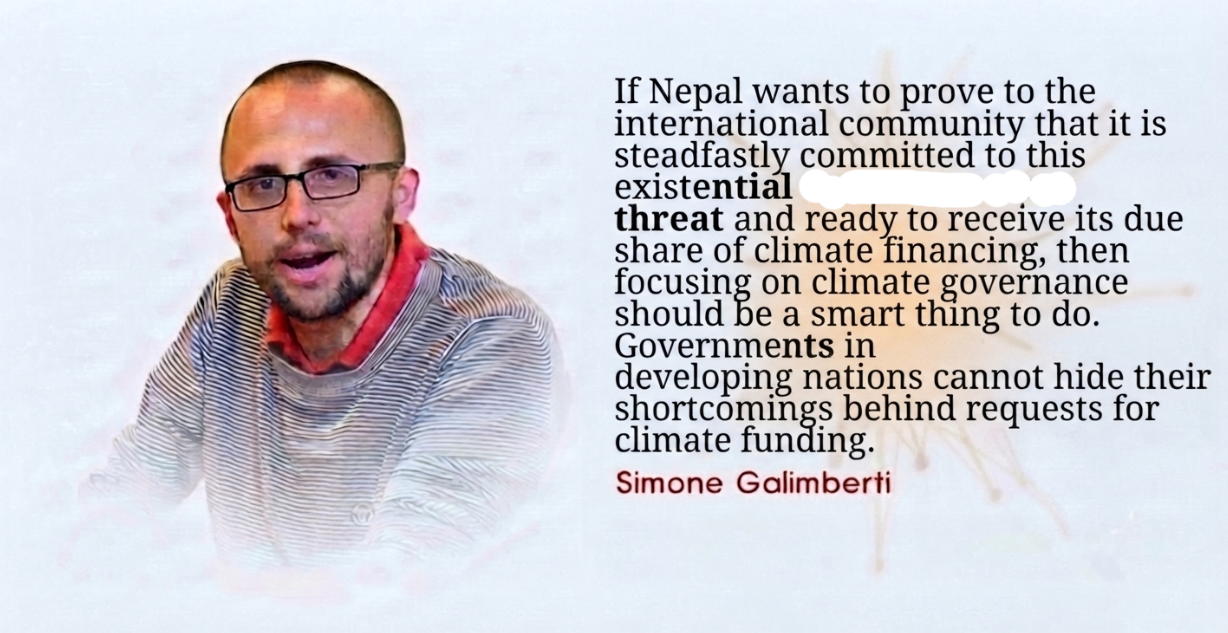
If Nepal wants to prove to the international community that it is steadfastly committed to this existential threat and ready to receive its due share of climate financing, then focusing on climate governance should be a smart thing to do.
Governments in developing nations cannot hide their shortcomings behind requests for climate funding.
While it is their inalienable right to ask for more resources, it is also their duty to do their own part.
(This is the second article of a series of opinion pieces centered on climate governance. The first piece provided practical ideas on the Federal Government to fortify its climate action while the next piece will be focused on climate citizens’ assemblies.)