Kathmandu
Wednesday, July 1, 2026





Changing weather patterns are escalating multi-hazard threats, with monsoon-induced floods and landslides in the Hindu Kush Himalayan region affecting 1.2 million residents and contributing to a record-breaking USD 169 billion global economic toll

KATHMANDU: A new study has revealed that the Hindu Kush Himalayan region is being pushed into even greater risk of disasters as climate change increases the frequency and intensity of extreme weather events. According to the recently released analytical study ‘2025 Disasters in Numbers’ by the International Centre for Integrated Mountain Development (ICIMOD), changes in weather patterns brought about by climate change have increased multi-hazard risks.
The Hindu Kush Himalayan region comprises eight countries across South and East Asia, including Nepal, Afghanistan, Pakistan, China, Bhutan, Bangladesh, Myanmar, and India. Multi-hazard risks, referring to various events increasing simultaneously, are on the rise in this region. A multi-hazard situation occurs when more than one type of risk, such as floods, landslides, and droughts, happens at the same time or when one risk triggers another. The 2013 Kedarnath floods in Uttarakhand, India; the 2023 flood following the outburst of the South Lhonak glacial lake in Sikkim; and the 2021 Melamchi floods in Nepal have been analyzed as multi-hazard events.
According to ICIMOD’s analysis, in 2025 alone, four out of the eight countries in the Hindu Kush Himalayan region experienced more than 10 major disaster events. Heavy monsoon rains caused repeated floods and landslides, primarily in the mountainous regions of Nepal, Bangladesh, India, and Pakistan, resulting in significant human and physical loss. Glacial Lake Outburst Floods (GLOFs) were also observed in some locations. Similarly, in 2025, monsoon-induced floods in Myanmar and China caused extensive damage to people’s daily lives and physical infrastructure.

ICIMOD reached this conclusion by analyzing disaster events recorded in the Emergency Events Database (EM-DAT) of the Centre for Research on the Epidemiology of Disasters (CRED) at Catholic University Leuven or KU Leuven in Belgium.
Pema Gyamtsho, the Director General of ICIMOD, stated that disaster risks have begun causing more damage in mountainous terrains. “In recent years, floods, landslides, and other risks have further increased in mountain regions, promoting damage to homes, infrastructure, and essential services,” he says.
According to a press release issued by ICIMOD yesterday (May 14), the entire Hindu Kush Himalayan region remained affected by monsoon-related disasters throughout 2025. Approximately 1.2 million people in the Hindu Kush Himalayan region were displaced or directly affected by disasters throughout the year. In 2025, the impact of disasters was globally most visible in Asia.
According to the ‘Global Status of Disasters in 2025’ report by the Centre for Research on the Epidemiology of Disasters, it is estimated that disasters caused more than USD 169 billion in damages worldwide in 2025. This loss is accounted for by 358 disaster events recorded by the Centre for Research on the Epidemiology of Disasters. In those events, 16,607 people died worldwide in 2025, while 110.2 million people were affected. The highest impact was seen in Syria, where 16.2 million people were affected by drought.
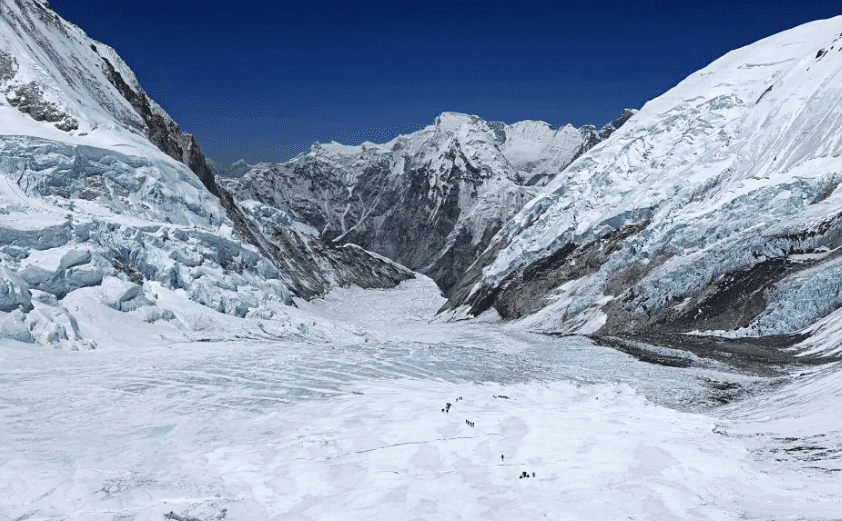
Declining snow levels in the Hindu Kush Himalayan region. Photo courtesy: ICIMOD
Studies have shown that dependent communities are vulnerable because the Hindu Kush Himalaya region is at high risk of disasters due to its complex geographical structure.
Manish Shrestha, a hydrologist at ICIMOD, suggests that because disaster risks are increasing, continuous investment must be made in preparedness and response. “Risk-based investment is necessary to reduce future disaster losses, and multi-hazards must be considered while making development and infrastructure plans,” Shrestha added.
Shanti Mahat, undersecretary and spokesperson of the National Disaster Risk Reduction and Management Authority (NDRRMA) under the Ministry of Home Affairs, says that they implement acts, procedures, and action plans for the necessary preparedness and response to tackle all types of disasters affecting Nepal.
“We create roadmaps to tackle every disaster. We are working on building mechanisms ranging from setting standards for search and rescue equipment to immediate mobilization if inundation occurs due to sudden rainfall,” Mahat added.
The authority prepares a ‘National Monsoon Preparedness and Response Action Plan’ every year to face monsoon-related disasters. Similarly, it has been implementing separate national action plans for preparedness, early action, and rapid response for snowfall, forest fires, cold waves, heat waves, and droughts.