Kathmandu
Wednesday, June 17, 2026





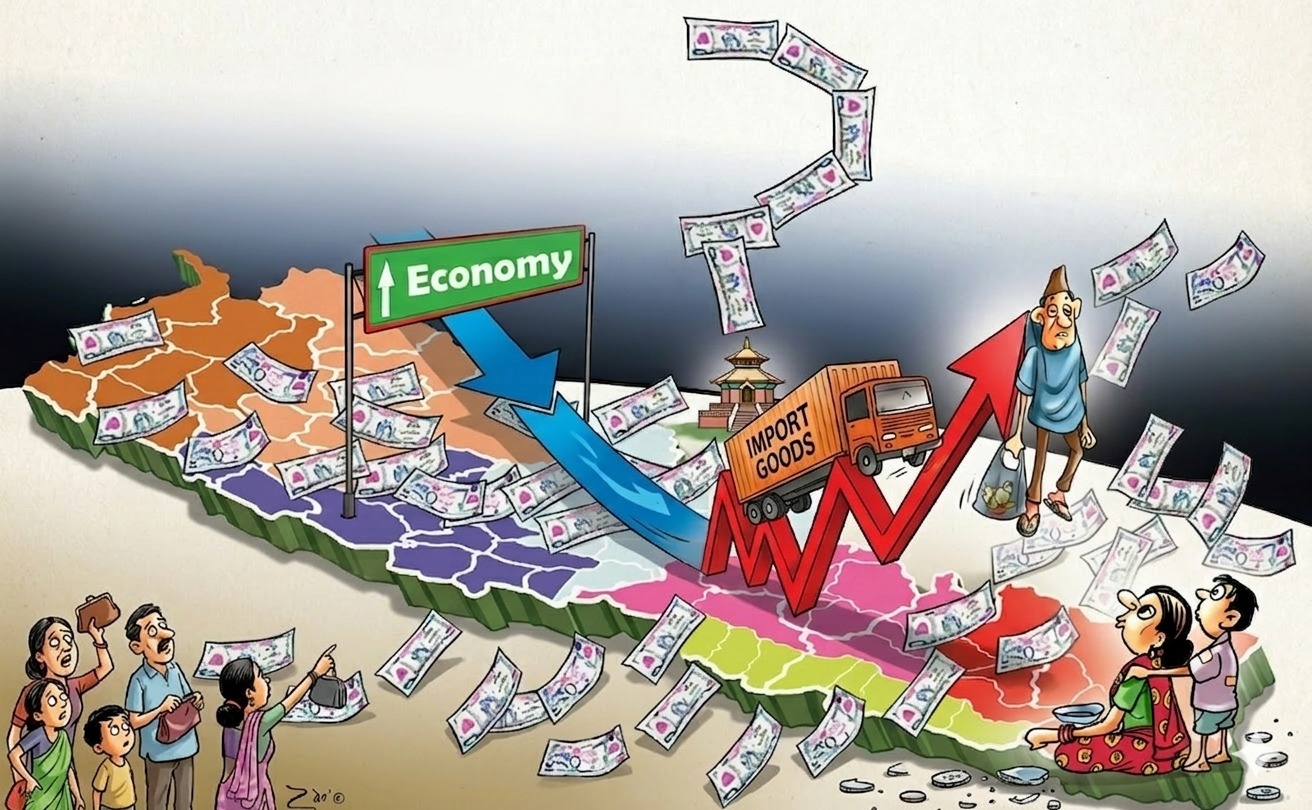
KATHMANDU: Nepal’s economy shows a mix of stability and pressure. The trade deficit widened 10.9% to NPR 955.34 billion, signaling growing gaps between exports and imports. Consumer price inflation eased to 3.25%, with food prices up 2.5% and non-food services rising 3.66%, reflecting moderate domestic price pressures.
Despite these challenges, strong remittance inflows and healthy foreign exchange reserves provide a cushion. Credit growth and monetary conditions remain moderate, pointing to a carefully managed macro-financial environment. Trade, remittances, foreign reserves, credit, and monetary policy-all here is what you need to know.
What are the major economic trends in the first seven months of FY 2025/26?
Nepal’s economy in the first seven months of fiscal year 2025/26 shows a mix of strong external-sector performance, moderate inflation, and steady financial sector expansion. Consumer price inflation remained relatively contained at 3.25 percent year-on-year, suggesting stable prices compared to previous years when inflation pressures were higher.
The external sector has strengthened significantly. Foreign exchange reserves reached Rs. 3,302.66 billion (USD 22.76 billion), enough to cover about 18 months of prospective imports, indicating strong external stability. The current account surplus of Rs. 493.78 billion and a balance of payments surplus of Rs. 572.73 billion further highlight improved foreign currency inflows. A key driver of this trend is remittance growth, which rose 39.8 percent in Nepali rupees (33 percent in USD), with Rs. 198.08 billion entering the country in just one month between mid-January and mid-February.
Trade data also show faster export growth than imports. Exports increased 32.2 percent, while imports rose 13.6 percent, helping narrow external imbalances. On the domestic front, government finances show Rs. 801.37 billion in expenditure against Rs. 665.02 billion in revenue collection during the period.
Meanwhile, the financial sector remains stable with gradual credit expansion. Broad money (M2) grew 5.9 percent during the period and 14.2 percent year-on-year, while deposits at banks and financial institutions increased 6 percent and private sector credit expanded 4 percent. Interest rates remain relatively low, with the inter-bank rate at 2.75 percent, 91-day Treasury bill rate at 2.45 percent, average deposit rate at 3.51 percent, and lending rate at around 7 percent, indicating accommodative liquidity conditions in the banking system.
What is the Consumer Price Inflation (CPI) in the first seven months of FY 2025/26?
Consumer price inflation in Nepal remained moderate during the first seven months of FY 2025/26. On a year-on-year (y-o-y) basis, CPI inflation stood at 3.25 percent in mid-February 2026, lower than 4.16 percent during the same period a year earlier, indicating easing price pressures in the economy.
Inflation was lower in food prices compared to non-food items. Food and beverage inflation stood at 2.50 percent, while non-food and services inflation reached 3.66 percent in the review month. In the same period last year, food inflation was 4.95 percent and non-food inflation 3.74 percent, showing that food prices have slowed significantly this fiscal year. The average inflation during the seven-month review period stood at 1.92 percent, sharply down from 4.86 percent in the corresponding period of the previous fiscal year.
Within the food category, prices of some items rose sharply: vegetables increased 11.63 percent, ghee and oil 7.61 percent, and fruits 7.41 percent. However, several staples recorded price declines, including pulses and legumes (–5.19 percent), cereal grains and related products (–2.97 percent), and spices (–2.61 percent).
In the non-food and services category, the highest price increase was seen in miscellaneous goods and services (21.98 percent), followed by education (7.46 percent), clothes and footwear (5.28 percent), tobacco products (4.15 percent), and alcoholic drinks (3.85 percent), while communication prices slightly declined by 0.08 percent.
Price increases were higher in urban areas (3.51 percent) than in rural areas (2.52 percent). By province, inflation was highest in Madhesh Province (5.14 percent) and lowest in Karnali (1.62 percent) and Sudurpashchim (1.64 percent). Regionally, inflation stood at 3.48 percent in the Kathmandu Valley, 3.66 percent in the Terai, 2.68 percent in the Hill region, and 2.58 percent in the Mountain region.
What is the Wholesale Price Inflation (WPI) in the first seven months of FY 2025/26?
Wholesale price inflation in Nepal accelerated during the first seven months of FY 2025/26. On a year-on-year (y-o-y) basis, the Wholesale Price Index (WPI) rose by 6.21 percent in mid-February 2026, compared with 3.47 percent during the same period a year earlier, indicating stronger price pressures at the wholesale level.
The rise in wholesale prices was driven mainly by intermediate goods, whose prices increased 9.83 percent y-o-y. Capital goods prices rose by 3.21 percent, while consumption goods prices increased only slightly by 0.72 percent, suggesting that most inflationary pressure is occurring in production and supply chains rather than directly in consumer goods.
Meanwhile, the wholesale price index for construction materials increased by 2.04 percent during the review month, reflecting moderate cost pressures in the construction sector.
In comparison, consumer price inflation remained lower than wholesale inflation. Nepal’s CPI stood at 3.25 percent in mid-February 2026, while India’s consumer price inflation was 2.75 percent in January 2026, indicating relatively moderate consumer price pressures in both economies.
How has Nepal’s merchandise trade performed in the first seven months of FY 2025/26?
Nepal’s merchandise trade expanded during the first seven months of FY 2025/26, with exports growing faster than imports, although the country continued to run a large trade deficit.
Merchandise exports increased by 32.2 percent to Rs. 168.15 billion, compared with a stronger 46.5 percent growth in the same period last year. Exports to India rose sharply by 40.3 percent, while exports to other countries increased by 9.4 percent. However, exports to China declined significantly by 55.3 percent during the review period. The rise in exports was mainly driven by higher shipments of soyabean oil, cardamom, palm oil, jute goods, and shoes and sandals, while exports of zinc sheets, particle board, tea, woolen carpets, and handicrafts declined.
On the import side, merchandise imports increased by 13.6 percent to Rs. 1,123.49 billion, slightly faster than the 10.1 percent growth recorded a year earlier. Imports from India grew by 5.5 percent, while imports from China and other countries rose more strongly by 22.3 percent and 29.5 percent respectively. The increase was largely driven by higher imports of crude soyabean oil, chemical fertilizer, silver, transport equipment, vehicles and spare parts, and gold, while imports of hot-rolled steel sheets, edible oils, pulses, and certain steel products declined.
Despite stronger export growth, Nepal’s total trade deficit widened by 10.9 percent to Rs. 955.34 billion during the review period. However, the export–import ratio improved to 15.0 percent, up from 12.9 percent in the same period last year, indicating a slight improvement in trade balance dynamics. Meanwhile, imports from India paid in convertible foreign currency stood at Rs. 103.92 billion, almost unchanged from Rs. 103.94 billion a year earlier.
What is the composition of Nepal’s foreign trade in the first seven months of FY 2025/26?
Nepal’s foreign trade structure during the first seven months of FY 2025/26 shows that exports remain heavily concentrated in final consumption goods, while imports are dominated by intermediate goods used for production and processing.
On the export side, final consumption goods accounted for 69.7 percent of total exports, followed by intermediate goods at 29.3 percent, and capital goods at just 1.0 percent. In the same period of the previous fiscal year, the shares were 61.8 percent for final consumption goods, 37.4 percent for intermediate goods, and 0.8 percent for capital goods. This shift indicates that Nepal’s exports are becoming more focused on finished consumer products rather than semi-processed goods.
On the import side, the largest share came from intermediate goods, which made up 53.8 percent of total imports, reflecting Nepal’s dependence on imported inputs for industry and production. Final consumption goods accounted for 37.0 percent, while capital goods represented 9.2 percent of total imports. A year earlier, these shares were 39.9 percent for consumption goods, 51.2 percent for intermediate goods, and 8.9 percent for capital goods, suggesting a slight increase in the share of productive and capital-related imports.
What do the export–import price index and terms of trade show?
The export–import price indices indicate modest changes in Nepal’s trade prices during the first seven months of FY 2025/26. On a year-on-year basis, the unit value export price index increased by 2.1 percent in the seventh month of the fiscal year, reflecting slightly higher prices for goods Nepal exports.
Meanwhile, the import price index rose by 0.6 percent, suggesting that the prices of goods Nepal imports increased at a slower pace compared to export prices. As a result, Nepal’s terms of trade (ToT) index improved by 1.4 percent during the same period. An increase in the ToT index means that export prices rose relatively faster than import prices, which slightly improves Nepal’s purchasing power in international trade.
What is the trend in Nepal’s services trade in the first seven months of FY 2025/26?
Nepal’s services account remained in deficit during the first seven months of FY 2025/26, with the gap widening compared to the previous year. Net services income recorded a deficit of Rs. 50.16 billion, up from a deficit of Rs. 36.17 billion in the same period of the previous fiscal year, indicating higher outflows for services than inflows.
A key component of the services account is travel income, which mainly includes tourism earnings. During the review period, travel income declined by 2.6 percent to Rs. 47.99 billion, compared with Rs. 49.28 billion in the same period last year, suggesting slightly weaker inflows from tourism-related activities.
At the same time, travel payments increased by 5.1 percent to Rs. 121.27 billion, reflecting higher spending by Nepalis abroad. A significant portion of this outflow was for education abroad, which amounted to Rs. 77.57 billion, up from Rs. 64.10 billion in the same period of the previous year. This increase in overseas education spending has been a major factor contributing to the widening services deficit.
How have remittance inflows performed in the first seven months of FY 2025/26?
Remittances have surged strongly during the first seven months of FY 2025/26, becoming one of the main drivers of Nepal’s external sector stability. Remittance inflows increased by 39.8 percent to Rs. 1,261.01 billion, compared with a much smaller 7.5 percent growth in the same period of the previous fiscal year. In the single month between mid-January and mid-February (Magh) alone, remittances reached Rs. 198.08 billion, up from Rs. 137.50 billion a year earlier.
In US dollar terms, remittance inflows also recorded strong growth, rising 33.0 percent to USD 8.86 billion, compared with 5.5 percent growth in the same period last year. As a result, net secondary income (net transfers)—which largely reflects remittances—reached Rs. 1,384.27 billion, significantly higher than Rs. 986.34 billion in the corresponding period of the previous fiscal year.
The data also show continued large-scale labour migration. During the review period, 245,153 Nepali workers received first-time approval for foreign employment, while 227,424 workers obtained approval for re-entry abroad. In the same period last year, the numbers were 274,662 for first-time approvals and 190,886 for re-entry, indicating a slight decline in new approvals but a rise in repeat migration.
What is the status of Nepal’s Current Account and Balance of Payments in the first seven months of FY 2025/26?
Nepal’s external sector strengthened significantly during the first seven months of FY 2025/26. The current account registered a surplus of Rs. 493.78 billion, up sharply from Rs. 184.14 billion in the same period last year. In US dollar terms, the current account surplus reached USD 3.47 billion, compared with USD 1.37 billion a year earlier, reflecting strong inflows from remittances, exports, and other services.
On the capital account, net capital transfers amounted to Rs. 11.43 billion, more than double the Rs. 5.83 billion recorded in the same period of the previous year. Foreign direct investment (FDI, equity only) also rose, totaling Rs. 10.22 billion, compared to Rs. 7.43 billion a year earlier, showing continued investor confidence.
Overall, the Balance of Payments (BOP) remained in surplus at Rs. 572.73 billion, up from Rs. 284.41 billion last year. In dollar terms, the BOP surplus reached USD 4.03 billion, nearly doubling the USD 2.11 billion surplus recorded in the same period of the previous fiscal year. This reflects a strong external position, supported by higher remittances, trade performance, and capital inflows.
What is the status of Nepal’s Foreign Exchange Reserves in the first seven months of FY 2025/26?
Nepal’s gross foreign exchange reserves strengthened significantly during the first seven months of FY 2025/26. By mid-February 2026, total reserves increased 23.3 percent to Rs. 3,302.66 billion, up from Rs. 2,677.68 billion in mid-July 2025. In US dollar terms, reserves rose 16.7 percent to USD 22.76 billion, compared with USD 19.50 billion in mid-July 2025.
Breaking it down by holders, the Nepal Rastra Bank (NRB) accounted for the majority of the reserves, which increased 21.2 percent to Rs. 2,926.99 billion, up from Rs. 2,414.64 billion in mid-July. Meanwhile, banks and financial institutions (excluding NRB) saw their reserves rise even faster, by 42.8 percent to Rs. 375.67 billion, compared to Rs. 263.04 billion in mid-July.
Regarding currency composition, the Indian currency accounted for 21.5 percent of total reserves in mid-February 2026, reflecting its continued importance in Nepal’s external liquidity management. Overall, the level of reserves is sufficient to cover over 18 months of prospective merchandise and services imports, ensuring strong external stability.
How adequate are Nepal’s foreign exchange reserves?
Nepal’s foreign exchange reserves remained highly adequate during the first seven months of FY 2025/26. Based on the level of imports during this period, the banking sector’s reserves were sufficient to cover 21.3 months of merchandise imports and 18.0 months of combined merchandise and services imports, reflecting a strong cushion for external stability.
The reserve adequacy ratios also showed significant improvement compared to mid-July 2025. The reserves-to-GDP ratio increased to 54.1 percent from 43.8 percent, the reserves-to-imports ratio rose to 150.2 percent from 128.1 percent, and the reserves-to-broad money (M2) ratio reached 39.7 percent, up from 34.1 percent. Overall, these indicators suggest that Nepal is in a comfortable position to meet its import needs and maintain monetary stability, highlighting the country’s strengthened external sector.
What are the trends in the price of oil and gold?
During the first seven months of FY 2025/26, international commodity prices showed divergent trends. The price of crude oil (Brent) declined, falling 7.4 percent to USD 69.80 per barrel in mid-February 2026 from USD 75.38 per barrel a year earlier, reflecting easing global oil prices.
In contrast, the price of gold surged sharply, rising 74.4 percent to USD 5,043.15 per ounce in mid-February 2026 from USD 2,891.50 per ounce a year ago. This significant increase highlights strong global demand or safe-haven investment trends for gold during the period.
What is the trend in the exchange rate of the Nepalese currency?
During the first seven months of FY 2025/26, the Nepalese currency depreciated against the US dollar, reflecting external and domestic market pressures. By mid-February 2026, the currency had weakened 5.4 percent compared to mid-July 2025, a larger depreciation than the 3.8 percent recorded in the same period of the previous year.
The buying exchange rate for one US dollar stood at Rs. 144.83 in mid-February 2026, up from Rs. 137.0 in mid-July 2025. This trend indicates a moderate weakening of the Nepalese rupee over the review period.
What are the trends in Nepal Government expenditure and revenue?
During the first seven months of FY 2025/26, the Nepal Government’s total expenditure reached Rs. 801.37 billion. Of this, capital expenditure accounted for Rs. 562.37 billion, financial expenditure was Rs. 63.73 billion, and other expenditures amounted to Rs. 175.27 billion, reflecting continued government spending across development, financial, and operational areas.
On the revenue side, the government mobilized Rs. 665.02 billion, including transfers to provincial and local governments. Tax revenue contributed Rs. 599.31 billion, while non-tax revenue totaled Rs. 65.71 billion. Overall, the figures indicate a fiscal gap between expenditure and revenue, highlighting the government’s continued reliance on borrowing or other financing to meet total expenditure requirements.
What is the cash balance of the Nepal Government?
The cash balance of the Government of Nepal (GoN), held across various accounts with the Nepal Rastra Bank (including provincial and local government accounts), stood at Rs. 373.73 billion in mid-February 2026. This represents a substantial increase from Rs. 149.83 billion in mid-July 2025, reflecting higher liquidity in government accounts, likely supported by strong revenue inflows and remittance-backed foreign exchange.
What are the trends in Provincial Government expenditure and revenue?
During the first seven months of FY 2025/26, total expenditure of Nepal’s provincial governments amounted to Rs. 48.51 billion, reflecting spending on provincial administration, development programs, and local services.
At the same time, total resource mobilization of provincial governments reached Rs. 109.89 billion. This includes grants and revenue transferred from the central government totaling Rs. 82.94 billion, and own-source revenue and other receipts amounting to Rs. 26.51 billion. The figures indicate that provincial governments maintained a strong resource base, with revenues exceeding expenditures, providing room for continued local development and fiscal stability.
What is the monetary situation and money supply in Nepal?
During the first seven months of FY 2025/26, Nepal’s broad money (M2) increased by 5.9 percent, compared with a 4.4 percent rise in the same period of the previous year. On a year-on-year basis, M2 expanded 14.2 percent by mid-February 2026, reflecting continued growth in deposits and liquidity in the banking system.
The net foreign assets (NFA) of the banking sector, after adjusting for foreign exchange valuation gains or losses, increased by Rs. 572.73 billion (21.5 percent) during the review period, significantly higher than the Rs. 284.41 billion (14.3 percent) increase in the same period last year, indicating strong external liquidity.
Meanwhile, reserve money decreased by 3.7 percent during the seven-month period, in contrast to a 3.6 percent increase in the same period of the previous year. On a year-on-year basis, reserve money grew 8.0 percent by mid-February 2026, suggesting moderate growth in the central bank’s monetary base amid changing liquidity conditions.
What is the status of domestic credit in Nepal?
During the first seven months of FY 2025/26, domestic credit recorded a slight decline of 0.3 percent, compared with a 1.3 percent increase in the same period of the previous year. On a year-on-year basis, domestic credit still grew 4.2 percent by mid-February 2026, indicating moderate expansion in overall lending.
The monetary sector’s net claims on the government decreased sharply by 26.3 percent during the review period, larger than the 20.5 percent decline in the corresponding period last year, reflecting reduced government borrowing from banks. On a year-on-year basis, such claims fell 12.0 percent.
Meanwhile, claims on the private sector increased by 4.5 percent during the seven-month period, slightly lower than the 6.0 percent rise a year earlier. Year-on-year, private sector credit expanded 6.7 percent by mid-February 2026, showing continued but moderate credit flow to households and businesses.
What is the trend in deposit mobilization in Nepal?
During the first seven months of FY 2025/26, deposits at Banks and Financial Institutions (BFIs) increased by 6.0 percent, or Rs. 433.71 billion, reaching Rs. 7,697.59 billion, compared with a smaller 3.8 percent increase (Rs. 245.34 billion) in the same period of the previous year. On a year-on-year basis, total deposits expanded 14.9 percent by mid-February 2026, reflecting strong growth in liquidity within the banking sector.
The composition of deposits also shifted over the period. By mid-February 2026, demand deposits accounted for 6.5 percent, savings deposits for 42.8 percent, and fixed deposits for 41.6 percent of total deposits. In comparison, a year ago these shares were 5.2 percent, 34.8 percent, and 52.4 percent, respectively, indicating a shift from long-term fixed deposits toward more liquid savings.
The share of institutional deposits in total deposits stood at 34.3 percent, slightly lower than 35.3 percent a year earlier, suggesting a small relative decline in institutional participation compared to individual deposits.
What is the trend in credit disbursement in Nepal?
During the first seven months of FY 2025/26, private sector credit from Banks and Financial Institutions (BFIs) increased by 4.0 percent, or Rs. 221.84 billion, reaching Rs. 5,719.54 billion. This growth was slightly lower than the 5.6 percent (Rs. 283.46 billion) increase recorded in the same period of the previous year. On a year-on-year basis, private sector credit expanded 6.8 percent by mid-February 2026, reflecting moderate lending activity.
The composition of private sector credit shows that 62.6 percent went to non-financial corporations, while 37.4 percent was directed to households, slightly shifting from a year ago when the shares were 63.8 percent and 36.2 percent, respectively. Among different types of financial institutions, credit increased 4.2 percent from commercial banks, 3.0 percent from development banks, and 1.8 percent from finance companies.
Regarding collateral, 15.0 percent of outstanding loans were backed by current assets such as agricultural and non-agricultural products, while 63.8 percent were secured against land and buildings, compared with 14.4 percent and 65.1 percent a year ago.
Credit by sector showed varied trends: loans to the consumable sector rose by 10.6 percent, construction by 8.7 percent, transportation, communication, and public sector by 6.8 percent, industrial production by 4.8 percent, and service industry by 1.1 percent. Meanwhile, agriculture loans fell by 1.4 percent and loans for insurance and fixed assets decreased by 1.9 percent.
By loan type, trust receipt (import) loans increased by 16.2 percent, margin loans by 11.0 percent, hire purchase loans by 9.3 percent, term loans by 3.1 percent, real estate loans including residential home loans by 2.5 percent, cash credit by 2.1 percent, and demand and working capital loans by 1.8 percent, while overdraft loans declined by 3.4 percent. Overall, the data indicate steady credit expansion with stronger growth in trade-related and consumable sector lending, while certain sectors like agriculture and fixed assets experienced a modest decline.
How has liquidity been managed in Nepal during the first seven months of FY 2025/26?
During the review period, the Nepal Rastra Bank (NRB) actively managed liquidity in the banking system using various monetary instruments. On a transaction basis, the NRB absorbed a total of Rs. 31,599.35 billion, which included Rs. 1,606.95 billion through deposit collection auctions, Rs. 29,792.40 billion through the Standing Deposit Facility (SDF), and Rs. 200.00 billion via NRB bonds. At the same time, the NRB injected Rs. 12.50 billion through the Overnight Liquidity Facility (OLF), resulting in a net liquidity absorption of Rs. 31,586.85 billion during the review period. This absorption was more than double the Rs. 14,858.65 billion absorbed in the same period of the previous year, reflecting a tighter liquidity management stance.
In addition, the NRB injected Rs. 564.04 billion liquidity through net purchases of USD 3.96 billion from the foreign exchange market, compared with Rs. 387.56 billion liquidity injection from USD 2.87 billion net purchases in the previous year. The central bank also purchased Indian currency (INR) worth Rs. 321.96 billion by selling USD 2.26 billion, slightly higher than Rs. 303.70 billion INR purchased through the sale of USD 2.24 billion in the corresponding period last year.
Overall, these operations indicate that the NRB maintained a deliberate approach to absorb excess liquidity while supporting forex market stability, ensuring that the banking system remained well-managed amid high foreign exchange inflows.
What is the trend in interbank transactions in Nepal?
During the first seven months of FY 2025/26, interbank transactions among Banks and Financial Institutions (BFIs) totaled Rs. 636.22 billion on a turnover basis. Of this, Rs. 559.86 billion occurred among commercial banks, while Rs. 76.36 billion took place among other financial institutions (excluding commercial bank transactions).
In comparison, during the same period of the previous year, total interbank transactions were much higher at Rs. 1,040.01 billion, including Rs. 937.81 billion among commercial banks and Rs. 102.20 billion among other financial institutions. This decline suggests a moderation in interbank activity, likely reflecting lower liquidity pressures and greater cash balances held by banks, reducing the need for frequent interbank lending.
What are the trends in interest rates in Nepal?
During the first seven months of FY 2025/26, interest rates in Nepal moderated across government securities, interbank lending, and commercial bank products. The weighted average 91-day Treasury bills rate declined to 2.45 percent in mid-February 2026, down from 2.86 percent a year ago. Similarly, the weighted average interbank rate among Banks and Financial Institutions (BFIs) fell from 3.00 percent to 2.75 percent, reflecting lower short-term funding costs.
Among financial institutions, the average base rates also declined. Commercial banks’ base rate dropped from 6.46 percent to 5.12 percent, development banks’ from 8.52 percent to 7.19 percent, and finance companies’ from 9.39 percent to 7.89 percent compared with the previous year.
Deposit and lending rates followed a similar downward trend. The weighted average deposit rate stood at 3.51 percent for commercial banks, 3.97 percent for development banks, and 5.01 percent for finance companies, compared with 4.62 percent, 5.41 percent, and 6.47 percent, respectively, a year ago. Meanwhile, the weighted average lending rate fell to 7.00 percent for commercial banks, 8.30 percent for development banks, and 9.56 percent for finance companies, down from 8.55 percent, 9.90 percent, and 10.88 percent in the corresponding month of the previous year.
Overall, these declines indicate a moderate easing of monetary conditions, lowering the cost of borrowing while reducing returns on deposits.
What is the status of financial access in Nepal?
As of mid-February 2026, Nepal’s financial sector continued to maintain broad coverage through a mix of banks and financial institutions. A total of 106 licensed institutions were operational, including 20 commercial banks, 17 development banks, 17 finance companies, 51 microfinance institutions, and 1 infrastructure development bank.
In terms of physical presence, the total number of branches of Banks and Financial Institutions (including microfinance institutions) stood at 11,490 in mid-February 2026, slightly down from 11,526 in mid-July 2025. This indicates that while there has been a marginal reduction in branch numbers, overall financial access remains extensive, supporting banking services across urban and rural areas.
What is the status of financial soundness in Nepal?
As of mid-February 2026, Nepal’s Banks and Financial Institutions (BFIs) maintained sound financial positions based on preliminary data from A, B, and C class institutions. The core capital to risk-weighted assets (RWA) ratio stood at 9.60 percent, while the total capital to RWA ratio averaged 12.61 percent, reflecting a healthy capital buffer to absorb potential losses.
Liquidity also remained strong, with the net liquid assets-to-deposits ratio at 34.76 percent, ensuring that institutions can meet short-term obligations. Meanwhile, the non-performing loan (NPL) ratio as of mid-January 2025 was 5.42 percent, indicating a manageable level of credit risk in the banking sector. Overall, these indicators suggest that Nepal’s financial institutions remain resilient and well-capitalized.
What is the trend in electronic transactions in Nepal?
Between mid-January and mid-February 2026, digital payment activity continued to grow strongly across multiple channels in Nepal. Debit card users conducted 9.81 million transactions totaling Rs. 75.60 billion, highlighting continued reliance on card-based payments.
Mobile banking recorded 67.36 million transactions worth Rs. 558.50 billion, demonstrating its dominance as a convenient and widely used payment channel. Meanwhile, QR code payments reached 46.23 million transactions with a total value of Rs. 125.21 billion, reflecting the increasing adoption of QR-based digital payments for retail and everyday transactions.
Overall, these figures indicate a steady shift toward electronic and mobile financial services, improving payment efficiency and financial inclusion across the country.
What is the status of Nepal’s capital market?
As of mid-February 2026, the Nepal Stock Exchange (NEPSE) index stood at 2,671.07, slightly lower than 2,685.73 in mid-February 2025, indicating relative stability in the stock market. Market capitalization reached Rs. 4,484.79 billion, up from Rs. 4,458.52 billion a year earlier, while the market capitalization-to-GDP ratio decreased to 73.43 percent from 78.09 percent, reflecting moderate growth in the stock market relative to the economy.
The number of listed companies at NEPSE increased to 284 in mid-February 2026 from 268 a year ago. Among these, 132 were banks, financial institutions, and insurance companies, 97 hydropower companies, 26 manufacturing and processing industries, 8 hotels, 7 investment companies, 4 trading companies, and 10 other companies. BFIs and insurance companies accounted for 51.7 percent of total market capitalization, followed by hydropower at 16.0 percent, investment companies at 7.4 percent, manufacturing at 7.0 percent, trading at 4.7 percent, hotels at 3.2 percent, and others at 10.1 percent.
The paid-up value of 9.23 billion listed shares stood at Rs. 908.83 billion in mid-February 2026. During the seven months of FY 2025/26, securities worth Rs. 50.94 billion were listed, including ordinary shares (Rs. 21.96 billion), right shares (Rs. 9.64 billion), mutual funds (Rs. 7.50 billion), bonus shares (Rs. 7.49 billion), debentures (Rs. 3.40 billion), FPOs (Rs. 925.05 million), and others (Rs. 22.85 million).
The Securities Board of Nepal approved public issuance of securities totaling Rs. 24.42 billion in the review period, comprising mutual funds worth Rs. 13.13 billion, ordinary shares Rs. 6.64 billion, right shares Rs. 4.41 billion, debentures Rs. 200 million, and FPOs Rs. 46.70 million. Overall, the data indicate that Nepal’s capital market remained active with steady listing activity and moderate growth in market capitalization.