Kathmandu
Saturday, June 20, 2026





The state’s two-way lens of evicting the poor in the name of beautifying the city
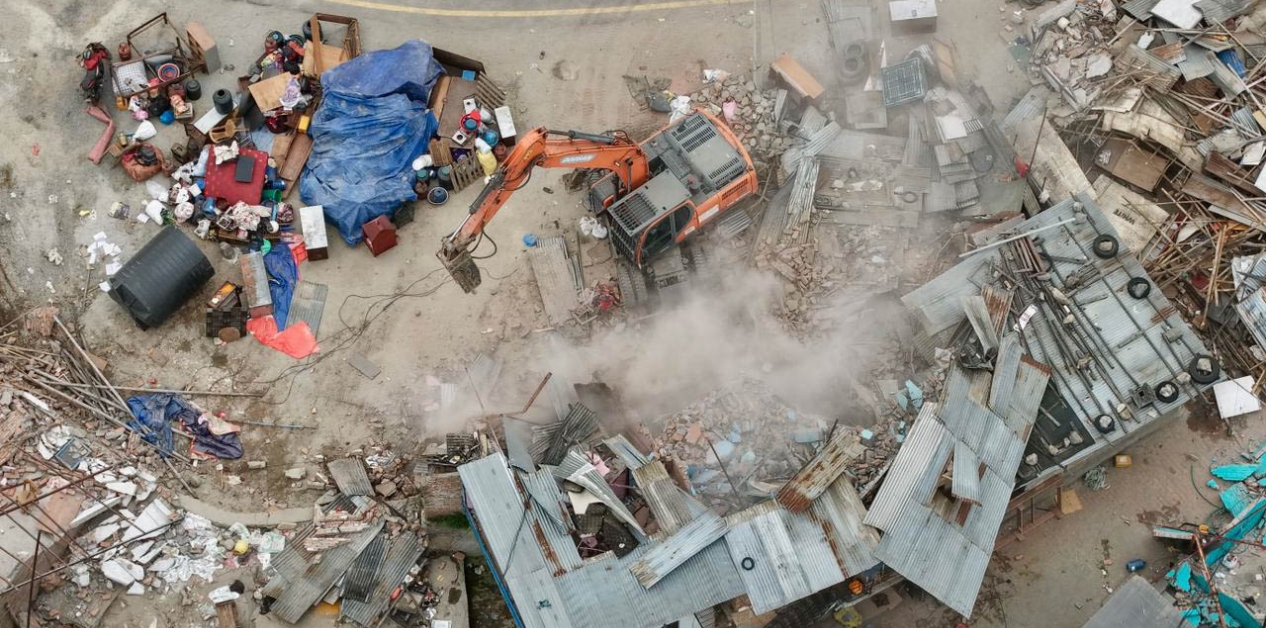
KATHMANDU: Whenever government bulldozers arrive to demolish settlements along the riverbanks of Kathmandu, a narrative is systematically thrown into the “market”—”the genuinely landless” and “fake landless leveraging power/orders.” The state, its spokespersons, and the “smart crowd” on social media immerse themselves so comfortably in this black-and-white classification that it feels as though the entirety of human life is merely a piece of land ownership certificate or a scrap of citizenship paper. However, this is a conspiracy that uses technical jargon to strip human beings of their very identity as humans. And then, the rulers themselves brand them: Encroachers! fake landless leveraging power!
This binary classification of “real landless people vs. fake” fabricated by the state is entirely fake and superficial. The law and order of the country recognize the landless not as encroachers, but as citizens deserving of special protection.
The prevailing laws of Nepal, particularly the Lands Act, 1964(seventh and eighth amendments), explicitly define landless Dalits, landless, and unsettled/unmanaged settlers for land rights and management.
According to this, a person or family belonging to the Dalit community who does not own land within the state of Nepal, is unable to manage land through their own income or efforts, and has no other alternative for housing or livelihood is defined as a landless Dalit. The state has made a constitutional commitment to prioritize providing housing and land to them for a dignified living.
The Act defines a non-Dalit person or family who does not own land anywhere within the state of Nepal and is unable to manage land through their financial status or labor as a landless people.
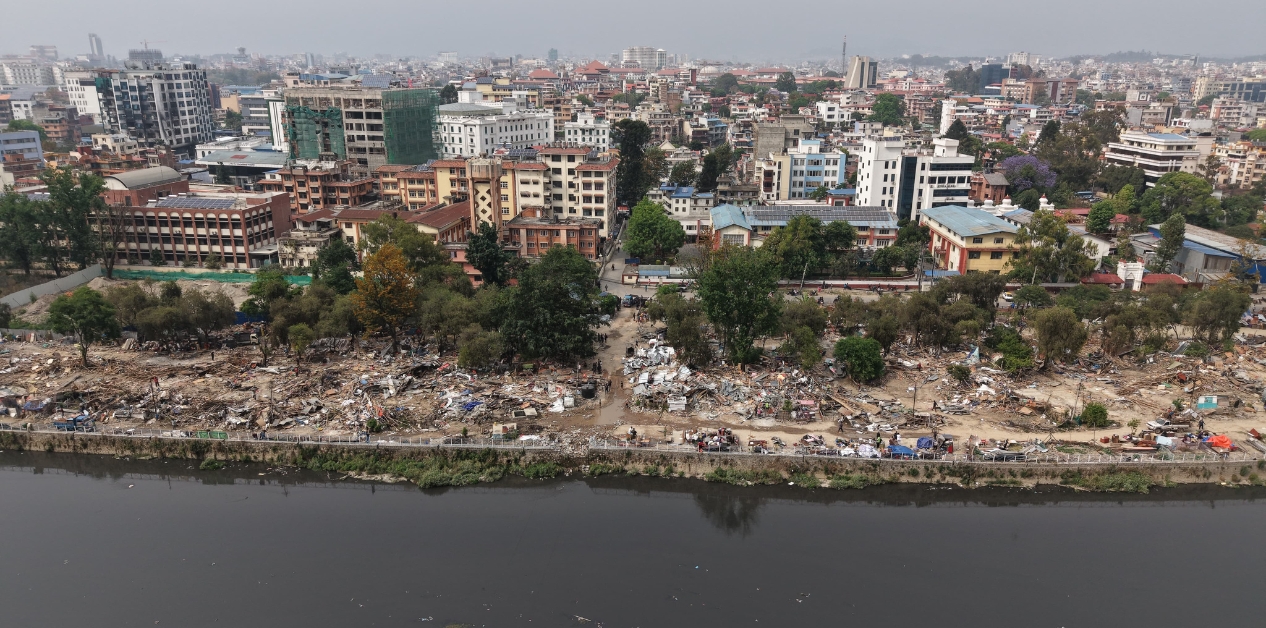
Status after the government ran bulldozers in the landless peoples’ settlement at Thapathali. Photo: Nepal Photo Library
The law defines those individuals or families who, despite owning land elsewhere under their or their family’s name, have built huts/houses on public or forest-demarcated land and have been cultivating or occupying it for at least 10 years, as unsettled/unmanaged settlers.
Section 52 (B) of Nepal’s Lands Act, 1964 (seventh and eighth amendments) clearly states: “Notwithstanding anything contained in the prevailing laws, the Government of Nepal shall, for one time, provide land to landless people in the place where they have been cultivating/occupying or in any other government land deemed appropriate by the Government of Nepal, not exceeding the designated area limit.” Similarly, Section 52 (C) of the same Act stipulates that for unmanaged settlers who have been living for at least 10 years on land converted into settlements—even if it is recorded as public or forest land—land can be provided for one time “in the place where they have been cultivating/occupying.”
When looking at constitutional commitments, this “bulldozer culture” directly contradicts the fundamental law of the land. The Preamble of the Constitution pledges social justice, a socialism-oriented state/economy, and economic prosperity. Article 16 ensures the right to live with dignity, Article 18 ensures equality and positive discrimination/measures for the protection of the economically underprivileged, and Article 25 guarantees the right to property. Most strongly, Article 37 (1) states that “Every citizen shall have the right to appropriate housing,” while Article 37 (2) specifies that “No citizen shall be evicted from the residence owned by him/her or encroached upon except in accordance with law.” Article 40 entrusts the state with the responsibility of identifying landless people and unmanaged settlers and rehabilitating them with housing, land, and employment.
Not only that, Section 5 of the Housing Act, 2018 sets a prerequisite that even if removal is required for public purposes, “When removing someone from the housing under their occupancy, rehabilitation must be arranged and compensation must be provided in accordance with the prevailing law,” and removals are forbidden during inappropriate times like night hours or cold weather. Looking at all these constitutional commitments and legal procedures, it is not the landless people, but the state itself that is the encroacher.
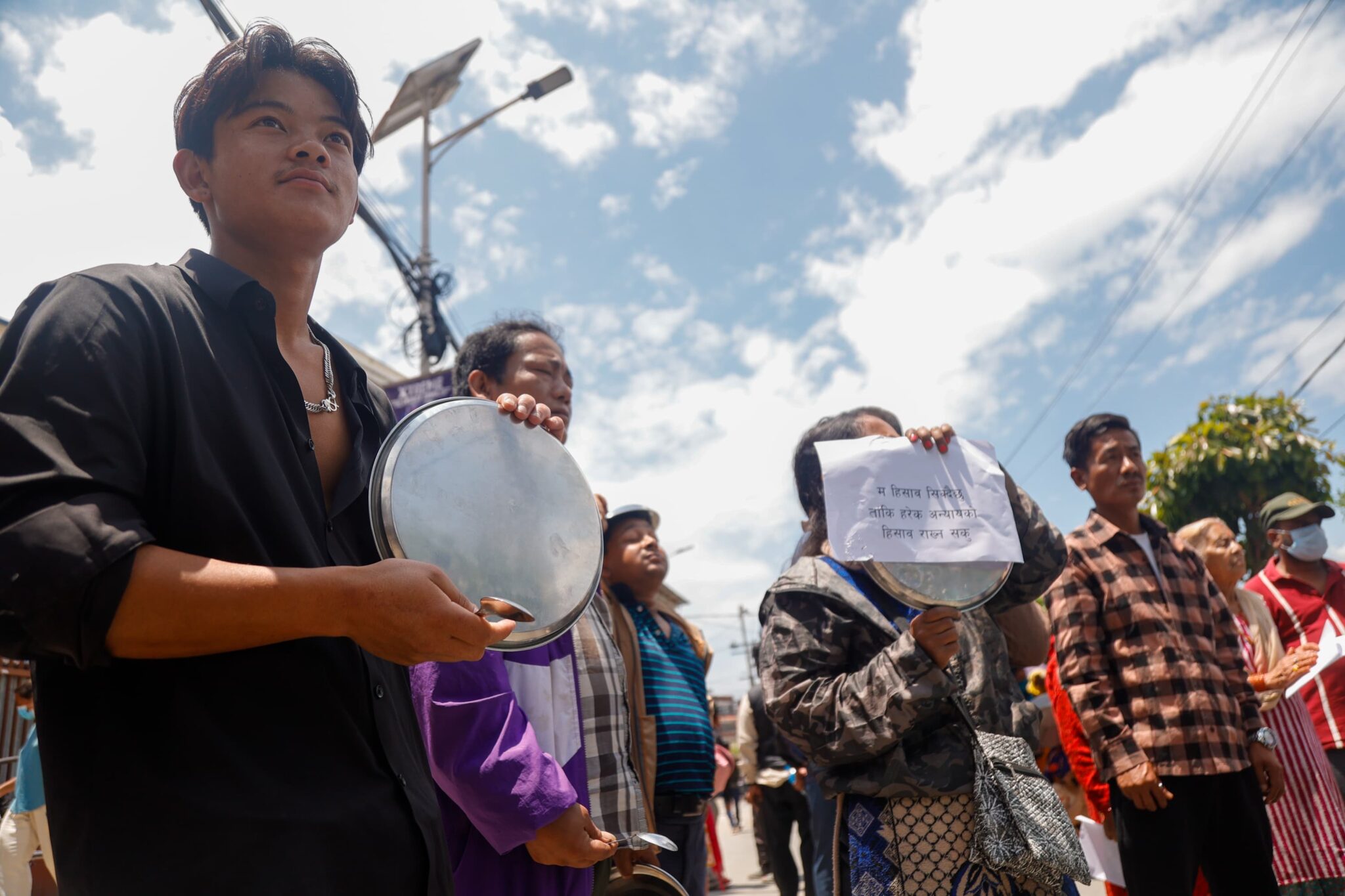
Protest by the landless people front against the government with plates and spoons in their hands at Maitighar Mandala, Kathmandu. Photo: Suryams Upreti / Nepal Photo Library
Despite all these clear legal definitions, the state’s deployment of the “real landless people vs. privileged land grabbers” label appears highly planned and deliberate. If one analyzes the hidden stories of the grassroots and the various forms of displacement experienced by those whom the state lumps together under the term “Hukum_basi, (privileged land grabbers)” it becomes clear how cruel this narrative truly is. For instance:
Beyond this, are the Chepangs and indigenous communities driven away from settlements near forests in the name of park expansion, and the locals within Kathmandu Valley who have been made “illegal” on their own historical homelands—are all these citizens living in informal settlements “privileged land grabbers” in the eyes of the state?
Lately, the narrative of encroachers and privileged land grabbers has been made so loud and toxic that minimum human sensitivity feels extremely rare. Consequently, grassroots individuals like Indra Bahadur Rai and Rabin Tamang were rendered so helpless and desperate before the state that they chose death over enduring further barbarism.
The height of irony and cruelty is that the state and its insensitive supporters even offered petty arguments regarding their deaths, asking, “Did the state kill them? They died by suicide!” But the question arises: when the state throws a citizen’s basis of survival, their shelter, and social identity onto the street overnight; when it pushes them into extreme mental pressure, forcing them to jump into the river; does that count as “dying on one’s own”? Is that merely suicide, or an “institutional murder” committed by state policy, the arrogance of power, and structural violence? For the state, are the likes of Indra Bahadur and Rabin citizens, or just statistics, land, or “privileged land grabbers”?
The state is trying to hide its cruel, inhuman, and “murderous” persona under the guise of urban beautification. This means covering the poor and their pain with a curtain in the name of making the city look clean and beautiful; spraying a few drops of “perfume” of ‘infrastructure development’ on the blood-stained banks of the Bagmati. But the state must understand that tomorrow, every conscious tourist who comes here will not just look at the beauty of the concrete; they will also dig into its ugly history and the blood, sweat, struggles, and tears of the grassroots people.
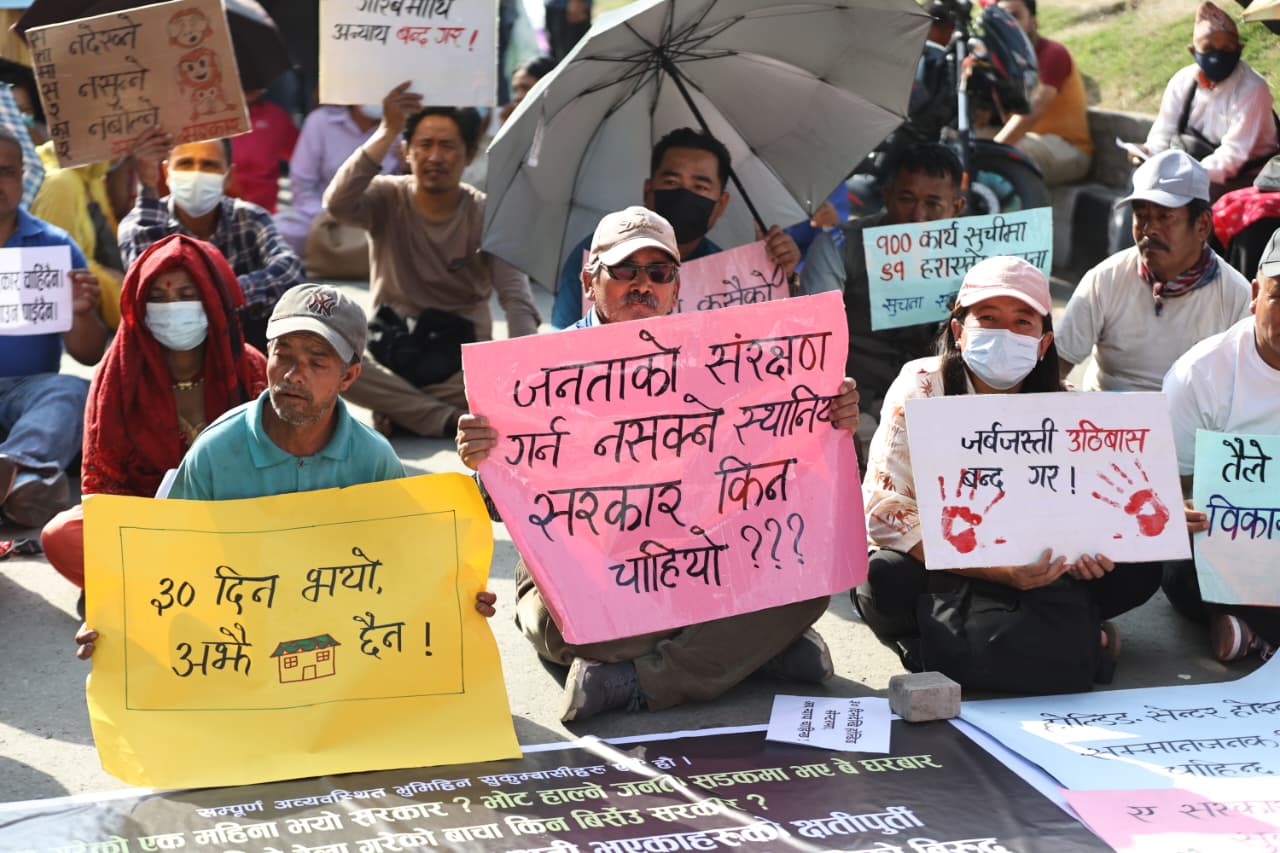
“Still no home after 30 days” – a protest by Sukumbasis. Photo: Nepal Photo Library
Amidst this, what is even more surprising is that in this engineered clamor of real landless people vs. fake, the discussion of land ceiling is nowhere to be heard. A land ceiling is the maximum limit of land an individual or their family can legally hold under their name. The language of the rulers might not directly utter this word, but those who occupy land exceeding the maximum legal ceiling through various manipulations and tactics under their own or their fake companies’ names are the real ‘fake landless people’ living under the protection of power; those who currently hold the reins of power and government.
Section 21 of the Lands Act, 1964 clearly states that land confiscated for exceeding the ceiling must be distributed by prioritizing local landless individuals among freed Kamaiyas, Dalits, indigenous peoples, and nationalities. However, the state hobnobs with land mafias and policy-corrupted individuals who violate the actual land ceilings, distributes party tickets to them in elections, and seats them in ministerial chairs. Then, when the marginalized—who have the legal right to receive that excess land—take shelter on the riverbanks, it slaps the ugly label of “fake landless people” onto them.
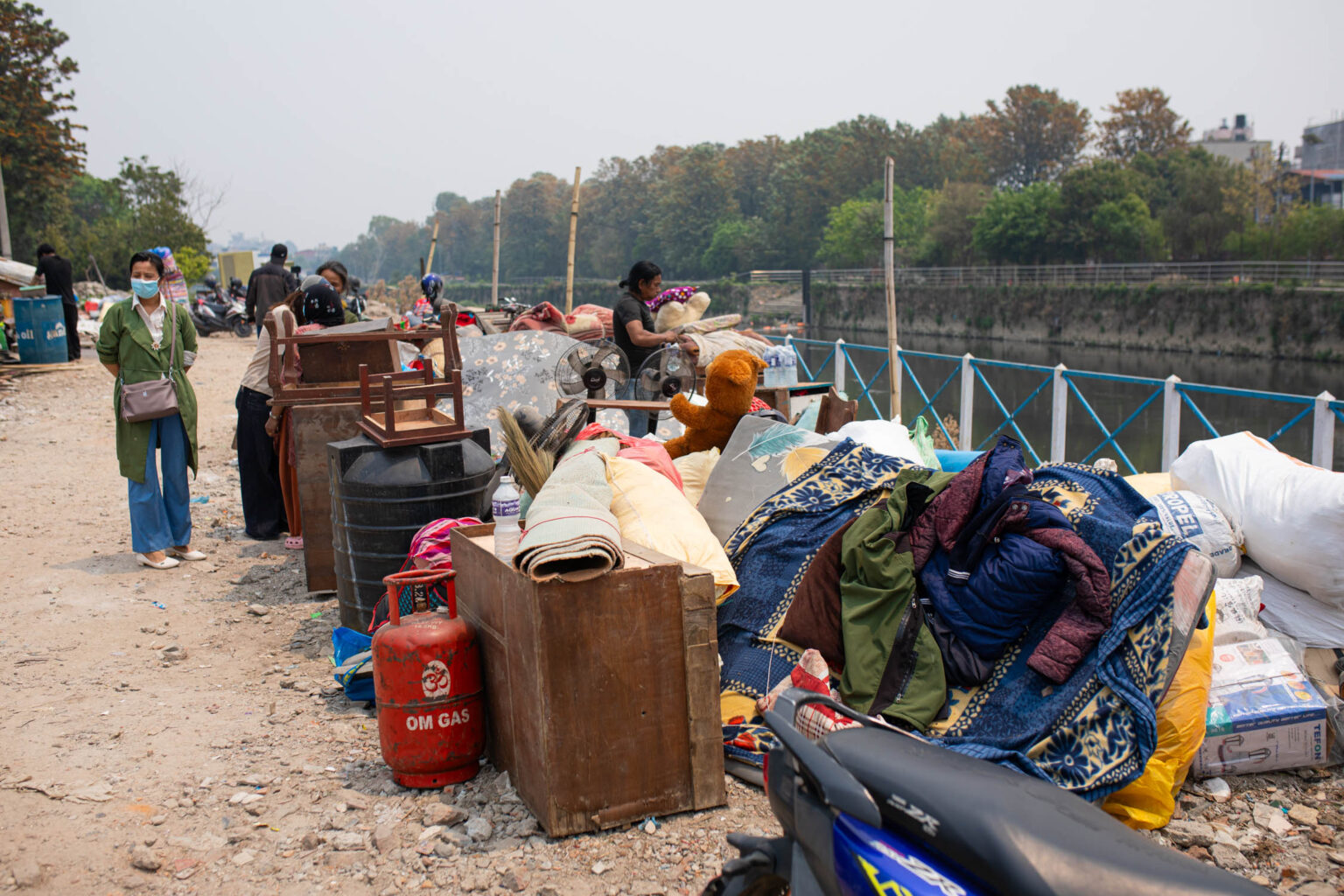
Arranging belongings after a bulldozer was run through the landless people settlement at Thapathali. Photo: Nepal Photo Library
Following exposures of child labor exploitation and environmental degradation, conscious people worldwide are completely boycotting various major commercial brands. People across the globe are strictly boycotting the business and identity of multinational companies like Starbucks on streets and social media, refusing to consume their products for supporting the genocide and oppression of the Palestinian people. Conscious citizens of the world will, and must, view the “magnificent infrastructure” to be built after this cruel and forced eviction of the people living on the Bagmati banks in the exact same way. Because this is barbarism unleashed upon the powerless. This is the state’s own defeat, because when the people lose, the state never wins.
(Sapkota is a queer feminist writer.)