Kathmandu
Saturday, June 13, 2026





Due to rapid urbanization, erratic weather patterns, overexploitation of groundwater, and government policy ambiguities, water scarcity is intensifying in the Kathmandu Valley.
KATHMANDU: Looking at the rooftops of houses in the urban areas of the Kathmandu Valley, none are adorned with attractive structures. Instead, one thing looks uniform: most rooftops have plastic and aluminum water tanks standing upright. To climate expert Ngamindra Dahal, who has been working in water conservation, this scene seems to tell a story of the state’s failure to provide basic drinking water services. “This shows how unreliable our water supply is,” says Dahal, president of the Nepal Water Conservation Foundation. “Not all places in the valley have access to taps, and even where they do, water doesn’t flow with enough force to reach the third or fourth floor. If there were twenty-four-hour water in the taps, why would we need to keep tanks?”
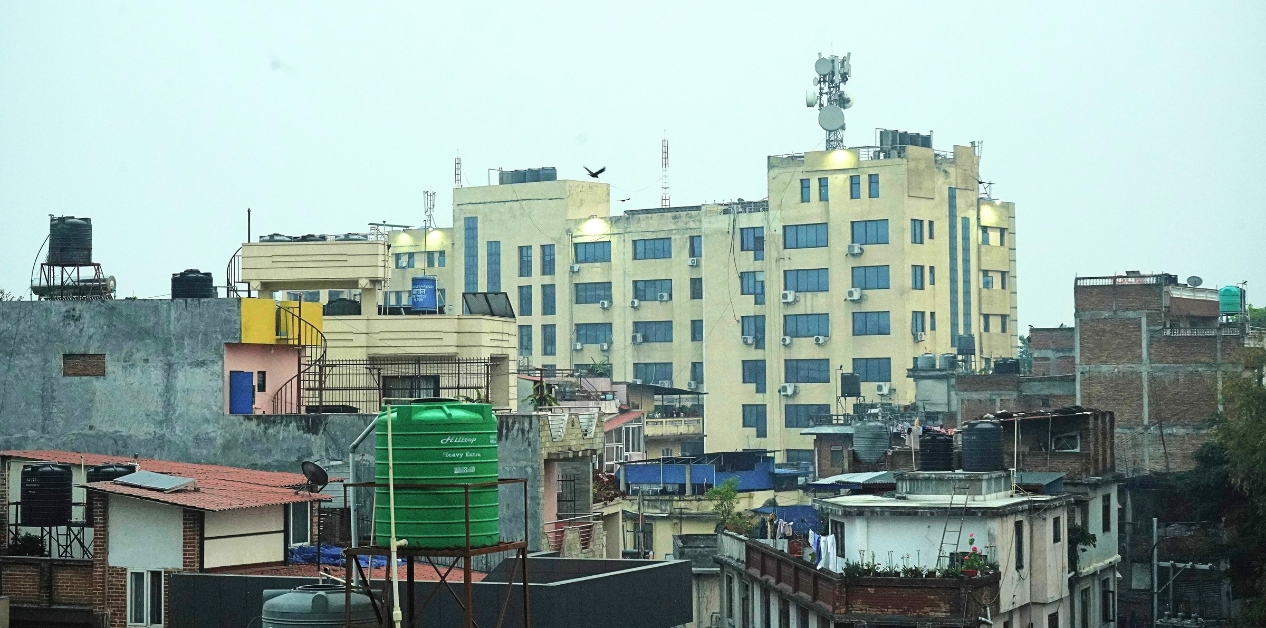
Water tanks placed on the rooftops of houses in the Babarmahal area of Kathmandu. Photo: Bikram Rai/Nepal News.
In the Kathmandu Valley, residents of both areas with and without tap water access have been managing their water needs through personal efforts. When new buildings are constructed, they drill borewells for water, build underground reserve tanks, and place water tanks on the rooftops. While the building code makes septic tanks mandatory, it does not require the same for reserve tanks. Climate expert Dahal says that building underground reserve tanks increases the cost of home construction. He adds, “Without building a septic tank and a reserve tank, the cost of a standard residential building can be reduced by up to 25 percent.”
Like other residents of the valley, Dahal is not untouched by the water problem. At his office at the Nepal Water Conservation Foundation in Maharajgunj, Kathmandu, and at his residence in Sanothimi, Bhaktapur, he has installed underground reserve tanks and rooftop tanks to manage water.
Providing clean drinking water to all citizens falls within the responsibility of the state. Article 35 of the Constitution places drinking water and sanitation under fundamental human rights. Water remains a priority for all three tiers of government. However, the water tanks on the rooftops of houses in the valley indicate that public trust in the state’s obligation to provide basic drinking water services is declining. Due to the government’s lack of a long-term policy for water management, water scarcity has developed into a permanent crisis.
According to experts, the drinking water crisis in the valley is not the result of a single cause. Issues such as rapid urbanization along with increasing migration, the government’s lack of a long-term policy, changing weather patterns, excessive extraction of groundwater, failure to protect traditional and local water sources, and a tendency to waste water have further intensified the water crisis.
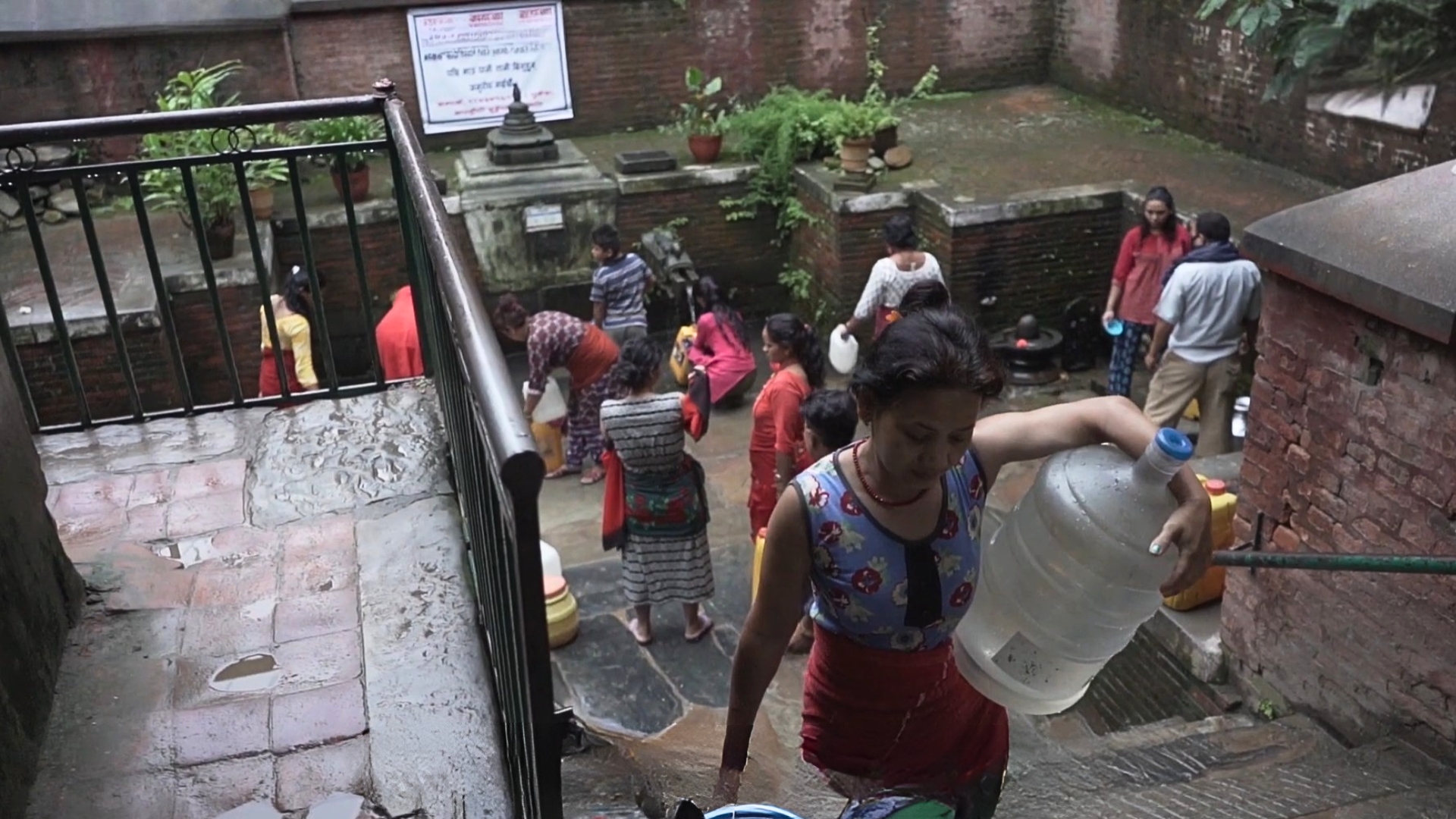
A woman carrying water from a traditional stone spout in Lalitpur. Photo: Bikram Rai/Nepal News.
Watershed expert Madhukar Upadhya says the government’s policy ambiguity is the biggest cause of the drinking water crisis. “Instead of seeking long-term solutions, we sought temporary fixes, and we only managed to push the crisis further down the road rather than resolve it,” he says. “To solve the water crisis, we need to identify and conserve local sources.” According to him, while water was traditionally conserved, today the tendency is to waste water rather than use it judiciously
In Kathmandu, the distribution of drinking water through taps began over a century ago. However, the growing population was not dependent on that alone. Sufficient water was also supplied from surface sources such as rivers, wells, and stone spouts. Among these, stone spouts were a major foundation. There used to be collaboration between the community and the state in the conservation and promotion of local water sources.
Now the situation has changed. The government’s priorities have focused on large-scale drinking water projects rather than the conservation of local sources. For the past three decades, the Melamchi Drinking Water Project was considered the surefire solution to the Kathmandu Valley’s crisis. However, despite being named a national pride project, it has not been able to become dependable and sustainable. The project, which already costs Rs 68.62 billion, does not supply water all year round. Following the 2021 floods, the main facility’s headworks and water filtering system were devastated. Since then, the tunnel mouth has been closed throughout each monsoon season. In order to fully restore the headworks and provide water all year round, an extra Rs 4.5 billion is expected to be needed. The Melamchi Project won’t be able to supply all of the valley’s water needs, even if it runs at full capacity.
Demand and supply
Although surface water sources such as rivers, wells, and springs have diminished, the development of technology has allowed people to access groundwater sources. While groundwater meets immediate needs for the time being, it is not possible to say how sustainable that will be.
When it comes to water resources, Nepal is regarded as one of the richest nations. However, drinking water shortages are a problem in several major towns, not only the Kathmandu Valley. Nepal releases 900,000 cubic meters of water into the Indian Ocean annually. However, inhabitants are compelled to live in constant water scarcity as a result of improper management of the drinking water supply.
There is a huge gap between drinking water demand and supply in the Kathmandu Valley. According to the annual report of the Kathmandu Upatyaka Khanepani Limited (KUKL) for the fiscal year 2024/25, the daily demand is shown to be 514 million liters. However, even when operating all sources including the Melamchi Drinking Water Project, only 322.4 million liters are produced daily. That is only about 62 percent of the demand. Because the Melamchi Project shuts down during the monsoon due to the risk of floods and landslides, the supply decreases even further.
If the water brought from Melamchi, Ribarma, and the Bagmati River is excluded, daily production would drop to just 91 million liters. That is only about 18 percent of the daily demand. This is equivalent to supplying just one liter where five liters of water are needed.
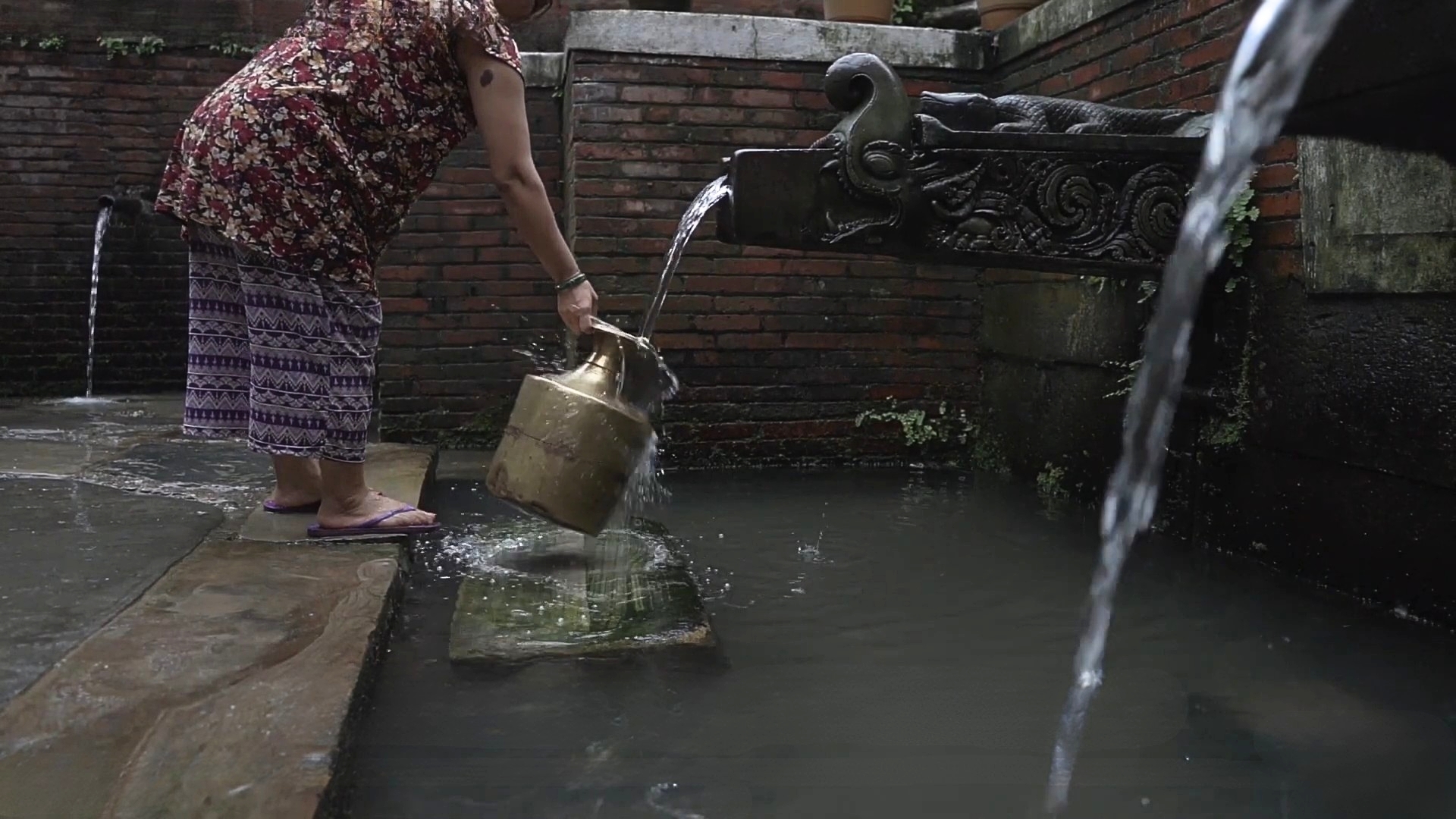
A woman filling water at a traditional stone spout in Patan. Photo: Bikram Rai/Nepal News.
The responsibility for producing, distributing, and sanitizing drinking water in the Kathmandu Valley lies with KUKL. However, its service does not cover the entire valley. “Dakshinkali and Ramkot also fall within the Kathmandu Valley, but KUKL does not cover those areas,” says watershed expert Upadhya.
Nepal has a long history of distributing water through taps. In 1834, water began to be supplied through taps to the ruling class, and by 1863, distribution was extended to the general public as well. However, despite the expansion of access, drinking water service through taps is still not available to everyone today.
Due to rapid urbanization, it is not possible to ensure water availability in the valley. In the ten years since 2011 , Kathmandu’s population increased by 0.5 million. According to the 2011 census, there were 2.517 million people living in Kathmandu, while the 2021 census showed that number had reached 3.025 million.
The challenge added by the changing weather system
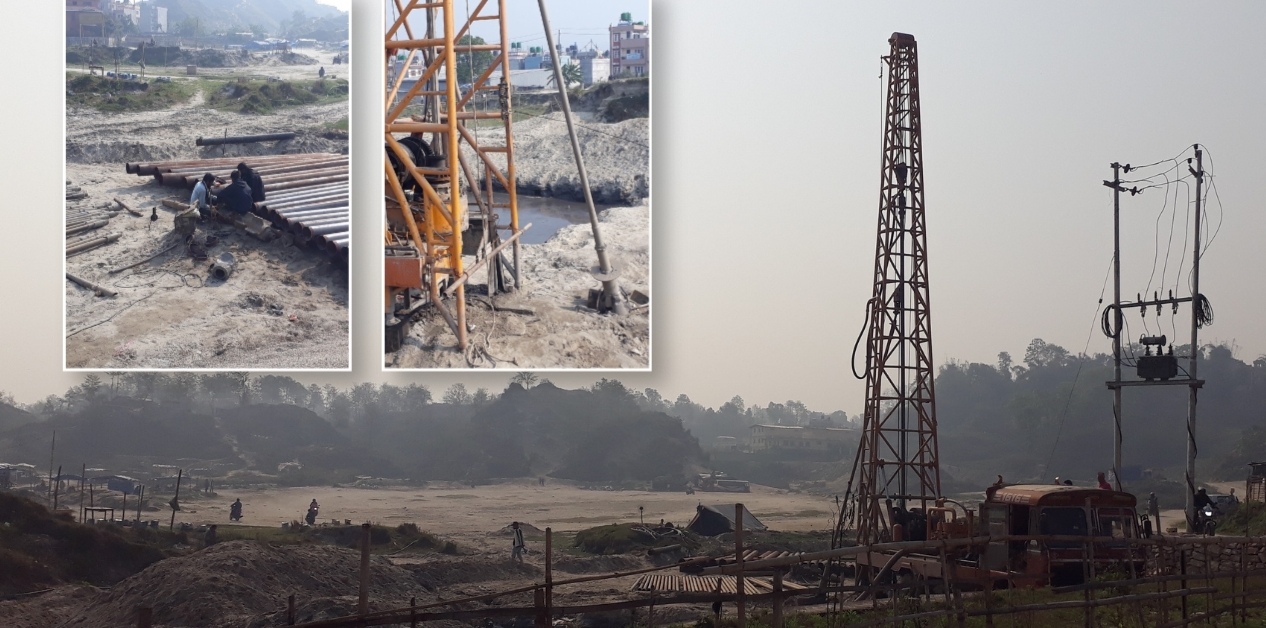
Gopal Gurung has been drilling borewells in Kathmandu since 1998 . On April 22 , he was drilling a borewell in Ramhiti, Kathmandu Metropolitan City–6. Gurung works with a team of five people to drill borewells. He says that since summer began this time, they have not had to sit idle even for a single day. “In places where water used to be found at 50–60 feet, we now have to drill up to 150 meters,” he says. “The place where I worked today already had a borewell, but after it dried up, we are drilling a new one.”
At Ramhiti, although there is water, he says that in Simaltar, located to the north, water has stopped coming even after drilling 400 feet (approximately 122 meters). Therefore, he no longer goes to drill borewells in Simaltar even if someone calls. His experience is that the groundwater level has been decreasing since the 2015 AD earthquake. “After the earthquake, the water just disappeared,” he says.
According to the National Climate Change Survey 2022 published by the National Statistics Office, residents of the hilly districts of Bagmati Province, which includes the Kathmandu Valley, report that the water crisis is deepening. About two-thirds of residents in the hilly districts of Bagmati Province say that the duration of water flow from taps has decreased. Similarly, according to three-fourths of residents, ponds, wells, and stone spouts have dried up.
Residents say the condition of rivers and streams has reached an even more critical state. Eighty-seven percent of households in hilly areas report that the water flow in rivers and streams has decreased. Likewise, 42.4 percent of respondents said that water sources have dried up.
The condition of groundwater sources is similar. Over 17.5 percent of households reported that water in wells or tubewells has decreased, while 13 percent reported that they have completely dried up. Regarding the main causes of these sources drying up, about half of respondents cited inadequate rainfall, and 20 percent cited increasing drought. Additionally, road construction and urbanization are also said to have affected water sources.
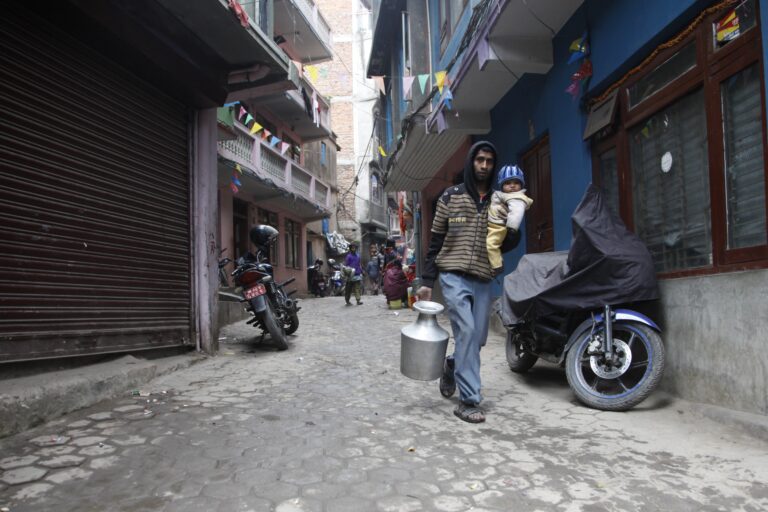
A man arranging/collecting water in Lagan Tole, Kathmandu. Photo: Bikram Rai/Nepal News.
Dahal and Upadhya say that excessive extraction of groundwater and a changing weather system are the causes of declining groundwater aquifers. Due to the effects of climate change, the traditional rainfall cycle has changed, leading to an increase in extreme weather events such as short-duration torrential rainfall, erratic monsoons, and no or little rainfall during the winter season. Dahal, who is also a meteorologist, explains that because water does not properly percolate into the ground, the groundwater aquifers cannot be naturally recharged, and the water table is declining. “In the valley, although there is increased rainfall during the monsoon and pre-monsoon, winter rainfall has decreased significantly,” he says. “When heavy rain falls all at once, the groundwater aquifers do not get adequately recharged.”
Upadhya says that in the past, unlike today, there were no concrete structures everywhere, so there was sufficient space for water recharge, but now, due to unplanned settlements and a lack of open land, adequate water does not accumulate in the groundwater aquifers. “Before, there were plenty of open spaces without houses, buildings, and paved roads, and there were places for water to collect. Now that concrete structures have been built in those places, recharge has been blocked,” he says. He adds that the government’s policy regarding the use of groundwater needs to be clear.
As the water crisis intensifies in the valley, it has become an opportunity for some to earn a living. The business of tanker and jar water has flourished. Within the valley, the main source areas for water are Chobhar, Balaju, Jorpati, Mata Tirtha, Godawari, and Machhegaun. From such places, water is extracted through springs, borewells, and shallow tubewells and then sold and distributed within the valley.
Although the water crisis has become a business opportunity for some, it remains a daily headache for valley residents. Due to the state’s failure to manage properly, a situation has arisen where residents must spend both time and resources for water. The water tanks on rooftops are an example of this. These installed tanks are not only the result of citizens’ personal management efforts to store water but also living proof that the state has failed to provide basic services to its citizens.