Kathmandu
Saturday, July 11, 2026





Cascading threats to public health, agriculture, and livelihoods as the nation faces historic temperature spikes.

KATHMANDU: In the past month alone, the government issued three “special bulletins” regarding the danger of hot days and heatwaves. The Department of Hydrology and Meteorology issued these bulletins on April 20, April 24, and May 22. In contrast, during last year’s summer season, such a bulletin was issued only twice.
In all three bulletins issued this time, residents of the Terai region in Lumbini and Sudurpashchim provinces were warned to take precautions, as maximum temperatures were expected to reach 40°C or higher, creating a high probability of heatwaves. Indeed, on May 25, Nepalgunj recorded its highest-ever maximum temperature for a 24-hour period at 42°C. Since then, the maximum temperature there has not dropped below 41.5°C.
Currently, daily life has been severely disrupted by the scorching heat and hot winds in several places across the Terai-Madhesh and hilly regions, including Nepalgunj. The Department of Hydrology and Meteorology has estimated that during this year’s monsoon, most parts of the country will receive below-average rainfall, while maximum temperatures will remain above average. Given that the heat is already blistering during the pre-monsoon period, the absolute peak of this year’s summer is yet to arrive.
Environmental science researcher Uttam Babu Shrestha says, “Right now is just the beginning of the summer season; even more intense heat is on the way. Extreme heat is expected in the coming June and July.”
According to meteorologist Saroj Pudasaini, a condition where the temperature rises significantly above normal is called a “heatwave” (extreme heat). A single day with excessive heat is called a hot day. The National Disaster Risk Reduction and Management Authority defines a heatwave, locally known as “Loo,” as a period when hot days persist for three consecutive days or more. Pudasaini adds, “If the maximum temperature at a single weather monitoring station remains at 40°C or above for three consecutive days, that region is considered to be experiencing a ‘Loo’.”
Bibhuti Pokharel, the spokesperson for the Department of Hydrology and Meteorology, states that hot days and “Loo” are primarily observed during the pre-monsoon. It is generally believed that once the monsoon begins, rainfall brings down the temperature. However, in recent years, the prolonged impact of extreme heatwaves has become more prominent in Nepal. Even after the monsoon starts, long dry spells without rainfall cause the heat to intensify. Due to the impact of climate change, unpredictable weather systems are developing, causing both the intensity and duration of the summer heat to rise every year. “It used to be hot in the past as well, but now climate change has increased both the intensity and duration of the heat,” Pokharel says. “Hot days are starting to increase during the summer season.”
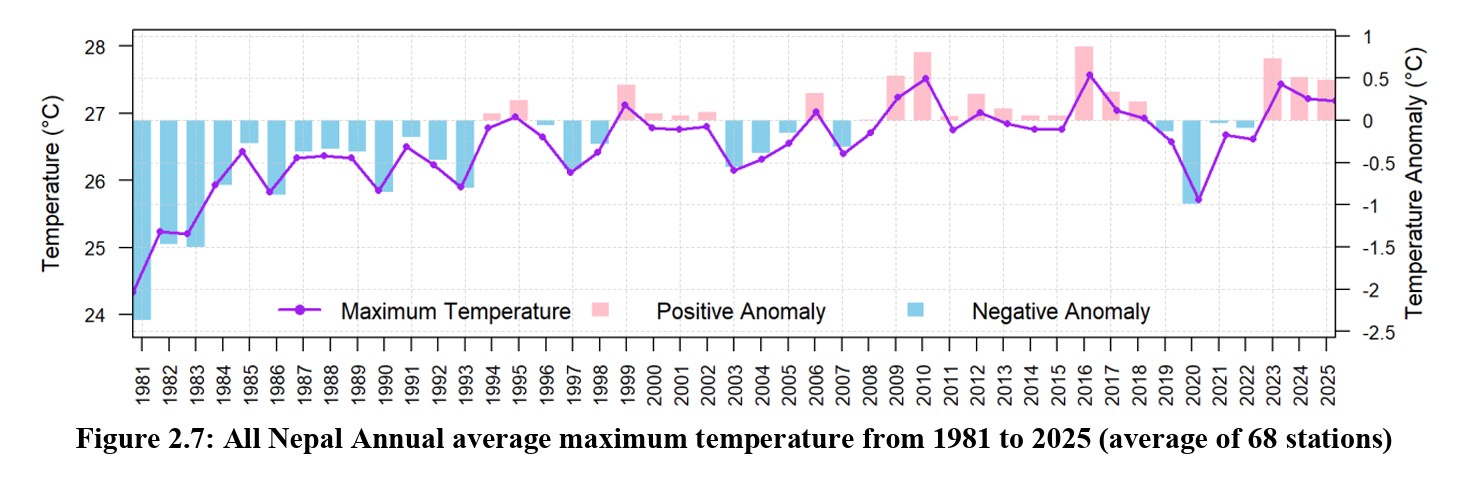
According to the meteorological department’s records, a total of 50 days were recorded as extreme heat days throughout the year 2024. The temperature on those days was above 40°C, severely affecting daily life in the Terai region. Similarly, from March to June in 2025, the maximum temperature crossed 40°C at many temperature monitoring stations in the Terai. In that year, 22 days were recorded as extreme heat days.
Three decades ago, the highest-ever maximum temperature was recorded. According to the records of the Department of Hydrology and Meteorology, the highest temperature ever recorded in Nepal was 46.4°C in Dhangadhi on June 5, 1995.
Multidimensional impact
As hot days begin to increase, everyday life is becoming increasingly painful. The blistering heat has added burdens to public health, education, agriculture, livestock, environment, employment, and public infrastructure. Nepal is considered a highly vulnerable country from a multi-hazard perspective due to its complex topography, weak geological conditions, weather extremes, environmental pollution, and climate change. Over the past decade, the burden of heatwave impacts has been added to its citizens.
Hot winds and scorching heat place women, children, senior citizens, and outdoor workers in greater distress. Beyond the impact on human lives, because the average temperature is expected to rise across the country this time, there is a risk of glacial lake outburst floods (GLOFs) in the high Himalayan regions, droughts in the hills, and extreme heatwaves in the Terai-Madhesh.
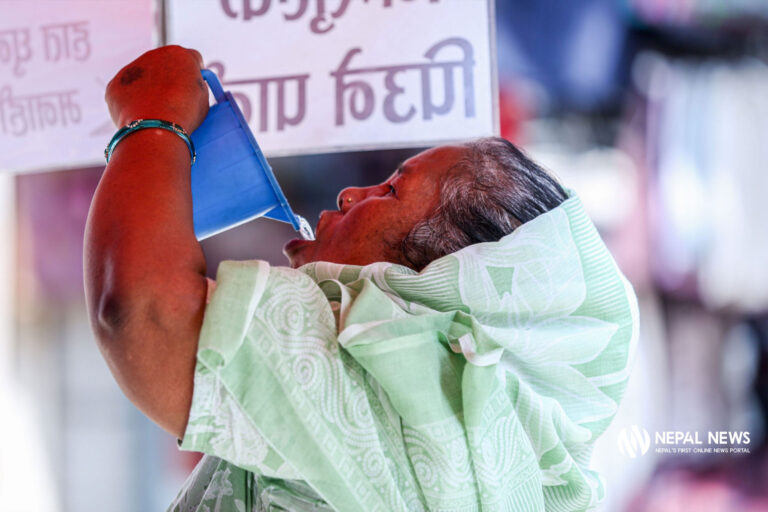
Extreme heat severely impacts public health. According to the World Health Organization (WHO), extreme heat leads to problems such as elevated body temperature, headache, fainting, vomiting, rapid heart rate, low breathing and blood pressure, fatigue, weakness, excessive thirst, leg cramps, dizziness, muscle pain, dry and red skin, dehydration, cramps, and “heatstroke.” Heatstroke occurs when the body’s temperature becomes excessively high due to the heat, causing its natural temperature regulation system to fail.
Stress caused by extreme heat also increases the risk of death among chronically ill patients suffering from conditions such as asthma, heart disease, mental health issues, and kidney disease. Studies from 2000 to 2019 show that approximately 489,000 people die globally every year from heat-related causes, with 45% of these deaths occurring in Asia and 36% in Europe.
According to environmental science researcher Shrestha, human health is endangered once the “wet-bulb temperature” threshold is crossed. “The human body can tolerate heat around 37°C; in heat beyond that, it stops sweating altogether,” he says. “When this happens, heatstroke occurs, and people can collapse and die while walking.”
The “wet-bulb temperature” refers to the limit of heat that the human body can tolerate. The human body cannot endure temperatures above 37°C for an extended period.
A study titled Health Risks of ‘Loo’, published by the Nepal Health Research Council in April 2018, cited records from the Ministry of Home Affairs showing that during 25 heatwave events in Nepal between 2002 and 2010 (excluding 2008), 25 people died and 280 were affected. Another study titled Trends of Climate Disasters in Nepal, published online in Springer Nature on April 1, 2022, mentioned that 35 people died due to heatwaves between 1991 and 2021. However, because there is no systematic reporting system for such incidents, all data regarding this issue fails to be fully counted.
Similarly, extreme heat frequently forces schools to close, disrupting students’ education. Because it becomes difficult to sit in classrooms, concentrate, or feel physically comfortable during extreme heat, students’ learning capacity decreases. Children in schools that lack well-ventilated or air-conditioned classrooms are particularly affected. Every year during extreme heat, the government routinely shuts down teaching and learning activities in schools across the Terai-Madhesh. Following the extreme heat this time, Shuklaphanta Municipality in Kanchanpur closed schools within its municipal area on May 26 and 27. Similarly, Krishnapur Municipality and Bhimdatta Municipality, also in Kanchanpur, closed all community and institutional schools within their municipal areas for three days starting May 25.
Rising temperatures affect farmers as well. Researcher Shrestha notes that as the heat rises, the risk of drought intensifies. He states that because rainfall decreases or stops entirely, and existing water evaporates quickly, temperature rises worsen drought problems. “This affects farming systems reliant on rainwater, leading to a decline in crop yields,” he says. Without irrigation, crops wither and fail to fruit properly, which reduces production. The heat leaves livestock fatigued and diseased.
There is a risk of miscarriages in pregnant livestock, reduced milk production in dairy animals, and in some cases, the death of the livestock itself.
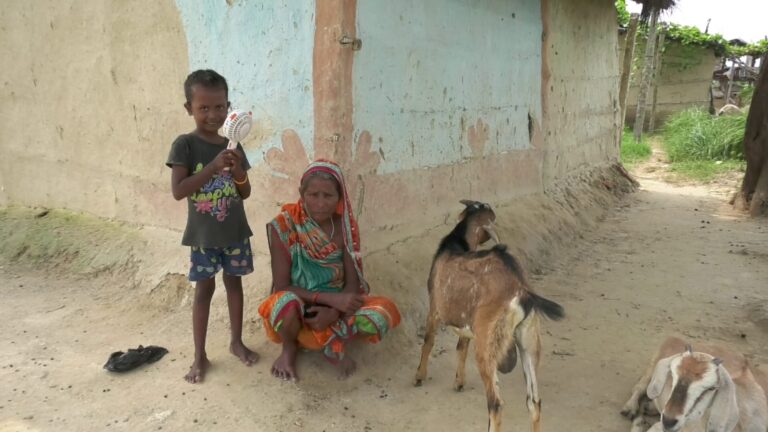
Intense heat brings greater suffering to low-income communities whose house structures are weak. The inside of houses with tin or galvanized iron sheet roofs or walls becomes extremely hot.
The heat can cause roads, bridges, and buildings to crack, and asphalt roads can melt and peel off. Long-lasting extreme heat events have increased pressure on water and electricity systems, as noted in a study released by the United Nations Office for Disaster Risk Reduction on May 8, 2026. Heat increases the demand for electricity and water, and when demand exceeds capacity, disruptions are created in the supply system itself.
Because heat increases dryness, the risk of fires and forest wildfires also rises. Researcher Shrestha states that temperature rises played a key role in the high frequency of fires and forest wildfires in Nepal in 2016, 2021, and 2024.
Double burden on women
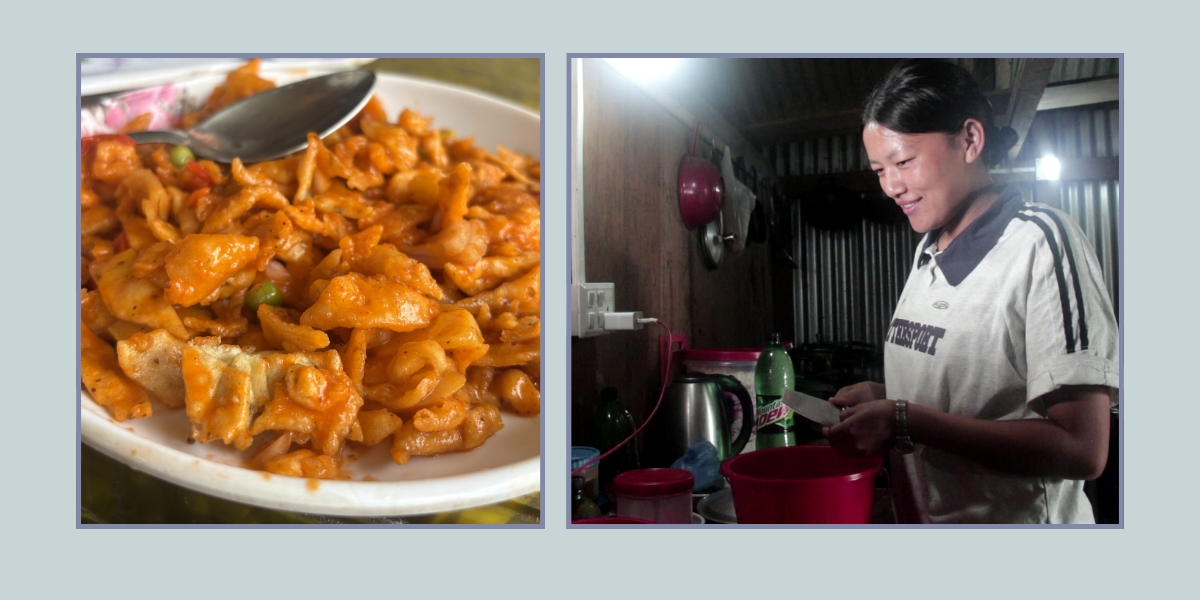
Studies have shown that extreme heat is bringing serious crises to women’s health, daily livelihoods, and economic status. In particular, pregnant women and outdoor laborers are at the highest risk. Working women endure the heat while working at their jobs on one hand, and must handle responsibilities like cooking, cleaning, and caregiving upon returning home on the other. Because most women do not receive early warnings and necessary information regarding heatwaves, health problems and economic burdens have been added to their lives.
A study titled The Impact of Heatwaves on Pregnancy, published online in Taylor & Francis on March 13, 2025, revealed that climate change and rising heatwaves have particularly impacted pregnant women and children. In low-income countries like Nepal, the risk of preterm births due to extreme temperatures is high, and this has impacted socially marginalized communities even more severely. Because heat increases stress in the body and disrupts biological processes, these problems have begun to rise.
Obstetrician and Gynecologist Dr. Kirtipal Subedi says, “A pregnant woman’s body is already warm due to hormonal changes. If it gets too hot, the water content in her body decreases, putting pressure on her blood pressure or heart.”
Hardship for workers
Extreme heat particularly hits workers in the informal sector. Because they mostly work outdoors, have to bake under the scorching sun, and have very low access to drinking water, they face a severe risk of heat-related impacts. Intense heat has caused a serious negative impact on their health, livelihoods, and overall standard of living, according to a study conducted by People’s Courage International and ISET-International. The study, titled Hot Cities Make Hard Work Harder, was made public on May 14, 2026.
Prakash Bhattarai, a researcher involved in the study, explains that the heat impacts workers in a dual manner. “Since they live in shacks or huts, they face heat while at home, and they are forced to work in the heat when they go to their workplaces,” he says.
Photos: Birendra Raman
Bhattarai argues that although the government has made action plans since 2024 to address the impacts of heat on daily life, they have not been effective. “To fulfill international commitments, the government creates policies and action plans on paper, but they are not found to be implemented in practice. The same problem is visible in the heatwave action plans,” he says. “Since the impact of heat varies from place to place, location-specific action plans are needed. In our case, a national-level action plan is made, and even that is left unimplemented.”
The study, conducted across five major cities in Nepal, India, Bangladesh, Indonesia, and the Philippines, highlighted the challenges faced by informal sector workers regarding their health and livelihoods. As heat causes a decline in work efficiency, the risk of salary cuts, wage reductions, benefit cuts, or complete job loss has increased.
Workers are pushed toward risks such as taking loans to treat health problems caused by the heat, cutting back on food, or delaying medical treatment.
The study also covered the extreme heat in Kathmandu and Nepalgunj and its impact on low-income informal sector workers.
Extreme heat, floods, and severe cold are the three major seasonal events that Nepali workers face at their workplaces. Among the workers participating in the study, 75% stated they faced problems from extreme heat, 47% from floods, and 42% from severe cold. Due to a decline in work efficiency caused by the heat, 49% revealed that their wages had been cut. Similarly, the heat led to food insecurity in 74% of households and caused health problems for 65% of the workers.
What is the cause of the heat?
Global temperatures are rising due to human-induced climate change. The World Meteorological Organization (WMO) issued a press release on January 14, 2026, declaring 2025 as the hottest year on record so far. The WMO stated that the past 11 consecutive years have been recorded as the hottest years in history.
In Nepal, the ‘El Niño’ system—one of two weather systems that develop in the Pacific Ocean—plays a major role in causing temperatures to rise even during the monsoon. Researcher Shrestha explains that during the El Niño cycle, ocean temperatures rise, bringing heat to South Asia, including Nepal. He says, “Since there is a super El Niño cycle this time, there is also talk that it will be the hottest year recorded so far.” During this phase, he notes that the temperature rate increases by an average of one to three degrees Celsius depending on the location.
The global weather system consists of two cycles: El Niño and La Niña. When El Niño is strong, the monsoon weakens in South Asia, including Nepal, leading to increased heat and drought. When La Niña is strong, the monsoon becomes active, bringing cooler conditions.
Although the El Niño and La Niña cycles are said to alternate every three to four years, Shrestha states that in recent years, El Niño has become more active and lasts longer, leading to rising temperatures and an increase in related weather events. He adds that it has been about a decade or a decade and a half since the impacts of heat began to be heard more frequently.
In Nepal, the perception of heat is drastically different between urban and rural areas. In urban areas like Kathmandu, urbanization and concrete structures make people feel a much higher increase in temperature. “Cities are called urban heat islands; many people reside there, roads and industries exist, and there are very few trees. Because of this, the intensity of heat is naturally higher,” Shrestha says.
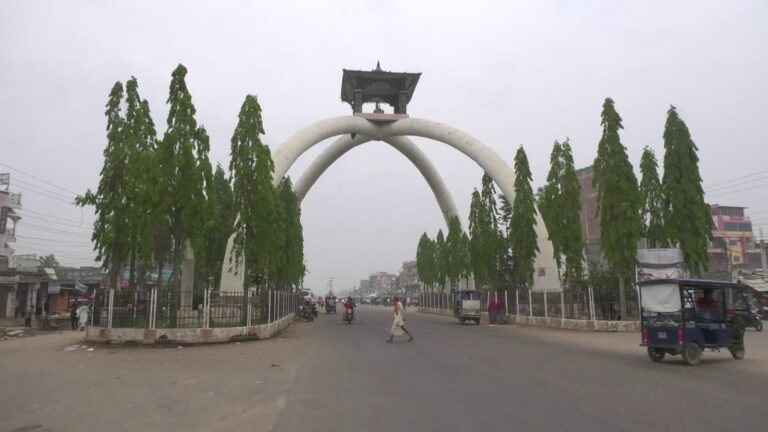
An empty road as heat rises in the Terai region.
Because concrete and asphalt roads absorb heat and do not cool down easily for a long time, more heat is felt in the city. When Shrestha and other researchers studied neighboring communities inside Kathmandu with and without trees, they found that places without vegetation recorded temperatures three to four degrees Celsius higher.
When they measured temperatures at the Jawalakhel Zoo versus Kumaripati, Tribhuvan International Airport versus the golf course area, and UN Park versus Baneshwor, they found higher temperatures in places with no or very few trees. This sends a clear message that to adapt to urban temperatures, cities must increase greenery by planting trees.
A Neglected Disaster
Studies estimate that due to climate change, the frequency, duration, and intensity of heatwaves in South Asia, including Nepal, will continuously rise, making health risks even more severe. Shrestha says, “A study by the United Nations Intergovernmental Panel on Climate Change (IPCC) shows that Gen Z and the Alpha generation will have to face seven and a half times more heat in their lifetimes compared to older generations.”
According to a study on heatwave risks published in PLOS ONE on August 13, 2025, if effective mitigation measures are not adopted, it is estimated that heat-related mortality in Nepal could reach 53 deaths per 100,000 population by the 2080s. During the period from 1961 to 1990, this rate was only four deaths per 100,000.
If the rise in frequency, duration, and intensity of temperatures continues in South Asia, it is estimated that the annual average temperature of this region could exceed 35°C. In 2025, Nepal’s annual average temperature stood at 21.21°C. The maximum temperature recorded this year was 27.18°C, which is 0.17°C higher than it was 13 years ago (2012).
In India, the government has undertaken adaptation efforts such as monitoring wet-bulb temperatures to issue warnings, and placing coolers or fans in public places to tackle the rising heat. However, in Nepal, there is a complete lack of priority and preparation regarding this issue. Researcher Shrestha says, “In other countries, the rate of human deaths due to heat is rising every year, and such a risk exists in Nepal too. However, our government mechanism does not seem to be prepared to control the danger of heat.”
According to Pokharel, the spokesperson for the Department of Hydrology and Meteorology, analyzing long-term data is necessary to prepare for avoiding risks caused by extreme heat, but the government lacks adequate and systematic data.
“There is a lack of sufficient and organized data regarding hot days and heatwaves, and detailed studies on the loss and damage caused by heat have not been conducted,” she says.
Nirmala Regmi, a meteorologist at the National Disaster Risk Reduction and Management Authority, explains that because the impact of hot winds is not visible like that of floods and landslides, the exact loss and damage caused by heatwaves cannot be ascertained. “It needs to be medically certified that a death occurred precisely due to a heatwave, and such a mechanism has not yet been established in Nepal,” she says. “For now, we have been formulating and implementing action plans for the past three years to prevent and mitigate the impacts of extreme heat.”
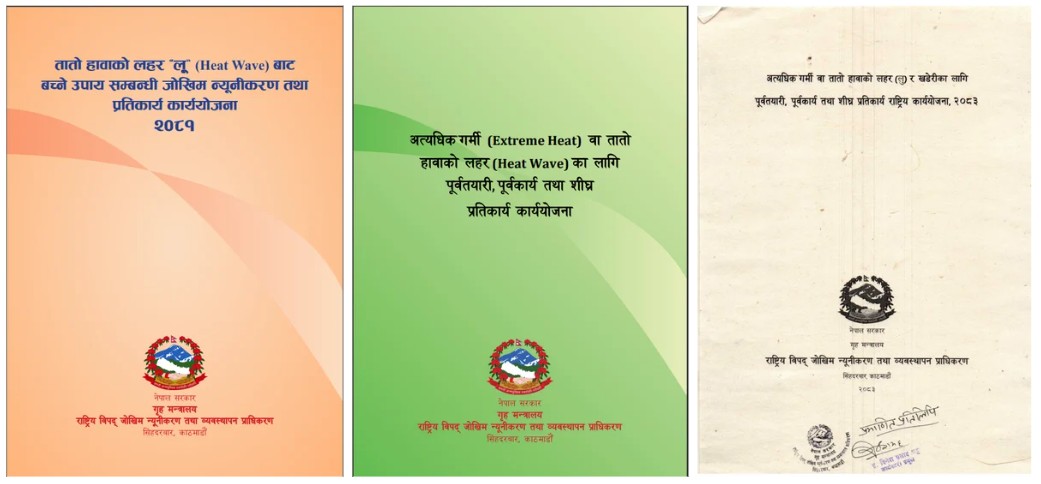
It has been only three years since the government began considering extreme heat—which severely impacts daily life, health, and the environment—as a disaster. For the first time in 2024, a heatwave preparedness, early action, and rapid response action plan was implemented. Since then, an action plan has been brought forward every year. The action plan has been created annually to minimize damage and impacts by making preparedness, early action, and response swift and effective.
To reduce the risks caused by heat, relief measures are coordinated and collaborated upon with all three tiers of government and stakeholders. The Department of Hydrology and Meteorology forecasts the weather, maps potential hit zones, and issues early warnings by publishing bulletins.
The Authority also issues early warnings and disseminates awareness materials through social media and communication media to reduce risks. Senior citizens, children, chronically ill patients, persons with disabilities, pregnant women, and postpartum mothers are requested to receive special care and protection as vulnerable groups.
Ways to stay safe
According to the NDRRMA, if necessary precautions are adopted before a heatwave arrives, its impacts can be minimized. For this, preparedness must begin before the month of March, when the summer season starts, and must be continued as long as the risk of hot winds remains. Setting up cool environments in a timely manner from homes to hospitals, schools, and public places, ensuring access to clean drinking water, and providing special care to children, the elderly, pregnant women, and patients are vital. Such preparations reduce the public health impacts of extreme heat and lower economic expenses in the long run.
According to the Department of Hydrology and Meteorology, during an ongoing extreme heatwave, people should avoid going outside in the scorching sun, stay indoors or in cool places, wear light clothes (cotton fabrics), cover their heads or wear hats when going out, repeatedly drink plenty of fluids like water, juice, lemonade, and buttermilk, and seek advice from doctors or health workers if health problems arise.
Similarly, to reduce the impact on agriculture, livestock, and livelihoods, researcher Shrestha suggests that the government should emphasize managing heat-tolerant crop varieties/breeds and shaded barns.
“In our neighboring country, India, based on forecasts of low rainfall and rising heat, the government has already told farmers to plant short-duration, drought-tolerant crop varieties,” he says. “We can also adopt this measure to prevent food crises from occurring.” He suggests that the government must secure necessary programs and budgets to battle extreme heat.