Kathmandu
Wednesday, June 17, 2026





As private institutions prioritize image and infrastructure, weak public schools and status-driven parental choices are creating a deeply imbalanced education system
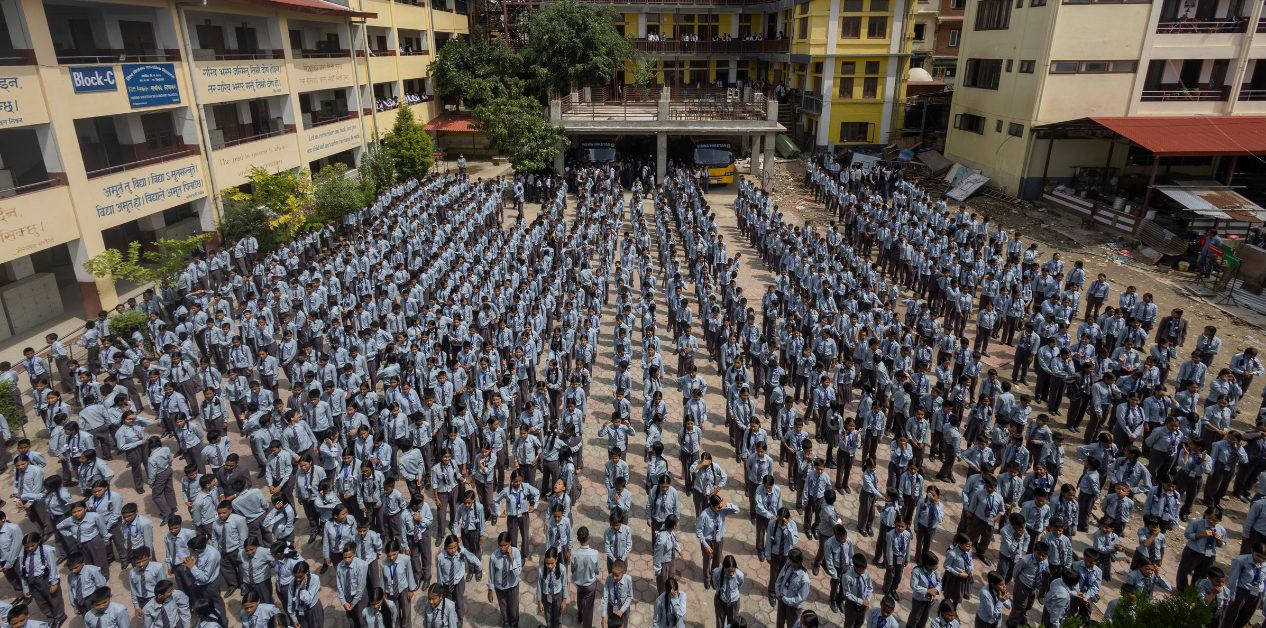
KATHMANDU: A few days ago, a friend asked for help in finding a good school to educate his daughter. I suggested a few names. But when he returned after visiting schools, he was shocked: monthly fees in Grade 1 alone were more than Rs 60,000/65,000 and in some cases Rs 40,000/50,000. Even the schools I considered moderate had monthly fees not less than Rs 30,000/35,000.
This is not just one parent’s problem; it reflects a deepening crisis within our education system. Is education in Nepal gradually being stratified according to social status? Have schools been transformed into “brands,” where instead of education, more emphasis is placed on attractive infrastructure, digital presentation, social media showcases, and the display of lifestyles to attract parents?
According to the government’s academic calendar, schools operate for only about 180 days a year. In this situation, the question “why is the fee so high?” naturally arises. Behind this transformation, the weak image of public and community schools appears to be a major cause.
When the state has failed for a long time to provide adequate resources, efficient management, and innovation-related knowledge to schools, a social perception has been established that “government schools are for those who have no other option.” However, this perception may not be entirely true. Public schools often have sufficient land and open space essential for physical development. In addition, they provide real practice of languages, culture, and social diversity. Students there come from different backgrounds, learn coexistence, and in many cases develop independent thinking and critical thinking skills. But the lack of systemic reform has weakened these possibilities.
Private schools, on the other hand, appear to have focused education on brand building. Through digital marketing, attractive photos and videos, involvement of celebrities, international names, and programs, education is presented in the market as a product. Many school activities appear similar, such as field visits to the same locations, similar types of activities, similar presentations, and even promotional styles. The depth of teaching and learning seems less important than the shine of presentation. While some institutions are doing quality work, the overall trend is becoming competitive, focusing not on “who taught better” but on “who looked better.”
The fee structure is the most sensitive aspect of the issue. Some large private schools are seen charging very high monthly fees, while even mid-level schools have become out of reach for ordinary families. When asked why fees are so high, schools argue that it is due to high salaries and benefits for staff, modern physical infrastructure, facilities provided by the school, and international-level education. However, many schools appear to have an economic structure based on loans, where vehicles, land, buildings, and infrastructure become long-term assets, but the immediate burden is borne by parents. In this way, education appears to have become not only a service but also a means of long-term asset creation. Therefore, it is also necessary for the state to consider what kind of infrastructure and support it can provide to help private schools reduce fees.
The entire responsibility cannot be placed solely on the private sector. Due to the state’s inability to provide clear policies, the education sector has become like an unregulated market. The history of private school operators themselves entering policy-making and political positions has further complicated this imbalance. When the distance between those who make policies and those who benefit from them disappears, private interests take precedence over public interest. As a result, public education reform has lagged behind.
If the state cannot ensure free and quality public education for all, private schools should be allowed to earn profits, but fees must be within fixed limits and must be transparent, and financial and educational audits must be mandatory.
Parents’ psychology is also an important part of this system. The desire to find the “best” for one’s children is natural, but this definition has become linked to social comparison and status. Where does the neighbor’s child study? How much do friends pay? Which school do they choose? These questions guide parents’ decisions in selecting schools. Thus, education is becoming not only a matter of knowledge but also a means of social prestige, which is putting financial pressure even on the middle class.
Parents themselves are also often not sufficiently aware. Communication with schools is mostly focused on facilities, structure, and management—such as transportation, the canteen, physical infrastructure, and various programs. However, deeper aspects such as children’s mental development, learning progress, knowledge-building process, and critical thinking are rarely questioned. As a result, schools also show less interest in making these aspects clear to parents. This is pushing education toward superficial evaluation.
In this context, an important policy question arises—should international curricula be allowed at the school level or should education be limited only to the national curriculum? There is currently no clarity on this matter. Some schools are seen charging high fees in the name of international curricula, but their regulation, approval process, and quality standards are unclear. This has increased both inequality and confusion in the education system. Therefore, the proposed School Education Bill must clearly define in what circumstances international curricula can be implemented, who will monitor them, and how they will be balanced with the national education system.
Recently, the government’s decision not to conduct annual examinations up to Grade 5 is a positive reform, and some private schools had already adopted this practice earlier. Reducing exam pressure on young children is necessary. At the same time, effective implementation of a “continuous assessment system” is even more important. Students should be evaluated based on what they learn, how they learn, and how learning is reflected in behavior. Evaluation should not be just a process of giving marks; it should be a true reflection of learning.
Overall, Nepal’s education system appears to be in a three-layered crisis—policy ambiguity, commercialization, and social psychology. Private schools are focused on branding, public schools are awaiting reform, and parents are under status pressure. This triangular structure has made the education system imbalanced.
If the state cannot ensure free and quality public education for all, private schools should be allowed to earn profits, but fees must be within fixed limits and transparent, with mandatory financial and educational audits. Provisions for separate school audits under the Education Act 1971 (amended) must be strictly enforced, and the School Education Bill 2023 must be passed immediately. The provision that assets of non-profit schools should be transferred to state ownership should be included in the Education Act itself, and such schools should be fully tax-exempt to encourage fee reduction as a long-term solution. Public schools must be improved in quality, teacher empowerment must be ensured, and practical education must be emphasized.
Going to school is not a luxury or a matter of prestige; it is a fundamental right of children. As long as we do not stop viewing education as a means of status display, this inequality will continue to deepen. The question now is not only about policy but also about our collective consciousness—are we seeking education for our children, or merely social prestige?
(Subedi has previously worked as Chief Operating Officer at prestigious educational institutions in Nepal.)