Kathmandu
Saturday, June 20, 2026





Good journalism is not like a happy fairy tale ending; it provides objective solutions backed by evidence and an acknowledgment of limitations.

Actually, I am a radio reporter. I also work for print media, but not as much. The procedure is the same for both, but in radio, you cannot paraphrase someone’s words into your own. You must use exactly what they have said. When I record something, I cannot change it; I can only provide context.
The method of writing a script for video is also different from print or written media. In that, too, what someone has spoken cannot be changed. You can use ‘jump cuts’ and edit, but the spoken words remain the same. In writing, however, there is more freedom to explain and provide context. You can take more time to prepare the material, and it is also easier to make it long. But in audio and video media, the time is fixed—for example, three minutes, eight minutes, or 26 minutes.
Solutions in news
I do not work on ‘breaking news.’ I focus on stories regarding the environment, science, and women’s rights. I live in India, but I do not cover politics. I tell stories where there are problems, such as pollution, trafficking, or deforestation.
In traditional journalism, we are taught that ‘the problem is the story.’ However, even before I heard the term ‘Solutions Journalism,’ BBC editors encouraged me to ask questions like, “What is the context of this? Is it replicable and scalable?” These questions are very important when reporting from India for nearly three million global listeners.
Readers of Nepal News are Nepalis living at home or abroad. Therefore, it is necessary to ‘zoom out’ and look at subjects from a broader perspective. For example, if people are cutting down trees, what does that signify? What is its economic, scientific, or cultural context? When writing news, one must think broadly and try to find solutions.
After training with the ‘Solutions Journalism Network,’ I realized that solution-oriented journalism is not just for information; it is equally important for giving people the inspiration to move forward.
Reader interest
You must have heard the term ‘compassion fatigue.’ It means that when you see ten beggars on the street, you eventually stop caring about them. When people hear news about bombed hospitals and buses every day, they simply stop paying attention.
So, how do we make people understand? Studies have shown that when you show a path to a solution along with the context, people take more interest. Instead of feeling hopeless, they feel empowered. For that, the solution must be presented alongside the problem. However, that solution should not be like a miracle.
Phrases like “We fixed everything, now there will be no corruption” do not apply in real life. In this type of news, there should be no ‘PR’ stories or personality cults. Rather, the limitations of the solution should be discussed.
When reporting from India, my main limitations are money, lack of interest in news, or lack of activism. But these things must be mentioned, and we must talk about what is needed to bring change. In doing so, someone sitting in Kathmandu or Lima, Peru, might feel, “We have this problem too. Work is being done that way there; how can I apply this in my area?” By saying this, I am not saying that a journalist should lead a campaign or movement, but at least an idea or a potential solution can be presented.
I consider myself a positive journalist. Therefore, I do not focus only on problems. I look at them from the perspective of a solution. Okay, there is a problem, but someone is trying to do something different. It may not be completely successful; there may be limitations; but we should think about what can be learned from it. By doing this, the subject can be presented completely.

Indian journalist Chhavi Sachdev. Photo: Bikram Rai
A news site in India presents positive news. For example, someone growing mushrooms at home to save money, someone rescuing animals, or someone reviving a lake. But this is not ‘Solutions Journalism.’ “Wow, how nice” type of news stories are not constructive because they are incomplete. They are exactly like fairy tales where it is said at the end, “And they lived happily ever after.” As if nothing happened after that, or they never fought over who would do the laundry or who worked harder. We don’t believe in such things.
Evidence, not reaction
I’ll tell you about a ‘story’ that I recently refused to write because it did not meet the criteria for solution-oriented journalism. I had heard a lot about Panauti in Kavrepalanchok. A ‘Community Homestay’ has started there. They collect profits, 80 percent of which goes back to the community and 20 percent is kept by the operators. Through this, they are preserved heritage. It is a wonderful initiative.
Such work has led to ‘reverse migration.’ People do not leave their homes; instead of going to Kathmandu or Delhi, they want to stay there. However, there is no solid data to prove this. There are only anecdotes based on personal experiences.
Solutions journalism is not just a reaction, but also evidence. Being a science journalist as well, I need independent sources or data to prove that something is actually happening. And the limitations of the story must also be disclosed. It cannot just be a ‘feel-good’ article with no problems.
This time, I did not have the time or skill to do full justice to this story. I couldn’t find time for investigative journalism. Going house to house to conduct surveys and collect data requires a lot of time, money, and sociological tools, which I do not have. Perhaps, after someone else does that work, I can follow up or do more work, or someone else can turn it into a solutions journalism news story. For that, some data must be found to see if the work has really been successful. Some experts can be consulted for this. In doing so, justice is done to the story.
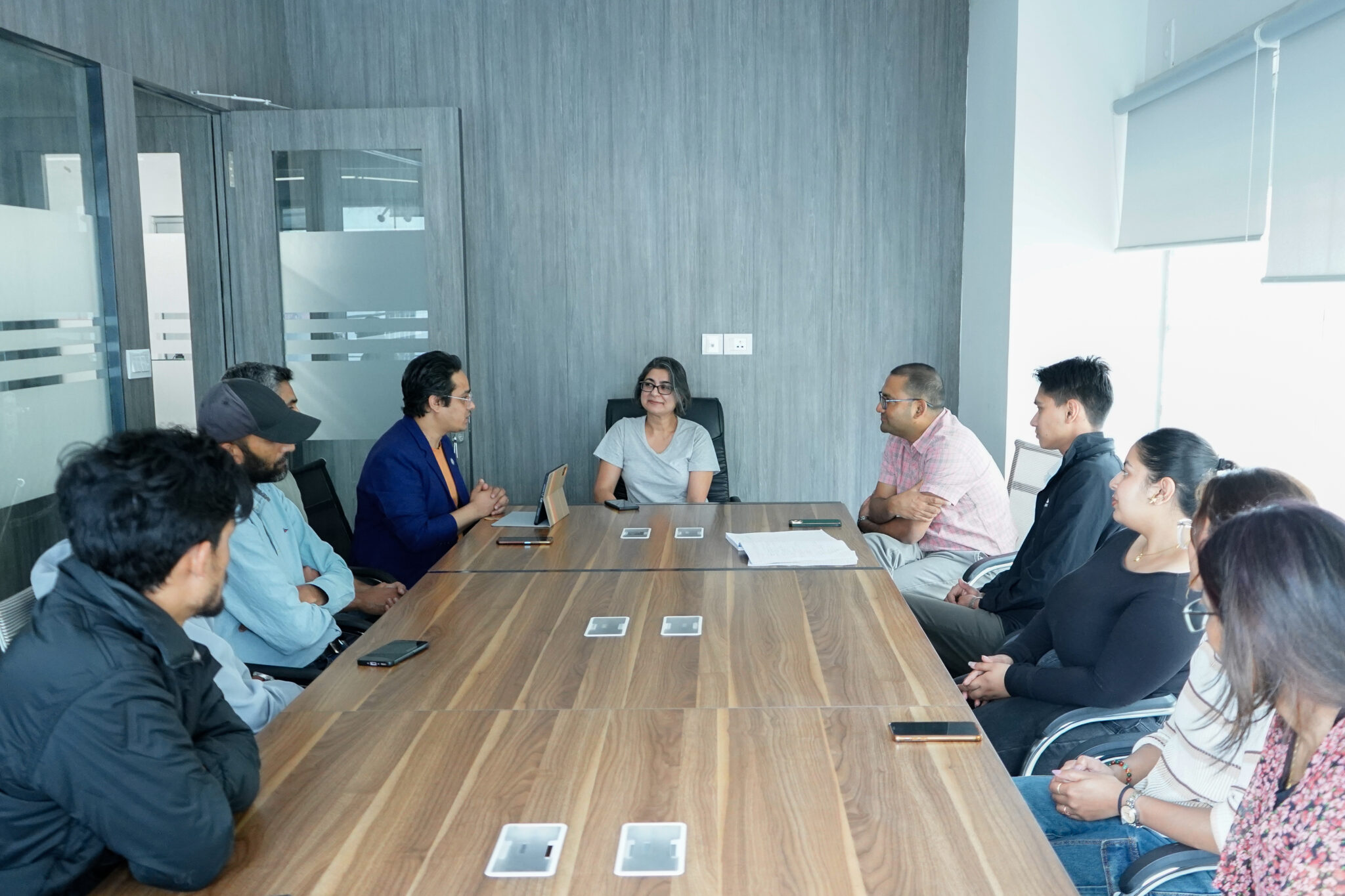
Indian journalist Chhavi Sachdev discussing in the Nepal News newsroom. Photo: Bikram Rai
I know that you too do not believe what someone says blindly. This time, I could not find any academic researcher or impartial person to talk about this, perhaps because it is a very new subject. I leave this task to you. But remember, you too must meet the criteria.
I was sad to have to leave this story. I really wanted to go to Panauti and stay in a community homestay, but I couldn’t. Because I have to put myself through some ‘filters’ too. And I cannot do a half-hearted job. The BBC would not even accept such a story.
Structure of the story
If you are writing about policy or economic affairs, it should not be presented as a problem starting from the headline. Focus should be on people who are trying for change or have done something good. Suppose traffic funds are being misused, but there might be one person there doing good work.
By prioritizing that example, it can be said, “This worked, but the rest didn’t.” If news can be presented this way, people are attracted to positive news. When they feel that something is working and everything is not broken, they stay connected with the news for a longer time.
Surveys have shown that people trust news sources more that focus on solutions while talking transparently about problems. Therefore, it increases credibility.
Headline Structure
How to craft a news headline depends on what you want to achieve from it. However, the headline should be attention-grabbing and touch the human heart. In such a case, balance can be maintained by making the sub-headline more objective.
The headline should be attractive and should not give a completely negative message. It should signal that everything is not bad, and there is hope somewhere. When I do radio stories, sometimes the strongest aspect is the problem itself, such as the sound of someone crying. But in the headline and description, we have already mentioned that there is not just despair in this, but also solutions and hope.
A question mark can also be placed in the headline: “This is happening, but will it work?” Such a headline motivates the reader to understand for themselves. The answer to this is usually not “Yes, it works perfectly.” The answer is often, “It works to a great extent, but these things can still be improved.” By keeping the subject open and giving a sign of hope from the beginning, people are attracted.
Solution-oriented thinking
Even amidst negative news, solutions journalism really works. As long as we aren’t talking about light gossip, it makes an impact. For example, take a common news story from India—a wealthy young man drove recklessly and killed many people. Naturally, everyone wants to read this because they are curious about the lives of wealthy people like the Ambanis.
Everyone is interested in how another driver took the blame on himself and how many millions of rupees he was paid. But that is a different type of reporting. That is not what I am talking about. You can mold that into solutions journalism too, but it will be extremely difficult.
Instead of giving ‘updates’ on such specific incidents, you can turn the broader problem of underage driving into a solutions-oriented story. Once the story of the rich man’s son is news in itself, what else can you do? Perhaps you can write about an organization or community that is trying to educate people not to drive under the influence or while underage. You can investigate whether they have brought any change. They must have made some impact.
In America, there is the organization ‘Mothers Against Drunk Driving,’ which has been very successful in changing laws. Can’t you write such a story from the perspective of solutions journalism? Wouldn’t people want to read that?
The ‘Solutions Journalism Network’ was established for this reason—because such a perspective works and inspires. Someone might think, “A similar organization can be started in my community too.” Whether it is about human trafficking or the misuse of budget, focusing on where good work is happening allows others to follow those efforts.
There are indeed intelligent people in the world who want to bring change. Who want to feel empowered and do not believe that everything is broken beyond repair. Our system may be broken, but there will always be people looking for hope and wanting to contribute. In my opinion, such people still exist, and that is what gives me the energy to keep working.
(Sachdev is one of India’s leading podcasters. She is the founder of the podcast production company ‘Sonologue.’ Her voice and stories have reached millions through international media such as the BBC World Service, NPR, and DW. An accredited solutions journalism trainer from the ‘Solutions Journalism Network,’ Sachdev shared her experiences and views during a visit to the Nepal News newsroom on April 17, 2026.)