Kathmandu
Monday, July 13, 2026





Rabi Lamichhane may be innocent; he may have become a victim of political vendetta by the rulers of the time who perhaps wanted to nip in the bud a new political force which had dared to challenge their monopoly over Nepali politics. But it is not Lamichhane, his party or supporters who decide this; this decision has to come from the court of law.
Over the past few years, Nepal has undergone a sea of change with regard to political dynamics. The growing sense of disillusionment with conventional political parties and politicians ensured that the voters rally behind new entrants to the political fray, who pledge to run the country’s administration with transparency and efficiency, and without the usual dirty practices of ‘old’ politicians.
Believing this pledge, the people of Nepal, through the March 5 polls, have catapulted the Rastriya Swatantra Party (RSP) to the position of power. The RSP, a relatively new entrant to Nepal’s political scene, has been able to capitalize on the growing disillusionment with conventional political parties to gain political mileage in a very short period of time.
This can be identified as a growing sense of willingness among the voting population in Nepal, a sense of willingness to support politicians who appear to be challenging the conventional system, even though these politicians themselves are a product of the legal process of the conventional system in Nepal.
Take, for example, the case of RSP Chairman Rabi Lamichhane. He has long thrived in the court of public opinion, often more decisively than in courts of law. From the height of his fame as a TV journalist, through the ascension of RSP leadership until now, his political rise has been accompanied by a litany of legal issues that would have ended many political careers before they even began. And yet, time and again, voters have elected him to positions of power, seemingly unfazed by the gravity of the allegations against him.
The contrast between Lamichhane’s ongoing legal issues and electoral success is now at the heart of Nepal’s ongoing experiment in democracy. As Lamichhane and his party sit poised on the verge of establishing a government with a broad mandate, it is not simply Lamichhane’s own future that is at stake, but also what his rise suggests about democracy, trust, and the rule of law in Nepal.
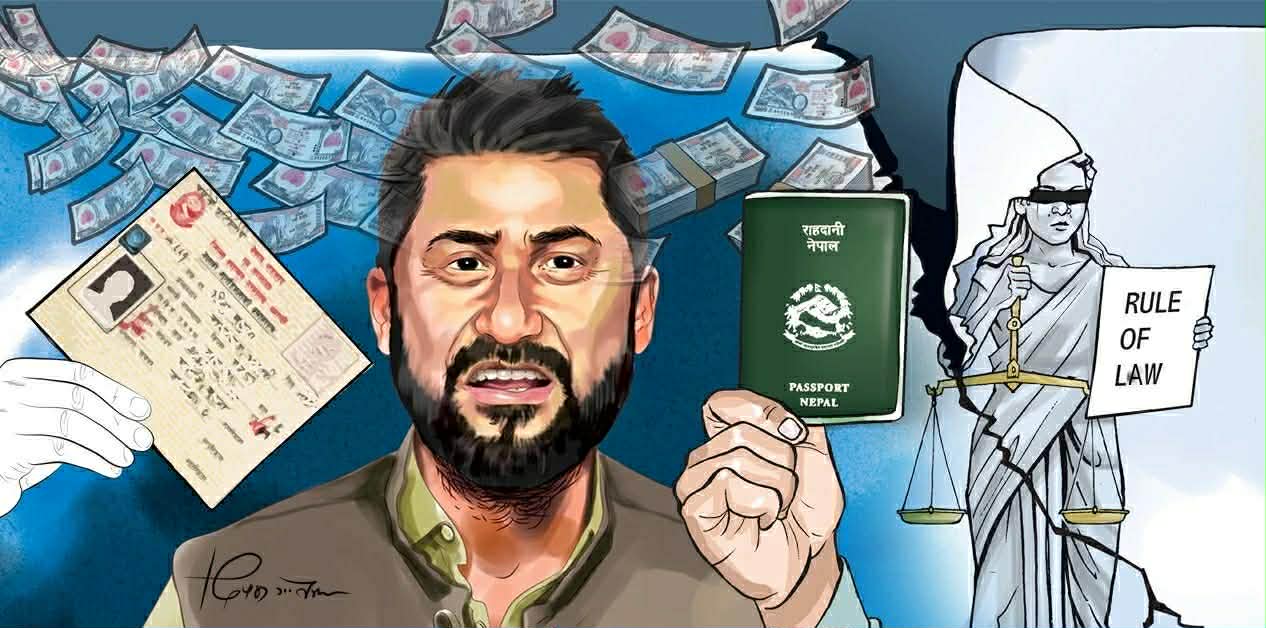
The controversies surrounding Lamichhane did not begin with the cooperative scandal or the recent withdrawal of organized crime and money laundering charges. They trace back to the now well-documented citizenship and passport episode of 2023, when the Supreme Court (SC) invalidated his status as a Member of Parliament (MP) due to procedural lapses in reacquiring Nepali citizenship after holding US citizenship.
The SC verdict forced him out of office. For a brief moment, it appeared as though the system had asserted itself. But the episode ended not with a decisive legal reckoning, but with a political reset. Lamichhane returned, re-contested from the same constituency – Chitwn-2 – and won. The electorate, rather than treating the court’s decision as disqualifying, appeared to interpret it as either a technicality or an injustice.
It was a moment that established a precedent, one which continues to shape the present.
Each subsequent controversy has unfolded in a similar manner: charges are leveled, cases are filed, public discussion intensifies, and yet, when the moment of decision-making arrives, the electorate passes judgment in a manner that is parallel to, rather than congruent with, the legal process.
Where the passport issue raised questions of legality, the cooperative scandal posed questions of morality, governance, and financial accountability. The question of the alleged misuse of cooperative funds, coupled with the charge of organized crime and money laundering, adds gravity to the situation.
This was no longer about procedural lapses. It was the question of whether a political leader could be held accountable for actions that had a direct impact on the lives of common citizens, such as depositors whose savings were allegedly in danger.
Lamichhane’s arrest and subsequent detention were a turning point. For his detractors, this was a measure whose time had come. For his supporters, this was another instance of a larger conspiracy against a political leader who had dared to challenge the status quo in Nepal’s politics.
However, even as the legal process played out, the larger political process continued on a different track. One of the most interesting aspects of Lamichhane’s political career has been the disconnect between legal proceedings and electoral outcomes.
Despite being charged with serious offenses, he has continued to win elections, convincingly. Each election victory has only served to reinforce the notion in the minds of his supporters that he was being wrongly targeted by the rulers of the time.
This brings us to a larger point: what are the consequences when public perceptions of a politician outstrip the ability of the system to hold them accountable and when the judicial notion of “guilty until proven innocent” is ignored in cases of corruption and other serious offences?
In the case of Lamichhane, it seems as if many people have come to a conclusion, either explicitly or implicitly, that he is not guilty. The reasons for this – whether it is a result of their perceptions of the politician or a result of their perceptions of traditional political parties and the government – is up for debate. The point is, however, that this has a great impact. It also establishes a precedent whereby electoral success trumps ongoing criminal proceedings.
A new chapter was added to Lamichhane’s case when the Office of the Attorney General decided to drop charges of organized crime and money laundering against him upon his request. Although the cooperative fraud case was still pending, the dropping of the more serious charges led to a flurry of criticism from legal experts, civil society, and a segment of the media.
At the center of the debate was not just the decision, but also the process that led to it. For Lamichhane, the decision may have been a reprieve in a legal sense. But politically, it was a double-edged sword. Instead of closing the chapter, it opened a new front of criticism that he had benefited from the very system that he had vowed to change.
A missed opportunity
On several occasions, Lamichhane could have reframed the discourse, not only for himself but also for the larger political culture of Nepal. He could have chosen to allow the legal process to reach its conclusion without any interference. He could have chosen to disassociate himself from decisions that seemed to favor him. He could have used this opportunity to reinforce the notion that no person, however popular or however powerful, is above the law.
However, Lamichhane’s actions, especially in the decision to seek the withdrawal of serious charges, have also been perceived by critics as an attempt to undermine that very principle.
In doing so, he may have missed a rare opportunity: to demonstrate that a new generation of leadership is willing to subject itself to the same standards it demands of others.
The optics of Lamichhane’s political moves have also come under the scanner. His release from custody during the peak of the Gen Z uprising, a period that witnessed strong demands for systemic overhaul, was perceived as a symbol of strength by some, and a politically convenient moment by others, where the line between individual legal battles and public aspirations was blurred.
In a highly charged political environment where the expectations of systemic overhaul are strong, such moments are critical. They not only define the individual leader but also the movement and party he represents.
The ongoing hearings in the Supreme Court have now brought the matter back into the domain of the institutional realm. The petitions against the decision of Attorney General Sabita Bhandari have ensured that the legal issues are not resolved.
This is where the story takes a crucial turn.
Unlike in the past instances where the judiciary’s decisions have been followed with a swift recovery in the political sphere, in the current case, both the judiciary and the political leadership are under intense public scrutiny. The judiciary’s response to the case is being watched not just for its implications, but also for what it may signify with respect to the independence of Nepal’s judicial system.
The burden on the RSP and the Balen government
However, in the case of RSP, the issues involved are not merely centered on the party’s own chairperson. The RSP was propelled to prominence on an agenda that promised change, transparency, accountability, and a break from conventional politics. The electoral success of the RSP is a reflection of the intensity of the longing for change in Nepal.
But change is about to be put to its first major test. The manner in which the RSP deals with issues concerning their own chairperson is going to be critical in establishing their own institutional credibility.
In a situation where a new political force is on the verge of taking over, the expectations are high. The leadership of former Kathmandu mayor Balendra Shah, also known as Balen, is fueling these expectations with a new direction for Nepal, one that moves away from traditional politics.
Together, the RSP and a Balen-led government have a chance to create new standards. At the same time, they are also faced with a critical question of how they can prove their commitment to change is not selective.
Lamichhane may be innocent; he might have become a victim of political vendetta by the rulers of the time who wanted to nip in the bud a new political force which had dared to challenge their monopoly over Nepali politics. But it is not Lamichhane, his party or supporters who decide this; this decision has to come from the court of law.
In other words, they need to ensure that justice is applied equally, to supporters and opponents, to ordinary citizens and political leaders – to everyone, without exception.
The message that must be sent
In times of political change, symbolism is just as important as substance. Letting justice take its own course, without any external influence, would send a powerful message – of respect for institutional limits and a desire to strengthen, rather than subvert, the rule of law.
On the other hand, any perception of special treatment would undermine public trust, not just of an individual, but of the idea of change itself. The real question, therefore, is not whether Lamichhane is guilty or innocent. This is for the courts to decide.
The real question is whether the political system will allow this judgment to be made independently and without undue influence.
The popularity of Lamichhane is a double-edged sword. While it is an asset for Lamichhane, it is also a problem for those who want to hold him accountable for his allegedly “criminal” actions. This is so because when a politician is very popular, legal action against them is seen to be political in nature, regardless of how true this is. This creates a cycle where Lamichhane’s popularity undermines the legitimacy of legal action against him, and legal action against him undermines his popularity.
This cycle can be broken by separating political and legal legitimacy.
Nepal is at a crossroads. The emergence of the RSP as the country’s new political force is an opportunity. It is also a responsibility – a responsibility to live up to the guiding principles of a democratic system of governance.
This is a defining moment not only for Lamichhane but also for his legacy. Will Lamichhane be remembered as a person who challenged the system but ended up becoming a product of the weaknesses of the same system he challenged? Or will he be remembered as a person who used the platform he has to make the system even stronger, a system designed to hold those in power accountable?
The way forward is not complicated or ambiguous. It requires self-restraint. It requires self-discipline. And it requires selflessness.
Through this process of letting the legal process run its course, the RSP and the government that they are going to form will be able to prove that their intentions are pure. They will be able to prove that the rule of law is not just a slogan, but a guiding principle, and that this principle is for all, not just for a particular party or allegiance.
However, Lamichhane is a symbol of something far greater than he is as an individual. He perhaps represents the changing dynamic between the people, politicians, and the state. He perhaps represents the tension between popularity and accountability. And he perhaps represents the choices that will define the democratic path of Nepal.
As the courts deliberate and the politics continue to evolve, however, one thing is certain: the real test of a nation’s change does not come in the form of elections, but in the wielding of power itself.
For the RSP and the leadership it represents, that test has already begun.