Kathmandu
Wednesday, June 17, 2026





Extreme avoidance in implementing decisions of public concern, letters keep circulating endlessly
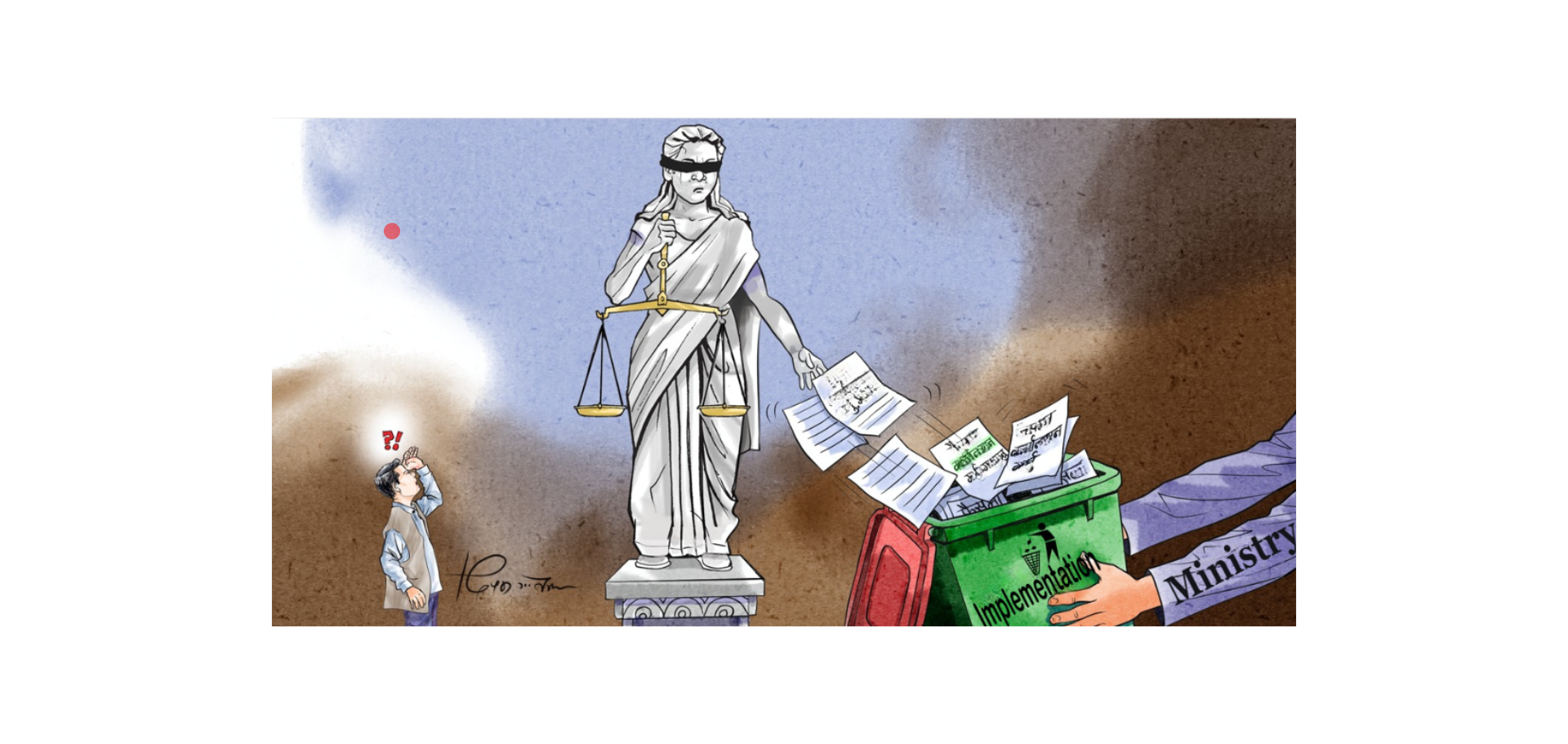
KATHMANDU: On December 16, 2009, the Supreme Court issued a writ of mandamus stating that in areas including the Kathmandu Valley, permission to extract water through deep boring must only be granted after conducting a study. The apex court also directed that, in accordance with the Water Resources Act, monitoring be done to determine whether water usage is occurring or not and to stop the uncontrolled exploitation of groundwater.
On July 20, 2010, a petition for the implementation of this mandamus was registered with the Supreme Court’s Decision Implementation Directorate. However, 15 years have passed, and it has still not been implemented. This is the oldest pending public interest decision yet to be implemented.
Since the petition was filed, the Directorate has repeatedly corresponded to implement the said mandamus, but no progress has been made.
Initially, the Directorate sent a letter to the Office of the Prime Minister and Council of Ministers, which is the primary stakeholder body of the executive branch. Nunetrahari Poudel, information officer at the directorate, says that seven reminder letters have been sent so far. The Directorate’s most recent letter was sent on November 6, 2025. Poudel says, “We still haven’t received a response to the letter we sent seven months ago.'”
After the Directorate sends reminder letters to the relevant ministry or body to implement a decision, a chain of correspondence begins within those bodies, one letter after another. Regarding the implementation of the mandamus related to deep boring, the most recent response came on July 27, 2025, when the Ministry of Energy, Water Resources and Irrigation sent a letter to the Department of Water Resources and Irrigation stating, “Inform whether the report has been prepared or not.” In this manner, important decisions connected to public interest end up stalled as letters keep circulating. According to Poudel, the Office of the Prime Minister writes to the relevant ministry, the ministry writes to its department, and the department writes to its branch this cycle continues endlessly. On the matter of decision implementation, they evade responsibility by pointing to this correspondence and the instructions given to subordinate bodies.
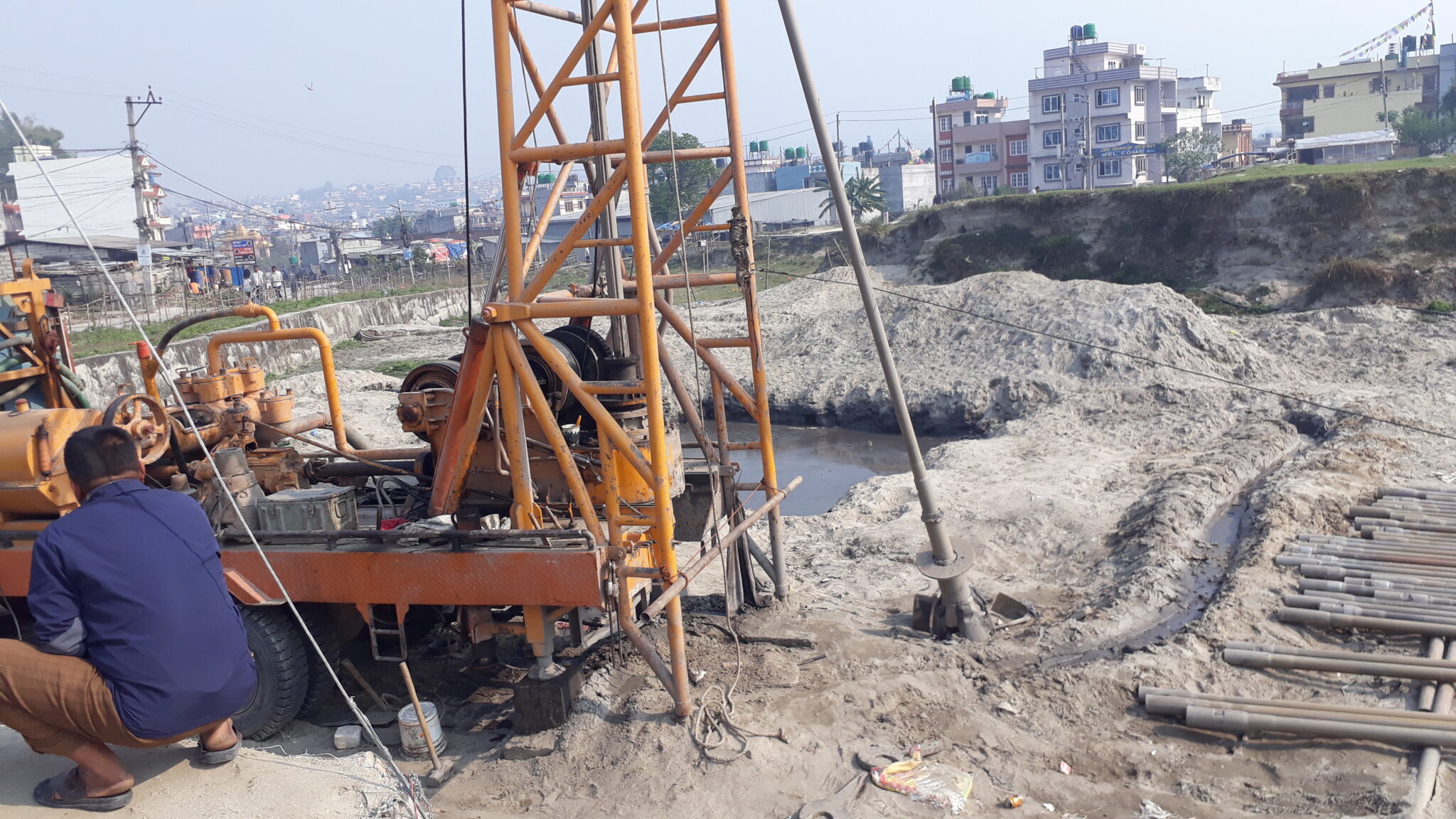
Deep boring work underway in Gothatar, Kageshwari Manohara-8. Photo: Shambhu Regmi/Nepal News
Since the first month of fiscal year 2010/11, a total of 91 public interest decisions have had letters circulating for implementation, moving from ministry to department to branch. Senior Advocate Prakash Mani Sharma, who files writs on public interest matters, alone has seven decisions sitting in the Directorate’s files.
The decision related to the ‘Rawal Commission Report’ of the fiscal year 1995/96, has also fallen into this same vicious cycle. On May 26, 2009, a joint bench of Supreme Court Justices Top Bahadur Magar and Mohan Prasad Sitaula issued a directive order to investigate the encroachment of government land across the country in accordance with the Rawal Commission report and to implement that report. The Rawal Commission had only studied public land in Kathmandu, but an expert committee had recommended investigating the encroachment of government and public land across the entire country. The Supreme Court stated: “Since it appears desirable to implement the Rawal Commission Report according to the expert committee’s recommendations and to investigate the encroachment of government and public land across the country and take legal action accordingly, give high priority and implement it quickly.”
However, that order has not been implemented to this day. The Ministry of Home Affairs sent a letter to the Ministry of Land Management, and that ministry sent a letter to the Land Revenue Office. Additionally, the Ministry of Home Affairs sent a letter to its own internal management division. Poudel, Information Officer at the Decision Implementation Directorate, says that because no response comes to the letters written by the Directorate, it has become difficult for them to show any results. “In meetings with us, officials from the ministries say that results have been achieved, but no work is visible,” he says.

Photo courtesy: PMO
There is also an instance where the Directorate sent a reminder to the Ministry of Finance to implement a public interest decision, only for it to be delayed for four years by writing letters to a division within that very ministry. The subject of the decision related to domestic industry and investment. The Supreme Court had issued a writ of mandamus that included the directive: “For the development of the national economy, give priority to promoting and protecting national industries and domestic investment.” To implement that mandamus, the Directorate sent a letter on March 18, 2022, to the Office of the Prime Minister and Council of Ministers and to the Ministry of Finance. The letter stated: “In the process of carrying out public procurement, while determining the qualifications and standards required by public bodies, adopt the principles of positive discrimination and equality for Nepali companies and industries, and implement them effectively.”
The Ministry of Finance, which is the body responsible for implementation, sent a letter to its own Revenue Management Division. The Ministry sent a letter to the Division on March 21, 2022, asking, “What has been done regarding the implementation of the order?” and a copy of that letter was sent to the Directorate. However, even after repeated reminders and follow-up letters, that mandamus still has not been implemented to this day. The Directorate has not used any measures other than sending letters for implementation.
On the same matter, the Directorate sent a letter simultaneously to the Ministry of Finance, the Department of Inland Revenue, and the Public Procurement Monitoring Office on November 9, 2025. This time, the Department of Inland Revenue sent a letter to the Revenue Management Division of the Ministry of Finance and replied to the Directorate stating, “A reminder regarding the implementation of the order has been received. Regarding the implementation of the matter related to this department, information has been provided. Therefore, a copy of that letter is attached herewith and a request is made as per the order.”

Ministry of Energy, Water Resources and Irrigation. Photo courtesy: Nepal Photo Library
Meanwhile, the Ministry of Finance did not hold back in showing that it had made efforts toward implementation. It evaded responsibility by indicating that it had again sent a letter to its own revenue management division for the implementation of the order.
In this manner, letters for the implementation of decisions keep circulating among the divisions and branches of ministries. Every ministry has been assigned a Law and Decision Implementation Division. However, looking at the maze that has taken place in implementation, the role and effectiveness of those divisions are not visible.
The Decision Implementation Directorate has a pile of pending public interest decisions yet to be implemented. There are orders and decisions that must be implemented by the Office of the Prime Minister and the ministries. Ministries are the place where laws are implemented. But because they show no interest in implementing court orders, not only is there extreme negligence on matters directly connected to citizens, but the dignity of the judiciary is also being trampled.
The Office of the Prime Minister and Council of Ministers issued a report in June/July 2025 titled “Progress Report on the Implementation of Orders Issued by the Supreme Court in Public Interest Disputes, 2025.” In it, the government has claimed that insofar as resources and means allow, court decisions or orders have been implemented expeditiously.
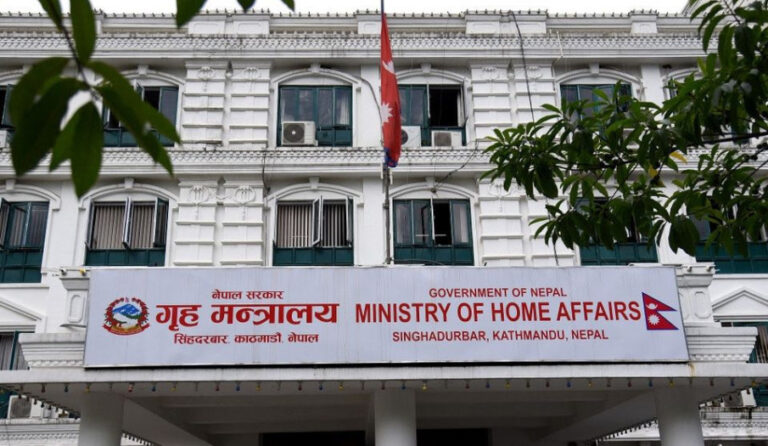
Ministry of Home Affairs. File photo
The report also acknowledges that there are problems in implementing court decisions and orders. It mentions that the record of implementation of decisions and orders has not been updated, there is an inadequacy of resources and means, regular record-keeping of those implemented has not been done, and some decisions and orders are unclear, creating difficulties in implementation. It has been stated that records for 64 writ petitions have been cleared.
91 verdicts yet to be implemented
The Directorate of Judgment Implementation was established to implement and monitor the judgments of the Supreme Court and subordinate courts. The Directorate acts as the central body for the implementation of judgments.
According to the Directorate’s data, 91 decisions and orders connected to public interest remain unimplemented. Among them, 19 decisions related to the Office of the Prime Minister and Council of Ministers have not been implemented. Similarly, 20 decisions related to the Ministry of Home Affairs, 15 related to the Ministry of Law, Justice and Parliamentary Affairs, 14 related to the Ministry of Forests and Environment, eight related to the Ministry of Federal Affairs and General Administration, five related to the Ministry of Women, Children and Senior Citizens, two related to the Attorney General and District Government Attorneys, two related to Kathmandu Metropolitan City, and five related to municipalities are awaiting implementation.
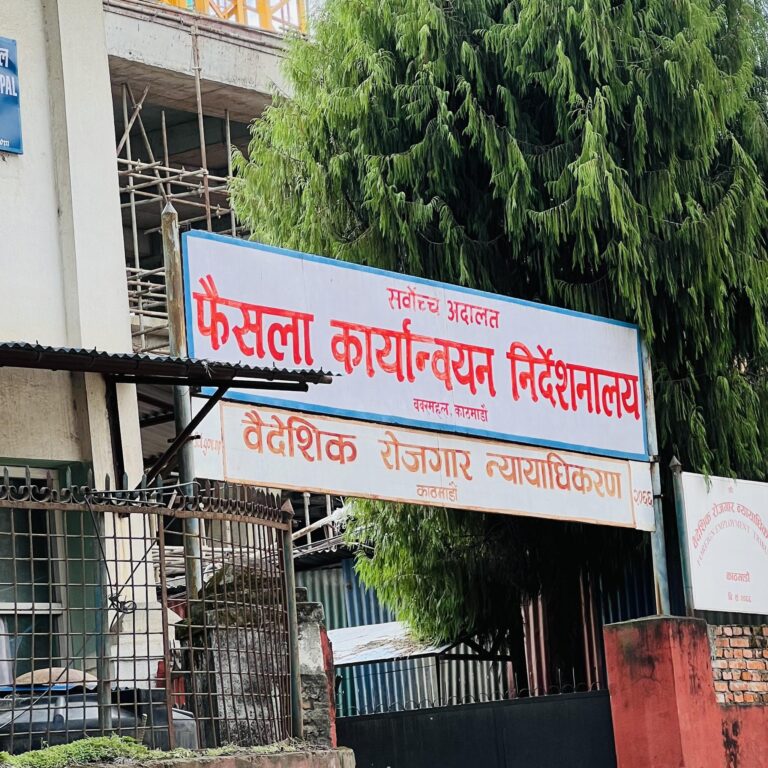
Directorate of Judgment Implementation. File photo
Govinda Prasad Ghimire, Director of the Decision Implementation Directorate, says that implementation problems have arisen because there are many bodies named as opposing parties in the decisions. “State apathy, inability to take responsibility, and lack of resources and means have caused problems in implementation,” he says.
The Directorate sends reminder letters to demand reasons why a mandamus or order issued by the court has not been implemented or, if it has not been implemented, why not. The Directorate has been sending letters and reminders to implement 20 decisions connected to public interest that are pending with the Ministry of Home Affairs, which is considered the main body for implementing laws.
Some public interest decisions have not been implemented due to the absence of laws. On the other hand, some decisions remain unimplemented because the relevant laws are impractical.
One example of an impractical law is the Social practice (Reform) Act, 1976. This law provides that only 51 people may go as a wedding procession with music and instruments, that no more than 25 people may be invited to ceremonies such as the sixth-day rite (Chhaithi), rice-feeding (Nwaran), birthdays, Pasni (first rice-feeding ceremony), and Bratabandha, and that violating this limit carries a penalty of Rs. 10,000 or seven days in jail. This is not practical in today’s time, and people do not comply with it.
A writ petition was filed in the Supreme Court by Kishor Bahadur Singh stating that the provisions made in this Act are being violated. In this case, the Supreme Court issued a mandamus ordering that activities prohibited by the Social practice (Reform) Act, 1976, not be performed, and that the penalties for violations be publicized through radio, television, and other communication media. However, this has not been implemented. In the mandamus, the Supreme Court stated: “To keep the law alive, take necessary steps to strengthen and streamline the enforcement aspect and strictly enforce the provisions of the Act, and take necessary actions to raise social awareness in this direction and to motivate the general public to inform them about the provisions of this Act.”
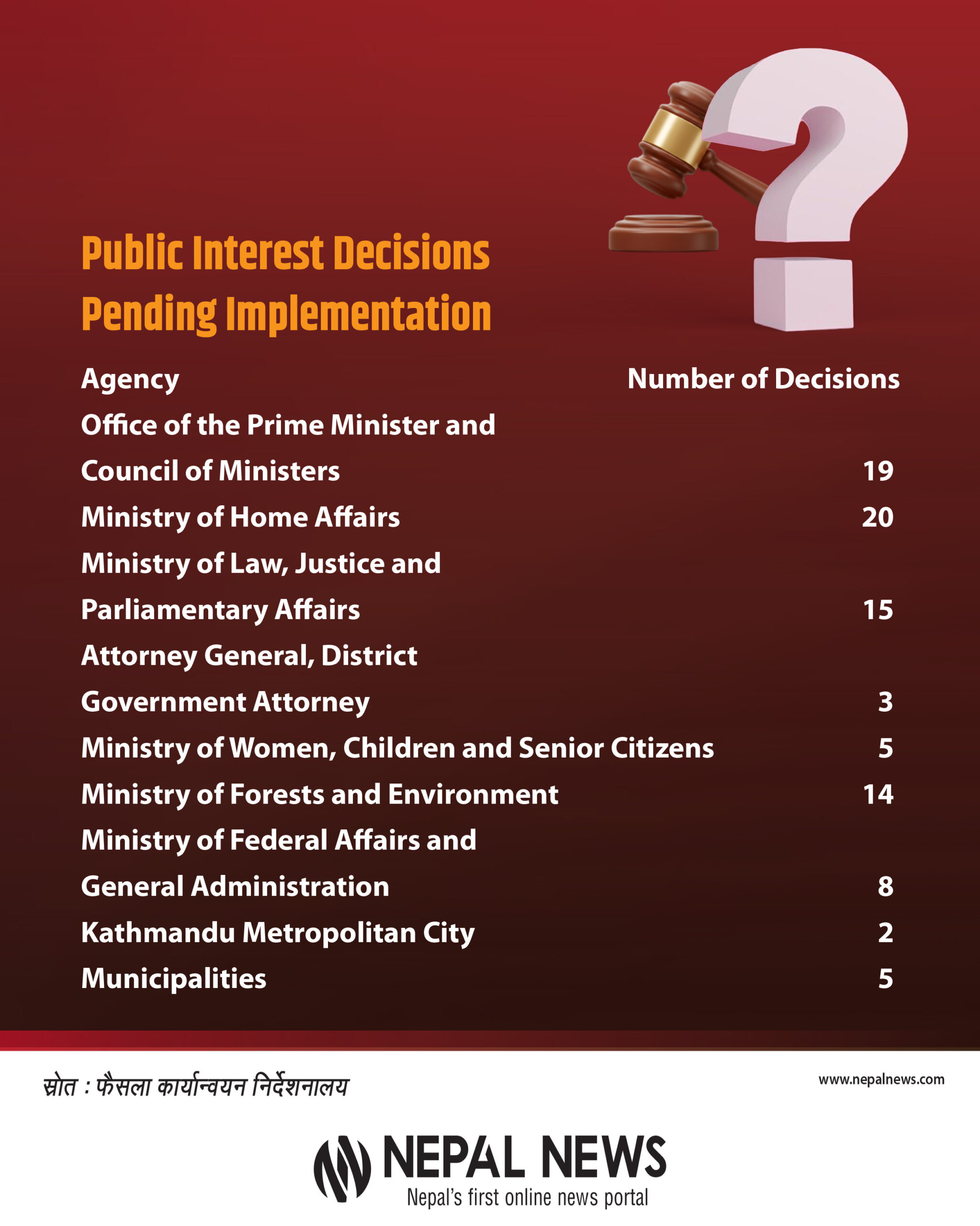
Source: Judgment Execution Directorate
After this order was not implemented, Senior Advocate Prakash Mani Sharma filed a contempt of court petition in the Supreme Court on September 10, 200. On January 1, 2009, a joint bench of Justices Min Bahadur Rayamajhi and Rajendra Prasad Koirala ruled that the government had not taken effective steps to implement the law, and directed the Attorney General’s Office to monitor the matter. Based on this order, the Directorate continues to correspond with the Ministry of Home Affairs and the Attorney General’s Office. This means that the said order has still not been implemented to this day.
Senior Advocate Jyoti Baniya, who has been advocating for the implementation of decisions related to consumer rights, had filed a writ petition demanding that medicine prices be fixed. The Supreme Court issued a directive order in that case. A petition for implementation was registered with the Directorate on July 28, 2011, yet the decision has not been implemented. Baniya says that at that time, only the prices of Jivanjal and paracetamol were fixed, and the legal obligation to publish medicine prices in the Nepal Gazette as required by the court’s order has not been fulfilled. He says: “The directive order required that mandatory prices be fixed for medicines needed for emergencies, essential care, and non-communicable diseases, and that those prices be published in the Gazette. This has not been fully implemented. As a result, medicine prices are set arbitrarily.”
Baniya says that not only this, but decisions prohibiting strikes in essential sectors such as hospitals, electricity, water, and telecommunications have also not been implemented.
Sanjay Adhikari, a lawyer who constantly advocates for the implementation of public interest decisions, argues that although there are provisions for contempt proceedings against those who defy court orders, the failure to take such action has led to apathy in decision implementation. “The court orders the implementation of its decisions. When we file contempt petitions after they are not implemented, the court says, ‘It is seen that it hasn’t been done,’ but it does not take action even when its own decisions are not implemented,” he says.
The Constitution clearly divides the responsibilities and powers among the three organs of the state: the legislature, the executive, and the judiciary. Article 128 of the Constitution contains provisions related to the Supreme Court. Considering the Supreme Court as a court of record, all courts and judicial bodies are subordinate to it. The Constitution states: “The Supreme Court shall have the ultimate authority to interpret the Constitution and laws. The interpretation of the Constitution and laws or the legal principles propounded by the Supreme Court in the course of hearing cases shall be binding on all.” The Constitution also provides for contempt proceedings and punishment for obstructing the administration of justice by the Supreme Court or subordinate courts, or for disobeying orders or decisions. However, this provision has not been implemented. As a result, even when responsible state bodies fail to enforce court orders and decisions, these matters have become normalized.
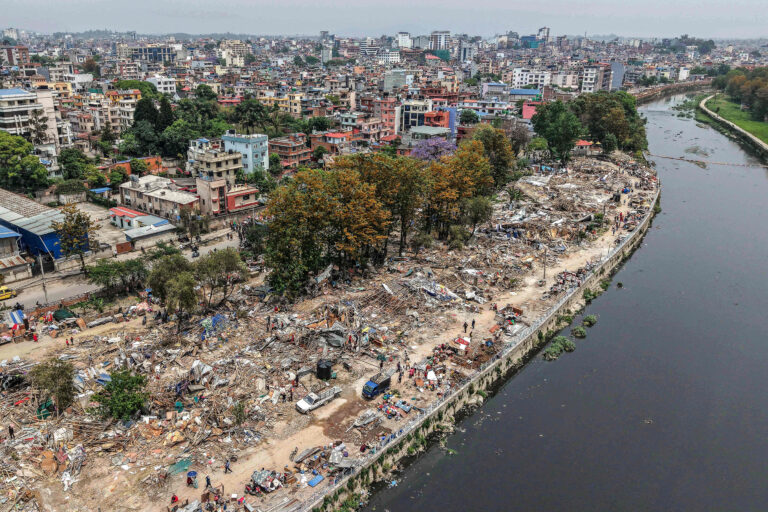
An aerial view shows squatter settlements demolished by Nepali authorities along the banks of the river Bagmati in Kathmandu on April 25, 2026. (Photo by Prabin Ranabhat / AFP)
Senior Advocate Prakash Mani Sharma has filed cases on public interest matters including the Nijgadh Airport decision, the decision to close the Godavari Marble Industry, and decisions related to Lumbini conservation. Getting a mandamus from the court was not enough. Advocate Adhikari says the process of having to constantly go back and forth to ensure implementation is frustrating. These decisions issued by the court have still not been implemented to this day.
On January 5, 2014, the Supreme Court ordered that a provision for “No Voting/Right to Reject” (the right of voters to reject all candidates if they do not approve of any) be included on ballot papers in upcoming local and parliamentary elections. However, voters have not been able to use this facility in subsequent elections. Last year, Advocate Adhikari filed a petition in the Supreme Court demanding contempt proceedings for failure to implement the order to include a “No Voting” provision on ballot papers, and demanding that this provision be included in the House of Representatives elections scheduled for March 5, 2026. The Supreme Court issued a show-cause order. This case is still pending.
Advocate Adhikari says that filing and winning public interest litigation in court is not enough. “Because implementation is difficult, we are forced to keep running back and forth,” he says. “We are exhausted from constantly pushing for the implementation of the decision prohibiting groundwater extraction.”
Every ministry has a decision implementation branch or division. But nothing beyond correspondence has been achieved for implementation. Ministries and bodies respond saying, “There is no budget.”
Even the interim election government led by former Chief Justice Sushila Karki did not prioritize decision implementation. The current government of the Rastriya Swatantra Party, which has nearly a two-thirds majority, now has an opportunity to establish the rule of law and protect the dignity of the judiciary by quickly implementing decisions.
What is the execution of the judgment?
Generally, decision implementation is understood to mean recovering fines imposed on defendants in criminal cases, executing decrees in civil cases, managing registrations and cancellations, transferring names, surveying and demarcating land, partitioning inheritance, recovering damages and fines, and collecting court fees. There is a legal provision that after a case is decided, the relevant district court implements the decision.
Court decisions must be implemented to protect citizens’ fundamental rights, restore usurped rights, ensure punishment for criminals, provide victims with justice, including compensation, and rehabilitate criminals into society. This plays a role in ending impunity, protecting human rights, promoting democratic values and norms, and maintaining peace and tranquility in society.