Kathmandu
Friday, July 24, 2026





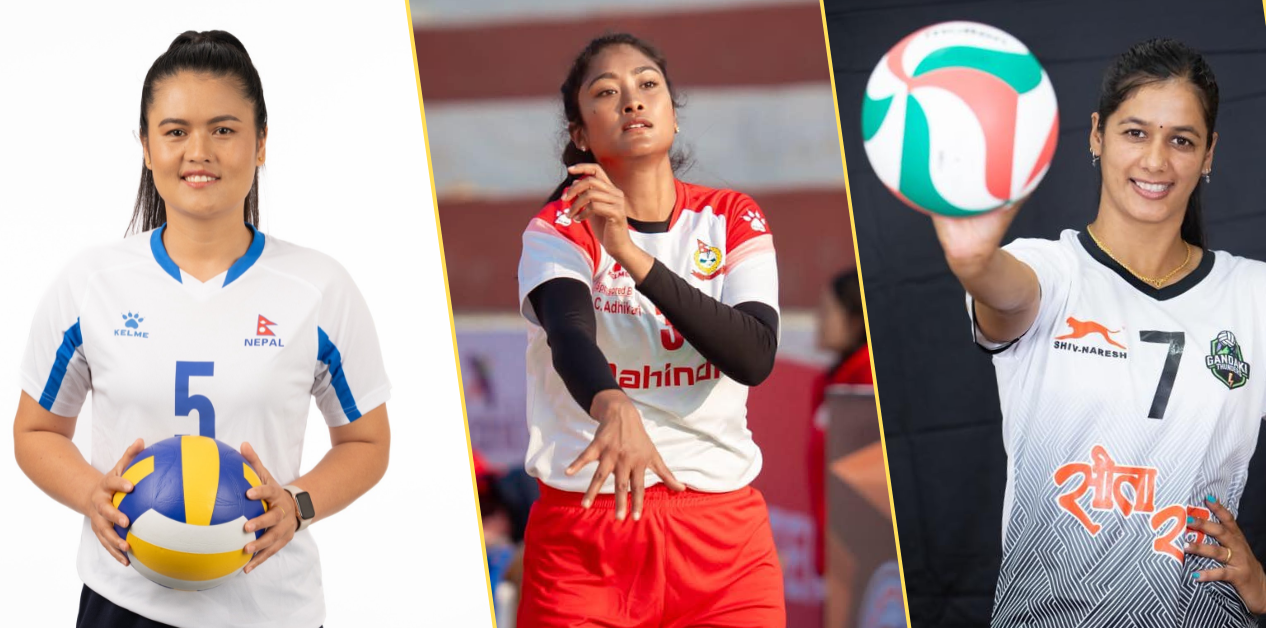
After a heartbreaking final loss on home court at the NSC Covered Hall in Tripureshwor, Nepal returns to the same venue with a reshaped squad, rising youth, and lingering belie, hoping to overcome the departure of key veterans and finally secure a historic title
Nepal had a golden opportunity to win a historic title at the very first edition of the CAVA Women’s Volleyball Nations League, to be held at the home court in about a month. Nepal had secured a place in the final by defeating India for the first time in the league stage held at the National Sports Council’s (NSC) covered hall in Tripureshwor.
Having pulled off a thrilling 3-2 win in a match that went to five sets in the first meeting, Nepal then suffered defeat against that same opponent in the final and missed the chance to make history. As the tournament returns to the same court this time (22 to 30 May), Nepal needs to forget that earlier defeat and set its sights on winning the title.
But spiker Niruta Thagunna says the team’s structure has weakened as senior players have been leaving. “The old players have gone abroad. So the current team is not as balanced and strong as before. It is weaker,” she says.
Nepal had taken the field in the tournament held from 1-7 August 2024 under the captaincy of Aruna Shahi. Under her leadership, Nepal delivered excellent performances in the league stage, defeating Sri Lanka and Maldives by identical 3-0 scorelines. Nepal recorded a competitive 3-2 win against the strong opponent India but was beaten by the same score against Iran.
In the semifinal of the five-team tournament, Nepal avenged the league stage loss by beating Iran 3-0 to secure a place in the final. But the bitter memory of losing the title on home ground against India in a best-of-five at the 2019 South Asian Games repeated itself. With the result repeating too, not only the spectators present at the home court but the players themselves could not hold back tears. However, spiker Thagunna says the team’s confidence remains high from the experience of having beaten India once. “We have already beaten India at least once. So our team’s morale is very high. We will take the field with the goal of defeating India by whatever means,” she says.
Exodus of veterans, arrival of newcomers
Captain Aruna Shahi, 31, who led Nepal to the final in the very first edition, has already migrated to Australia. When regular captain Binita Budathoki was out of the national team, the Nepal Volleyball Association had given setter Aruna the captaincy responsibility on 15 October 2019. Since then, the team under her leadership won gold medals at the AVC Asian Central Zone Senior Women’s Volleyball Championship in 2019 and 2021, and silver at the 13th SAG held in Nepal in 2019. Similarly, the team continued its success with bronze at the CAVA Women’s Volleyball Challenge Cup held at this same court in 2023 and silver at the 2024 CAVA Nations League.
Nepal Volleyball Association President Jitendra Chand says that despite delivering so many achievements, Aruna quietly left for Australia without even informing the association. “Some players have gone missing, one must say. Aruna left without giving the association any information. Other players are the same,” he says.

Nepali women volleyball players training. Photo: Volleyball Association
In recent times, Aruna had not been active in domestic tournaments either. She also did not play in the 9th NVA Women’s and Men’s Volleyball Championship held at the NSC Covered Hall from 26 December to 3 January 2026, which was organized by the association itself.
In the tournament organized as a selection process for the Prime Minister Cup NVA League, Shahi did not choose any club citing personal reasons. Having played from Gandaki Province and affiliated with Everest Volleyball Club of Butwal, she faced criticism for not participating in the league. At that time, she had made her decision clear, saying, “This time, I have decided not to play, so I have not affiliated with any club.”
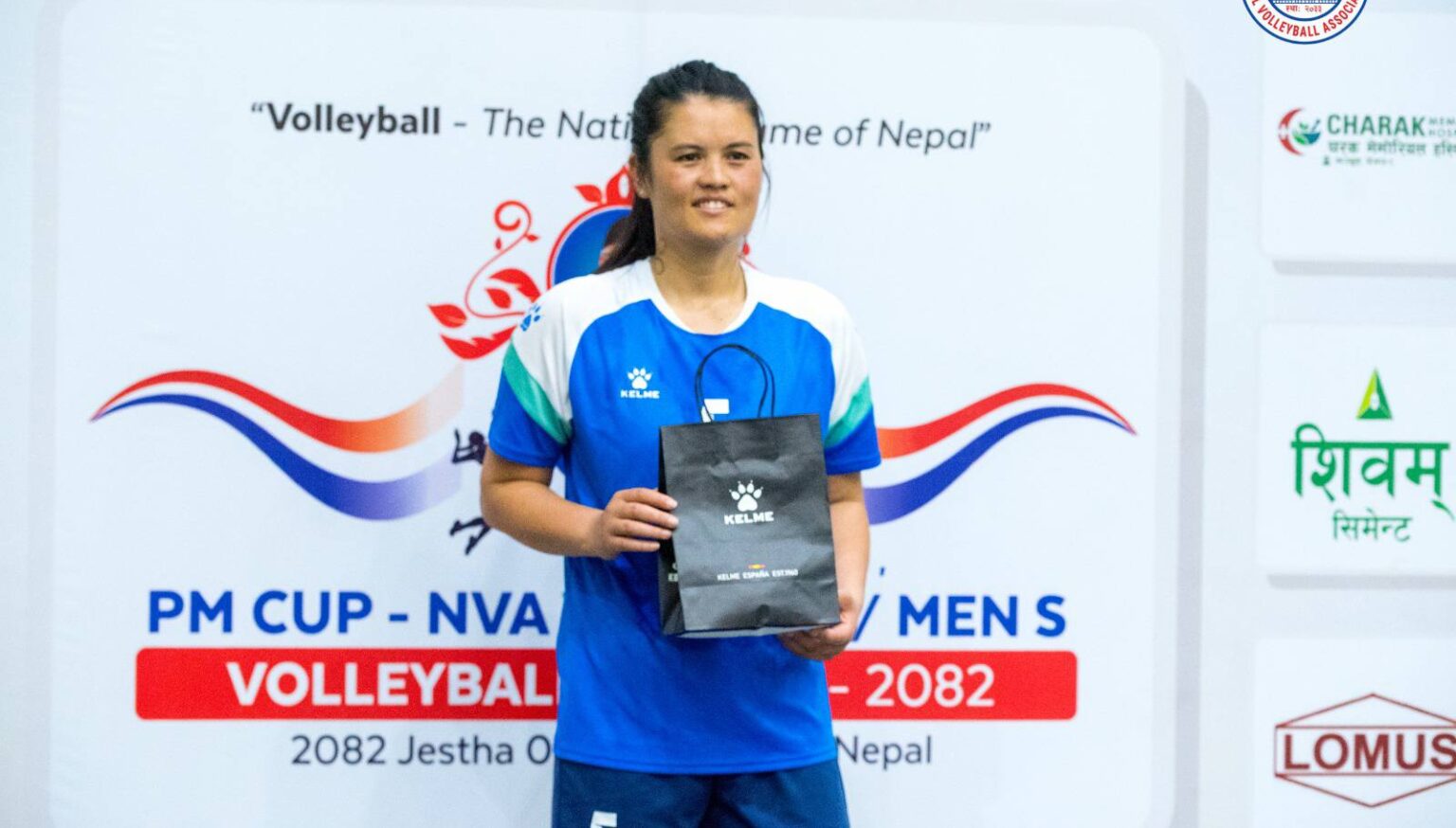
Aruna Shahi. Photo: Volleyball Association
It’s not only Aruna; hitter Saraswati Chaudhary, outside hitter Punam Chand, blockers Kabita Bhatt and Safiya Pun who played alongside her in the CAVA Women’s Volleyball Nations League, as well as rising player Manisha Chaudhary, have all migrated to Australia this year.
The departure of these key players has affected the team’s balance. For this reason, the Nepal Volleyball Association has faced additional challenges in building a strong team recently. Keeping this situation in mind, the association had recalled open spiker Pratibha Mali, who had been out of the national team for a long time, for the tournament. Nepal Volleyball Association President Chand says she too could not participate as she is also in Australia.
“We had also contacted current star player Pratibha through Kumar sir (New Diamond’s head coach Kumar Rai). It turned out she had just had surgery. So word came that she could not participate,” he says.
Mali had delivered remarkable success to New Diamond Club in a short time last year. With her outstanding performance, the club won the 9th NVA Women’s and Men’s Volleyball Championship, the 6th Tiger Cup Volleyball Championship, and the 9th Sher Bahadur Khadka Memorial National Women’s Volleyball Tournament title all within one month.
In both the 9th NVA and the Sher Bahadur Khadka Memorial National Volleyball Tournament, Mali was named the best player. At the Tiger Cup she won the best server award.
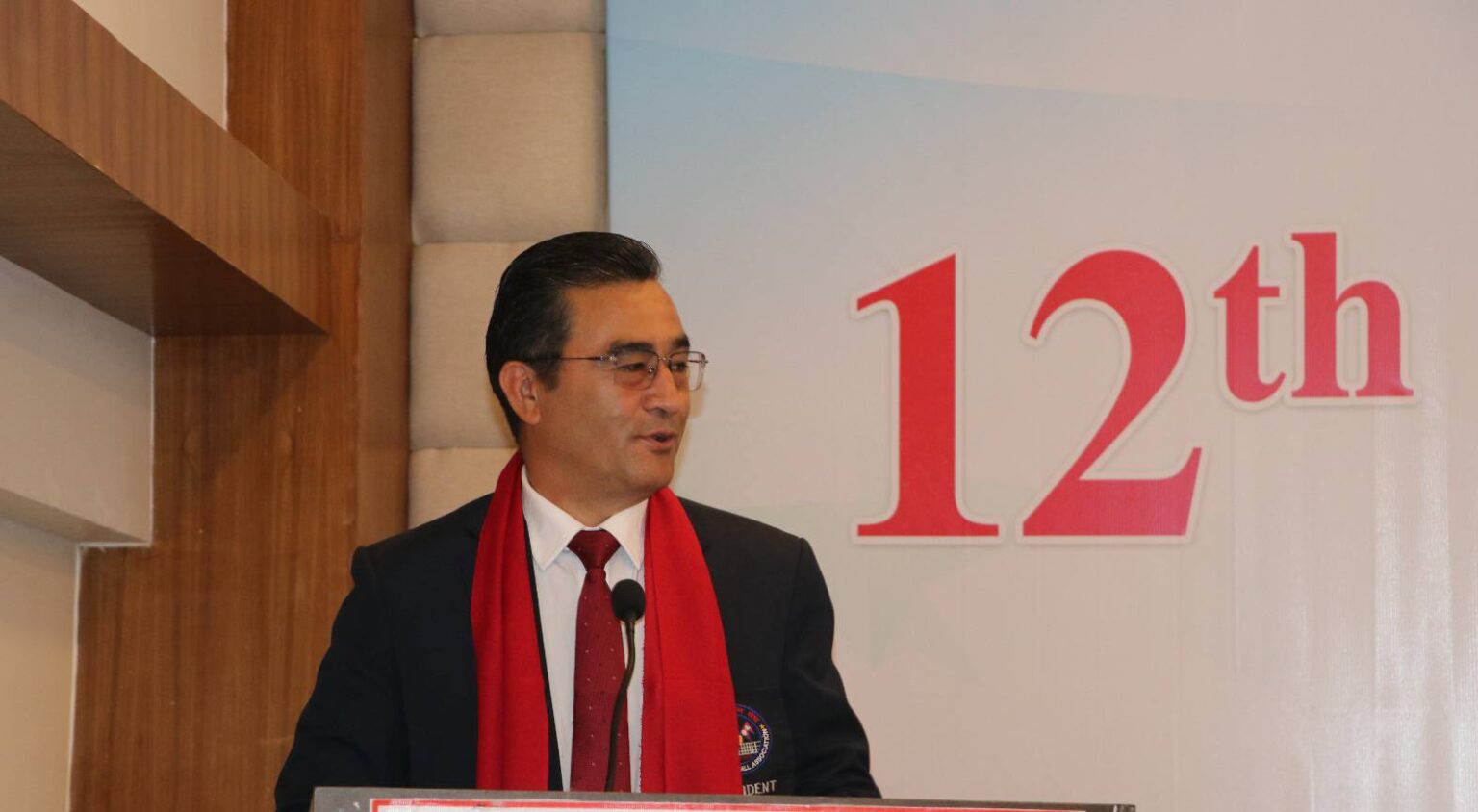
Jitendra Chand. Photo: Volleyball Association
Chand has expressed confidence in good performance at the tournament since experienced players like spikers Niruta Thagunna and Usha Bhandari are still in the team. “We had called all players who could play for the nation and train with the team. But not all could participate. There are some good players in the team. So we expect better performance than in the past,” he says.
A structure similar to 2019
This time’s tournament will see Uzbekistan, Kyrgyzstan, Tajikistan, India, Maldives, Sri Lanka, and Nepal participating. Due to the ongoing conflict in Central Asia, defending champion Iran’s participation is still uncertain. Although the previous edition was scheduled to be held in Nepal, it was shifted to Tajikistan due to the 8-9 September 2025 Gen Z movement, Nepal did not participate in the conpetition. Spiker Usha Bhandari says the challenge has increased as they return to the tournament after a one-year gap and amid a shortage of experienced players.
“With senior players like Saraswati didi leaving, all the responsibility has come to us. This pressure is not just on the players; it is on the coaching and management team too,” she says.
As the past has shown, good results are also possible from new players. When Nepal won the title at the first edition of the AVC Asian Central Zone Senior Women’s Volleyball Championship in 2019, the team consisted mostly of new players.
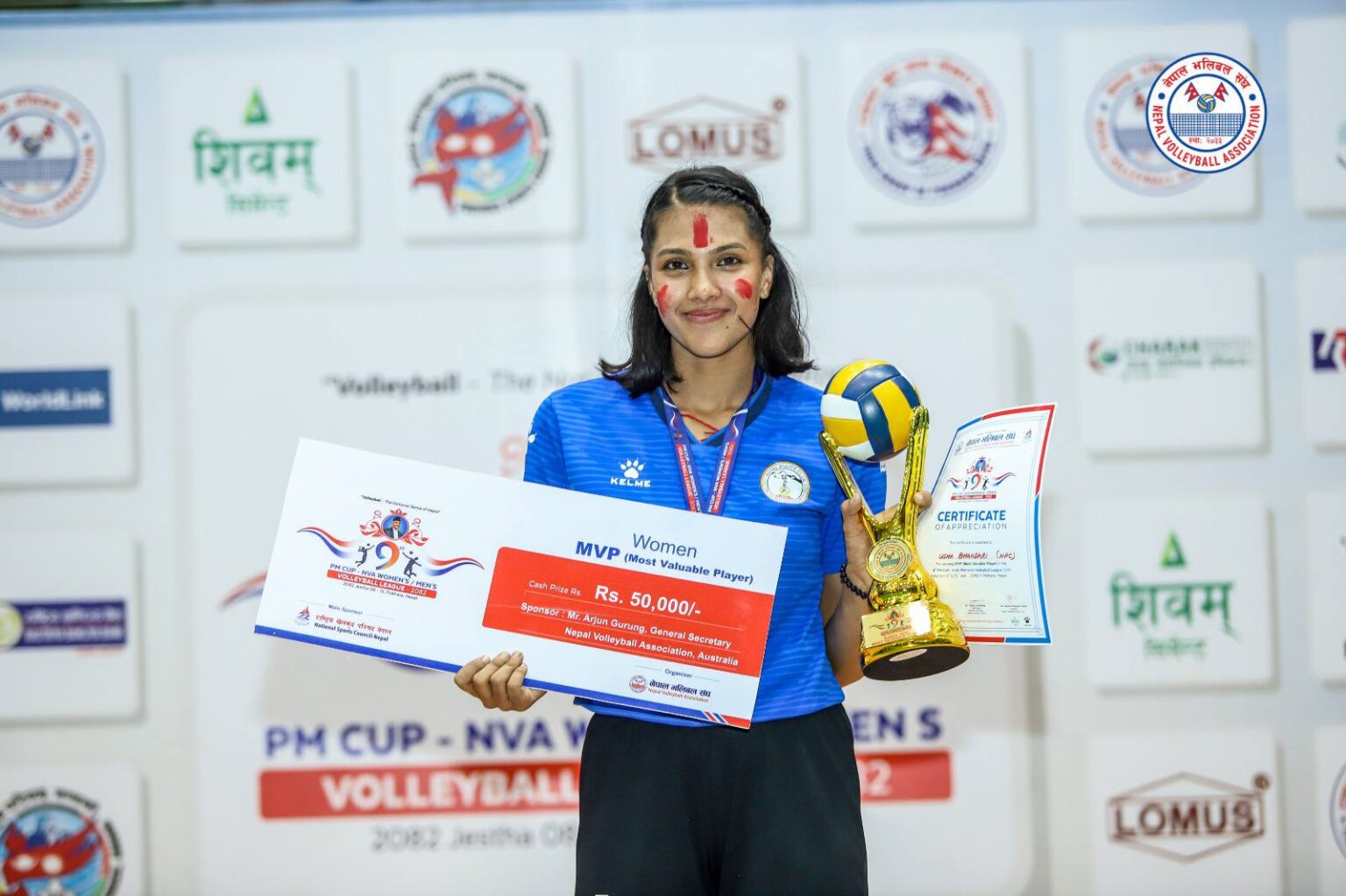
Usha Bhandari. Photo: Volleyball Association
At that time the team included players aged 18 to 27 with an average age of 23. Through that tournament, six players including middle blocker Sunita Khadka and Punam Chand made their international debuts. That team achieved historic success, going through the entire tournament undefeated and without losing a single set to become champions. This was Nepal women’s volleyball’s first international title. Before that, Nepal had won silver at the South Asian Invitational Women’s Volleyball Championship held on home court in 2014.
This time too, the team has a similar composition to 2019. The most experienced player is libero Salina Shrestha, who won the best libero award at the 2024 CAVA Women’s Nations Volleyball League. Alongside her, Usha Bhandari and Niruta Thagunna are also in the team as experienced players.
Players who also played in that tournament including middle blocker Sumitra Regmi, libero Shanti Kala Tamang, spikers Kamana Bista and Aarti Subedi, and setter Pragati Nath have also continued in the team. To support these experienced players, players who have gained experience from the U-19 and U-20 national teams have also been included this time. Young players including Alisha Manandhar, Sunita Khatri, Rima Bishwakarma, Yamuna Rasaili, Ashika Chhetri, Meena Sunuwar, and Jenisha Bishwakarma have been added to the team.
Although the final team composition is yet to be confirmed, spiker Usha Bhandari says training and coordination have been easier since most players are from the same age group. “The junior players are also in good form. How the mix of new and old will play out can only be known at that time,” she says.
What hope is there?
Although the team is new, the coach is the same – Jagadish Prasad Bhatta. Also a coach at NSC, he has been training this team for about 14 months. He is preparing the team with an eye on the Asian Games to be held in Japan this year as well.
In these 14 months, the women’s team has already played 14 international and national tournaments. This has given Bhatta ample opportunity to evaluate the players closely. However, compared to the first edition, opposing teams have come even more mature this time.
Sri Lanka and Maldives, long considered weak even within the South Asian region, have been showing improved performances recently. Uzbekistan and Kyrgyzstan, whom Nepal had beaten in previous tournaments, have now reached the level of playing in the Asian Championship. Although Nepal has defeated India once, that team is now seen as an equal competitor. And this time India is also taking the field with a young team.
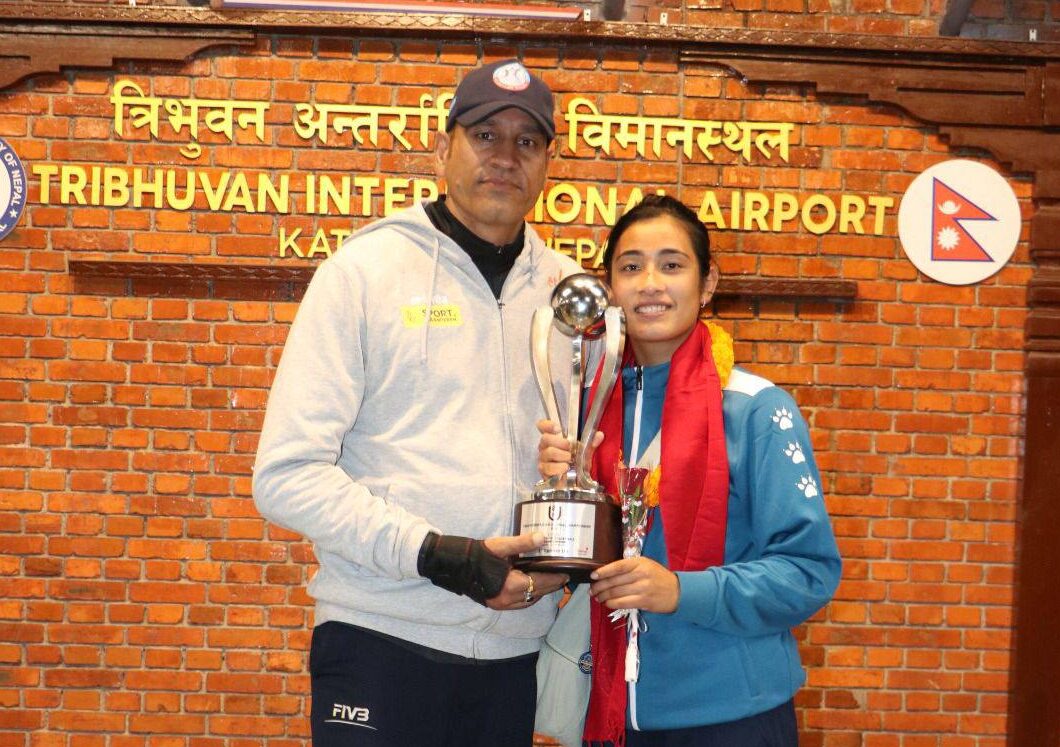
Head coach Jagadish Prasad Bhatta (left) and player Jenisha Bishwakarma. Photo: Volleyball Association
Iran, however, is participating with experienced players having played with the same core team for five consecutive years. Overall, the tournament is not considered easy for Nepal. And although volleyball is Nepal’s national sport, Nepal has not yet been able to win a title on home soil. In such circumstances, coach Bhatta says just participating is a matter of pride.
“The biggest thing is that an international tournament is happening; that itself is a matter of pride. The other thing is that Nepal is participating; that is our victory. So we are preparing with every possible effort,” he says.
Will Nepal this time repeat that history from nearly seven years ago and spring a surprise?