Kathmandu
Tuesday, June 16, 2026





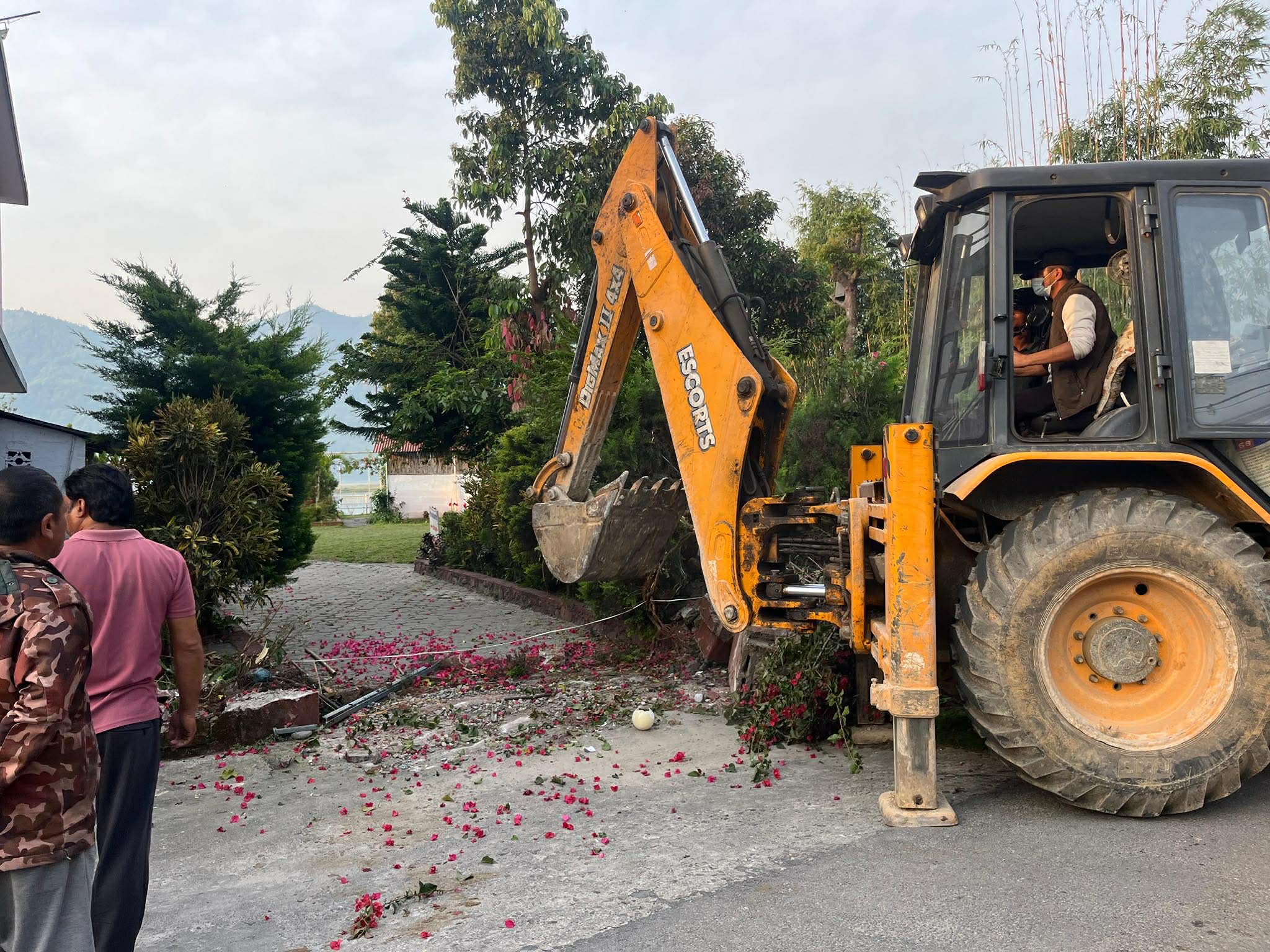
KATHMANDU: Bulldozers arrived early Saturday morning (April 4, 2026) at Karna Shakya’s Waterfront Resort on the shores of Phewa Lake in Pokhara’s Lakeside area, tearing down its swimming pool, gate, and boundary walls.
The operation, carried out by Pokhara Metropolitan City on direct orders from Prime Minister Balendra Shah, enforces long-standing Supreme Court rulings against decades of illegal lakeside construction and has ignited heated debate across the city.
Phewa Lake in Pokhara has gradually shrunk over decades due to hotels, resorts, and other buildings that illegally encroached on its shoreline and buffer zones.
Supreme Court rulings in 2018 and a detailed 2023 verdict ordered the removal of all structures within a 65-meter protected area from the high-flood line to safeguard water quality, biodiversity, and the lake’s natural beauty.
What lies at the heart of the Phewa Lake encroachment conflict?
The conflict revolves around hotels, resorts, restaurants, and other commercial structures built over many years that have slowly invaded the lake’s natural shoreline and designated protection zones.
These developments have reduced the lake’s surface area, introduced pollution through waste and runoff, and disrupted its delicate ecosystem, including fish, birds, and aquatic plants.
Authorities have documented numerous violations of historical planning limits that prohibited construction close to the water.
The demolitions launched on April 5, 2026, specifically target these unauthorized buildings to restore the lake’s boundaries and ecological balance in line with binding Supreme Court mandates issued years earlier.
Conservation groups argue that without strict enforcement, the iconic lake—central to Pokhara’s tourism identity—could face irreversible damage from siltation and urban pressure.
When did the Supreme Court issue its major conservation orders for Phewa Lake?
The Supreme Court first delivered comprehensive instructions on April 29, 2018, after combining and hearing several related writ petitions in a single bench.
That landmark order laid the groundwork by directing demarcation of the lake’s boundaries and removal of encroachments.
A more detailed 30-page judgment followed on June 19, 2023, delivered by Justices Kumar Regmi and Hari Phuyal.
This ruling reviewed extensive evidence, quashed an earlier local attempt to shrink protection zones, and reaffirmed the need for immediate protective measures.
Both decisions emphasize the lake’s status as a vital natural resource and place responsibility on federal, provincial, and local governments to coordinate enforcement without delay.
Did the Supreme Court directly require the removal of lakeside structures?
Yes, the court explicitly ordered authorities to demolish every permanent and temporary structure—including houses, hotels, resorts, and commercial buildings—located inside the 65-meter buffer zone measured from the lake’s highest flood line.
Both the April 29, 2018, directive and the June 19, 2023, verdict set a clear six-month deadline for clearance and imposed a permanent ban on any future construction that could harm the lake’s environment.
The April 5 operation directly implements these unchanged judicial commands.
The rulings stress that the buffer must remain a green, vegetation-filled zone free of human activity to prevent pollution and preserve biodiversity for future generations.
What local decision did the Supreme Court overturn?
On December 31, 2021, Pokhara Metropolitan City’s executive board, under then-Mayor Man Bahadur GC, voted to reduce the protected buffer around Phewa Lake from 65 meters to just 30 meters on all sides, claiming it would promote tourism.
The Supreme Court declared this decision illegal in its June 19, 2023, verdict because it directly contradicted national planning laws, earlier court orders, constitutional environmental rights, and the federal division of powers.
Judges ruled that local bodies lack authority to unilaterally weaken long-established safeguards without coordination with higher levels of government.
The overturned move had allowed continued construction in sensitive areas, further endangering the lake’s long-term survival.
What earlier planning rules were designed to protect the lake?
A formal city development plan approved by the national cabinet in 1973-74 designated Phewa Lake as a protected natural zone and strictly prohibited any construction within at least 200 feet (approximately 61 meters) of its bank.
In 2007-08, the Kaski District Council and Pokhara Valley Town Development Committee reinforced this by defining a 65-meter no-build buffer zone.
These decades-old standards aimed to prevent silt buildup from upstream rivers, preserve water clarity, protect surrounding forests and wildlife, and maintain the lake’s role as Pokhara’s premier tourist attraction.
The Supreme Court has repeatedly upheld these rules as legally binding, noting they were established long before recent commercial pressures intensified.
Why does the 65-meter buffer zone matter for Phewa Lake?
The 65-meter buffer functions as an essential green belt that blocks polluted runoff, controls soil erosion, and filters sediment flowing in from rivers like the Harpan Khola.
It shelters birds, fish, insects, and other wildlife while helping maintain stable water levels and high quality.
The Supreme Court has stressed that this strip must stay completely free of buildings and be developed into a planted park or garden to ensure the lake’s long-term survival.
Without it, human activities accelerate pollution, reduce the lake’s natural storage capacity, and threaten the entire ecosystem.
Leaving the zone as open green space also supports Pokhara’s tourism economy by preserving the scenic beauty that draws visitors from around the world.
How did older court rulings and historical concerns shape today’s actions?
Legal battles over Phewa Lake date back to the Panchayat period, with multiple cases highlighting ongoing threats from unchecked development.
The April 29, 2018, Supreme Court order combined five separate writ petitions and issued 11 specific requirements, including boundary demarcation, immediate structure removal, pollution controls, and watershed protection.
The June 19, 2023, judgment built directly on that foundation, reminding all government agencies that they must obey these earlier instructions to prevent irreversible damage.
Advocates such as Khagendra Subedi played key roles in filing early petitions that kept the issue alive in court.
Was Prime Minister Balendra Shah’s decision to begin demolitions justified?
Prime Minister Balendra Shah’s directive strictly follows the Supreme Court’s binding orders from 2018 and 2023, which the Constitution requires every public official to implement without exception.
He personally contacted Pokhara Mayor Dhanraj Acharya to ensure swift action as part of his government’s broader environmental agenda.
While some residents complained about the sudden nature of the operation and lack of advance notice, supporters view it as long overdue after decades of ignored warnings and continued illegal building.
The court has warned that failure to enforce these rulings could lead to contempt proceedings against officials.
The move balances environmental protection with legal compliance, though it highlights the need for better communication with affected communities.
What is the legal position of land and buildings inside the protected zone?
Land within the lake’s historical high-water area and its immediate banks is classified as public or government property under national land laws.
Any structures built inside the 65-meter buffer, such as those at Karna Shakya’s Waterfront Resort on plots 173, 304, and 305, violate these rules and must be removed without compensation for the encroached portions.
Certain older land registrations made during temporary low-water periods after a past dam breach were declared invalid if they overlapped the original lake bed.
The Supreme Court has clarified that compensation may apply only to qualifying private plots outside the core protected area that were legitimately registered before the lake’s boundaries were formalized.
This framework prioritizes public heritage over private claims in sensitive ecological zones.
How does Nepal’s Constitution allocate responsibility for lake protection?
The Constitution assigns primary authority over national environmental standards, wetlands, biodiversity, and water resources to the federal government, while provinces and local bodies handle day-to-day implementation through coordinated efforts.
Local levels can develop supporting policies but cannot override federal laws or Supreme Court rulings.
In the Phewa Lake case, the court ruled that Pokhara Metropolitan City’s 2021 buffer reduction exceeded its powers and conflicted with higher constitutional duties to safeguard clean air, water, and natural heritage.
All three tiers of government—federal, provincial, and local—must work together under schedules that emphasize joint responsibility for environmental matters.
This structure ensures uniform national standards while allowing localized execution.
Which fundamental rights and environmental principles are involved?
Citizens hold an explicit constitutional right to live in a clean and healthy environment, which is directly threatened when lakeside development pollutes water and destroys habitats.
State policies further require sustainable use of natural resources, pollution control, and biodiversity conservation.
The Supreme Court warned that allowing Phewa Lake to disappear would harm tourism-dependent livelihoods, wipe out unique wildlife, and erase part of Pokhara’s cultural and economic identity as Nepal’s most popular lakeside destination.
The rulings link these issues to broader principles of intergenerational equity and the “polluter pays” concept, emphasizing that private commercial gains cannot come at the expense of public natural assets protected under the Constitution.
What were the main requirements in the June 19, 2023, Supreme Court ruling?
The court canceled the illegal 30-meter buffer reduction, ordered all structures inside the 65-meter zone removed within six months, and required the entire area to be restored as a fully vegetated green belt.
It directed proper correction of land records, implementation of watershed protection measures under existing laws, and continuous coordination among federal, provincial, and local agencies.
The verdict also mandated monitoring to prevent future encroachments and emphasized strict compliance to preserve Phewa Lake’s ecological, cultural, and economic value for present and future generations.
These requirements remain unchanged and form the legal basis for the recent enforcement actions across multiple sites in Pokhara.
Who are some of the key individuals and businesses highlighted in the Phewa Lake encroachment cases?
Prominent among those facing action is veteran tourism entrepreneur Karna Shakya, whose popular Waterfront Resort in Lakeside had its swimming pool, gate, and boundary walls demolished because the structures fell within the protected 65-meter zone on public land plots.
Earlier court documents also reference other hotels and commercial buildings in areas such as Khapaundi and Sedi.
Advocates like Khagendra Subedi have been central to filing petitions that kept the issue before the Supreme Court since 2018.
The cases involve hundreds of owners whose developments were built without proper approvals, turning what should have remained open green space into private commercial property.
Police sources confirmed the demolitions targeted only verified illegal constructions to uphold court orders.
What is the controversy surrounding Home Minister Sudan Gurung and the rented land near Fewa Lake?
Home Minister Sudan Gurung is facing controversy for allegedly not paying rent on around 10 ropani of land he leased near Phewa Lake in Pokhara.
He rented the land in 2017 for 15 years at an annual rate of Rs 200,000 but reportedly paid only for the first year, leaving seven years of dues unpaid.
He had planned to build tourism infrastructure such as water sports facilities and a swimming pool, investing an estimated Rs 10–15 million, but the project stalled due to disputes, environmental changes, and municipal restrictions.
Landowners say they have neither received rent nor been able to use the land, and have urged him to either pay dues or cancel the agreement.
The issue has gained attention amid enforcement of a Supreme Court order on Phewa Lake conservation, which requires removal of structures in designated areas.
Although the land is not owned by Gurung, it falls within a regulated zone where structures were supposed to be cleared following a municipal notice in February 2026, a directive that remains unimplemented.