Kathmandu
Sunday, July 12, 2026





A growing exodus from school teaching driven by low pay, limited mobility, and job insecurity, is pushing thousands of teachers into other careers, raising alarms over a looming nationwide teacher shortage in Nepal

KATHMANDU: Dipesh Yogi, now a section officer at Bara District Court, once worked as a teacher. From his home in Khajura Rural Municipality, Banke, he spent three years, from 2013 to 2016, teaching science to classes 7 through 10 at Brichet Secondary School in Khaniyabas Rural Municipality-3, Dhading. He had gone to Dhading to teach on a private source basis after completing his final year of science at undergraduate level in Kathmandu.
“In teaching you can’t easily get a transfer to go elsewhere. The benefits are also only so-so. So, it seemed better to join the civil service than to go through getting a teaching license and competing for a teaching post,” Yogi says. “So, I quit teaching altogether and started preparing for the civil service exam.”
He entered the civil service in 2017 through the Public Service Commission exam, starting as a kharidar and rising through nayab subba to section officer. The trend of leaving school-level teaching for other professions and trades is nationwide. About 1,000 teachers abandon the profession for other fields every year, says Mahendra Parajuli, deputy director general and spokesperson of the Education and Human Resource Development Center. “People always look for better opportunities; that is a matter of their freedom,” he says.
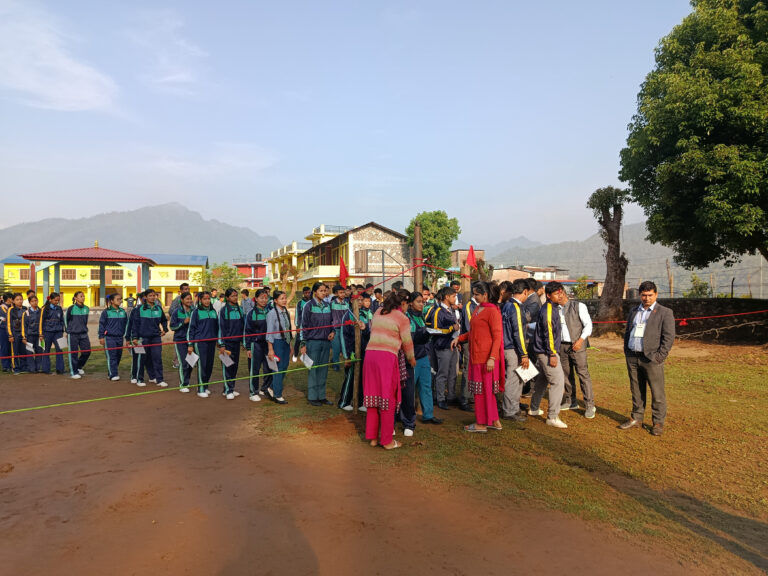
Ishaneshwar Secondary School, located in Bhorletar, Ward No. 6 of Madhya Nepal Municipality, Lamjung. Photo: Devendra Gurung/RSS.
In recent years, not only has the attraction of the teaching profession for the new generation declined but also the tendency to leave teaching for other fields has been growing. Stakeholders have expressed concern that even the gains and targets achieved so far in school education could erode as a result. Professor Bal Chandra Luitel, dean of the School of Education at Kathmandu University, says, “If the government does not pay attention to this in time, within the next two to three years there will be a shortage of more than 100,000 teachers for classes 1 through 12 across both community and institutional schools.”
Prof Luitel says consultations with education sector stakeholders and officials confirm that a teacher shortage is in the making. The government, however, has not yet established the precise scale of the expected shortfall at the school level. Deputy Director General Parajuli says, “If the university has made that determination, that is their finding. We do not have such an estimate.”
The current total number of teachers for classes 1 through 12 across community and institutional schools nationwide is approximately 300,000. According to government figures, in academic year 2081 BS (2024/25), as many as 188,344 teachers were working in community schools and 91,241 in institutional schools, for a total of 279,585.
He says work is under way on establishing a teacher bank with teacher management in mind. The government’s budget statement for the current fiscal year 2025/26 mentioned establishing a teacher bank in collaboration with universities to prevent shortages in English, science, and mathematics, and deploying university graduates as volunteer teachers. However, only a concept paper for the teacher bank has been prepared so far, says Madhav Banjade, director of the Teacher Management Coordination Division at the Education and Human Resource Development Center. “There is a budget shortfall for moving to implementation,” he says.
The current total number of teachers for classes 1 through 12 across community and institutional schools nationwide is approximately 300,000. According to government figures, in academic year 2081 BS (2024/25), as many as 188,344 teachers were working in community schools and 91,241 in institutional schools, for a total of 279,585. This does not include teachers working under teaching-learning grants.
The teacher shortage is not Nepal’s problem alone. A UNESCO global report on teacher shortages published on 26 February 2024 estimated that by 2030 a shortage of 44 million teachers at primary through secondary level will be felt worldwide. The report notes that this shortage will impede the UN Sustainable Development Goal 4 target of ensuring inclusive and equitable quality education for all and promoting lifelong learning opportunities by 2030.
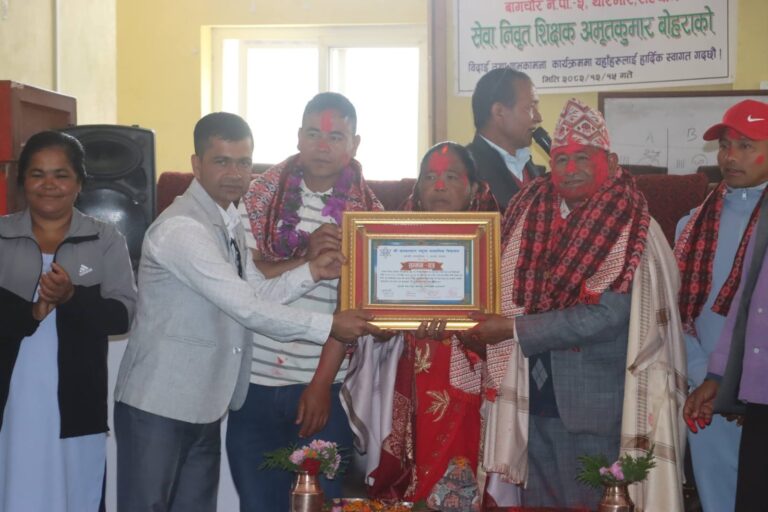
Farewell program for retired teacher Amrit Kumar Bohara at Janakalyan Model Secondary School in Tharmare, Ward No. 2 of Bagchaur Municipality, Salyan, on 29 March 2026. Photo: Secretariat of Mayor Janak Raj Gautam.
Education expert Bidya Nath Koirala says the teacher shortage will mean curricula go uncompleted within academic years, student learning and examination results will suffer, and the gap in education between urban and rural areas will widen further. The rate of subject-specific teacher shortages in rural areas is increasing.
In Nepal, the reasons driving people away from teaching differ between community and institutional schools. Nepal Teachers’ Federation President Laxmi Kishor Subedi says teachers are leaving community schools because they see no professional security. “Nobody from the civil service, police, or Tribhuvan University service is coming into teaching. But teachers are leaving for those fields. If this continues, the teacher shortage will take a severe form in the future,” Subedi explains. “Once someone finds a more secure profession, who would stay in this one?”
His demand is that the government establish teaching as a profession by ensuring teachers receive salaries, benefits, and professional security on a par with civil servants. It was to press these same demands, and to call for early passage of the pending School Education Bill, that teachers across the country staged a major street movement from 2 April 2025 to 30 April 2025. When parliament itself was dissolved, the bill that had been pending since 2080 BS (2024) became inactive along with it.
In institutional schools, teachers choose other professions because of the heavier workload and stress. Pressure to show high pass rates to attract students keeps institutional school teachers grinding away. Studies show that low salaries and professional insecurity are driving them out of the profession.