Kathmandu
Saturday, July 18, 2026





Despite the declining performance level of community schools and students’ learning achievement, the government lacks concrete programs to improve quality

KATHMANDU: In the 2082 BS annual examination for grade 5, some 170 students from 20 community schools in Panchakanya Rural Municipality, Nuwakot, sat the test. Of them, only 52 (30.6 percent) passed. Five schools recorded a zero-pass rate. The students who sat the grade 5 annual exam and all failed included four from Bandevi Basic School, five from Devaki Dharam Basic School, seven from Gambodanda Basic School, five from Bhedabari Secondary School, and three from Sundara Basic School.
Keshav Pandit, headteacher of Gambodanda Basic School in Panchakanya-4, which teaches up to grade 5, says failures by all three parties – teachers, parents, and students – have brought the pass rate to zero. “Those who are better off send their children to boarding schools. You can’t improve results just by sending a child to school with books and notebooks,” he told Nepal News on 12 April 2026. “Teachers have their shortcomings too, but parents must pay attention to their children’s studies and students must also focus on learning.”
Ward chair of Panchakanya-4, Sancha Tamang, says the zero-pass rate is the result of teachers failing to be professionally responsible. “The teachers who are supposed to teach don’t reach the classroom on time; they’re always running off to hotels and restaurants. Because they pay no attention to students’ learning, education is in ruins,” he says.
Headteacher Pandit responds that elected representatives always make such accusations. “This is just the language elected representatives use,” he says. “From the next academic year, we will move forward with discussions between local elected representatives, the school management committee, the school, and parents to address the zero-pass rate. We will need to reach a conclusion on whether teachers need to change or what else can be done to improve things.”
In the 2082 BS annual grade 8 examination, 458 students from 21 community schools in Bhumikasthan Municipality, Arghakhanchi, sat the test. Of them only 94 (20.52 percent) passed. Of the 12 students from Lamchi Basic School in Bhumikasthan-8 who sat the grade 8 exam, all failed.
The recent exam results of these 41 schools in Bhumikasthan and Panchakanya reflect the weak learning achievement of community schools. Professor Bal Chandra Luitel, dean of the School of Education at Kathmandu University, analyzes that community schools’ failure to adopt continuous assessment in line with evolving learning methods has produced weak annual results. “Teaching students, assessing their learning, and giving feedback for improvement should be a daily activity. But here we still have the old habit of testing only at the end, and that is why results have slipped,” he says. “A single end-of-year exam is convenient for teachers and schools, but students end up becoming disengaged from learning.”
Learning achievement in decline
According to Ministry of Education records, 46.51 percent of students nationwide passed the SLC examination in academic year 2062 BS. Some improvement followed, with the SLC pass rate reaching 68.47 percent in 2065 BS. By 2071 BS, only 47.43 percent of SLC candidates passed. In 2072 BS, the SLC was renamed the SEE (Secondary Education Examination) and a letter grading system was introduced. Because practical work marks were included, the overall pass rate up to academic year 2079 BS doubled compared to the earlier SLC era. But by the 2080 BS SEE the rate had fallen back, with only 47.86 percent of candidates passing that year. In the 2081 BS SEE, 61.81 percent of students passed. While the 2081 BS SEE pass rate was an improvement over 2080 BS, it remains lower than the 2065 BS rate.
The Balendra Shah government has stated that from the last year (2082 BS) onwards, SEE results will be published within one month of the examination’s completion. The answer sheets from the SEE examination, which ran from April 2 to April 12, 2026, are currently being marked centrally.
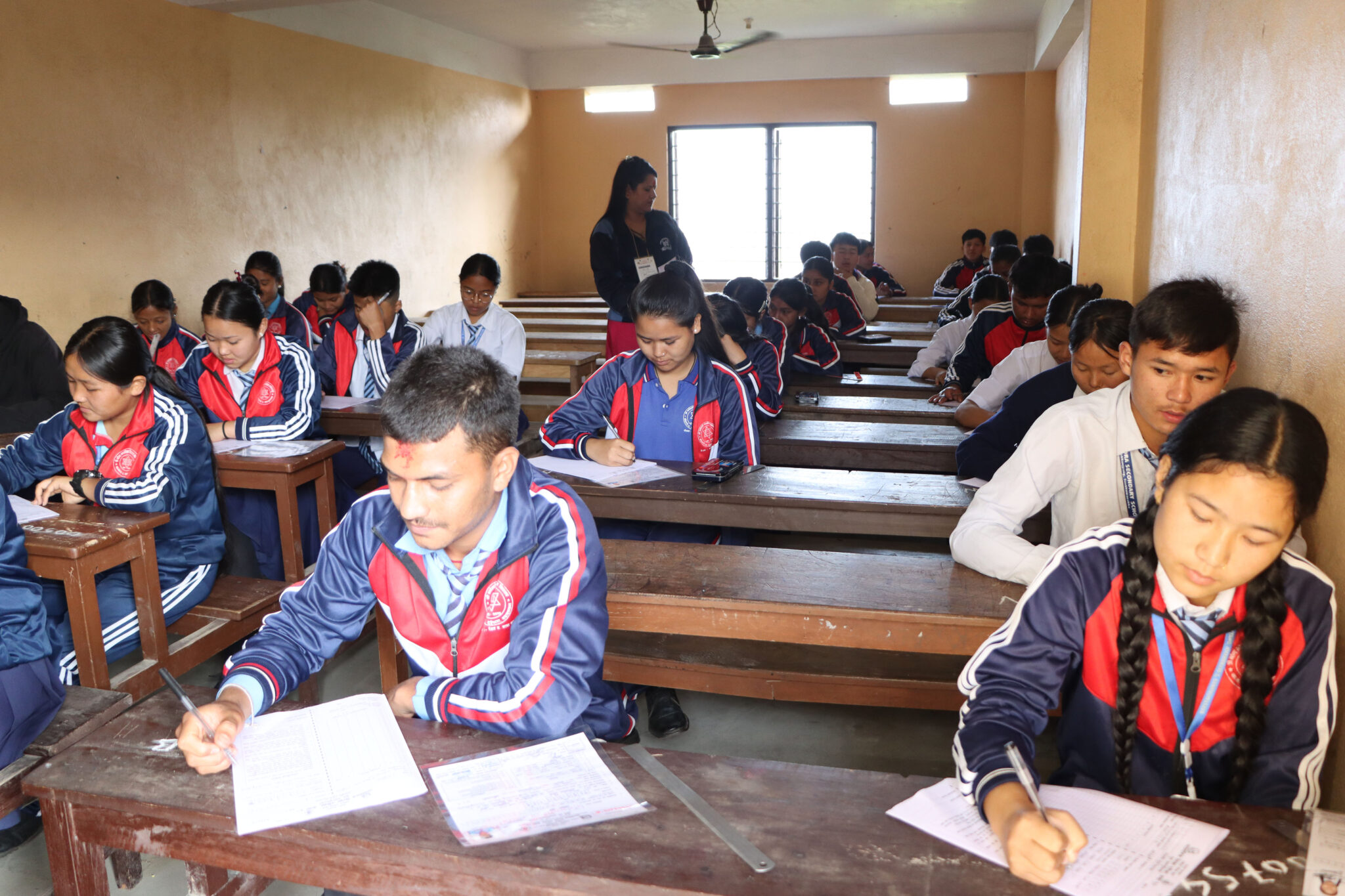
Students appearing for the Secondary Education Examination (SEE) at the Himalaya Secondary School examination center located in Khandbari Municipality-1 of Sankhuwasabha. Photo: RSS
According to the Ministry of Education’s own records, close to 40 percent of students are still failing the grade 12 examination. Pass rates in academic years 2078, 2079, 2080, 2081, and 2082 BS stand at 53.56, 51.91, 50.91, 52.15, and 61.17 percent respectively.
In recent years, it is not only passing rates that have fallen; average learning achievement has also been declining. Data shows that average learning achievement in core subjects such as mathematics, Nepali, English, and science has become weaker still. The government has been raising its targets for average learning achievement in these subjects every year, but rather than meeting the targets, achievement has been falling.
Average learning achievement in mathematics, Nepali, English, and science at grade 8 is lower in FY 2080/81 BS (2023/24) than it was in FY 2078/79 BS (2021/22). In FY 2078/79, the target for average mathematics achievement was 57 out of 100 but actual progress was limited to 43, falling 14 points short. In FY 2079/80 (2022/23), the target was raised to 60 but progress fell further to 38.67. In FY 2080/81, the target was raised again to 63, yet achievement fell still further to just 26.
The same pattern applies in Nepali. In FY 2078/79 BS, a target of 60 was set and 59 was achieved, a near-target result. Since then, progress has declined. In FY 2079/80 B S, the Nepali target was raised to 62 but achievement fell to 49.09. In FY 2080/81 BS, the target was set at 66 but progress fell further to 40.
In English at grade 8, FY 2078/79 BS saw a target of 57 but progress was limited to 51. In FY 2079/80 BS, the target was raised to 60 but progress fell to 49.9. In FY 2080/81 BS, the target was set at 63 but achievement fell further still to just 25.
In Science at grade 8, a target of 58 was set in FY 2078/79 BS but only 38 was achieved. In FY 2079/80 BS, a target of 60 produced progress of only 45.07, and in FY 2080/81 BS, a target of 63 produced an achievement rate that fell to just 28.
When the foundation is weak, higher grades suffer too
The government has long used annual grade-level examinations as the primary measure of student learning achievement. Whether or not students have attained the learning outcomes set by the curriculum in the classroom is assessed primarily through examinations.
Because the government has adopted a liberal promotion policy for grade 5, even students who have not passed are allowed to advance to grade 6. At grade 8, however, students who fail even after a re-examination are not allowed to proceed to grade 9, and the same policy applies at grades 10 and 12.
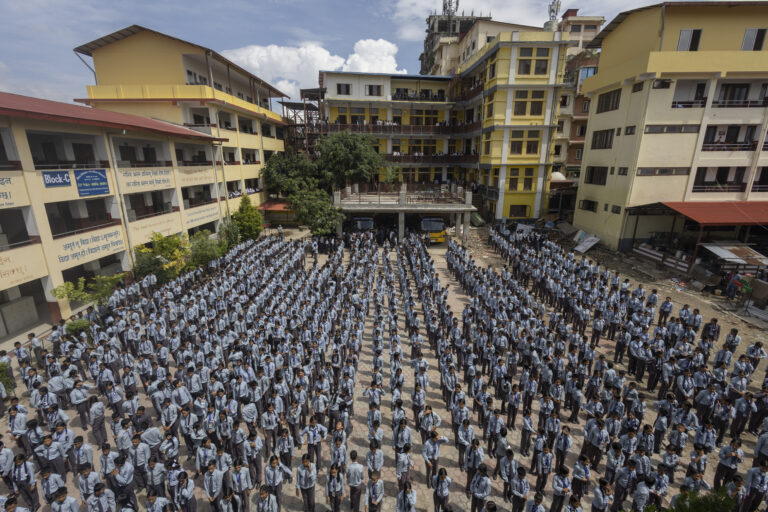
Students of Vishwa Niketan Secondary School located in Tripureshwor, Kathmandu. Photo: Bikram Rai/Nepal News
In Nepal, grades 1 through 8 are considered the basic tier of school education and the foundation of learning. Education expert Tika Bhattarai analyzes that when that foundation crumbles, results in higher grades must inevitably deteriorate. “When a student fails, they lose the desire to study and parents lose the will to keep them in school,” he says.
In Bhattarai’s understanding, improving school performance and learning achievement requires the roles of government, community, parents, school management committees, headteachers, teachers, students, and stakeholders, with teachers bearing the greatest responsibility. “Teaching is a profession that requires being aware of each student’s learning and progress around the clock,” he says. “But this profession has become the job most favored by the lazy. That is why parents too find it more convenient to put their children in private schools than to push for improvement in community schools.”
Rajendra Dahal, editor of Shikshak Monthly, said in an interview with on 21 August 2023: “Because the state and government have not taken initiative to strengthen the foundation of our teaching and learning, students remain trapped in the snare of examinations and keep failing.”
Poor physical infrastructure, lack of educational materials, a shortage of qualified and trained teachers, low professional commitment among teachers, inappropriate learning practices, weak management and supervision, and insufficient motivation among students have all prevented improvement in learning quality. Inadequate investment in secondary education and a flawed curriculum are also impeding quality improvement.
Prof. Luitel, dean of the School of Education at Kathmandu University, analyzes that learning standards have declined further because school management committees are formed through political quota-sharing and then endorse headteachers accordingly. “When a headteacher lacks the skills and standing to lead, teachers don’t listen, students listen even less, and the school descends into chaos,” he says. He recommends redefining the selection process for school management committees and the duties, responsibilities, and authority of headteachers.
Ministry of Education joint secretary and spokesperson Shiva Kumar Sapkota says the ministry has been continuously working to reform public education to produce good citizens and a workforce that meets contemporary needs. “The measurement of educational quality keeps changing with the times, and the ministry is constantly working to improve education accordingly,” he says. “The federal ministry makes policy; local governments are at the implementation level and they need to take responsibility and work to improve learning standards.”
Despite declining school performance and student learning achievement, the Ministry of Education has not been seen running concrete programs to improve educational quality. The Auditor General’s Annual Report of 2078 BS (2021) had also recommended that the ministry review its educational programs to bring about quality improvement.
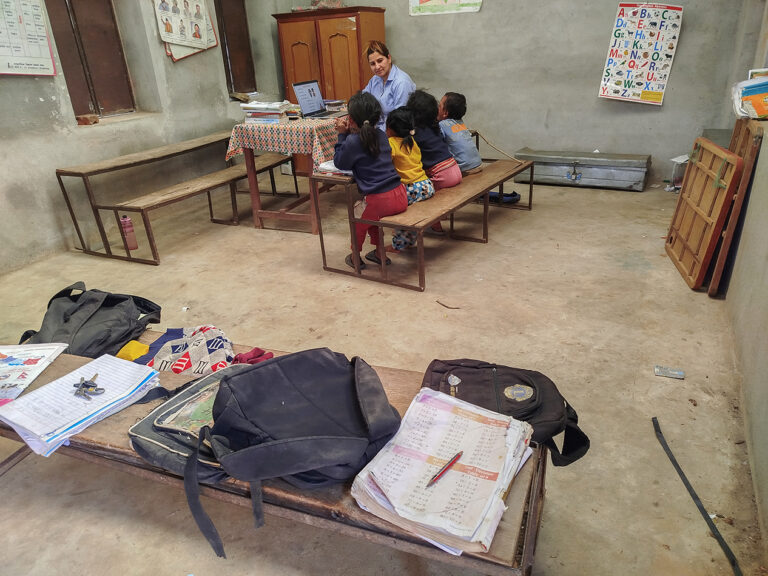
A teacher teaching four students at Gangadevi Primary School in Panchkhal, Kavre. Photo: Bidhya Rai.
According to the report, community school performance levels have also been declining compared to previous years. When performance assessments were conducted at 1,999 schools in 2075 BS and 996 schools in 2076 BS, the average score of community schools fell from 63 to 60 percent. The proportion of schools rated good or medium fell from 16 to 14 percent, while those rated poor or average increased from 84 to 86 percent.
The government has been measuring educational quality through assessments of student learning achievement and school performance since 2068 BS. An Educational Quality Testing Center was established in 2066 BS (2009) in accordance with the Education Act 1971. The center conducts national achievement tests every year. Between 2068 and 2077 BS, it tested the educational achievement of 409,000 students in grades 3, 5, 8, and 10 across 15,815 schools. Grade 5 mathematics learning achievement scores fell by an average of 0.45 points between 2072 and 2075 BS. Districts with the lowest learning achievement include Achham, Bardiya, Jumla, Khotang, Mahottari, Rolpa, Saptari, and Udayapur. Sudurpaschim and Karnali provinces consistently record the lowest learning achievement.
By contrast, studies show that private schools have been able to achieve expected learning outcomes through their headteachers’ leadership style. The learning achievement of institutional schools is exemplary because of the administrative leadership approaches adopted for improving and developing educational quality, contributing to the production of qualified human resources, as noted in a study titled Administrative Leadership Practices of Headteachers in Institutional Schools published in Jestha 2081 BS (2023) in the Education for Development journal of Tribhuvan University’s Research Center for Educational Innovation and Development.
Why students drop out
Weak learning achievement has become the primary reason for student dropout across the country.
According to the Fourth Nepal Living Standards Survey published by the National Statistics Office in June 2024, the largest share of students who drop out of school or college – 28.1 percent – do so because of weak learning achievement. The problem is most acute in the rural areas of Koshi Province, where 35.4 percent of dropouts cite weak learning achievement as the reason.
The survey, conducted across 9,600 households nationwide, found that students aged 5 to 23 said they had left school or college midway because their learning level had not improved.
“When a student’s learning achievement is weak, they understand little of what is taught in class. With weak understanding, they have no questions worth asking the teacher,” wrote Deviram Acharya, director of the Performance Testing Unit of the Educational Quality Testing Center, in Shikshak Monthly. “Because of their weak understanding, they neither do nor can do the homework the teacher assigns. As a result, they gradually drift out of school or college.”
Parents’ enthusiasm for regularly sending children who repeatedly fail also wanes. According to the Economic Survey 2081/82 BS (2024/25), as much as 13.5 percent of students enrolled drop out after reaching grade 8; 33.1 percent after grade 10; and 59.4 percent after grade 12.
Enrolment and retention rates falling
The proportion of children aged 5 to 12 who remain out of school has been rising since 2080 BS. Up to 2079 BS, the rate had fallen to 3.9 percent. In 2080 BS, it rose to 4.9 percent and in 2081 BS, it climbed further to 5.9 percent.
Similarly, 44.2 percent of students of secondary school age (grades 9 to 12) remain outside school. Overall, the net enrolment rate, which had been improving at all levels through academic year 2079 BS, has been declining in recent years.
According to Ministry of Education records, the net enrolment rate for grades 1 to 5 was 97.1 percent in academic year 2079 BS. It fell to 95.6 percent in 2080 BS and further to 94.4 percent in 2081 BS. Similarly, the net enrolment rate for grades 1 to 8 was 96.1 percent in 2079 BS, falling to 95.1 and 94.1 percent in 2080 and 2081 BS respectively. The government had set a target of 99 percent net enrolment for grades 1 to 8 since the Fifteenth Plan was introduced, a target that remained in place through FY 2080/81 BS (2023/24). Rather than achieving the target, even the gains previously made in enrolment have been eroding.
In 2080 BS, the net enrolment rate for grades 9 to 12 was still on an improving trend at 57.9 percent. By 2081 BS, it had fallen to 55.8 percent.
Similarly, the retention rate through grade 10, which had been improving through academic year 2080 BS, fell by three percentage points by 2081 BS – from 69.9 percent in 2080 to 66.9 percent in 2081. Data on net enrolment rates, retention rates, and out-of-school children aged 5 to 12 for academic year 2082 BS will take a few more months to become available, says Bhakta Bahadur Godar, director of the Educational Information Management Division of the Education and Human Resource Development Center.
The growth of educated unemployment
Nepal’s educational process is examination-focused rather than learning-focused. Access to science and technology-based education and technical education has not expanded adequately. Higher education is not competitive or research-oriented. Professional competence, ethics, and motivation among teachers are weak.
According to the Auditor General’s Report 2082 BS, only 28 percent of schools nationwide had internet access in FY 2075/76 BS (2018/19). Despite a target of reaching 95 percent by FY 2080/81 BS (2023/24), internet access has reached only 43.1 percent of schools.
The proportion of secondary students studying technical subjects stood at 10 percent in FY 2075/76 BS (2018/19) and has since fallen to 2.7 percent in FY 2080/81 BS (2023/24).
In a labor market shaped by rapid advances in science and technology, quality education has become more important than ever. Yet, because learning standards at the school level are weak, there is no alignment between what the market demands and what employment requires. The Auditor General’s Report 2079 BS concludes that educated unemployment is growing.
Informed observers have been pointing out that educated unemployed youth are compelled to go abroad in search of livelihood. According to them, the younger generation has reached a mindset in which going abroad to earn is seen as inevitable regardless of how much education one has attained.