Kathmandu
Saturday, June 20, 2026





Illegal opium cultivation and trade in the villages of Western Nepal where police and administration cannot reach

On April 14, 2026, two individuals were arrested with illegal opium from Thalabazar in Chhedagad Municipality-5, Jajarkot. Police arrested Deepak Kumal of Bairiyabazar, Rapti Sonari Rural Municipality-1, Banke, and Jaya Bahadur War of Damdala, Kushe Rural Municipality-5, Jajarkot, with 7 kilograms and 30 grams of opium while they were preparing to transport it for sale from the Mahendra Salmi Hotel.
According to Police Inspector Ekka Bahadur Nepali, Information Officer at the District Police Office Jajarkot, preliminary investigations revealed that they had rented a room in the hotel to sell opium brought from villages within Jajarkot. According to him, they had planned to take the opium to India via Nepalgunj.
A team from the Drug Control Bureau at the Karnali Province Police Office, Surkhet, and the District Police Office Jajarkot reached Thalabazar after receiving special information regarding opium cultivation and trade.
Jajarkot police investigations show that locals produce opium in the villages of Jajarkot and middlemen transport it to the market. “Two people were arrested while following this investigation; we are conducting a detailed investigation into the illegal opium cultivation and its trade,” says Deputy Superintendent of Police (DSP) Basanta Kumar Sharma, Chief of Jajarkot Police.
According to him, opium cultivation is widespread in most areas of Jajarkot. Large-scale opium cultivation is taking place in Nalgaad Municipality, Chhedagad Municipality, Barekot Rural Municipality, Kushe Rural Municipality, Junichaande Rural Municipality, and others. Police studies show that cultivation is highest in Nalgaad Municipality. DSP Sharma states that they are intensifying efforts to destroy opium cultivation in those areas.
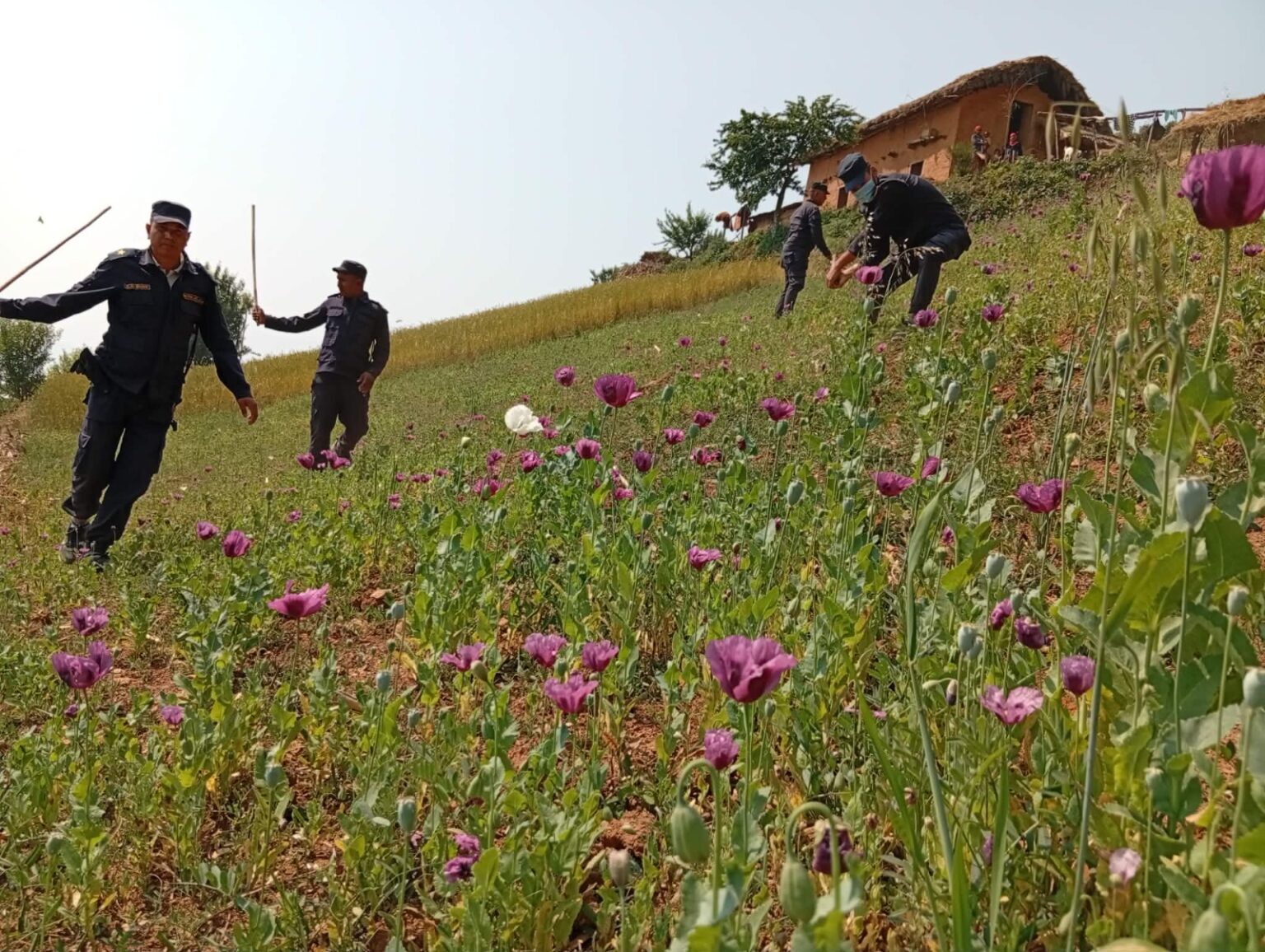
“Opium cultivation is occurring in all local levels of Jajarkot except Shibalaya Rural Municipality,” he says, “We have destroyed opium planted on 1,700 ropanis (864,824 square meters) of land in the last month alone.” He mentions that mostly impoverished people and conflict victims are involved in opium cultivation. These areas were base areas for the then-rebel Maoists.
According to the District Police Office, opium planted on 1,462 ropanis (743,777.88 square meters) was destroyed in 2024/2025. The destruction of 1,700 ropanis (864,824 square meters) of opium cultivation at the beginning of this year shows that opium cultivation in Jajarkot is more alarming than before. “Its cultivation has mostly flourished in remote areas where the police cannot reach,” says DSP Sharma.
Trade and smuggling
Opium cultivation is not limited to Jajarkot; it is equally alarming in neighboring districts Rukum Paschim, Rukum Purba, and Rolpa. Many locals have fallen into legal traps due to such cultivation and illegal trade.
On June 9, 2018, three individuals from Sisne Rural Municipality in Rukum Purba were arrested with opium in Nepalgunj. On the morning of June 9, police arrested Bhupesh Khadka of Kada, Sisne-4, Man Bahadur Khatri of Pokhara, Sisne-4, and Bam Bahadur Khadka with 6 kilograms and 500 grams of opium from the Dailekhi Jay Hotel and Lodge in Nepalgunj Sub-metropolitan City-1, Banke.
According to the police, Bhupesh used to travel from Dang to Rukum to bring opium. Living in Tulsipur, Dang, he would contact drug traders at the Nepalgunj border. After traders at the border ordered opium, Bhupesh reached Solabang in Rukum West and planned with Man Bahadur Khatri and Bam Bahadur Khadka to deliver it to Nepalgunj. On March 18, 2020, the Banke District Court sentenced all three to 17 years and 6 months in prison and a fine of 1.25 million rupees.
This incident is just representative; many people from remote villages in Western Nepal have ended up in jail due to involvement in the opium trade. Yet, there seems to be no shortage of those engaging in such illegal work.
On May 19, 2017, the Area Police Office Kusum detained three people from the police checkpoint in Bairiya, Rapti Sonari Rural Municipality-1, Banke. Two kilograms and 551 grams of opium were recovered from them. Those arrested were Rupesh Pun, Ayan Roka, and Bhageshwar Roka of Ghorahi Sub-metropolitan City-6, Dang. Investigation showed that they, whose ancestral home is in Rukum Purba, used to bring opium from places like Rukum and Jajarkot for sale. On December 13, 2019, the Banke District Court sent all three to prison with a sentence of 15 years and a fine of Rs 500,000 rupees each under the Drug Control Act, 1976.
Dominance of middlemen in villages
Police investigations show that middlemen visit local farmers’ doorsteps themselves to provide seeds and purchase the produced opium. This is why remote villages are attracted to opium cultivation. Middlemen are taking advantage by exploiting the economic hardships of the poor and lower classes.
Due to the lack of government presence and monitoring in remote areas, middlemen have easily spread organized networks. Although action and monitoring occur occasionally, the lack of adequate and continuous oversight allows middlemen to benefit.
When talking to people involved in opium cultivation, they did not want to disclose their names. However, they revealed that due to a lack of employment, low income, and food shortages, they got involved in this illegal work lured by the prospect of quick income.
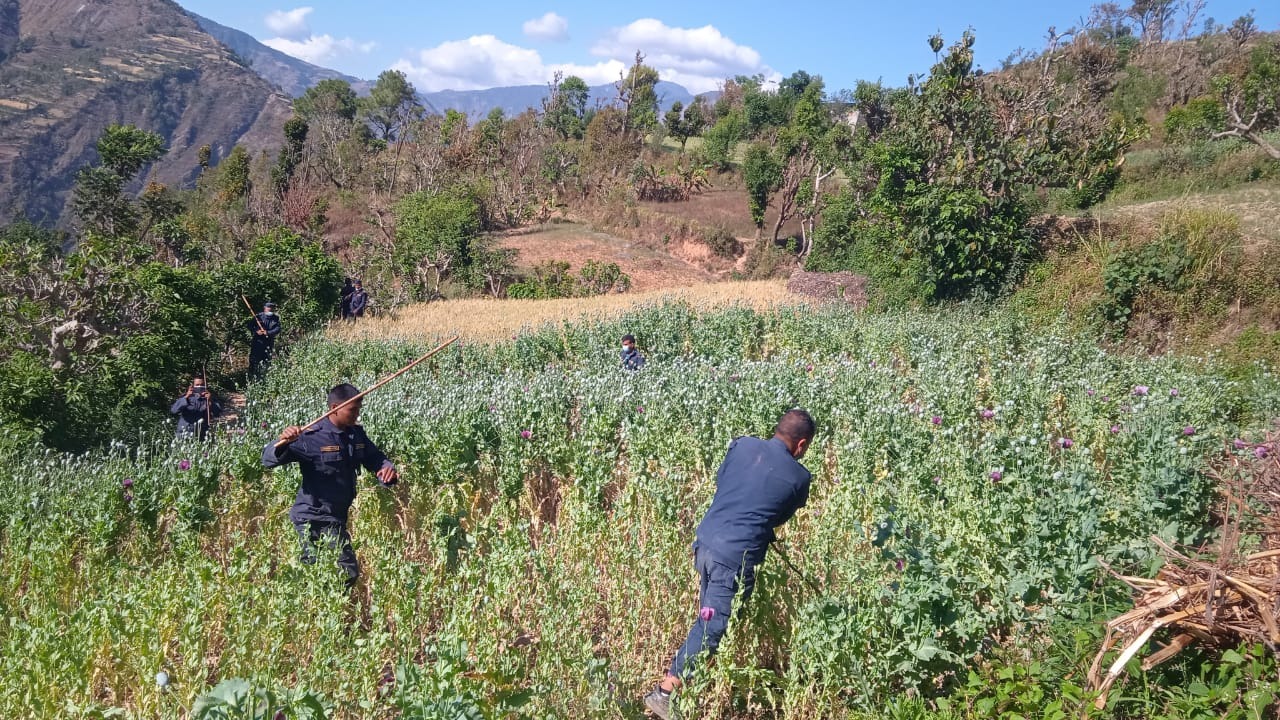
DSP Sharma says, “Poor farmers in remote areas are involved in opium cultivation; their crops are destroyed, but the problem repeats.” Residents of Rukum Purba, Rukum Paschim, Jajarkot, and Kalikot appear involved in opium cultivation and trade. Police studies show that opium from these areas usually reaches India through border points like Nepalgunj.
Short-term solution
The measure police have adopted so far to control opium cultivation is destroying the crops. However, experts say this is not a long-term solution. Indeed, police destroy the crops every year, but the trend of locals taking risks to cultivate it is not decreasing.
In Rukum Paschim, opium planted on 518 ropanis (263,516.96 square meters) of land was destroyed in the short period between mid-February and mid-May, 2025. According to the District Police Office, middlemen transport the opium produced there through Dang and Salyan to Nepalgunj and smuggle it to India from there.
DSP Bed Bahadur Paudel, Chief of the District Police Office Rukum Paschim, says opium cultivation has spread particularly in remote, less developed areas inhabited by impoverished classes where police cannot reach. “We are doing our best to control illegal opium cultivation, which is being treated like a normal crop,” he says, “While moving forward with legal action, we are also investigating how middlemen are pushing remote farmers onto this illegal path.”
In the last three months, the highest amount of opium cultivation—400 ropanis (203,488 square meters)—was destroyed in Aathbiskot Municipality of Rukum Paschim. Similarly, cultivation on 90 ropanis (45,786.6 ) in Sanibheri Rural Municipality and 28 ropanis (14,244.16 square meters) in Banphikot Rural Municipality was destroyed. In Aathbiskot Municipality, even families of lower-class residents who went to India for daily wage labor are found involved in opium cultivation.
Indian ‘connection’
A study by the Narcotics Control Bureau of Nepal Police shows that opium cultivation is significantly increasing in Surkhet, Jajarkot, Salyan, Rukum Purba, and Rukum Paschim under Karnali Province. Not only this, opium is also being illegally cultivated in districts like Dang, Makwanpur, Dhading, Rautahat, Bara, Udayapur, Parsa, and Siraha. The Bureau states that the task of destroying crops in these areas is ongoing.
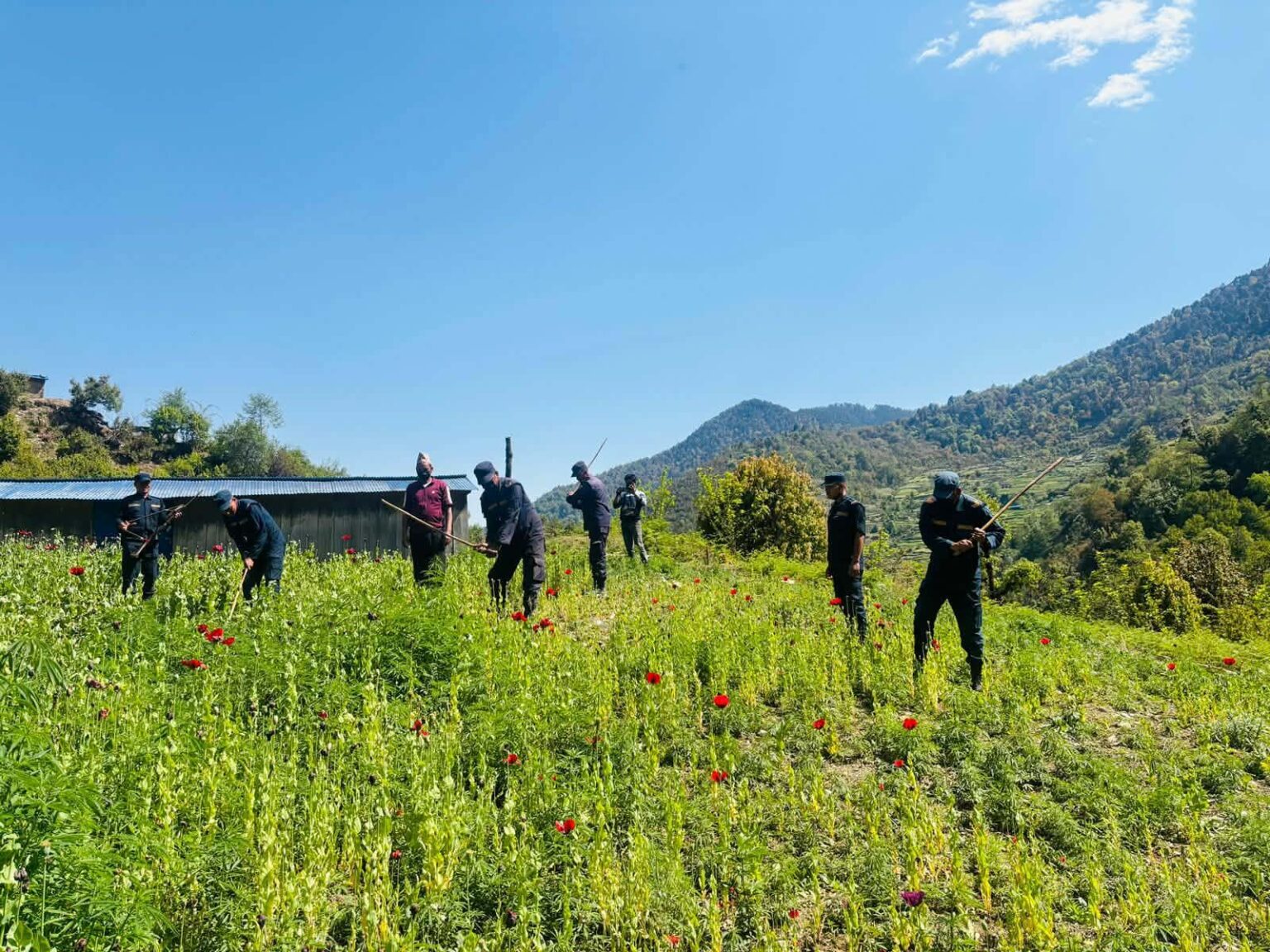
According to Senior Superintendent of Police (SSP) Krishna Prasad Koirala, Chief of the Narcotics Control Bureau, opium produced in hilly areas like Jajarkot and Rukum is transported to India through various border points. He says, “We have arrested middlemen and destroyed crops in many places.”
Former Nepal Police DIG Hemanta Malla Thakuri says that although the expansion of opium cultivation in Nepal is concerning, the government has not shown sufficient sensitivity toward it. “There is some noise when opium crops are destroyed, but the government stops showing interest after that,” he says, “It doesn’t seem like the government has made the necessary investment to control drugs, which is why opium cultivation is increasing.”
In Thakuri’s understanding, Indian traders play a huge role in the expansion of opium cultivation in Nepal. “They are getting it produced in Nepal for their own market; because demand for opium is higher in India, Nepali farmers are utilized; Nepali middlemen are also involved in this,” he says. He warns that if the government cannot effectively control opium cultivation in time through rigorous investigation, a huge risk will be faced in the future.
Looking at the data from the Narcotics Control Bureau over the last three years, drug traffickers appear to be increasing. The Bureau registered 4,399 drug-related cases in the fiscal year 2023/24. In 2024/25, the number of such cases increased to 5,061. In 2025/26, drug-related cases were registered against 2,851 individuals.
Data shows the Bureau recovered 61 kilograms and 690 grams of opium in fiscal year 2023/24. Similarly, 184 kilograms and 98 grams were recovered in 2024/25, and 39 kilograms and 286 grams in 2025/26.
Bureau Chief SSP Koirala says cases have even been filed against Indian citizens in incidents of opium and heroin recovery.
According to high-ranking Nepal Police officials, opium cultivation and trade were previously centered in Terai districts and border areas with Indian investment. But now that style has changed, and cultivation has spread to remote hilly districts including Karnali. DIG Govinda Thapaliya, former chief of the Narcotics Control Bureau who has also worked in the Central Investigation Bureau (CIB), accepts this fact.
Thapaliya, currently the chief of Madhesh Province Police, says, “Even if opium cultivation is in the remote hills, its market is across the border; even now, Indian traders have links with Nepali farmers in some places; Nepal Police is conducting a serious investigation into this matter.”


![Bharatpur decorated with blue flags ahead of RSP General Convention [Photo Feature]](https://english.nepalnews.com/wp-content/uploads/2026/06/5-1.png)