Kathmandu
Monday, July 13, 2026





Nepal heads into the SAFF Women’s Championship still chasing its first title despite reaching multiple finals over the years. With star striker Sabitra Bhandari sidelined through injury and limited preparation compared to rivals India and Bangladesh, the team hopes a new generation can finally end decades of heartbreak.

KATHMANDU: Which edition was the closest Nepal ever came to winning the South Asian Football Federation (SAFF) Women’s Championship title? Anita Basnet, a midfielder for the Nepali women’s football team, says, “2022. But, unfortunately, we missed out.”
That edition remained historic for Nepal. In the group stage, Nepal easily defeated Bhutan and Sri Lanka to secure a place in the semifinals. After that, the Nepali women’s football team experienced an unforgettable moment in history, witnessing a packed stadium of spectators at the Dasharath Stadium in Tripureshwar. That was their first-ever victory against India.
In the semifinal held at Dasharath Stadium in Tripureshwar on September 16, 2022, Nepal defeated India 1-0 with the help of a decisive goal scored by Rashmi Kumari Ghising during injury time of the first half.
However, in the final, Nepal was once again deprived of the title. Bangladesh, a team Nepal had consistently defeated before, emerged as a new challenge. Bangladesh defeated Nepal, who had reached the final performing brilliantly throughout the tournament, by 3-1 to win the title for the first time. Anita herself scored the only goal for Nepal in that match.
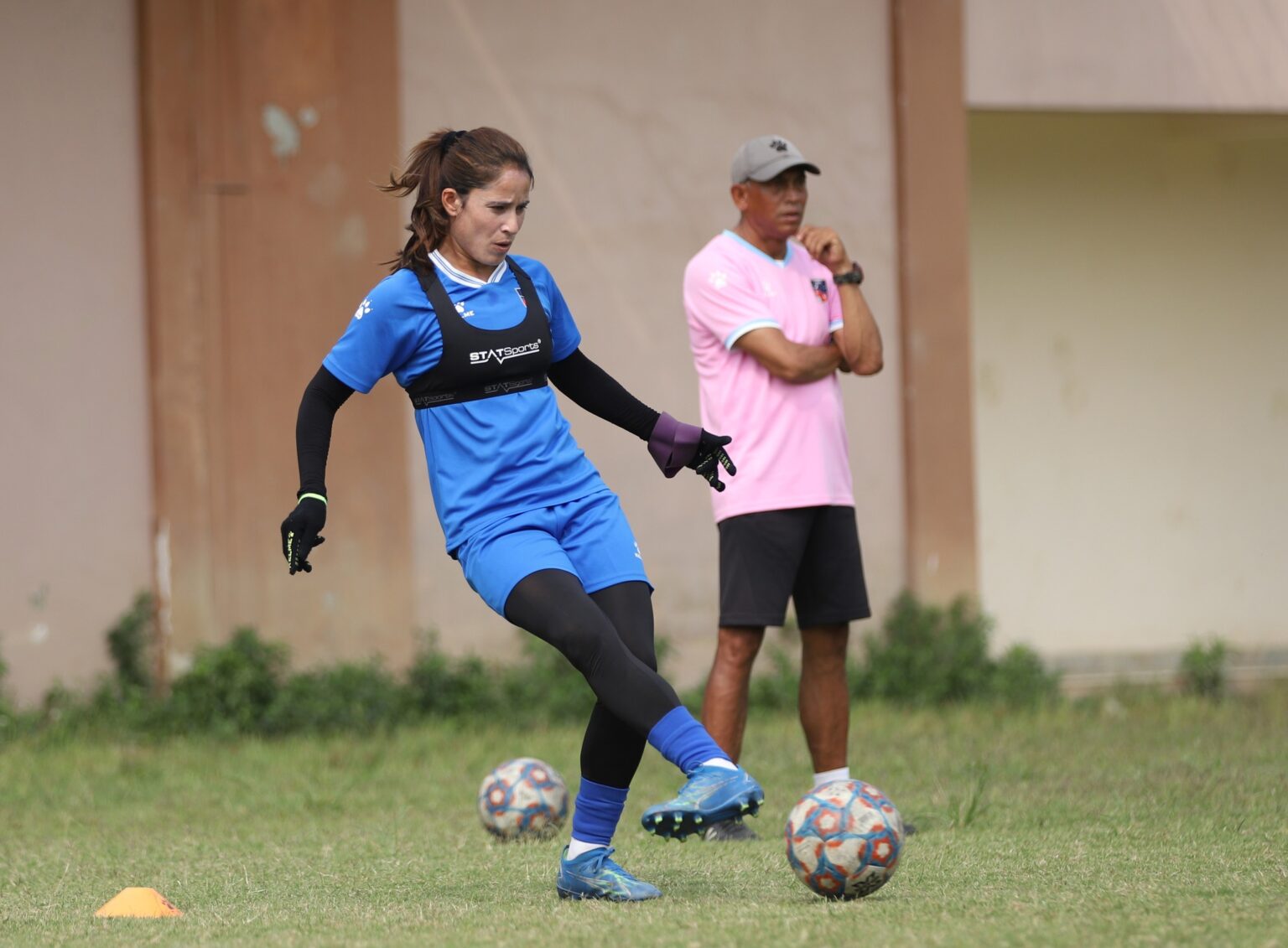
Midfielder Anita Basnet
Nepal has also made it to the finals in subsequent editions. However, while Nepal has been brushing aside the challenge from India, Bangladesh has been stopping them in the same manner. Anita states that this time, they must overcome that challenge and win the title.
“Our ambition is simply to become champions. New players have also joined the team now. Therefore, I believe our goal will be fulfilled this time,” she says. In the tournament starting on Monday in Goa, India, Nepal, along with Bhutan and Sri Lanka, are in Group ‘A’. In the other group, reigning champions Bangladesh are placed alongside India and the Maldives.
Fear of Bangladesh over India
The SAFF Women’s Championship began in the year 2010. In the first edition hosted by Bangladesh, Nepal defeated the Maldives, Afghanistan, and Pakistan to secure a place in the semifinals. Then, defeating the host team Bangladesh 3-0 in the semifinal, Nepal reached the final. Nepal, which had scored 34 goals throughout the tournament, went goalless in the final. Securing a 1-0 victory with a decisive goal from Sasmita Malik, India claimed the title.
In the next two editions as well, the final clash took place between Nepal and India. At that time, the dominance of these two teams in South Asian women’s football was clearly visible. Let alone defeating them, other teams could not even pose a challenge. Although Afghanistan exited SAFF after 2014, the dominance of Nepal and India continued.
Usually, these two teams would fall into different groups and reach the final by topping their groups and clearing the semifinals. Therefore, their meeting would happen only in the title clash.
However, the 2016 edition turned out differently. Although Nepal and India were in different groups, their meeting was set in the semifinal itself.
The main reason for this was India, placed in Group ‘B’, playing a goalless draw against Bangladesh in the final group match. In that match, maintaining their dominance as in previous editions, India defeated Nepal 3-1.
Nevertheless, from that very tournament, Sabitra Bhandari ‘Samba’ began to show signs of her impactful presence. Having made her debut against Bhutan in the previous edition, she drew everyone’s attention by scoring the highest 12 goals in the 2016 tournament. In the subsequent three editions as well, she remained Nepal’s primary goal scorer.
In 2022, however, the balance of power in South Asian women’s football began to shift. Bangladesh emerged as a new obstacle for Nepal, which had been battling India’s challenge for a long time. Arriving in Kathmandu with excellent performances from young players and strong team coordination, Bangladesh defeated India 3-0 for the first time in the group stage. Then, after beating Bhutan by a wide margin of 8-0 in the semifinal, Bangladesh succeeded in winning the title by defeating Nepal for the first time in the final.
Since then, from age groups to the senior level, Bangladesh has become Nepal’s biggest challenge in women’s football.
In the final of the SAFF Women’s Championship 2024 as well, Bangladesh maintained its dominance by defeating Nepal 2-1. Nevertheless, the head coach of the Nepali team, Nabin Neupane, claims that his team possesses better players than those in India and Bangladesh.
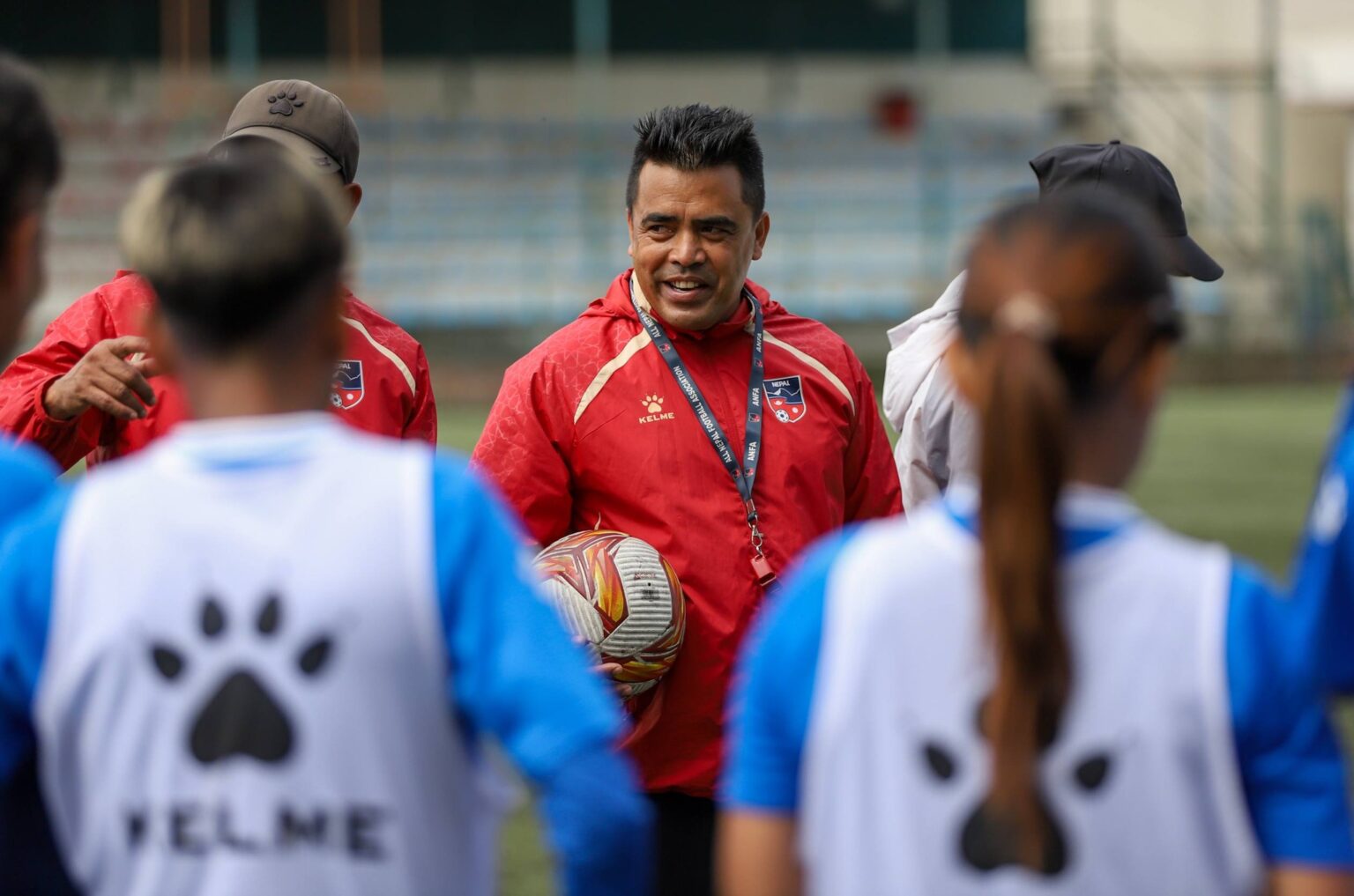
Coach Nabin Neupane
“Our targets are precisely India and Bangladesh. But Samba and Sabita (Rana Magar) are injured. I have included new players. Nevertheless, I am fully confident that I will bring results,” he shares.
The absence of Samba
In the SAFF Championship, considered the ‘Mini World Cup’ of South Asian women’s football, the attention of Nepali fans is usually focused on goals, speed, and victory. All those qualities are visible in a single player. That is Samba. Samba, who has established a distinct identity in South Asian women’s football, will be out of the tournament this time. Currently, she is in ‘rehab’ after undergoing knee surgery in Qatar.
After joining the New Zealand club Wellington Phoenix, Samba sustained her first injury on November 8, 2025, during a match against Canberra United. Following that, when she was injured again during a Melbourne City women’s team match on December 9, she remained off the field for two weeks and was even deprived of playing in the tri-nation women’s football tournament organized in Yogyakarta, Indonesia, from November 26 to December 2.
Returning to the field on January 3, Samba’s old knee problem became serious when she collided with Brisbane Roar’s goalkeeper Chloe Lincoln. Having gathered experience in the Indian, Israeli, French, and Australian leagues, Samba is still the most crucial player for the Nepali team.
Having made her debut for the national team against Bhutan on November 12, 2014, she has already scored 21 goals, including two hat-tricks, in the last five editions of the SAFF Championship. Along with this, she is also the highest goal scorer for the Nepali team. She has scored 66 international goals.
The ability to score goals in difficult situations, the speed to tear through the opposition defense, and the confidence to energize the team are her key characteristics. When Samba is on the field, Nepal tends to adopt an aggressive style. Since the opposing team also devises special strategies to stop her, she possesses the ability to single-handedly change the course of the game.
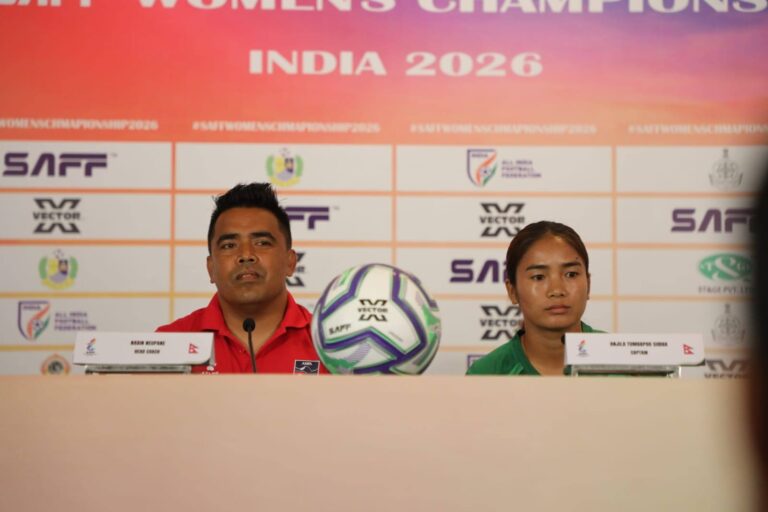
Coach Nabin Neupane and Captain Anjila speaking to journalists before the match against Bhutan
In the absence of Samba, a situation has arisen where the Nepali team must find a new combination. “Just like Argentina without Messi and Portugal without Ronaldo, Nepal feels incomplete without Samba. But sustaining injuries is natural in a player’s career. Although we don’t have a player like Samba, there are some junior players in the team who reflect her glimpse,” says coach Neupane.
Along with Samba, forward Sabita Rana Magar is also injured, so the coach has given opportunities to Purnima Rai and Mina Deuba in the team. Both of them drew everyone’s attention with their excellent performances in the SAFF U-20 Women’s Championship held in Bangladesh from July 11–21, 2025. While Purnima scored the highest 10 goals in the tournament, Mina scored seven goals. With their powerful performances, Nepal became the runner-up.
Mina, who has been playing domestic football for Nepal Police Club, was given her national team debut by coach Neupane through a tri-nation tournament organized in Shillong, India, on October 27, 2025. In the match against India, she replaced striker Rekha Poudel.
Purnima, on the other hand, made it to the squad during that tour but did not get an opportunity to step onto the field. She wore the national team jersey for the first time on December 2, 2025, in a friendly match against the Chinese Taipei women’s national football team. However, that debut could not turn out to be pleasant. In that tournament where Samba was absent, Nepal was defeated 2-1 by Indonesia and 1-0 by Chinese Taipei. Since then, the Nepali team is returning to an international tournament for the first time.
Although this SAFF is a major opportunity for Purnima and Mina, the lack of experience could pose a challenge. Coach Neupane admits that the team might feel the absence of players who can overturn the game at crucial moments. He says, “Especially against strong teams like India and Bangladesh, Samba’s presence used to give extra confidence to Nepal. Even in the semifinal of the last edition, when we were trailing 1-0, she was the one who scored to level the match and took the team to the tie-breaker. But now, we must build the team by accepting the new situation.”
Low investment, hope for title
This time, many players of the Nepali team playing the SAFF Women’s Championship have reached the final stages of their careers. Midfielders Renuka Nagarkoti, Anita Basnet, and Saru Limbu, goalkeeper and captain Anjila Tumbapo Subba, and defenders Hira Kumari Bhujel and Gita Rana are names that have been the pillars of the national team for a long time.
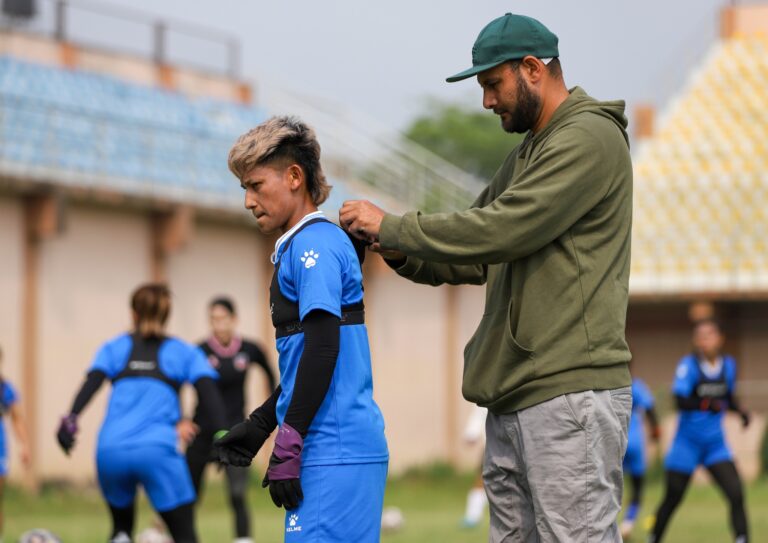
Defender Hira Kumari Bhujel training in Nepal before departing for Goa
Particularly, Renuka, who has been playing for the national team since 2010, has not been able to win a major international title yet. Therefore, she along with the experienced players share a single dream—to bid farewell to the national team by winning the SAFF title.
However, no matter how big the players’ dreams are, the All Nepal Football Association (ANFA) does not seem to have made the level of preparation and investment required to win the title. Nepal, which announced a goal to reach the Women’s World Cup by 2031, could neither play any significant international tournament this year nor make effective preparations targeting SAFF. On the contrary, it even lost the opportunities it received due to administrative reasons.
Nepal’s main competitors, India and Bangladesh, remained continuously active in international competitions during this interval. India played the AFC Women’s Asian Cup held in Australia from March 4–10. Following that, it also participated in the FIFA Series organized in Kenya on April 11 and 15.
Through these competitions, India got the opportunity to play against teams like world champion Japan, Vietnam, Chinese Taipei, Kenya, and Malawi. Meanwhile, Bangladesh played informal friendly matches with Sydney Wanderers and also played the Asian Cup against China, North Korea, and Uzbekistan. The Bangladeshi team, aiming to win its third consecutive title in SAFF, reached Thailand for a two-week training camp. After playing two friendly matches with local clubs there, the team reached Goa.
While even Bhutan was preparing by playing friendly matches against Macau, Nepali players reached Goa to play SAFF relying solely on mofussil gold cups. Due to its own administrative weaknesses, Nepal also missed the FIFA Series that started in Thailand on April 12. However, ANFA’s Chief Executive Officer, Indraman Tuladhar, blames the National Sports Council (NSC) for losing such opportunities.
“We were doing our job. But due to the interference of NSC, not only domestic football but also the opportunity to play the FIFA Series was lost. If we were allowed to work independently, these opportunities would not have been lost,” Tuladhar had stated. The NSC, taking action in accordance with the National Sports Development Act, 2020, and National Sports Development Regulations, 2022, had suspended ANFA for three months on March 25.
The NSC had alleged that ANFA failed to follow repeated directives, attempted to move forward with the election process without approval, and that the clarifications sought by the council were not satisfactory. Specifically, the council took strict steps, stating that the process was advanced against the decision of the executive committee.
ANFA had tried to advance the process related to the General Assembly (Auditory Congress) and elections without the council’s approval. Declaring this against the prevailing laws, the NSC decided to suspend it for up to three months.
During the suspension period, provisions were made that ANFA could not conduct any administrative or election-related activities. This directly impacted the Women’s League as well, and the tournament was halted. However, on May 15, the NSC lifted the suspension unconditionally. With this, the uncertainty hovering over the Nepali team’s SAFF Championship journey cleared up. Nonetheless, defender Gita Rana states that these incidents will not cause any impact.
“This time we got to play continuously. Since we played Gold Cups continuously, we can expect to win SAFF,” she says.