Kathmandu
Friday, June 12, 2026





The US policy now requires some Nepali visitor visa applicants to deposit up to USD 15,000 as a refundable bond before receiving a visa. Here's how the program works, who is affected, how refunds are processed, and what it could mean for future travel between Nepal and the United States
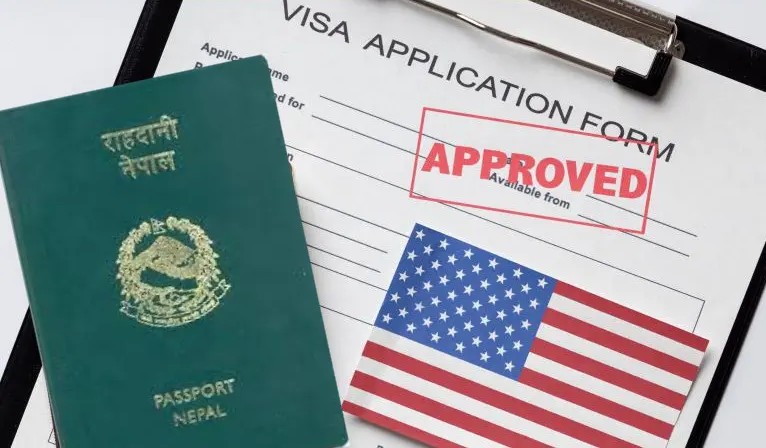
KATHMANDU: Nepali nationals applying for US visitor visas now face a major new financial requirement under a program rolled out by the Trump administration. Since January 21, 2026, Nepalis seeking B1 or B2 visas must deposit a refundable cash bond of up to USD 15,000 before their visa is issued.
The requirement stems from a 12-month pilot program launched in August 2025 under an executive order signed by President Donald Trump.
Nepal was added to the list alongside 24 other countries after US government data flagged its overstay rates as a concern. The program has now expanded to cover more than 50 countries.
What exactly is the US Visa Bond Pilot Program?
The Visa Bond Pilot Program is a temporary policy introduced by the US Department of State that requires certain visitors to deposit a large sum of money as a financial guarantee before they are granted a B1 or B2 visitor visa.
The money is held by the US government for the duration of the visa period and is supposed to be returned automatically once the traveler departs the United States on time and follows all visa conditions.
Think of it as a security deposit, not unlike what a landlord might demand before handing over keys. The difference here is that the government is treating the risk of visa overstay as the liability it wants to insure against. The program was published as a Temporary Final Rule in the US Federal Register on August 5, 2025, and came into effect on August 20 that year.
It is set to run through August 5, 2026, after which the State Department is expected to evaluate whether the mechanism worked and whether it should be made permanent or expanded further.
Who introduced this program and what was the stated reason?
The program was introduced by the Trump administration as part of a sweeping immigration enforcement agenda. Its formal legal basis is Executive Order 14159, signed by President Trump on January 20, 2025, titled “Protecting the American People Against Invasion.”
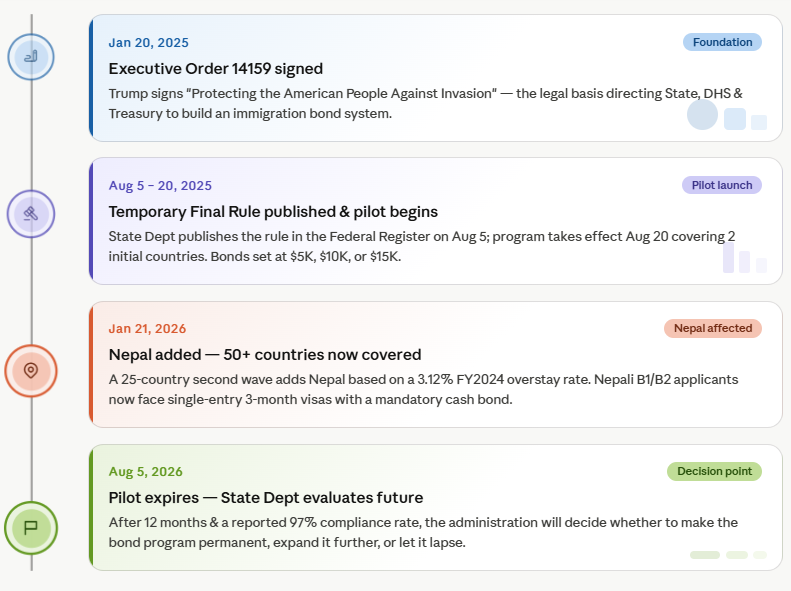
That order directed the Departments of State, Homeland Security, and Treasury to work together to build a system for administering immigration bonds. The subsequent Temporary Final Rule published by the State Department in August 2025 put the mechanism into practice. The administration’s stated rationale was to reduce visa overstays, which it described as a national security concern.
According to US government figures, roughly 500,000 people overstayed their visas in 2023. The State Department also framed the program as a diplomatic tool, saying it was intended to pressure foreign governments to bring down their nationals’ overstay rates and improve the quality of their travel and civil documents, including passport and citizenship issuance systems.
How did Nepal end up on the list?
Nepal was added to the visa bond list effective January 21, 2026, as part of a large second-wave expansion in which the State Department added 25 countries at once. The US government selected countries based primarily on B1 and B2 overstay data published annually by the Department of Homeland Security.
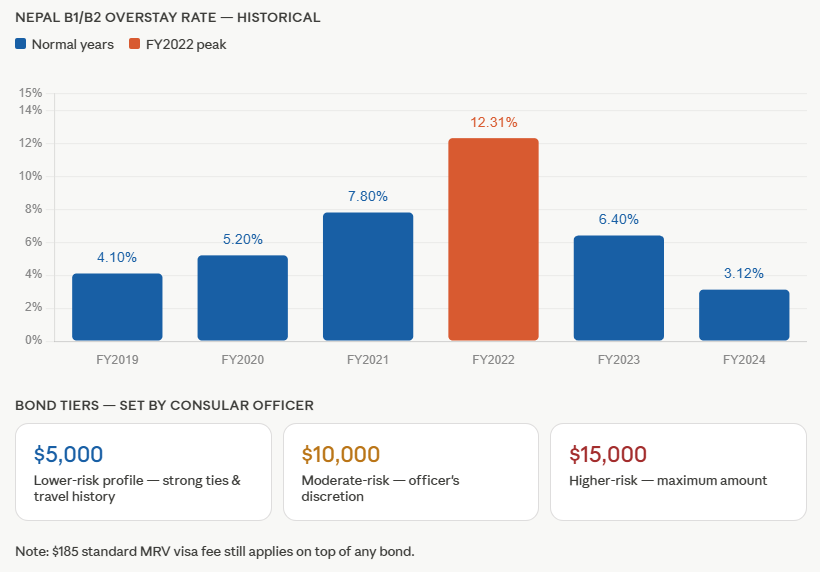
According to the DHS Entry/Exit Overstay Report for fiscal year 2024, out of approximately 34,070 Nepali B1/B2 visa holders expected to have departed the United States, about 1,064, or 3.12 percent, overstayed their authorized period. Of those, around 892 were believed to still be in the country at the time of reporting, representing a suspected in-country overstay rate of about 2.62 percent.
Historical figures were even higher in some years, reaching 12.31 percent in fiscal year 2022. The selection criteria also included whether a country has deficient background screening and vetting systems, and whether it offers citizenship-by-investment programs without requiring actual residency. Nepal was flagged primarily on overstay grounds.
How does the bond process work step by step?
The process begins when a Nepali applicant goes through the standard B1 or B2 visa interview at the US Embassy in Kathmandu. If the consular officer determines that the applicant is otherwise eligible for the visa but must post a bond under the pilot program, the officer will inform the applicant of the bond amount and provide a direct payment link to Pay.gov, which is the official payment platform of the US Treasury Department. The applicant then has 30 days to complete the payment.
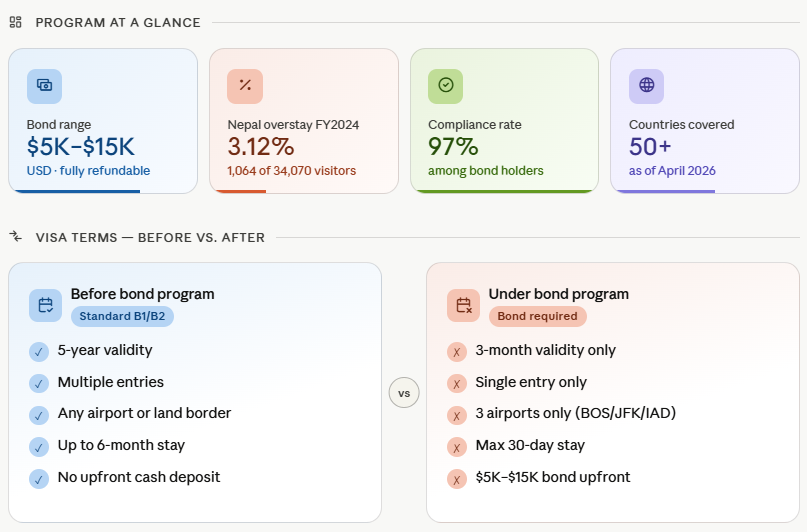
Once the bond is paid and accepted, the visa is issued as a single-entry visa valid for up to three months. The applicant must also complete DHS Form I-352, the official immigration bond form.
The traveller then enters the United States only through one of the three designated commercial airports: Boston Logan International Airport, John F. Kennedy International Airport in New York, or Washington Dulles International Airport. Upon departure from the US within the authorized period and through a designated exit point, the bond cancellation and refund process is triggered automatically.
How much does the bond cost and who decides the amount?
The bond amount is set at one of three fixed levels: USD5,000, USD10,000, or USD15,000. The exact figure is not predetermined for all Nepali applicants uniformly. Instead, it is determined by the consular officer during the visa interview based on the individual’s specific circumstances.
Factors likely considered include the applicant’s financial situation, travel history, ties to Nepal, and perceived risk of overstay, though the regulation does not publicly spell out a precise formula for how officers arrive at the figure. The bond does not earn interest while held by the government.
It is important to note that the bond is on top of, not instead of, the existing visa application fee. Nepali applicants still pay the standard non-refundable MRV fee for the visa interview, which currently stands at USD185 for B1/B2 visas. The bond is an additional requirement imposed after eligibility has already been assessed.
What is the challenge for Nepali applicants in actually paying this bond?
A significant practical complication arises from Nepal’s own foreign exchange rules. Nepali banks and card issuers impose limits on how much money individuals can spend in foreign currencies, and for many applicants, the bond amount of USD5,000 to USD15,000 far exceeds those limits.
This means that simply swiping a Nepali debit or credit card on Pay.gov is not straightforward for most applicants. Following concerns raised about this issue, the US Department of State clarified that a friend, family member, or any other interested party may post the bond on the applicant’s behalf.
That person would use the Pay.gov link provided by the consular officer and supply the appropriate identifiers for the applicant. In practice, this means many Nepali applicants may need to rely on relatives already living in the United States or elsewhere who have access to international banking facilities to make the payment on their behalf.
The State Department has firmly warned against using any third-party websites for the transaction, noting that the US government will not be responsible for payments made outside official systems.
What happens if you follow all the rules? How is the refund processed?
If a visa holder enters the United States through one of the three designated airports, complies with all visa conditions during their stay, does not take up employment, and departs on time through an authorized exit point, the bond is supposed to be cancelled and refunded automatically.
US Customs and Border Protection records the departure electronically, which triggers the process. According to the State Department, the program has reported a 97 percent compliance rate among bond holders since its launch in August 2025, suggesting that the financial stake does appear to be functioning as a deterrent.
However, the refund does not arrive immediately. Reports indicate it can take anywhere from six to eight weeks for the money to be returned after departure.
The bond will also be returned if the applicant does not travel before the visa’s expiry date or is denied admission at the port of entry upon arrival in the US. In those cases, the government simply unwinds the transaction because no stay took place.
What happens if someone overstays or violates the conditions?
If a bond holder overstays their authorized period in the United States, works without authorization, or files an application to change or adjust their immigration status, including filing for asylum, the bond is forfeited.
That means the entire amount, whether USD5,000, USD10,000, or USD15,000, is lost to the US government and will not be returned under any circumstances. Cases of breach are referred to US Citizenship and Immigration Services for review, and once a breach is confirmed, the forfeiture is finalized. This is a significant departure from how things worked before the program.
Previously, overstaying or violating visa conditions could result in bars on future travel to the United States, but there was no immediate financial penalty attached at the point of visa issuance. Now the financial consequence is baked in from the start.
The State Department’s position is that this forfeiture mechanism is precisely what gives the bond its deterrent power. Applicants should also note that the bond has no effect on the legal consequences of a visa violation, which can include deportation, entry bans, and criminal liability in certain circumstances.
What kind of visa does a bond holder receive, and how is it different from a regular B1/B2 visa?
This is where the program introduces a meaningful downgrade from what Nepali travelers had previously been accustomed to. Under the pilot program, a visa issued with a bond attached is a single-entry visa valid for a maximum of three months, with a maximum authorized stay in the United States of just 30 days. This is markedly different from what Nepali nationals typically received before.
Until the program was introduced, Nepal nationals were generally issued B1/B2 visas valid for five years with multiple entries. Under the bond requirement, that five-year, multiple-entry benefit disappears, and travelers receive a far more restricted document that permits just one trip and a month-long visit.
Additionally, bond holders must enter and depart only through one of three designated airports: Boston Logan, JFK in New York, or Dulles in Virginia.
Using a land border crossing with Canada or Mexico, a seaport, or a private charter will result in bond forfeiture because those exit points currently lack the electronic tracking systems needed to verify a bonded departure.
Who is most affected by this rule among Nepalis?
The impact is broad but falls most heavily on specific groups. Nepalis seeking to visit relatives settled in the United States, a very common travel purpose given the large Nepali diaspora, now face the prospect of relatives having to post a substantial cash bond to facilitate the visit.
Business travelers attending conferences, trade meetings, or short commercial engagements are affected since B1 visas are among those covered. Tourists traveling to the United States for sightseeing or cultural visits are equally subject to the requirement.
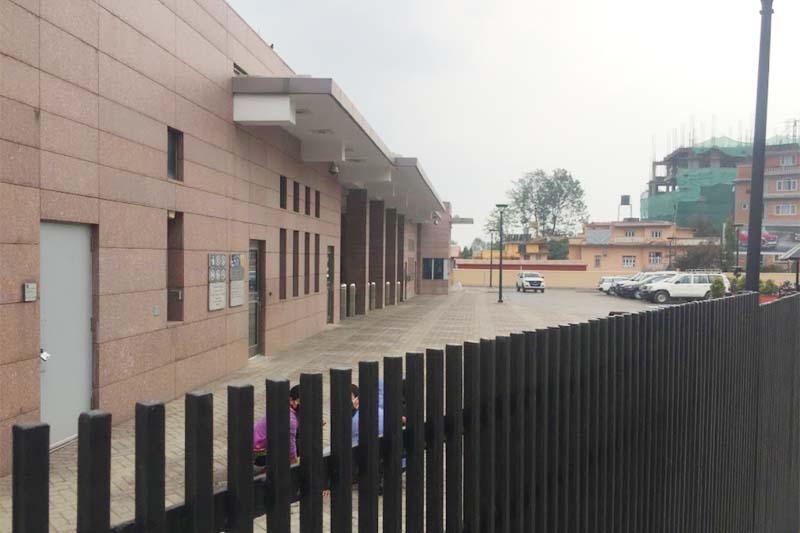
US Embassy in Kathmandu. File photo
Academic visitors who might normally use a B1 visa to attend a workshop, seminar, or short professional program at an American university are also affected, though some universities have suggested that the J-1 short-term scholar visa might be an alternative for such individuals.
The program does not affect students on F-1 visas, workers on H-1B or other employment-based categories, or exchange visitors who already hold J-1 status. It is purely a B1 and B2 visitor visa measure.
Are there any exemptions or waivers available?
The rules are strict and exceptions are narrow. The State Department has stated that there are very limited circumstances under which the bond requirement might be waived. Examples cited in the regulation include US government employees traveling on official business and applicants with urgent humanitarian needs.
Beyond those narrow categories, there is no general waiver mechanism and no avenue for appeal of the bond amount through the normal visa process. It is also worth noting that not every Nepali applicant for a B1/B2 visa will automatically be required to post a bond.
The consular officer retains discretion to decide whether a particular applicant poses enough risk to warrant the requirement. An applicant with a strong travel history, clear financial ties in Nepal, a credible itinerary, and a compelling reason to return may not be asked to post a bond even though Nepal is on the country list.
The country designation sets the baseline risk assessment, but the individual decision rests with the officer at the interview.
What happens after the pilot ends in August 2026, and what does this mean for Nepal’s long-term relationship with the US on visa matters?
The program is technically set to expire on August 5, 2026, after running for 12 months. At that point, the State Department is required to assess whether the bond mechanism effectively reduced visa violations and whether it is operationally sustainable to administer.
Given that the administration has cited a 97 percent compliance rate among bond holders so far, and given that the program has already grown from covering just two countries at launch to more than 50 by April 2026, the political direction is clearly toward expansion rather than expiry.
An earlier attempt at a similar program during Trump’s first term was abandoned when the COVID-19 pandemic shut down international travel before any meaningful data could be collected. This second attempt is generating data, and the administration is expected to use it to make a case for a permanent or expanded program.
For Nepal specifically, the inclusion on the list reflects how the US government now formally categorizes Nepal as a higher-risk country in terms of potential visa overstay. Removing Nepal from the list would require a sustained and demonstrable improvement in the national overstay rate.
The Nepali government has not yet announced any formal diplomatic initiative aimed at addressing this categorization, but the long-term visa implications, including the effective end of multi-entry, multi-year B1/B2 visas for many Nepali applicants, make it a matter worth pressing in bilateral discussions.