Kathmandu
Saturday, June 13, 2026





A musical intervention combating substance abuse in Damauli
In the bustling market of Damauli, there is a street named Safa Sadak Marg (Clean Street Avenue). Situated right beside the Vyas Municipality office, the avenue isn’t quite as pristine as its name proudly claims. This road, cutting right through the heart of the municipality, leads straight to the District Administration Office of Tanahun. Adjacent to it lies a sprawling open ground and a traditional resting square (chautari), famously known as Ansan Chautari (Protest Square).
It is a peculiar name, isn’t it? Yet, it makes perfect sense. For years, this square has stood as a silent witness to every conceivable form of hunger strike, sit-in, protest rally, political demand, and march.
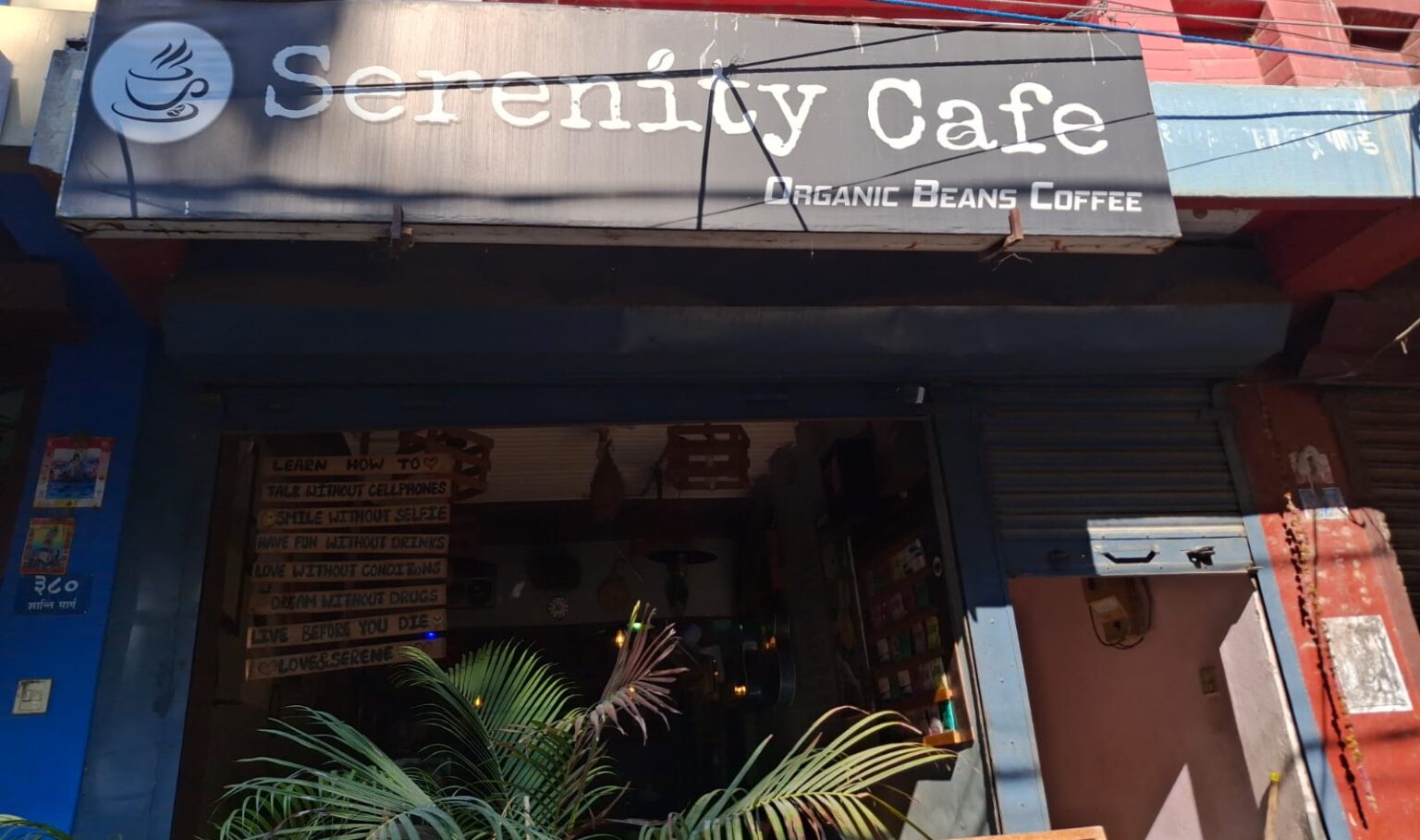
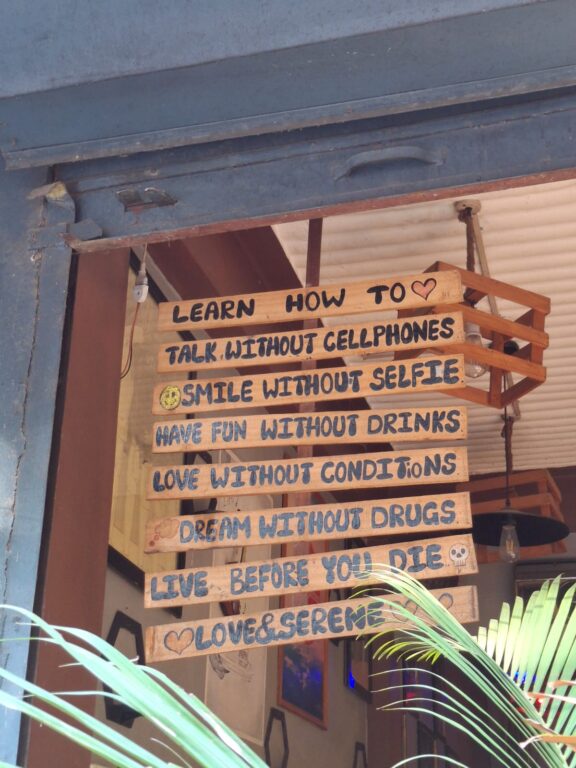
Right across from Ansan Chautari sits a cafe. Inscribed clearly upon its storefront is its identity: Serenity Cafe. True to its name, it is a peaceful sanctuary tucked away right next to a hub of loud commotion and political power displays. Hearing the name Serenity standing amidst such chaos, you might find your own mind drifting into deep reflection.
The first entry
Imagine for a moment that you are a local resident of this hill town. You are wandering aimlessly through the streets, trying to kill time that refuses to pass. Finding yourself at this historic square, you dissolve into the local scenery and settle down comfortably at the base of a sprawling banyan tree. As the mid-day sun beats down, a sharp thirst hits you. You reach into your backpack, pull out a fresh sweet orange (junar), and begin peeling it to quench your thirst. Your hands are busy separating the citrus segments while your eyes wander, lazily soaking in the rhythmic daily activities unfolding around you.
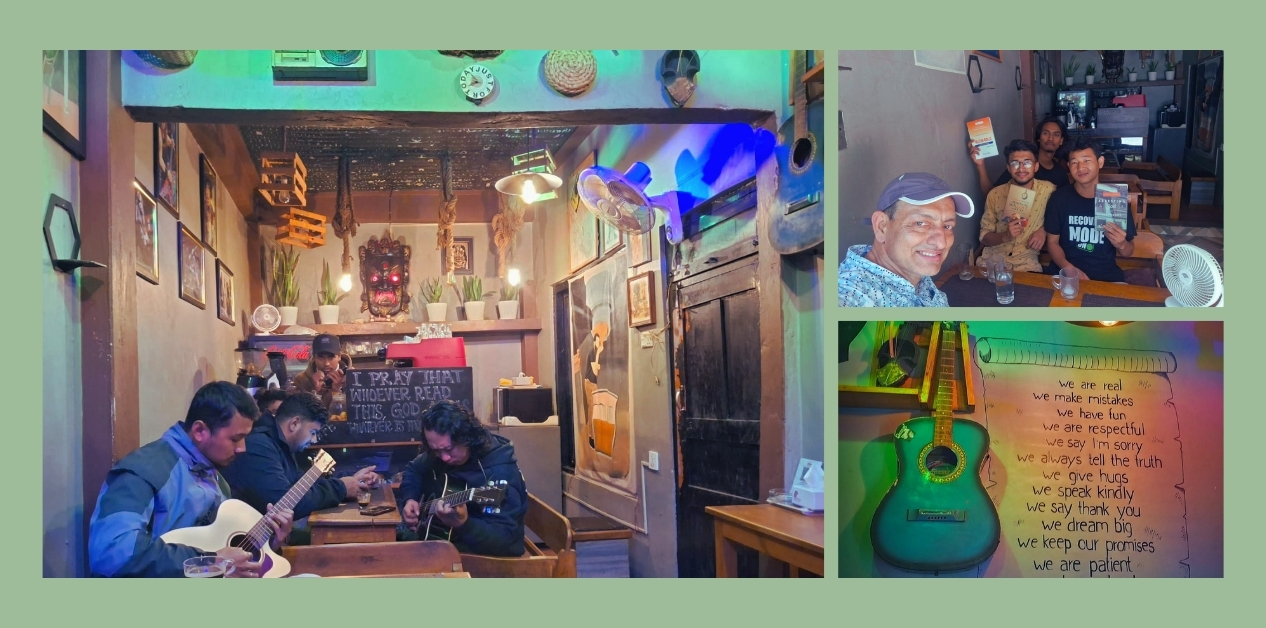
At the entrance, lush green plants and vibrant flowers offer a silent welcome. The interior draws you in even deeper. As you settle onto a sofa, you notice guitars hanging beautifully all across the walls. You are completely free to pick up any guitar that catches your eye and strum whatever melody your heart desires.
Here, you can sip a cup of coffee deeply infused with the warm hospitality of the owners, Dipesh and Amrit, while immersing yourself in music. This musical remedy is completely free of charge. There is no “luxury tax” here—or rather, excuse me, no “music tax.”
The writer at Serenity Cafe (second from right). Photo: Ganesh Khaniya
The walls and ceilings might make you pause in wonder, asking yourself: Where exactly have I stepped into? The space unfolds like a living art museum—a sanctuary where various creative forms converge. Alongside rows of guitars, traditional Sarangis hang gracefully on the walls. Instantly, the endless melancholic and joyous tunes wrung from the strings of a Sarangi begin to echo in your mind.
The haunting strain of the late Jhalak Man Gandharva’s iconic ballad, “Hey Barai…”, might pull you into deep nostalgia. Or perhaps you will find yourself humming the contemporary hit “Purna Bahadur Ko Sarangi”, picturing a father sacrificing his waistcoat to stitch a shirt for his son.
A natural honeycomb, an antique cassette player, intricate hand-drawn sketches, and portraits of legendary musicians collectively transport you to a bygone era. It leaves you wondering: How has a detailed portrait of life from fifty years ago been captured so perfectly inside this modern coffee house?
Amrit started this cafe during the height of the COVID-19 pandemic. Possessing a generous heart and a gentle, unassuming smile, Amrit greets customers the moment they walk in and immediately gets to work ensuring they feel at home. He strikes up easy conversations, and if a shared comfort develops, he doesn’t shy away from lighthearted banter.
I found myself under Amrit’s hospitable care on a pleasant afternoon. In my hands was a non-fiction book, The Return World and the Unreturn World, by the Italian master Italo Calvino. “Take a nice photo of brother here, make sure the book is in the frame too,” Amrit instructed his partner Dipesh with a warm smile.
During my two-hour stay, I downed two servings of coffee. You could easily call this the “Amrit Special Offer” because he stubbornly dug his heels in, insisting, “Even if it costs me my life, I will not take money from you today.”
Inside Amrit’s sanctuary, you can stay as long as you like. You can play the guitar, sing a song, whistle a tune, tap the tables rhythmically, light a cigarette, and watch the smoke drift away without a care in the world. There are no restrictions here.
The second entry
It is December 31, 2025. The clock reads 7:30 PM. In this hill station, the streets have already grown quiet, with foot traffic thinning out significantly. Only a handful of pubs, cafes, and restaurants remain open, alongside a few local taverns and betel-leaf shops.
From behind the counter at Serenity Cafe, Dipesh spots us walking in. His enthusiastic “Welcome back!” and warm wave make the greeting exceptionally charming. Placing two glasses of piping hot water on our table, he smiles and says, “Please, have some warm water while I brew your coffee.”
On the other side of the room, Amrit’s fingers are busy dancing across guitar chords at a front table. He is deep in a practice session with Pawan Shrestha, a musician hailing from Khudi, Lamjung. The moment we had walked in, Amrit had welcomed us with a subtle nod.
Shortly after, Jacky, who runs a sweet shop nearby and belongs to Janakpur, arrives with his friend Ayush. For a while, the duo sits completely absorbed in a rich cocktail of warm coffee sips and drifting cigarette smoke.
Finishing his musical session, Amrit approaches our table with a respectful Namaste. I hand over two books I brought for him: Paulo Coelho’s The Alchemist and H.G. Wells’ The Time Machine. His face lights up with a mixture of joy and surprise. It wasn’t an extraordinary gift, yet he placed his hands on his head in disbelief, shaking his head repeatedly as if unable to process the unexpected gesture.
Being a man of few words, Amrit communicates mostly through expressive physical gestures. Polished and carrying a gentle air of mystery, he walks back over to Pawan, picks up his guitar as before, and their musical duet resumes. An Americano coffee is served before us. Raising his glass in a silent toast, Amrit lifts his guitar slightly and plunges right back into his chords.
Laxman, the man behind the coffee machine, is a bit reserved. He offers a shy greeting from a distance. As it is getting late for him to head home, he quickly bids us goodbye, kicks his scooter into life, and rides off.
Sitting at the table directly ahead of us is Zoya. Keeping quiet until now, she gradually eases into our conversation. It is fascinating how connections, introductions, and relationships among humans can flow effortlessly like a stream expanding into a river, eventually finding profound depth in an ocean. At other times, they fracture like a stray current, separating just as quickly as they formed.
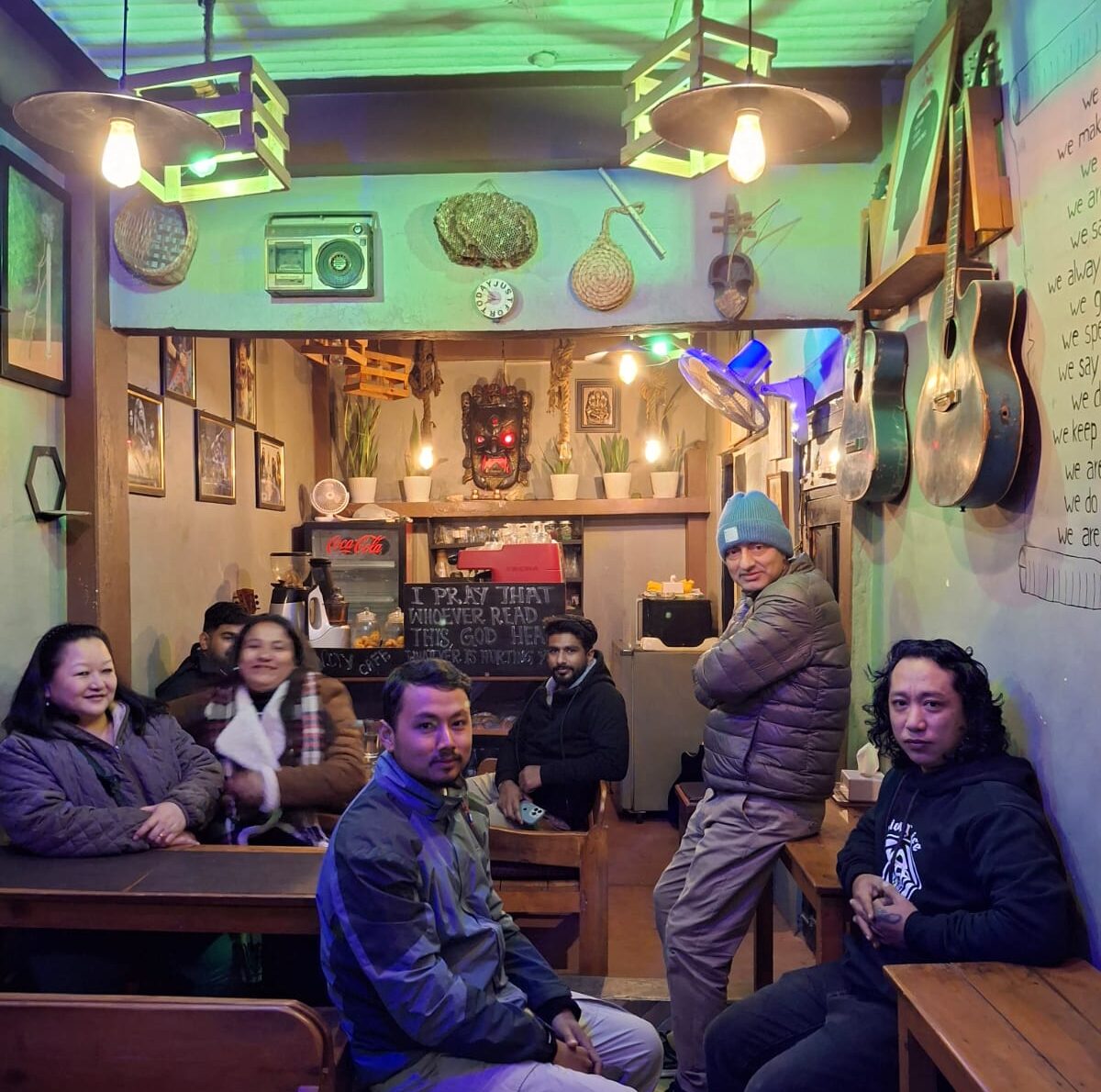
The wall clock chimes, signaling 9:30 PM. The biting winter cold is turning sharp, much like a potent batch of local millet beer. The cafe band is packing up their gear, preparing to call it a night. To capture the final evening of 2025 into a memorable keepsake, the seven of us gather together for a photograph. We drain the final drops of our coffee to mark the end of the year and step out, our footsteps echoing through the completely silent heart of the town.
The third entry
“No man ever steps in the same river twice.” — Heraclitus
Stepping into Serenity Cafe for the third time, the scene before me looks entirely different from the days before. Just as Heraclitus observed, both people and environments inevitably change with every passing moment.
On the open ground adjacent to Ansan Chautari, a vibrant festival celebrating Maghe Sankranti is in full swing. Loud music blares continuously, occasionally turning harsh to the ears. The peaceful sanctuary of Serenity faces a loud external challenge today.
Inside, a young couple is entirely engrossed in their coffee, each completely lost in their respective smartphones—a clear indicator of how modern dating dynamics have evolved.
At the front table, another group caught my attention. Among three young men, two are entirely immersed in music with a guitar in hand. One is playing the instrument, while the second is enthusiastically air-guitaring—mimicking chord movements with his fingers in mid-air. Their third friend claps along rhythmically, checks his phone, and takes a drag from a vape pen.
Serenity cafe. Photo: Ganesh Khaniya
This group, currently employed in Portugal, is back home on vacation. “We are just enjoying a little chill time, uncle,” they say with easy grins.
I am delighted to see Jacky and Ayush, the two friends I met during my previous visit, walk in again. A long thread of conversation unfolds over cigarettes. A short while later, Basanta Khanal joins us. “My home is in Gunadi, just a bit outside Damauli. I’ve just arrived from Pokhara. I couldn’t possibly pass by without stopping for a coffee,” he shares warmly. Amrit and Dipesh mention that Basanta is an avid ghazal writer. Before long, Basanta recites two of his beautifully penned verses:
A wise soul once came to reside within my heart,
Having murdered that very heart, he fled into the dark.
What must these eyes witness, searching through the strain?
Why must we endure dark markets in times of sheer pain?
As I chat with Basanta, my eyes scan the interior of the cafe once more. Every object is exactly where it stood during my very first visit. Yet, everything feels entirely fresh to me—even more artistic. The cafe beautifully masterminds a perfect trinity of green plants, visual art, and live music. Diverse expressions of creativity are scattered everywhere, leaving an impression on every corner.
The final entry
This is the very scene of Serenity Cafe that I have visited numerous times now. I have completely lost count of the visits. Yet, with every single trip, I find myself interacting with new faces, collecting fresh perspectives, and returning home a bit changed, corrected, or enlightened.
Yesterday, I was introduced to Kisan here. He is a man of few words who communicates mostly through a quiet, gentle smile. My other two companions are familiar faces—Dipesh and Basanta. Basanta has a book by Khushwant Singh in his hands: Khushwant Singh on Women, Sex, Love and Lust. He reads a passage aloud: “Love tortures, sex delivers bliss.” You might wonder what kind of a scandalous old man this Khushwant was. In truth, he wrote with absolute, unfiltered honesty. He once famously said, “Everyone calls me a dirty old man, yet they read my books in secret.”
This reminded me of an insight shared by my student, Sufana, who noted that this exact thought represents the classic male discourse—and arguably, the root of all modern romantic complications.
Let us leave Khushwant aside and turn our focus back to Serenity. Picture a blazing hot mid-day afternoon paired with a piping hot cup of coffee. It sounds completely counterintuitive. Yet, visiting Serenity means drinking coffee, regardless of the weather. Basanta is an absolute coffee addict himself. However, he confesses that a double shot of Americano a few weeks ago left him wide awake for two straight nights. Because of that experience, he has temporarily sworn off coffee and shifted his loyalty to refreshing lassis.
My mind begins to construct a fictional plot. Why does coffee leave such a lasting, intense impact on Basanta? I am reminded of David Shields’ essay, Natural Born Liars. Most of us are practiced in the art of minor deceptions. As the essay suggests, if we successfully deceive ourselves, we can effortlessly wrap the rest of the world in a blanket of untruths.
In the chaotic game of love, complications are permanent fixtures, so why should Basanta be any exception? It feels as though Basanta is quietly holding back an unspoken truth. Perhaps he is experiencing the silent grief of separation from a long-term partner, which might explain his recent bout of insomnia. The vivid images of heartbreak woven into his ghazals certainly didn’t emerge from thin air:
Do not claim my fragile breath after tearing my heart apart,
She blooms beautifully, do not steal her fragrance from the start.
Love thrives deeply in the heart when left unexpressed,
As it fractures, leave no despair in the eyes of the depressed.
When making vows, stars and moons seem to descend near,
He was, and remains, an echo of one’s own self, dear.
He plucks a single rose to lay his emotions bare,
Is he practicing love, or seeking the divine in prayer?
The philosopher Carl Jung famously noted that thinking is difficult, which is why most people prefer to judge. However, I have no desire to be judgmental. Drenched in sweat from the blistering heat, my mind keeps looping back to the weather. To counter this intense heatwave, are commercial soft drinks like Coke, Pepsi, or energy drinks truly enough? How many bowls of yogurt or ice cream can one possibly consume?
Instead, this is the perfect time to dive into the cool waters of the Madi, Marsyangdi, Dordi, or Chepe rivers. For those who cannot swim, it is the season to lounge under the cool, shaded canopies near the Vyas Cave, or spend a relaxing two-day government weekend sprawled on a traditional straw mat, enjoying the breeze of a ceiling fan.
Cafe
Driven by these thoughts, my feet pivot before I even reach the cafe doors, leading me to a nearby shaded canopy. I settle onto a concrete bench and melt into the casual chatter of the people around me. A colorful mosaic of topics bubbles up. You can find everyone here—from citizens singing high praises of the government to frustrated youths whose visa rejections have left them completely distraught.
Growing restless sitting in one spot, I move over to an adjacent cluster of people. A lively World Cup fever is palpable among a group of young boys. They are proudly sporting jerseys of Brazil, Spain, France, and Argentina.
People often claim that Nepal’s socio-political landscape has transformed entirely because of Gen Z. Yet, looking at the World Cup fandom, I see the exact same old team loyalties dominating the space.
As I sit there lost in thought, a young woman approaches me. “Would you like some buttermilk (mohi)?” she asks gently. For a split second, I am caught off guard. What is this girl talking about? I think to myself, slightly annoyed. Sensing my confusion, she clarifies, “It is exceptionally hot out today, I just thought you might enjoy a cold glass of buttermilk.”
Light dawning on me, I smile and reply, “Ah, I understand now. Give me two bottles, please.”
With the bottles in hand, I head straight back to Serenity. Dipesh and Basanta are already in the middle of an impromptu guitar session. A moment later, wiping sweat from his brow, Amrit walks in. I hand over the fresh buttermilk, and we share the refreshing drink together.
I had been intensely curious about Amrit’s unique initiative. I have seen numerous artistic cafes across various cities. In Jamal, Kathmandu, there is an ‘Artistic Cafe’ beautifully adorned with diverse plants and flowers, where people sit with palettes and brushes, completely lost in painting or sketching. There, you can occasionally witness Gen Z couples weaving romance into their art, offering onlookers a free display of affection.
The capital city also boasts several book cafes. While other cafes display rows of books on shelves nowadays, their core transactions feel rigidly commercial. Waiters appear every few minutes to prod you with, “What can I get you next?” Without explicitly telling you to leave, such places ruin the experience, shaking the foundations of reading culture before it can even take root.
From this perspective, the environment inside Amrit’s cafe is completely liberating. Whether you order something or not, choose to take a nap, or simply hum to yourself, it makes absolutely no difference to them.
Why did he specifically build a guitar cafe? Amrit explains with a tone of deep concern, “The drug problem has grown alarming here, brother. The local youth are ruining their lives entirely. That is why I started this cafe. I wanted to see if music could offer them a path to healing.” Knowing that Amrit has begun picking up musical influences from across the border through his friendship with Ranjan, a companion from Darjeeling, his words carry a profound weight.
Amidst the loud, jarring rhetoric and heavy self-promotion of various social organizations claiming to drive societal change, Amrit’s quiet campaign stands entirely unnoticed. Yet, he remains completely unbothered by the lack of recognition. He is content to let the therapeutic power of music envelop the local youth, gently guiding them miles away from the destructive paths of addiction that he himself walked away from years ago.
If you ever find yourself traveling toward Pokhara and the timing works in your favor, you too should make it a point to be a guest at Serenity Cafe. Consider this a warm, open invitation to share a cup of coffee and a soul-stirring melody.