Kathmandu
Thursday, June 18, 2026





If members of the government turn digital media into tools for popularity, retaliation, and conflict among fans instead of using them as platforms for civic education, the politics of the new generation will simply become a digital version of the old, intolerant culture
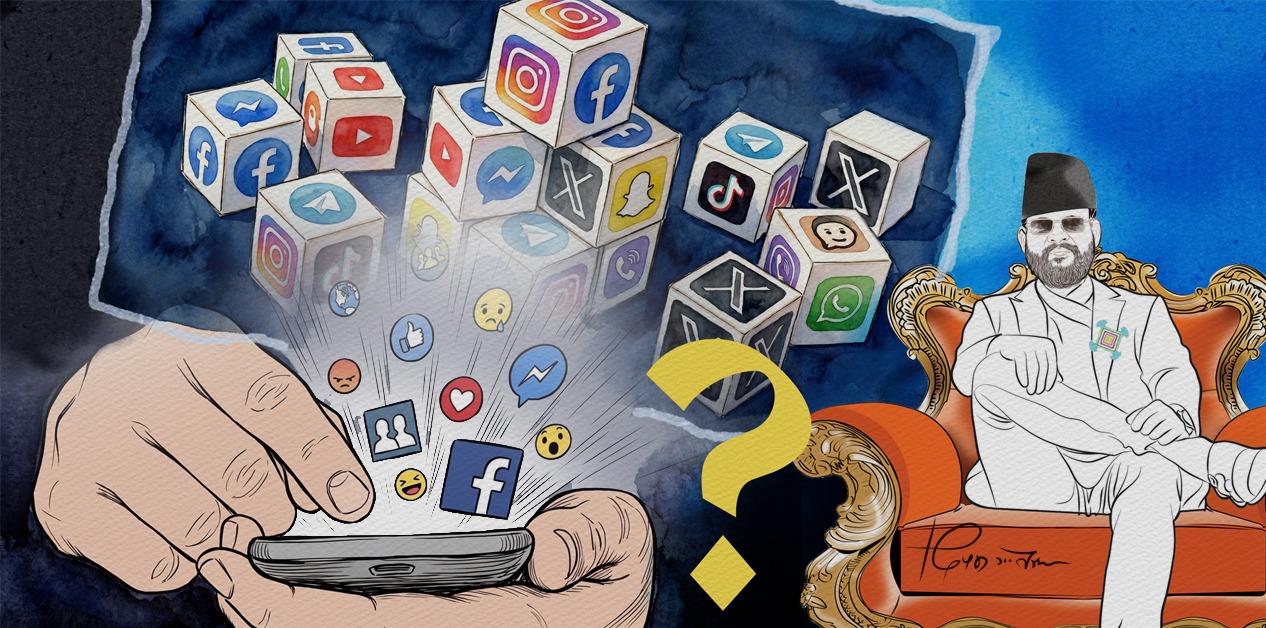
KATHMANDU: The country’s public life is currently influenced by the political presence of the new generation. The attraction toward youth leadership is not born out of age alone; behind it lies dissatisfaction with the old political culture, intense anger against corruption, high frustration with public service delivery, deep skepticism and mistrust toward governance, and a new political consciousness expressed through digital networks. Therefore, the youth presence seen today in the government, parliament, local levels, and public institutions should not be understood merely as an event of acquiring posts, but must be viewed as an important opportunity for Nepali democracy to redefine itself.
However, a serious challenge is also attached to this very opportunity. That is the situation where the boundaries between expression, popularity, criticism, and trolling in digital media are becoming progressively blurred. For members of the youth government, this issue is not about criticizing someone else, but a question of public accountability that they must reflect upon themselves. This is because today’s political communication is not limited to press releases, speeches, or formal interviews alone. A single social media status, a short video, a satirical comment, an emoji, a share, or even a silence is read as a public message.
This situation is even more sensitive in a society like Nepal, where digital literacy remains weak. Many citizens have not had sufficient practice or opportunity to distinguish between facts, opinions, propaganda, satire, anger, unverified information, and institutional decisions. Under such circumstances, the social media usage of young leaders in power cannot remain confined to personal expression alone. It becomes a signal that determines the behavior of supporters, the reaction of opponents, the framing by the media, and the direction of civic debate.
Therefore, members of the youth government must ask themselves a few questions: Is my use of social media maturing civic dialogue, or is it instigating a mob reaction? Is my post clarifying policy, or is it merely transmitting impulse? Is my language accommodating dissent, or is it presenting critics as enemies? Is what I have written a personal reaction, or an expression bearing the moral weight of a public office?
The context here seeks to bring up trolling. It is a mistake to understand trolling merely as a general joke or political satire. There is a place for satire in democracy, there is a right to criticism, and there is civic freedom to question authority. However, when criticism turns into insult, dissent into abuse, questioning into character assassination, and political dialogue into entertainment for a digital mob, that is where trolling begins. Trolling does not just hurt an individual; rather, it weakens the collective culture of how to speak, how to listen, how to disagree, and how to seek evidence in a society.
The context here seeks to bring up trolling. It is a mistake to understand trolling merely as a general joke or political satire. There is a place for satire in democracy, there is a right to criticism, and there is civic freedom to question authority.
Academic studies do not look at trolling merely as the behavior of a few uncivilized individuals. As early as 2004, John Suler discussed cyberpsychology and behavior as the “online disinhibition effect,” warning about how anonymity, distance, instantaneous feedback, and a lack of social control in the online environment can prompt people to behave in ways they would never dream of in face-to-face interactions. In other words, he presented the foundation that digital mediums can weaken human restraint. Following this, a 2017 study by Justin Cheng, Michael Bernstein, Cristian Danescu-Niculescu-Mizil, and Jure Leskovec showed something even more serious: even ordinary users can be nudged toward trolling behavior under the influence of a negative environment, provocative reactions, and a bad mood. This means trolling or trolls are not confined to a specific group; the context can pull even an ordinary citizen into becoming a troll.
This very point holds special meaning for the youth leadership. When an individual occupying a high public office posts aggressive, satirical, ambiguous, or impulsive content on social media, it can send a serious, long-term signal to their supporters to “now defend,” “attack,” or “answer the opponent.” Plentiful examples of this scenario can be factually verified from the period when Donald Trump was elected president for the second time in the United States and through his subsequent continuous social media posts, as documented in various studies, media reports, and even congressional remarks. Even if the leader himself does not intend it, the digital crowd of supporters might derive exactly that meaning. After that, social media posts cease to be the beginning of a dialogue and instead become flashpoints for digital clashes.
Greek-American social scientist and professor Zizi Papacharissi has explained digital politics as an “affective public sphere” formed through the interaction of emotion, communication technology, and political participation. On social media, people organize themselves not just on the basis of facts, but on anger, hope, insult, fear, pride, pain, and group identity. In Nepal, youth political activism also derives its energy to a large extent from such emotional publics. This energy can be transformative, but if it is not connected with critical media literacy and democratic discipline, the danger of it transforming into digital retaliation, conflict among fans, and a troll culture always remains.
A 2015 meta-analysis on social media use and political participation by Canadian sociologist Shelley Boulianne, an expert in political communication and digital media, shows that a positive relationship has developed between social media and political participation. Social media gives the youth an opportunity to speak, be seen, organize, and enter the political process. However, the quality of all digital participation does not possess a democratic character. “Likes,” “shares,” “comments,” “trends,” “viral,” and “attacks” can be indicators of participation, but they are not always conscientious civic engagement. Therefore, members of the youth government must distinguish between digital activism and digital consciousness.
The Media and Information Literacy framework put forward by UNESCO is extremely useful in understanding this context. UNESCO does not encourage looking at media and information literacy merely as a skill to operate mobiles, computers, or social media. Its core intent, insistence, and campaign lie in developing the capacity to search for information, identify sources, critically evaluate content, create messages, share responsibly, and behave ethically as digital citizens. This perspective of UNESCO urges citizens to connect with digital media not just “for participation,” but “critically.”
For the young members of our government, media and information literacy must not remain confined merely to a subject of the Ministry of Education or the school curriculum. It must also be the very foundation of their own style of governance. When young members of the government use social media, they must view themselves on three levels. First, they are citizens and, like anyone else, have the right to freedom of expression. Second, they are political figures; hence, their language influences supporters and opponents. Third, they are public officials; therefore, institutional accountability is attached to their posts. Forgetting this third level can turn digital carelessness into a crisis of governance.
What today’s youth leadership needs to understand is that popularity and accountability are not the same thing. Popularity is measured by immediate reactions, the praise expressed therein, the inherent “viral” visibility, and the enthusiasm of supporters. Accountability, however, is measured by long-term trust, institutional dignity, policy clarity, and the capacity to tolerate criticism. Social media increases popularity; but running a state demands accountability. There is no guarantee that a leader who succeeds in the language of agitation will be equally successful in the language of governance.
Social media gives the youth an opportunity to speak, be seen, organize, and enter the political process. However, the quality of all digital participation does not possess a democratic character.
For this reason, members of the youth government must treat their digital communication not as a tool for managing personal whims, but as a medium for building public trust. If the public needs to be informed about a decision, it should be given along with facts, procedures, and context. If a criticism needs to be answered, the argument must be addressed, not the individual. If misinformation has spread, clarity should be provided with evidence, not insults. If a mistake happens, one must show correction and accountability, not silence or a counter-attack.
Another crucial aspect is the question regarding the use of “verified” and “unverified” accounts. When the authenticity of social media accounts linked to public figures remains ambiguous, citizens get confused. Is a certain post personal or institutional? Is a certain reaction the government’s stance or an individual’s emotion? Is a shared topic an endorsement or a general reference? Such ambiguity is fertile ground for trolling. Members of the youth government must formulate a clear policy on this. Such a policy should, at the very least, clearly address: which account is official, who operates it, how mistakes are corrected, how old posts are archived, and how personal expressions are separated from official government statements.
For the youth leadership, this issue is not just a matter of prestige, but also a question of psychological public health. Trolling increases mental stress, social fear, self-censorship, character assassination, gender-based insults, professional damage, and social hostility. When journalists, teachers, students, civil servants, women, minorities, critics, or ordinary citizens stop speaking out of fear of the online mob, democracy weakens. A situation where citizens choose not to speak even when they see wrong is not a good sign for any government standing on the foundation of democracy.
Therefore, members of the youth government must also show the path of digital ethics to their community of supporters. A good leader is not just someone who excites their supporters; they are also the person who keeps them restrained. Hurling abuse at critics while giving silent approval to supporters is a sign of a flawed political culture. Portraying dissent as treason, anti-development, old politics, or personal enmity is a weakness of democratic consciousness. A leadership that can tolerate criticism is a mature leadership.
What Nepal wants right now is civic media literacy, not censorship. The mindset of shutting down social media, keeping critics under fear and intimidation, or solving digital problems through legal controls is democratically dangerous—an example of which was already witnessed during the protests on September 8 and 9, 2025. Therefore, the solution is to enable citizens in media and information literacy. For that, it is also the government’s job to motivate people to check facts, understand sources, distinguish between insult and criticism, recognize hate speech, understand algorithmic manipulation, and think before clicking. To this end, UNESCO’s vision of “Think critically, click wisely” is extremely relevant for Nepal.
What Nepal wants right now is civic media literacy, not censorship. The mindset of shutting down social media, keeping critics under fear and intimidation, or solving digital problems through legal controls is democratically dangerous—an example of which was already witnessed during the protests on September 8 and 9, 2025.
A few practical initiatives are immediately necessary for this. First, digital public communication orientation must be mandatory for all young members of the government. Second, a clear code of conduct must be created for the social media accounts of public officials. Third, the digital volunteers of political parties should be taught fact-checking and civic dialogue, not trolling. Fourth, media and information literacy should be integrated with civic education, journalism education, ICT education, and social studies in schools and universities. Fifth, when working against disinformation and online abuse, the government must keep the constitutional protection of freedom of expression at the center.
Ultimately, the greatest point of reflection for members of the youth government is that digital power can be fleeting, but digital culture is long-lasting. A post written today can become the political culture of tomorrow. A trolling behavior given silent approval today can become the standard language of public life tomorrow. A critic insulted today can become a citizen afraid to speak tomorrow. And in a society with citizens afraid to speak, democracy may appear alive on the outside, but it hollows out from within.
Youth leadership is a beacon of hope for Nepal’s democracy. However, hope is not born out of age alone; it is born out of self-reflection, restraint, evidence, transparency, and the capacity to endure criticism. If members of the youth government can turn digital media into platforms for civic education instead of arenas for outrage, they will not just run the government; they will build a new political culture. But if social media is made a tool for popularity, revenge, and conflict among fans, the politics of the new generation will also become a digital version of the old, intolerant culture.
Therefore, today’s urge is simple: young friends running the administration, think before you post; seek evidence before you react; do not turn critics into enemies; do not turn supporters into trolls; and do not mistake digital popularity as a substitute for democratic accountability. Nepal does not just need a youth government; it needs a digitally mature, ethically restrained, and civically accountable youth governance.