Kathmandu
Sunday, July 5, 2026





To convert the influx of tourists into sustainable gains, a registration system and safe environment remain to be built
On the evening of June 27, at 7:00 PM, the daily ritualistic Arati accompanied by hymns began as usual on the banks of the Bagmati River, directly opposite the Pashupatinath Temple. A massive crowd, ranging from youths to senior citizens, gathered on both sides of the river to witness the Arati. Mingle among the Nepalis in the crowd were numerous Indian citizens.
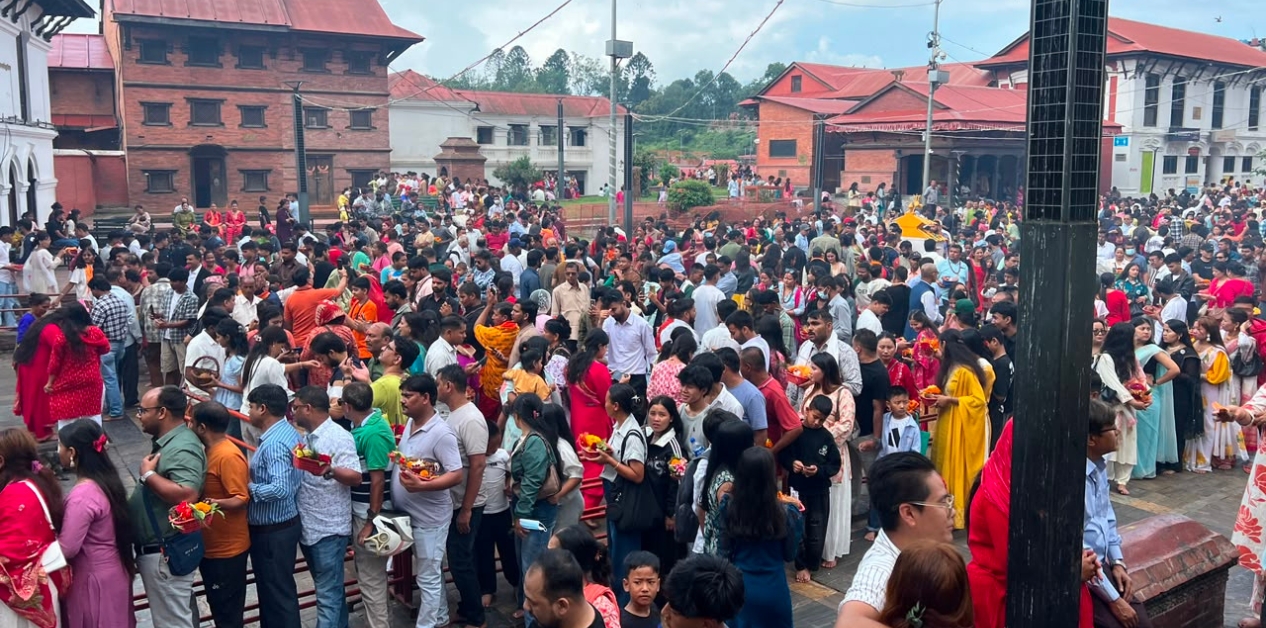
Earlier that morning, the majority of devotees standing in long queues to pay homage to Pashupatinath were also Indian visitors. After their prayers, some were busy performing Havan (sacred fire rituals) in the temple premises, while others strolled around.
This scene is not unique to just one day. Whether it is morning or evening, the Pashupati area witnesses a similar rush of Indian devotees almost every single day.
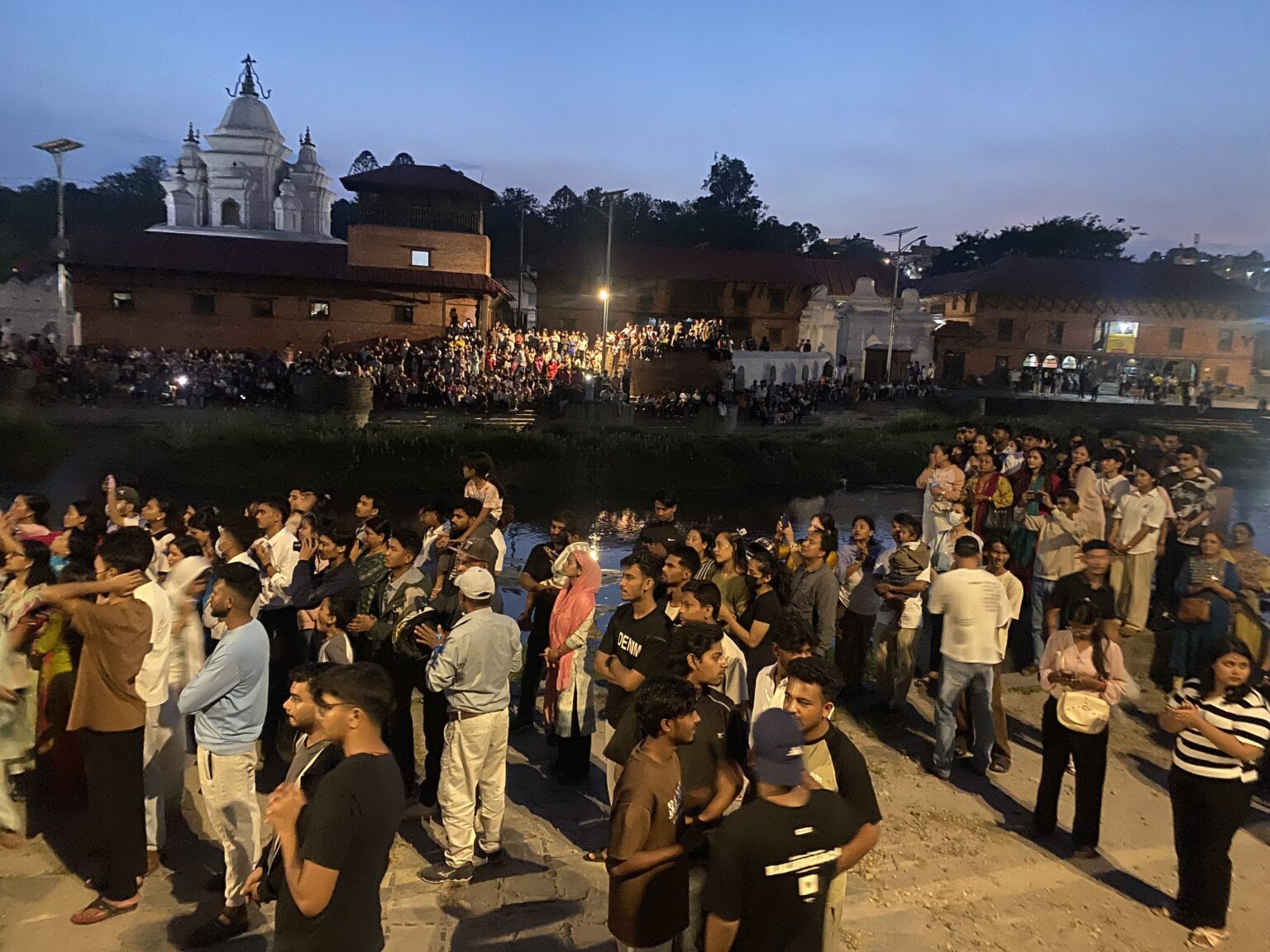
Indian tourists witnessing the Arati alongside Nepalis at Pashupati on the evening of June 27. Photo: Gopal Dahal
The Pashupatinath Temple, a sacred pilgrimage site for Hindus, is a religious heritage site inscribed on the UNESCO World Heritage list. Consequently, it attracts tourists from all over the world. Among them, a vast majority of tourists come from India, a Hindu-majority country, specifically to worship at Pashupati. The Pashupatinath Temple is a primary destination for Indian tourists visiting Nepal. Most Indian Hindus harbor a lifelong wish to visit Pashupatinath at least once.
While the number of Indians visiting Pashupatinath is always significant during the annual Shivaratri festival and the holy month of Shrawan (July–August), this year, the influx began as early as Chaitra–Baishakh (March–May). The Pashupati Area Development Trust (PADT) charges an entry fee of Rs 1,000 for citizens of other countries to enter the temple premises, but entry is free for Indian nationals.
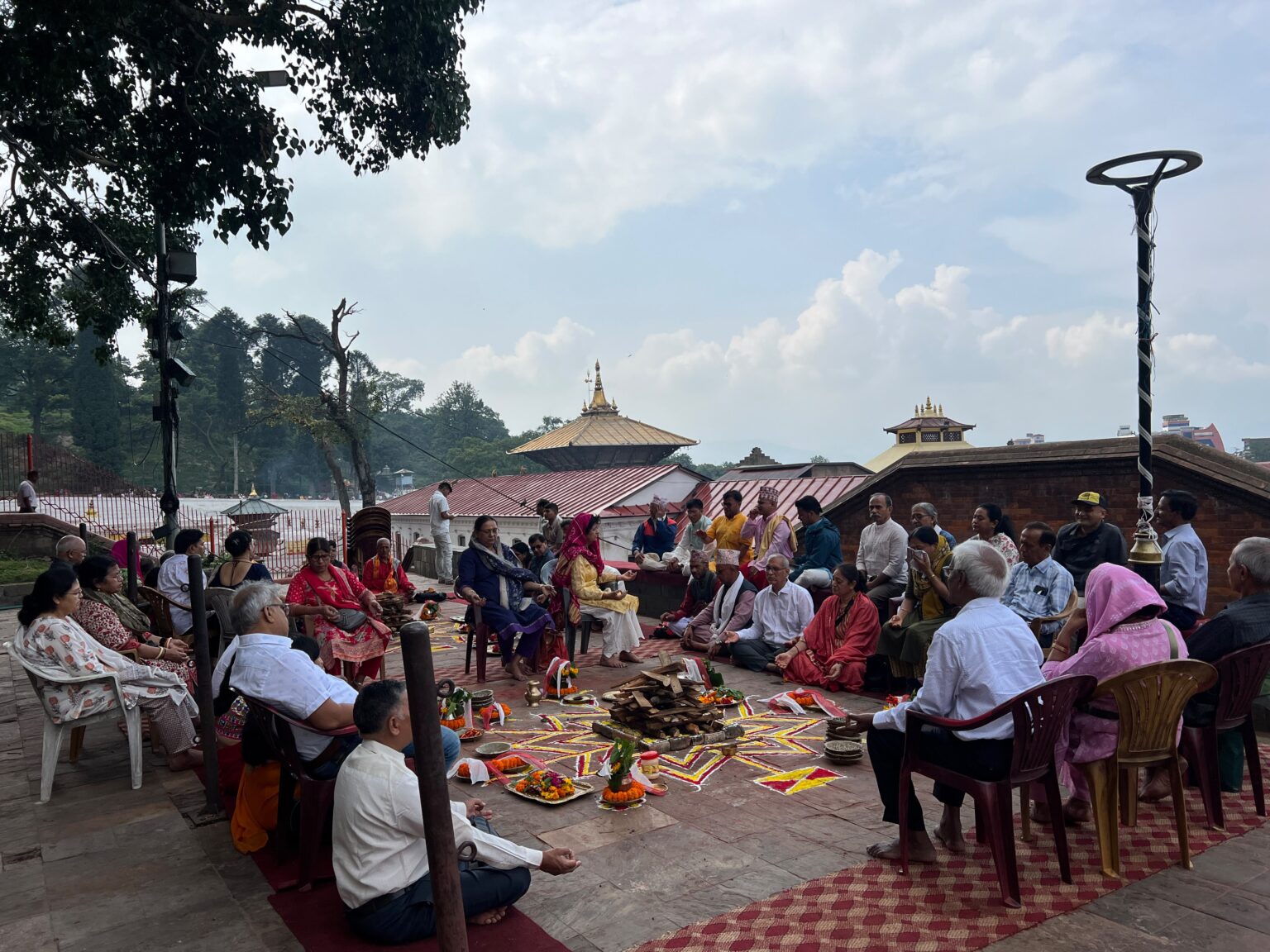
Indian tourists performing Hawan at Pashupati on June 27, 2026. Photo: Nepal News
Because registration takes place during fee collection, the data for tourists from other countries visiting Pashupati is easily accessible. However, since Indian tourists are neither registered nor counted this way, accurate statistical data remains unavailable. Surya Bahadur Bhat, the Information Officer for the Pashupati Area Development Trust, estimates that the number of Indian tourists in the past month of Jeth (May–June) tripled compared to previous years. He states, “Currently, 50 percent of those visiting Pashupatinath are Indian citizens. This is three times higher compared to the same month last year.”
With the rise in the number of Indian devotees, the daily monetary offerings (Bheti) collected at the Pashupatinath Temple have also increased. Until three months ago, around Rs 200,000 was collected daily. Following the surge in Indian tourists, the daily collection has jumped to between Rs 400,000 and Rs 450,000. According to the Trust, the number of Indian visitors has been steadily rising over the past three months.
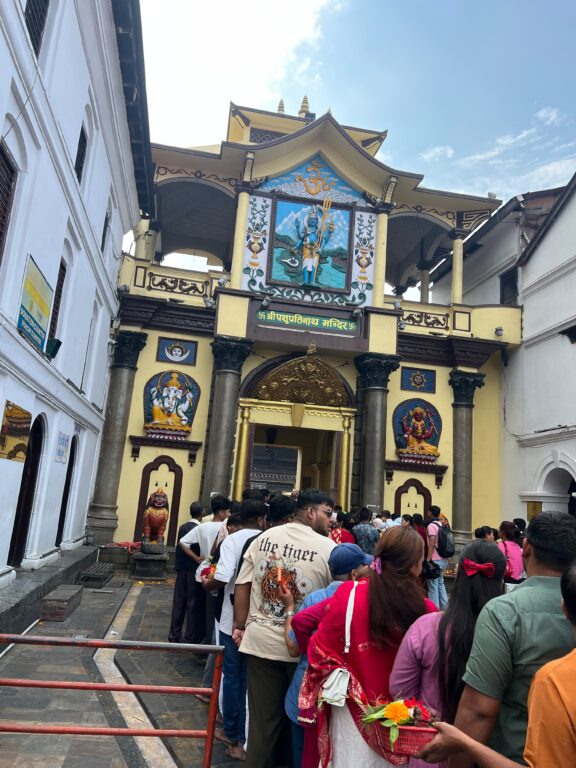
Indian tourists queuing up to visit Pashupatinath on the morning of June 27. Photo: Nepal News
Indian tourists have been pouring into Nepal through various border points since March. Compared to Indians visiting other locations in Nepal, the number of those coming specifically for Pashupatinath is much higher. Information Officer Bhat notes, “Most Indians coming to Nepal wish to visit Pashupati. Many come here after traveling to Pokhara or Muktinath.”
Due to the Indian tourists arriving for the Pashupati pilgrimage, hotels and pilgrim rest houses in the Gaushala area are currently packed to capacity. Indian tourists are frequently spotted not just around Pashupatinath, but heavily across Thamel as well. They maintain a prominent presence across Thamel’s restaurants, clubs, and hotels.
Even though May and June are historically considered the tourism off-season in Nepal, this year has seen a massive wave of incoming Indian tourists during these months. Tourism entrepreneurs are delighted. Mahanta Shrestha, the operator of Hotel M in Jyatha, Thamel, remarks, “Even in this off-season, Thamel is vibrant and bustling thanks to Indian tourists.”
Bustling Pokhara
The majority of Indian tourists visiting Nepal arrive for religious pilgrimages and leisure sightseeing. Due to those coming for leisure, the regions of Pokhara, Manang, and Mustang are also thriving. Most hotels in Pokhara are filled with Indian tourists. According to local hoteliers, 90 percent of Pokhara’s hotels were occupied by Indian tourists this season.
It is not just Pokhara’s Lakeside; areas like the World Peace Pagoda, Sarangkot, and the Shiva Temple are equally crowded with Indian tourists. Pokhara’s entrepreneurs have long been running campaigns like “Chaliye Pokhara” (Let’s go to Pokhara) targeting Indian tourists during the hot summer months. Similarly, in May, representatives from the Nepal Association of Tour and Travel Agents (NATTA) Gandaki traveled to Kolkata to launch the “Pokhara-Nepal Promotion Campaign 2026” alongside Indian operators.
Because schools in India go on vacation during this period, a massive number of Indians head to Pokhara for holidays. Indian tourists traveling to Pokhara either fly in via Kathmandu or arrive by bus and private vehicles through various border entry points. Those arriving by overland routes from places like Delhi, Uttar Pradesh, and Lucknow enter Pokhara via the Gorakhpur–Sunauli–Bhairahawa border point. Meanwhile, those traveling from Bihar, Kolkata, and nearby areas enter via Raxaul–Birgunj.
The distance from Bhairahawa to Pokhara is approximately 185 kilometers. According to data from the Bhairahawa Customs Office, between 600 and 1,200 rental cars, private vehicles, and motorcycles carrying Indian tourists have been entering Nepal daily through the Belahiya border point this season.
The economic background of Indian tourists visiting Nepal ranges from lower-middle to middle and upper-middle class. Some arrive by bus, some drive their own cars, while others fly in. Upon arrival, some book star-rated hotels while others stay in budget accommodations. There are also groups who bring their own cooking supplies and utensils from home to prepare meals out in open spaces.
Suman Ghimire, Senior Manager of the Tourism Market and Promotion Department at the Nepal Tourism Board (NTB), claims that the surge in Indian tourists is due to aggressive marketing of Nepali tourist destinations in the Indian market following the COVID-19 pandemic. The Board actively campaigned by participating in major Indian exhibitions, such as South Asia’s Travel and Tourism Exchange (SATTE) in New Delhi, the Outbound Travel Mart (OTM) in Mumbai, and the Travel and Tourism Fair (TTF) in Bengaluru. He states, “The number of Indian tourists is rising; now, all tourism-related sectors must collaborate to focus on management.”
Historic highs in the Annapurna region
A large number of Indians arriving in Pokhara wish to trek through Manang, Mustang, and Ghorepani, and visit the Muktinath Temple. These locations, falling within the Annapurna Conservation Area, rarely see tourists from third countries between March and May. Hence, this period is traditionally regarded as the “off-season.” However, for Indian tourists, these very months have turned into peak season this year.
According to data from the Annapurna Conservation Area Project (ACAP), this year recorded the highest number of Indian tourists in history. Throughout June alone, over 100,000 Indians visited the Annapurna region. On June 1, out of 4,816 total individuals who obtained entry permits for the ACAP region, 3,898 registered online. Among them, over 95 percent—specifically 3,724—were Indian tourists.
According to Rabin Kadariya, Head of ACAP, around 130,000 people visited the Annapurna Conservation Area in May alone, the vast majority of whom were Indians. In previous years, only about 35,000 people visited this area during the same month.
On May 12, 2018, Indian Prime Minister Narendra Modi visited the Muktinath Temple in the morning, followed by a visit to the Pashupatinath Temple. Modi’s pilgrimage vastly popularized Muktinath among Indian citizens. However, the global COVID-19 pandemic broke out later that year. By March 2020, Nepal went into lockdown, halting all travel.
Following the subsidence of the pandemic, Nepal’s tourism witnessed a strong revival. Since then, the number of visitors to the Annapurna region grew annually. However, ACAP Head Kadariya highlights that this year brought a record-breaking, unprecedented number of Indian tourists. He explains, “March, April, and May are off-season for tourists from other nations, but they constitute peak season for Indian tourists.”
According to ACAP data, 15,679 Indian nationals obtained permits in January and 11,833 in February of this year. This figure spiked suddenly to 30,794 in March. In April, it climbed further to 42,372 permits. In May, another traditional off-season month, the numbers more than doubled to 86,113 individuals. In June, 105,169 Indian tourists traveled through the ACAP region. Consequently, in the first six months of 2026, a total of 291,960 Indians visited Manang, Mustang, Muktinath, and neighboring areas.
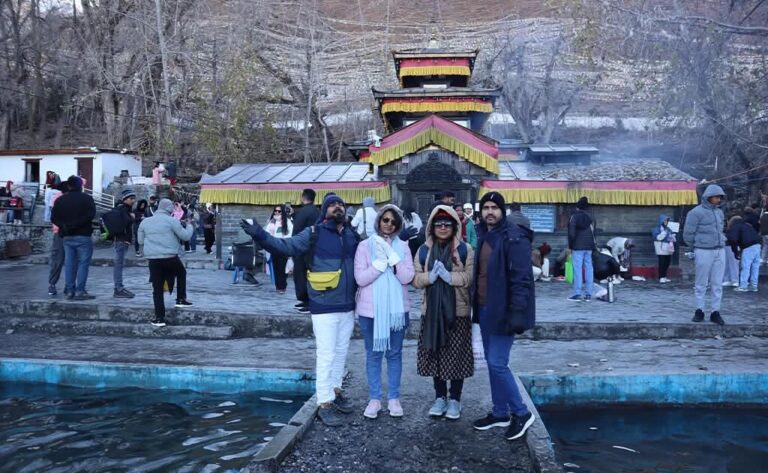
Indian tourists arriving to complete their pilgrimage at Muktinath.
To enter the ACAP area, citizens from SAARC nations must pay an entry fee of Rs 1,000, while other foreign nationals are charged Rs 3,000. Going by this rate, the government has collected over Rs 280 million in revenue solely from Indian tourists. Around Rs 100 million was collected in June alone. If hotel bookings, food, and other expenditures are factored in, the total contribution is significantly higher. Additionally, when entering Nepal through the Indian border, a daily fee of Rs 600 is charged for four-wheelers and Rs 100 for motorcycles.
Recently, the road network leading from Pokhara to Manang and Mustang has improved. Because the commute is far more accessible than before, many Indian tourists bring their own vehicles. Entry permits for the ACAP region can be obtained from the Nepal Tourism Board counter in Kathmandu, as well as counters in Pokhara, Simpani, and Ghasa. Furthermore, an online permit system has been successfully implemented.
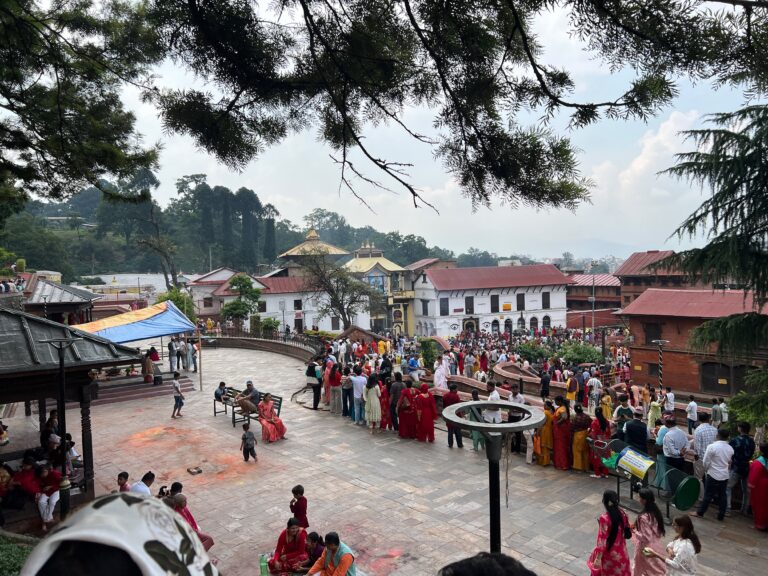
Indian tourists in the Pashupati area. Photo: Nepal News
Lately, a significant portion of visitors to the ACAP region obtain their permits online. For instance, out of 1,851 individuals who took out permits on June 26, a total of 1,314 utilized the online platform—1,273 of whom were Indian tourists. Transitioning to the ACAP online system has streamlined the process for Indian travelers.
Sanjit Dhamala, Counter In-Charge for ACAP at the Nepal Tourism Board, states, “Since the launch of the online permit facility, the number of individuals securing permits from abroad before arriving has risen. Indians make up the majority of those taking out online permits.”
From scorching Indian summers to the impacts of the Iran conflict
The surge in Indian tourists this season is not restricted to Kathmandu, Pokhara, Manang, and Mustang; it spans from eastern to far-western Nepal.
NTB Senior Manager Ghimire notes that Indian tourists are visiting sites ranging from Arjun Dhara in Jhapa, Kanyam in Ilam, Dharan, Bhedetar, and Hile in the east, to Chitwan and Lumbini in the west, all the way to Badimalika in the far-west.
Tourists from Bihar, Uttar Pradesh, and Southern India are entering Nepal in vast numbers. According to Ghimire, several factors have driven this notable increase in Indian tourist arrivals this year.
Temperatures soar drastically across India during this season. This year, temperatures reached 40–45°C across several Indian states. Escaping the oppressive heat, Indians are traveling to the cooler hilly and mountainous regions of Nepal.
Additionally, Indian vloggers and social media users have recently produced numerous videos showcasing Pokhara, Manang, Mustang, and various Nepali tourist destinations. This coverage has attracted travel-loving Indians. ACAP Head Kadariya adds, “As the middle class expands in India, a culture of traveling is also growing. Due to the extreme heat and school vacations this time, there is a clear trend of families traveling together to Nepal.”
The escalating conflict in Iran, which triggered rising fuel prices and disrupted global supply chains, appears to have paradoxically left a positive indirect impact on Nepal’s tourism. The conflict involving the United States, Israel, and Iran drove up worldwide fuel prices, putting pressure on India’s foreign exchange reserves.
In response, Indian Prime Minister Modi called upon citizens to limit dollar expenditures on international leisure travel. Addressing a gathering in Hyderabad on May 10, he urged Indians to refrain from international travel and purchasing gold. According to a report by Al Jazeera, 27.9 million Indians traveled abroad in 2023, and 30.9 million in 2024, spending USD 31.7 billion on foreign trips.
Schools across various Indian states remain closed from April to June. During this period, affluent Indian families traditionally vacation in cooler destinations across Europe or Australia. A Reuters report indicates that because Modi commands a massive following in India, his appeal led to a notable decline in the number of Indians traveling overseas.
Consequently, individuals who previously spent US dollars on international vacations are now choosing to spend Indian Rupees at destinations across Nepal, according to calculations by NTB Senior Manager Ghimire.
Historically, Indians seeking cooler climates during this season would travel towards Kashmir. However, in April of last year, gunmen attacked tourists vacationing in Pahalgam, Jammu & Kashmir. Following the tourist casualties, travelers looking for safer destinations may have shifted their focus toward Nepal.
Furthermore, recent road expansions within Nepal have made travel much more convenient. Nepal’s proximity, affordability, and visa-free policy serve as strong incentives. To enter Nepal, Indian citizens only require a valid passport or an official identification card.
The introduction of cross-border digital payment systems between Nepal and India has further simplified travel for Indian visitors. The open border allows tourists to travel directly in their private vehicles, and airfare remains affordable.
Incomplete data, lax management
Given the open border and historical cultural ties, Indians have traveled to and from Nepal since ancient times. Initially visiting primarily as pilgrims to religious sites like Pashupatinath, Muktinath, Janakpurdham, Barahachhetra, and Lumbini, modern Indian tourists are increasingly drawn to the Himalayan and hilly regions to enjoy Nepal’s natural beauty.
Despite the annual rise in Indian tourist arrivals, the government lacks precise statistical data on the exact number of Indians entering the country each year. Official agencies only possess solid statistics for Indian tourists arriving via air routing. The government maintains no specific data for those arriving via land routes, nor does it have accurate figures for how many Indians visit Pashupatinath, Pokhara, or other regions.
Recently, the road network leading from Pokhara to Manang and Mustang has improved. Because the commute is far more accessible than before, many Indian tourists bring their own vehicles. Entry permits for the ACAP region can be obtained from the Nepal Tourism Board counter in Kathmandu, as well as counters in Pokhara, Simpani, and Ghasa. Furthermore, an online permit system has been successfully implemented.
According to Nepal Tourism Board data, 91,363 foreign tourists entered Nepal this past June. Of these, 41,809 were Indian nationals, constituting 45.76 percent of the total arrivals. In June 2025, 32,662 Indian tourists had arrived. Compared to last year, the number of Indian tourists this June increased by 19.5 percent. The Board publishes these figures based on Department of Immigration data collected exclusively via air travel.
Similarly, 40,742 Indian tourists flew into Nepal this past May. In comparison, 28,160 Indians arrived in May 2025, and 38,288 arrived in May 2024.
According to historical government records, 106,574 Indians visited Nepal in 1992. Thirty-five years later, in 2025, that number reached 293,383. NTB data shows that the highest arrivals occurred in 2023 with 319,936 visitors, followed closely by 317,781 in 2024. In the first six months of the current year, 2026 (January to June), 182,884 Indian tourists have visited Nepal by air.
In recent years, an overwhelming majority of Indians entering Nepal for summer vacations have chosen overland routes. The primary land border checkpoints between India and Nepal include Kakarbhitta–Siliguri, Biratnagar–Jogbani, Birgunj–Raxaul, Bhairahawa–Sunauli, Rupaidiha–Jamunaha, Gauriphanta–Mohana, and Gaddachauki–Banbasa. Beyond these checkpoints, the open border permits entry into the Terai plains from virtually any point.
According to a report published in the Kantipur daily, roughly 2,000 Indian vehicles carrying tourists and pilgrims enter Nepal daily through major border points.
Among those arriving via land, some travel by motorcycle or bus, but a substantial majority use private cars. Tourism operators note that 70 percent of Indian tourists reaching Pokhara travel in their own vehicles. Based on these estimates, with 8,000 to 10,000 Indians entering Nepal daily via land routes, the monthly total reaches between 200,000 and 300,000.
Some Indian tourists also use Nepal as a transit route to reach Kailash Mansarovar. Following a sharp increase in travelers choosing this route, the Government of India has begun advising its citizens to ensure they carry all necessary documentation before embarking on their journey.
According to a report by the Times of India, India’s Ministry of External Affairs issued an advisory warning citizens against traveling through Nepal without proper credentials.
While the Indian government has taken proactive measures, the Government of Nepal has largely failed to focus on adequate management.
Tourism operators point out that the massive influx of tourists has led to an increase in littering, and vehicle parking has become a persistent issue. Additionally, sporadic criminal incidents have begun to emerge.
On June 24, at the Sunrise Hotel located between Durbin and Bhujung Danda along the Ghandruk–Chhomrong trail in the Annapurna Conservation Area, four Indian tourists broke into a shop and stole goods. Local residents apprehended them while they were in possession of weapons, including knives. They were subsequently sent back under the supervision of ACAP representatives.
Similarly, on June 9, five Indian nationals were arrested in the Pashupatinath Temple area on charges of snatching a gold chain from a devotee. While such criminal incidents remain isolated, they inevitably surface when tourist volumes spike, requiring the government to prioritize preparedness and vigilance. Failing to maintain records of visitors in high-traffic zones like Pashupatinath makes tracking individuals difficult should major crimes occur.
ACAP Head Rabin Kadariya emphasizes that since Indian tourist numbers are growing annually and show potential for further expansion, management strategies must be implemented immediately. “We must stay vigilant to systematically organize Indian tourist data, manage cleanliness and parking, and prevent criminal activity,” he says. “Additionally, Indian tourists naturally tend to speak in louder tones. Recognizing this trait, we must focus on responding with patience, courtesy, and hospitality.”
Ramkrishna Lamichhane, Director General of the Department of Tourism under Nepal’s Ministry of Culture, Tourism, and Civil Aviation, concedes that the state has failed to maintain integrated data for Indian tourists. He shares, “Welcoming a high volume of tourists is positive. Alongside this, we must systematically record Indian tourists and streamline essential infrastructure.”
He adds that with the annual increase in Indian visitors, the Department is working to catalog and certify restaurants catering to their preferences. “We are actively working on improving facilities for tourists,” Lamichhane states.
In the past, Nepali society primarily viewed fair-skinned individuals from third countries as true tourists. There was no established practice of counting Indians as conventional tourists. They were largely categorized as pilgrims who brought their own food, cooked independently, and spent very little locally. However, times have changed. Today, Indian tourists explore diverse destinations, spend money, and make up the largest demographic of visitors. The government must focus on ensuring a seamless and secure environment for them.
The country operates under a three-tiered government structure. Suman Ghimire, Senior Manager at the Nepal Tourism Board, believes that coordination among all three levels of government is vital to fostering tourism and building a tourist-friendly environment. He concludes, “If all three tiers collaborate to maintain official data and involve the private sector in management, Nepal can successfully transform into a sustainable destination for Indian tourists.”