Kathmandu
Monday, July 6, 2026





An administrative procedure designed to reduce caseload is being used to shut the doors of justice itself.
KATHMANDU: On June 29, Advocate Kumar Prasad Thapaliya arrived at the Supreme Court with a writ petition demanding the removal of discriminatory titles like “Right Honorable” and “Honorable” used for state officials. However, the Supreme Court administration refused to register the writ petition—meaning it issued an order of refusal to register/return order. The Registrar issued the Denial of order on the grounds that the matter did not involve a violation of fundamental rights and that the documents failed to substantiate the petitioner’s meaningful relation and substantial concern. Whether this denial of order will be sustained or overturned by the bench remains to be seen.
On May 7, 2026 (24 Baishakh 2083 BS), immediately after the Constitutional Council recommended Justice Manoj Sharma for Chief Justice instead of the most senior Justice Sapana Pradhan Malla, Senior Advocate Dinesh Tripathi and Advocates Prem Raj Silwal and Gita Thapa reached the Supreme Court against this decision. The court administration initially did not register the petition. It issued the denial of order only after Sharma’s parliamentary hearing concluded. Recommended and endorsed by the parliamentary committee on May 19, Chief Justice Sharma was appointed and assumed office on the very same day.
The petitioners filed another application against that denial of order. The application, which had been kept unregistered, was finally registered on May 20, and a single bench of the Supreme Court forwarded it to the Constitutional Bench. By provision, the Constitutional Bench is led by the Chief Justice. However, this lawsuit was directed precisely against the appointment of Chief Justice Sharma himself. On June 24, a bench comprising Chief Justice Sharma himself, along with Justices Kumar Regmi, Binod Sharma, Abdul Aziz Musalman, and Mahesh Sharma Paudel, sustained the very order of the court administration that had issued the denial of order on the writ.
Was Chief Justice Sharma compelled to have a bench led by himself quash a lawsuit filed against him? Because the Constitution itself grants the Chief Justice the authority to lead the Constitutional Bench, it could be called a compulsion. On the other hand, adjudicating one’s own case is considered a direct contradiction.
Senior Advocate Tripathi, one of the writ petitioners, argues that a Chief Justice cannot act as a judge in their own case.
“One cannot adjudicate a matter involving a conflict of interest. Even basic judicial prudence was not demonstrated,” he says.
According to him, during the tenure of former Chief Justice Cholendra Shumsher Rana, when a recommendation was made that he could not oversee a case linked to himself, Rana had directed the case to be presented before a bench excluding him, and it was carried out accordingly. Tripathi states that this tradition was broken during Sharma’s tenure. He suggests that an appropriate alternative would be for the Acting Chief Justice to conduct hearings of the Constitutional Bench on days when the Chief Justice takes leave.
The President of the Nepal Bar Association, Bijay Prasad Mishra, also states that since Chief Justices in the past recused themselves from cases involving them, it is inappropriate for the leadership of the judiciary to decide on matters concerning themselves.
“The issuance of a denial of order against writs challenging the recommendation and ordinance for the appointment of the Chief Justice, and the failure to register applications against the denial of order in a timely manner, went against judicial tradition,” Mishra says.
Understanding denial of order
Denial of order refers to the process where, if a document or petition presented for registration at an office or court does not meet the legal format or falls outside its jurisdiction, the concerned officer writes the reasons on the document itself and returns it. It is a system where the Registrar issues a written order detailing the reasons why registration is not possible after evaluating the content through the court’s case registration division.
When visiting a court to file a writ petition or a lawsuit, it must first be submitted to the administration. If for some reason the administration does not register the case, the path for the service seeker is not entirely blocked. The service seeker can file an application against the denial of order directly before the bench—meaning before a judge. Subsequently, if the bench deems it appropriate, it overturns the previous denial of order and commands the administration to register the case. This reopens the path of the case registration process for the service seeker.
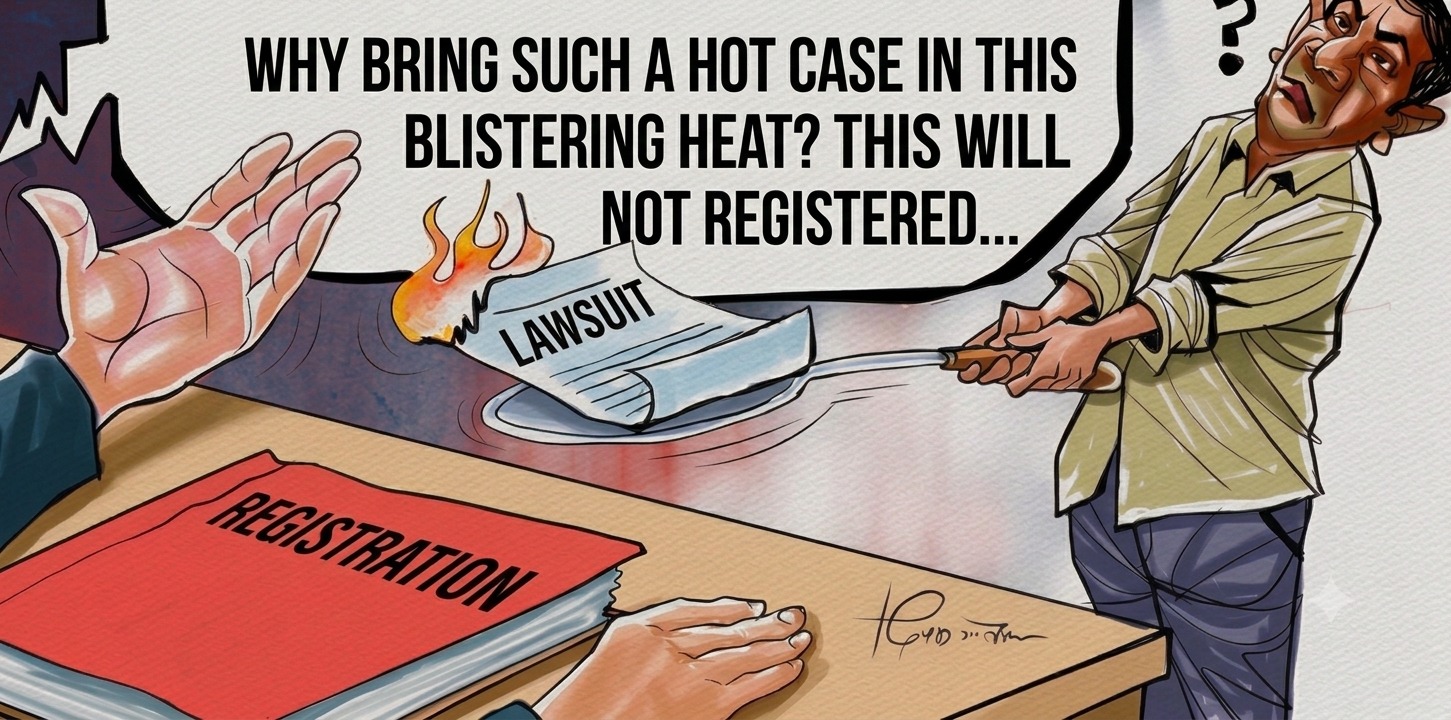
According to Bar President Mishra, the practice of issuing denial of order on petitions was established to reduce the caseload in courts. However, he notes that the frequency of issuing denial of order has increased due to external “climatic influences” and the likes/dislikes of the government. He adds:
“The view has emerged that a practice of registering or refusing petitions based on the outside weather should not be established. The administration must not issue denial of orders on writ petitions by reading politics, atmospheric conditions, or the weather.”
The court administration had issued denial of orders on three writ petitions that reached the Supreme Court against the Constitutional Council’s decision to recommend Sharma—who held the fourth position in seniority—as Chief Justice. An application filed against the denial of order on May 8 was left hanging for 10 days without even being registered. Ultimately, while concluding the writ petition submitted against Sharma’s appointment, the Constitutional Bench sustained the court administration’s denial of order decision, thereby validating the decision of the Constitutional Council and the subsequent appointment made by the President.
There are numerous other examples of such denial of orders. It has been observed that even public interest litigation (PIL) writ petitions are being rejected through denial of order by the Supreme Court administration.
On August 6, 2025, a writ petition seeking the annulment of the appointment of officials to the Truth and Reconciliation Commission and the Commission of Inquiry on Enforced Disappeared Persons was rejected via denial of order at the Supreme Court. The then-Registrar of the Supreme Court, Man Bahadur Karki, had issued the denial of order, stating that the issue regarding the appointment of the commission officials lacked evidence establishing a meaningful relation and substantial concern.
Writ petitions on which the court administration has issued denial of orders have been either sustained or overturned by the bench. Writ petitions raising questions about civic and fundamental rights have occasionally been registered later by the bench after initially facing a denial of order by the administration. The writ petition challenging the appointment of officials to the two transitional justice commissions, which faced a denial of order, was also registered later after the bench overturned the administrative order. Nonetheless, the case remains sub judice in the Supreme Court.

Supreme Court building. Photo: Bhasha Sharma
Similarly, last year, against the shutdown of social media platforms by the government led by K.P. Sharma Oli, the Supreme Court administration issued a denial of order on a writ petition on September 7, 2025. After the Supreme Court bench overturned the denial of order on September 9, 2025, ten cases on the same subject were subsequently registered.
Senior Advocate Tripathi, who frequently files public interest litigation writs, states that the challenge of denial of order has to be confronted much more frequently in recent times.
“Previously, a denial of order happened occasionally; nowadays, it feels as though a writ cannot even be registered without crossing the wall of a denial of order,” he says.
He argues that the administration should not reject writ petitions connected to the general public. He states that although the Constitution ensures that the adjudication of justice rests solely with the judiciary and its judges, it appears as though administrative staff are starting to dominate the court. He expresses deep concern that the administration rejects matters requiring judicial adjudication through denial of order, and judges simply sustain those orders.
“The Registrar appears to be curtailing the judicial process. Working as a ‘roadblocker’ is a matter of grave concern,” he adds.
The shrinking path to justice
As the court administration continuously issues consecutive denial of order on public interest writs, individuals associated with the legal sector are raising their voices, stating that the exercise of judicial authority belongs only to judges, not administrative staff. According to Bar Association President Mishra, dissenting voices are growing, asserting that the court administration cannot exercise judicial discretion in issuing a denial of order.
Mishra suggests that the court administration must always be ready to register writ petitions that raise constitutional and legal questions.
“Generally, it is better to provide access to justice by registering all matters that reach the court and presenting them before the bench for the judicial process,” he says.
In the past, even writ petitions against the Chief Justice used to be registered. Mishra points out that a writ raising questions about a Chief Justice’s age was also registered back then. In his experience, the practice of refusing to register writs on such matters has increased nowadays. President Mishra recalls that during the tenures of former Chief Justices Surendra Prasad Singh, Keshav Prasad Upadhyaya, and Chief Justice Gopal Parajuli, questions regarding their ages, writs against the recommendation for appointment of Justice Balaram KC, and recommendations for appointments of Justices Manoj Sharma, Nahakul Subedi, and Renuka Shah, among others, were registered in the Supreme Court without facing any denial of order.
The Nepal Bar Association had also raised questions regarding the Supreme Court administration’s refusal to register the writ petition against the recommendation of Sharma as Chief Justice. However, the court administration, which even flouted the order of the then-Acting Chief Justice, was unlikely to heed the Bar’s query. Justice Sapana Pradhan Malla, who was serving as the Acting Chief Justice, had issued an order addressed to Chief Registrar Bimal Paudel on May 18 to register the applications filed against the rejection of the writs concerning the Chief Justice recommendation. She had issued this order in accordance with Article 136 of the Constitution, Section 35 of the Administration of Justice Act, 2016, and Rule 7 of the Supreme Court Rules, 2017. She had ordered all writ petitions and applications against the denial of order to be registered by 1:00 PM on May 18 and listed for hearing on May 19. However, that order was not implemented. On May 19, a parliamentary hearing was hastily convened, and the Chief Justice was appointed.
This issue was also raised before the Parliamentary Hearing Committee when questions were posed to the proposed Chief Justice Sharma. Regarding the blockade on registering the writ petition against him, Sharma had responded that the matter belonged to the court administration and the Registrar, and therefore, it was inappropriate for him to intervene.
The law defines the duties, functions, and powers of judges and administrative staff to manage the court’s jurisdiction, to render justice swift, accessible, impartial, effective, and publicly accountable, and to run the administration of justice. In her order, Justice Pradhan had noted that the court administration failed to fulfill its legally assigned responsibilities by neglecting to register applications against denial of order and other writ petitions.
Following public protests against the denial of order practice, the Supreme Court issued a public notice on June 10. The notice stated that ‘actions regarding the registration of petitions submitted with the necessary documents for registration in court shall be concluded within 24 hours.’ Similarly, the Supreme Court administration informed that if petitions of an unregistrable nature are presented, a decision will be delivered within 48 hours.
Let us look at another example of a denial of order. Questioning the appointment process of judges, the Judicial Council had published a notice requesting individuals to update their personal profiles, including copies of at least 50 judgments and any researched or published works. Claiming that the notice violated the Constitution and the law, Advocate Kirtinath Sharma went to file a writ petition against the Judicial Council on February 9, 2021 (27 Magh 2077 BS), seeking its annulment. However, the then-Acting Chief Registrar Lal Bahadur Kunwar issued a denial of order. Later, the bench overturned the administration’s denial of order. The case registered after that intervention remains sub judice to this day.
Advocate Sharma argues that since the authority for judicial adjudication rests with the bench, the court administration should not block the registration of writ petitions. He states that the right to justice enshrined in Article 20 of the Constitution should not be halted at the gates of the court.
“The job of the court administration is merely to register cases. It is unfortunate for the administration to issue a denial of order, thereby obstructing the path of justice,” he says. He shares that whenever he takes writ petitions raising public interest matters to court, the administration occasionally hesitates to register them.
Senior Advocate Tripathi points out that the denial of order practice, which causes delays in the judicial journey, is becoming a severe crisis for the judicial process itself. In his experience, by the time a denial of order issued by the administration is overturned by a bench and subsequently registered and heard, time slips away, and the utility or relevance of the subject matter in many cases expires.
“Cases involving profound constitutional questions are initially rejected via denial of order, and by the time they are overturned by the bench and re-registered, it is already too late,” he says. “If an interim order is not granted immediately in certain matters, their entire relevance is lost.” He expresses disappointment that in some writ petitions, the Registrar goes deep into the subject matter and essentially delivers a judgment on the case itself.
Deputy Registrar and Spokesperson of the Supreme Court, Arjun Prasad Koirala, claims that the court issues denial of orders on certain incomplete applications in accordance with the authority granted by law.
“Parties bringing documents must fulfill the due process. While checking whether the process is complete, if we find no basis regarding the limitation period, the court’s jurisdiction, locus standi, or necessary documents, we ask them to bring them,” he says. “The law itself empowers the Chief Registrar and the Registrar to issue a denial of order.”
He argues that registering cases unrelated to the court or lacking documentation wastes the bench’s time and consumes resources, which is why the administration halts cases that can be settled administratively, following the intent of the law. When asked why denial of order are frequently overturned by the bench, he points to examples where the Supreme Court reverses decisions made by District and High Courts.
“The path to correct any matter always exists; the bench can correct it. Human error can also occur in certain denial of order,” Deputy Registrar Koirala says. “The bench can declare that a denial of order was improper. The jurisdiction of the bench to overturn it is always there.”
The Nepal Bar President Mishra maintains that a petition should only face a denial of order if the court has already decided on the matter previously, if the petition is brought forward under someone’s instigation, if it seeks to defame someone, if it serves political interests, or if it attempts to abuse the jurisdiction of public interest litigation.
Legal provisions regarding denial of order
Provisions regarding denial of order are laid out from Sections 126 to 130 of the National Civil Procedure Code, 2017. Section 126 of the Code mandates the examination of written documents. As soon as a plaint, written statement, or petition filed during the course of legal proceedings is received for registration in court, the registering official has a duty to verify whether the format is correct, whether it falls within the limitation period, and whether it lies within the court’s jurisdiction. Section 127 of the Code provides an opportunity to correct a non-compliant document. If the examination reveals that the format does not comply with the law, fails to disclose necessary details, or contains errors, incompleteness, or mistakes in writing, presentation, or reference, it shall be registered once it is brought back corrected. If a document faces a denial of order, and is brought back duly completed or corrected within seven days from that date, the concerned officer must order the registration of such document.
Section 128 specifies the conditions under which a document must face a denial of order. It states:
‘If upon examination it appears that the document is not within the limitation period or deadline, does not fall within the jurisdiction of the concerned court, does not need to be or cannot be heard by the court, or is unregistrable due to being contrary to the law, the concerned officer shall issue a denial of order, affix the court stamp, obtain a receipt from the concerned person, and return it.’
If the final limitation period to file a lawsuit regarding a matter rejected via denial of order due to lack of jurisdiction expires on the very day the denial of order is issued, then notwithstanding anything contained in the prevailing law, if the person filing the complaint brings it for registration within 15 days from that date (excluding travel time), the court possessing jurisdiction must register it according to the law.
Section 130 provides the right to file a petition against a denial of order. It states: ‘A party dissatisfied with a denial of order issued by the concerned officer may, within seven days from the date of the denial of order, file a petition before the judge of the court, and if the judge himself has issued the denial of order… requesting an order to register the document.’
Within 15 days from the date the petition is filed, the judge of the concerned court or the appellate court must issue an order regarding whether the denial of order was lawful. If an order to register is issued, the officer who executed the denial of order must register the document on the very same day. If the denial of order is found to be lawful, the appellate court can state the reasons and issue an order concluding the proceedings on that petition. Similarly, Rule 18 of the Supreme Court Rules, 2017 contains provisions regarding denial of order on documents. It grants the authority to execute a denial of order by detailing the grounds if an ambiguous writ petition, devoid of constitutional or legal questions, is presented for registration.